To accurately calculate leather yield, you must account for the 25-35% waste factor from hide defects and irregular shapes. Failing to bridge the gap between the gross area you purchase and the net material you can use directly inflates your cost per unit and makes budget forecasting unreliable.
This analysis covers the variables that control consumption, from sourcing LWG Certified hides to the impact of cut geometry and CAD nesting. Use this data to establish realistic yield targets and protect your material budget during factory negotiations.
Net Area vs. Gross Area: The Hidden Cost
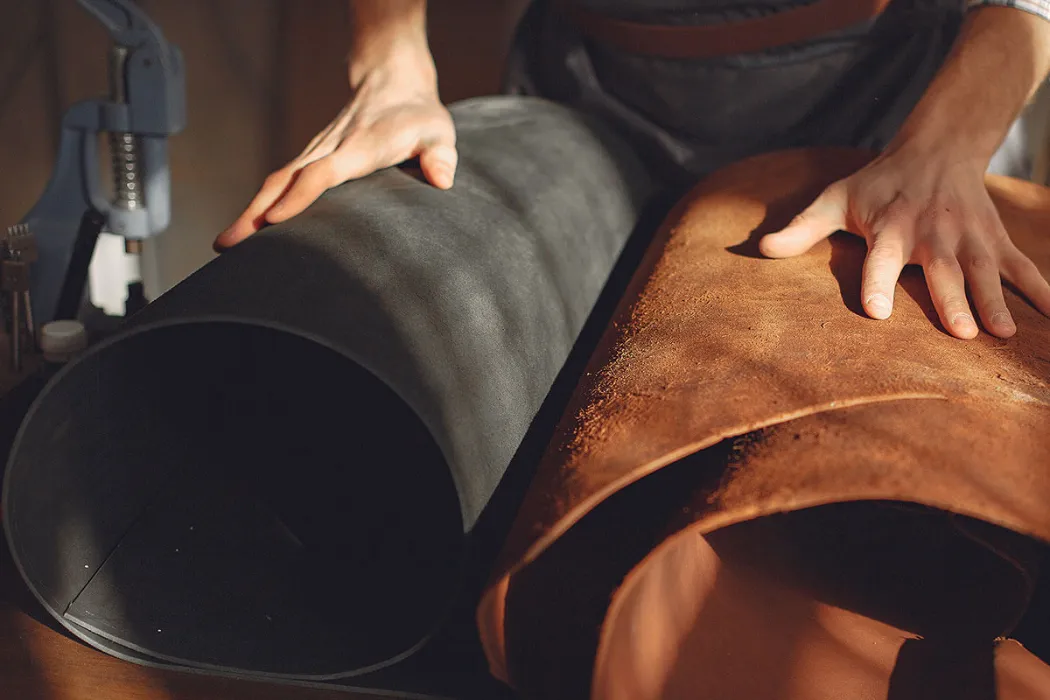
Gross area is the total leather hide you buy; net area is what’s actually usable for belts. This gap is a hidden cost that directly impacts your final price per unit.
Defining Usable (Net) vs. Purchased (Gross) Leather
When you buy leather, you pay for the “gross area”—the entire hide, measured from edge to edge. But belts can only be made from the “net area,” which is the usable material left after accounting for natural defects, irregular shapes, and quality inconsistencies. The gap between what you purchase and what you can actually use is the primary variable that determines your true material cost per belt. A poor yield means you paid for leather that ended up as waste.
How Vertical Integration Maximizes Your Yield
Managing the net-to-gross ratio is critical for cost control. We address this directly by controlling the material from the start.
- Our in-house Pro Pelli leather finishing facility gives us direct control over material quality from the moment it arrives from the tannery.
- This vertical integration allows us to optimize hide selection and finishing to minimize defects, increasing the net usable area.
- A higher yield from high-quality LWG Certified Leather translates directly to a lower, more predictable cost per unit for your brand.
The Yield Formula for Belt Straps
The leather yield formula isn’t one standard equation. It’s a calculation that subtracts waste from defects and hide shape to find the net usable material.
Key Variables in the Calculation
| Variable | Impact on Yield |
|---|---|
| Gross Hide Area | The starting point. This is the total square footage you pay for before any deductions for waste. |
| Unusable Areas | Stretchy belly, neck, and flank sections are often discarded, immediately reducing the usable area. |
| Defect Rate | Natural scars, insect bites, and branding marks must be cut around, creating significant waste. |
| Cutting Pattern Waste | The empty space between nested belt strap patterns. Tighter, more efficient nesting directly improves yield. |
How Premium Sourcing Improves Usable Area
Better raw materials directly result in higher yield. Sourcing LWG Certified Leather provides hides with higher consistency and fewer natural defects. This increases the net usable area from the very start, reducing the percentage of material that has to be discarded.
Focusing on Full-Grain and Top-Grain cuts also ensures a better ratio of high-quality surface for strap production. Cheaper cuts or splits often contain more flaws that force cutters to work around them, which drives up the waste factor and the final cost per belt.
Our vertical integration allows us to pre-screen raw hides before they ever enter the cutting phase. We can reject poor-yield materials upfront, protecting our clients’ material budgets and ensuring production runs are based on efficient, high-quality stock.
Scale Your Brand with Premium Custom Belts
Impact of Hide Shape: Sides vs. Double Butts
Double butts provide a rectangular shape for higher cutting yield and less waste. In contrast, irregular sides include belly areas, lowering the number of belts per hide.
Yield Efficiency: The Geometry of Hide Cuts
The geometry of a leather cut directly impacts material costs. A double butt is the prime, rectangular section of a hide. Its uniform shape is perfect for nesting long, straight patterns like belt straps, which minimizes the space between cuts and reduces scrap.
A side, on the other hand, includes the irregular belly and shoulder areas. The curved and often thinner leather from the belly makes it difficult to get clean, consistent straps. This irregular shape can lead to 25-30% more material waste compared to the efficiency you get from a clean double butt.
Sourcing Strategy for Maximizing Usable Area
Better raw materials mean a better final cost for our clients. We prioritize sourcing hides from LWG (Leather Working Group) certified tanneries. This provides a higher grade of material from the start, with fewer defects, scars, and brand marks that force cutters to discard sections.
Our vertical integration gives us another layer of control. With our in-house leather finishing facility, Pro Pelli, we grade and select hides before they ever hit the cutting floor. This process improves the net usable leather per hide, ensuring that production runs are as efficient as possible for your belt orders.
Defect Rate: How Scars Reduce Yield
The defect rate measures leather discarded due to natural flaws like scars and brand marks. Cutters work around these areas, reducing usable material, with industry waste factors around 25%.
When calculating the cost of a custom belt order, the single biggest variable is yield—the amount of usable material you get from a whole hide. Because leather is a natural product, every hide has a unique history written on its surface. These imperfections directly impact how many belt straps can be cut, affecting both final cost and production time.
Common Defects and the Standard Waste Factor
Our cutting teams can’t use the entire hide. They must navigate around a number of natural markings that would compromise the quality of a finished belt. These flaws are inherent to the material.
- Scars from injuries
- Scratches from branches or fences
- Insect bites
- Brand marks from the ranch
- Holes or thin spots
Because of these defects and the hide’s irregular shape, a standard waste factor is built into every production forecast. Industry-wide, you can expect about 25% of a hide to be unusable for cutting long, clean belt straps.
How Leather Grade Affects Usable Area
The grade of leather you choose has a direct effect on the final yield. Full-Grain leather, prized for its natural surface, displays every scar and bite. This means our cutters must be more selective, placing patterns carefully around more imperfections, which often leads to a lower cutting yield.
In contrast, Top-Grain or Corrected-Grain leathers have their surfaces buffed and finished to remove these flaws. This process creates a more uniform material, resulting in a higher and more predictable yield during production. This is also why sourcing consistently graded material is critical. We rely on our LWG Certified tannery partners to provide hides that meet clear quality standards, allowing for much more accurate yield forecasting for large-scale orders.
Nesting Software: CAD vs. Manual Cutting
Automated nesting software maximizes material yield, cutting waste up to 25% over manual methods. Professional CAD systems deliver the accuracy and repeatability needed for large-scale production, resulting in significant cost savings.
Efficiency Gains with Automated Nesting
The difference between automated and manual cutting isn’t just about speed; it’s about measurable performance. While a skilled human cutter is valuable, they can’t compete with an algorithm designed for pure optimization. The data shows clear advantages in material use and production consistency.
- Material Savings: Automated nesting algorithms consistently achieve up to 23-25% in material cost savings compared to manual layouts. This directly reduces the cost per belt.
- Increased Throughput: The software dramatically cuts down setup time. This means more cutting jobs can be completed in the same shift, increasing overall factory output.
- Repeatable Quality: Automated systems produce the same optimized layout every time. Manual nesting results can vary widely depending on the operator’s skill, focus, or even fatigue.
The Strategic Advantage of Professional CAD Systems
For any serious B2B manufacturer, professional CAD nesting isn’t a luxury—it’s a core operational tool. Investing in this technology provides a clear strategic advantage that translates into better value for clients. It’s a fundamental part of a modern, efficient production line.
- Cost Control: By minimizing both material waste and labor hours spent on manual layouts, we can maintain competitive Factory Direct Pricing for our B2B clients.
- System Integration: These systems connect directly to our ERP, streamlining work orders and inventory management. This is a key component of our efficient Turnkey Solution.
- Rapid ROI: For the factory, maximizing machine runtime and material usage ensures a fast return on the software investment, keeping our operations lean and cost-effective.
Calculating Price Per Square Foot vs. Per Belt
Calculate per-belt cost by multiplying the leather needed (typically 2-3 sq ft) by its price per square foot. Add hardware and labor, then apply your retail markup.
The Core Calculation: From Hide Cost to Belt Cost
Leather is a raw material sold by the square foot. This is the starting point for all your production costs. You can’t price a finished belt without first knowing how much leather goes into it and what that specific piece of leather costs.
The formula is direct. If a standard belt requires 0.75 square feet of leather and your hide costs $8 per square foot, the leather cost for that single belt is $6.00 (0.75 x 8). This material cost is the foundation you build on by adding hardware, labor, and packaging.
How Leather Grade Affects Per-Belt Pricing
Your choice of material is the biggest lever you can pull on the final unit cost. A belt made from premium Full-Grain leather at $3–$8 per square foot will have a much higher base cost than one made from economical Genuine Leather at $1–$3 per square foot. This decision directly impacts your production budget and the final retail price your brand can command.
We help you manage this by offering factory-direct pricing on a range of materials, including LWG certified leathers. This access allows you to source premium, sustainable materials without destroying your margins, finding the right balance between quality and your target cost per unit.
Negotiating Yield Requirements with Factories
Negotiating leather yield starts with a realistic 75% target. Success depends on hide quality, leather type, and the factory’s cutting technology and process controls.
Establishing Realistic Baselines for Leather Yield
Any discussion about leather yield has to start with a hard fact: a typical hide has about 25% unavoidable waste. Its irregular shape means a 75% yield is a realistic maximum, even under ideal conditions. This figure drops based on the leather grade, the size of the hide, and the number of natural defects like scars or brand marks that must be cut around.
Before you even talk numbers, the most critical step is agreeing on clear definitions. Both you and the factory must be perfectly aligned on what constitutes ‘usable material’ and what level of natural defects is acceptable for your product. Without this shared understanding, any negotiation is pointless.
How Process Control Maximizes Material Use
Predictable yield comes from predictable material. Our vertical integration through the Pro Pelli tannery in Cambodia gives us direct control over leather quality. This ensures consistency from batch to batch, significantly reducing yield loss from unexpected defects in the raw material.
Our ISO 9001 certified factories don’t leave material use to chance. We use optimized pattern nesting and modern cutting techniques to get the maximum number of belt straps from every single hide. This isn’t guesswork; it’s a controlled process. This level of control allows for transparent, data-driven negotiations where we can establish fair and genuinely achievable yield targets for your specific project.
Frequently Asked Questions
What is leather cutting yield and how is it calculated?
Leather cutting yield is the percentage of usable material obtained from a total hide. It’s calculated with the formula: (Usable material area / Total hide area) × 100. For most projects, yields typically range from 50% to 70%, with the remainder being unusable due to the hide’s shape and natural defects.
What is the formula for calculating leather consumption per belt?
The core formula is Gross Leather = Net Area ÷ Yield Factor. A common industry shortcut for converting fabric needs to leather is to multiply fabric yards by 18 square feet. This standard includes a 30% waste allowance to account for leather’s irregular shape and imperfections.
What is the average cutting waste for leather belts?
The average cutting waste for standard leather belts is between 25% and 35%. This percentage can rise to 40-60% for complex designs or fall below 25% when using advanced cutting technology and skilled operators who can optimize the layout.
How can leather cutting efficiency be improved?
Efficiency can be improved by using computerized cutting systems with nesting software to optimize pattern layouts, selecting high-quality leather with fewer defects, and relying on experienced cutters who can make real-time adjustments to avoid flawed sections.
Why is leather yield often low?
Leather yield is low mainly because of the natural, irregular shape of animal hides and inherent defects like scars, holes, and brand marks. Cutters must work around these imperfections, which means that 25-30% of a typical hide cannot be used and becomes waste.
Final Thoughts
A low price-per-belt quote is meaningless if the factory has poor yield control, driving up your real costs. Our vertical integration with LWG Certified Leather removes that risk by guaranteeing material quality and maximizing usable area. This approach provides the predictable unit cost and consistent quality your brand requires.
Don’t guess on material efficiency—see it for yourself. Request a sample kit to evaluate our leather grades and craftsmanship firsthand. Send us your design specifications, and we will provide a detailed yield and cost analysis for your next production run.