Global sourcing strategies have shifted dramatically in 2026. Major fashion brands no longer rely on a single country for their leather goods supply chain. Risk management and cost reduction now drive every decision. Sourcing teams increasingly look to Southeast Asia to balance these needs. Cambodia has emerged as a mature alternative to traditional hubs like China.
This shift is not just about lower labor costs. Cambodia offers a sophisticated manufacturing ecosystem that combines Zero-Duty trade privileges with vertical supply chain integration. Technical buyers now find factories here that manage the entire process, from raw hide finishing to final belt assembly.
This guide analyzes the five technical and financial benefits of manufacturing belts in Cambodia. It provides the data sourcing managers need to calculate landed costs and protect profit margins.
Executive Summary: The 5 Strategic Pillars
| Benefit Category | Strategic Advantage (2026) | Direct Impact on Margin |
|---|---|---|
| 1. Import Duties | GSP & MFN Status (Zero/Reduced Tariff) | Reduces Landed Cost by 10% – 15%. |
| 2. Labor Structure | Stable Wage Policies & High Efficiency | Lowers FOB Prices on high-volume orders. |
| 3. Supply Chain | In-Country Leather Finishing (Vertical) | Cuts material lead times by 2-3 weeks. |
| 4. Scalability | Massive Capacity (500k+ units/month) | Supports large global retail programs. |
| 5. Compliance | Strict Auditing (BSCI, SMETA, ISO) | Mitigates reputational risk for big brands. |
Duty-Free Status: The Primary Driver for Cost Reduction
Duty-free status is the single largest factor in reducing the “Landed Cost” of leather belts. Cambodia benefits from Generalized System of Preferences (GSP) and Most Favored Nation (MFN) status in key markets. This allows brands to bypass the steep import taxes often applied to goods from other regions.
Understanding the “Landed Cost” Advantage
Sourcing managers must look beyond the FOB (Free On Board) price. The FOB price is just the cost to put the goods on the ship. The Landed Cost includes the FOB price plus freight, insurance, and Import Duties. Import duties can destroy a margin if not calculated correctly.
In 2026, standard import duties on leather goods from non-exempt nations into the USA and Europe remain high. These tariffs often range from 10% to over 20% depending on the specific HS Code of the belt. Cambodia minimizes this burden.
| Market | Product Category | Standard Tariff (Non-Exempt) | Cambodia Tariff (GSP/MFN) | Potential Saving |
|---|---|---|---|---|
| USA | Genuine Leather Belts | High (varies by HS) | Reduced / 0%* | Significant Margin Gain |
| USA | Synthetic (PU) Belts | Standard Rate | Reduced / 0%* | Volume Cost Reduction |
| Europe (EU) | Leather Goods | Standard Rate | 0% (GSP EBA) | Full Duty Elimination |
| Canada | All Belts | Standard Rate | 0% (LDC Status) | Full Duty Elimination |
*Note: Duty rates are subject to specific HS Codes and current trade agreements. Always consult a customs broker for the latest rates.
- GSP (Generalized System of Preferences): Many developed nations grant Cambodia duty-free access to aid economic development. This instantly removes the tariff line item from the cost sheet.
- MFN (Most Favored Nation): Even where full GSP does not apply, MFN status ensures the lowest possible tariff rates available.
- Competitive Edge: A leather belt costing $5.00 FOB might land at $6.00 from a tariff-heavy country. The same belt from Cambodia lands closer to $5.20.
This savings goes directly to the bottom line. It allows brands to price their products competitively or invest more in marketing. Large retail buyers leverage this spread to offset rising raw material costs.
Leather vs. PU: The Tariff Impact
The material composition of the belt changes the tariff classification. Engineers and buyers must classify their products correctly to maximize savings.
- Genuine Leather Belts: These usually attract higher base tariffs in Western markets. The duty-free exemption for leather goods creates the most significant financial savings per unit.
- Synthetic (PU) Belts: While the unit cost is lower, the volume is often higher. A small percentage saving on duty multiplies across 1,000,000 units to create massive value.
Smart sourcing teams use Cambodia for their high-volume core programs. This strategy maximizes the utility of these trade agreements.
Labor Structure: Competitive Wages Drive Lower FOB Prices
In 2026, labor arbitrage remains a critical lever for controlling costs. Cambodia maintains a stable wage structure that is significantly lower than traditional East Asian manufacturing hubs. This difference directly impacts the Free On Board (FOB) price, especially for labor-intensive products like hand-braided belts or complex leather goods, allowing brands to secure margins that are impossible elsewhere.
The 2026 Wage Gap Reality
While manufacturing costs in mature markets have surged due to economic development, Cambodia offers a stable alternative. The cost of skilled labor here is structurally lower, yet the workforce is increasingly experienced in leather craftsmanship.
- Wage Stability: As of 2026, the minimum wage trend in Cambodia remains predictable and competitive compared to the rising labor costs in China and Vietnam.
- The “Cut & Sew” Factor: Leather belt manufacturing involves significant manual handling—cutting, edge painting, and stitching. Lower hourly rates for these processes reduce the “Cost of Making” (CM) portion of the price sheet.
- Skilled Workforce: The workforce is no longer “entry-level.” With decades of foreign investment, Cambodian workers now possess the technical skills required for premium finishing.
This structural gap means that for the exact same specification—same leather, same buckle—the manufacturing overhead is lower in Cambodia, resulting in a more attractive final price.
Direct Impact on FOB Pricing for High-Volume Orders
For global buyers placing orders in the hundreds of thousands, small savings per unit compound into millions of dollars. The labor advantage is most visible in complex product categories.
- Labor-Intensive Styles: Styles requiring hand-work, such as Braided Belts or woven designs, see the biggest price reduction compared to sourcing from higher-wage countries.
- Volume Efficiency: On a standard order of 50,000 units, the reduction in labor overhead can lower the FOB price by a tangible percentage, independent of material costs.
- Overhead Allocation: Lower operational costs for land and utilities in Cambodia further depress the factory’s overhead allocation per unit.
Buyers can leverage this lower cost base to either improve their retail margin or reinvest the savings into better raw materials (e.g., upgrading from Split Leather to Full Grain) without raising the retail price.
Modern Management: Efficiency Beyond Low Wages
A common misconception is that “low cost” implies “low tech” or poor management. In 2026, the leading factories in Cambodia operate with sophisticated management systems, often imported from global industrial leaders.
- Management Transfer: Many Cambodian facilities are managed by veterans from the leather industry who bring decades of technical SOPs (Standard Operating Procedures) from established manufacturing regions.
- Lean Manufacturing: Top-tier factories implement “Lean” principles to minimize waste, ensuring that the low labor cost isn’t negated by inefficiency.
- Technology Adoption: Low wages do not stop factories from using automated cutting machines and computer-aided stitching to ensure consistency.
The result is a hybrid model: the cost benefits of a developing nation combined with the efficiency and quality control standards of a developed industrial hub.
Supply Chain Integration: Vertical Capabilities Reduce Lead Times
A historical weakness of Southeast Asian manufacturing was the reliance on imported finished materials, which added weeks to the lead time. In 2026, this bottleneck has been resolved. Leading Cambodian manufacturers now operate in-house leather finishing facilities. By importing “crust” leather and finishing it locally, factories can slash material readiness time by 2 to 3 weeks while maintaining strict control over color and texture.
The Shift from “Cut & Make” to Full Vertical Integration
Ten years ago, Cambodia was primarily a “Cut, Make, Trim” (CMT) destination. Factories waited for finished leather to arrive from tanneries in China or Italy before production could start. Today, the supply chain is vertical.
| Production Stage | Traditional Model (Imported Leather) | Vertical Model (Local Finishing) | Time Advantage |
|---|---|---|---|
| Material Sourcing | Wait for finished hides to ship (20-30 days) | Finish ‘Crust’ from Stock (3-5 days) | Save ~20 Days |
| Sampling Speed | Wait for tannery swatches (10-14 days) | Local Lab Dip / Effect (2-4 days) | Save ~10 Days |
| Quality Control | Inspect upon arrival (risk of rejection) | Inspect before finishing (Process Control) | Eliminates Rework |
| Total Lead Time | 60 – 75 Days | 40 – 55 Days | Faster to Market |
- Local Finishing: specialized facilities in Cambodia now process raw “crusts” (semi-processed hides) directly. This means the final color, shine, and texture are applied minutes away from the cutting table, not thousands of miles away.
- Global Sourcing, Local Control: Manufacturers source high-quality crusts from premium origins like Italy, Brazil, and Argentina. These hides are then finished in Cambodia to meet specific client specs.
- Inventory Resilience: Holding stock of neutral crusts allows factories to pivot quickly. If a trend shifts from Black to Brown, the factory doesn’t need to order new leather; they simply change the finishing recipe for the stock on hand.
This integration transforms the region from a passive assembly hub into an active material development partner.
Technical Agility: The “Crust-to-Finish” Model
For technical designers and buyers, the “Crust-to-Finish” capability offers specific advantages in product development and speed.
- Rapid Prototyping: Designers can request specific finishes—such as Crazy Horse, Oil Tanned, or Vintage Wash—and receive actual material samples in days. There is no need to wait for a tannery overseas to ship swatches.
- Consistent Quality: Finishing leather in-house allows the engineering team to inspect hides before the value-added finishing process. This reduces the rejection rate of the final leather significantly.
- Lead Time Data: By removing the transit time for finished leather, the standard production timeline for a container of belts stabilizes at 15 to 20 days after material approval.
This agility is crucial for brands operating on tight fashion calendars. It ensures that the cost savings of Cambodia do not come at the expense of speed.
Compliance and Scalability: Massive Capacity Meets Global Standards
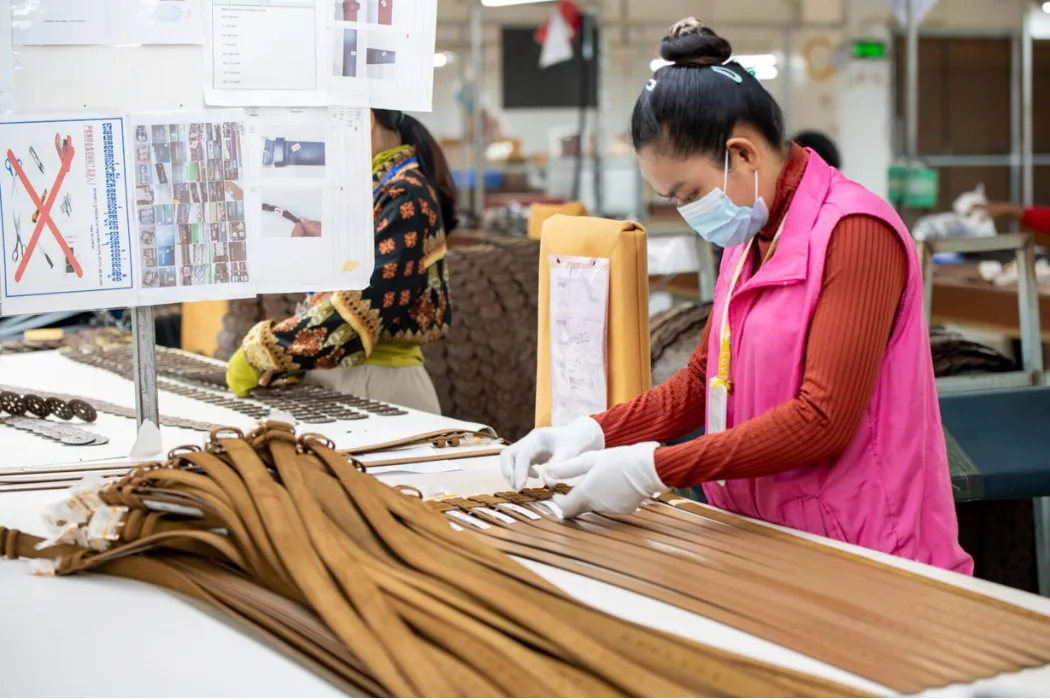
For international buyers, low cost is worthless without compliance. In 2026, Cambodian leather factories are not backyard workshops; they are industrial fortresses designed to pass the strictest audits from Fortune 500 retailers. Facilities routinely hold BSCI, SMETA, and ISO certifications, ensuring that ethical sourcing is built into the low-cost model.
The “Audit-Ready” Infrastructure
Global brands cannot afford a PR scandal. The leading manufacturers in Cambodia have anticipated this by building “Audit-Ready” facilities from day one. Unlike older industrial zones where compliance is retrofitted, new Cambodian plants are designed with safety and worker welfare as structural pillars.
- Social Compliance: Routine audits like SMETA (Sedex Members Ethical Trade Audit) and BSCI (Business Social Compliance Initiative) are standard operating procedure. Factories are accustomed to unannounced visits.
- Safety Standards: Facilities comply with international building codes and fire safety regulations. This often surpasses local government requirements to satisfy the strict vendor manuals of Western buyers.
- Transparency: Modern ERP systems track working hours and wages digitally. This ensures verifiable adherence to labor laws regarding overtime and compensation.
This level of professionalization makes Cambodia a safe harbor for risk-averse corporate buyers who need to secure their supply chain ethics.
Scale Requirements for “Big Box” Retailers
To serve retail giants, a factory needs more than just a certificate; it needs massive, reliable throughput. Boutique workshops cannot handle the replenishment volume of a global chain.
- Volume Capacity: Top-tier facilities in the region now boast capacities exceeding 800,000 PU belts and 300,000 genuine leather belts per month.
- Workforce Stability: With workforce numbers often topping 4,500 skilled workers per site, these factories offer the labor stability needed for continuous programs.
- Consistency: Managing this scale requires ISO 9001 quality management systems. This ensures that the 100,000th belt off the line is identical to the first sample.
This scale allows buyers to consolidate their entire season’s order into one location, simplifying logistics and quality control management.
Sustainability and Material Traceability (LWG)
In 2026, compliance extends beyond the factory walls to the raw material itself. Consumers demand to know where the leather comes from.
- Leather Working Group (LWG): Sourcing managers now prioritize leather from LWG-rated tanneries. Cambodian factories have integrated this requirement, sourcing crusts directly from LWG Gold/Silver rated partners.
- Chemical Safety: Strict adherence to REACH (Europe) and Prop 65 (USA) regulations is non-negotiable. Internal labs often test for restricted substances before mass production begins.
- Environmental Management: Leading plants adopt ISO 14001 standards to manage waste and water usage, aligning with the global push for sustainable manufacturing.
By combining massive scale with strict environmental governance, Cambodia offers a sustainable manufacturing solution that goes beyond simple price cutting.
Technical Craftsmanship: Meeting Luxury Standards with Precision
Perception often lags behind reality. In 2026, Cambodia is not limited to basic commodity belts. The region has mastered complex constructions required by mid-to-high-end brands. From intricate hand-braiding to multi-layer reversible straps, factories now deliver technical precision that rivals established manufacturing hubs.
Dispelling the “Basic Goods Only” Myth
The “Basic Goods Only” myth is dead. As brands moved higher-tier production to Cambodia to escape tariffs, factories upgraded their skill sets. Today, the technical capabilities cover the full spectrum of belt construction, proving that “duty-free” does not mean “quality-free.”
| Technical Feature | Basic Market Standard | Advanced Cambodian Capability |
|---|---|---|
| Edge Finishing | 3-Layer Paint (Rough) | 7-Layer Auto-Inking (Smooth, Rounded) |
| Braiding | Machine Woven (Loose) | Hand-Braided (Tight, Consistent Tension) |
| Reversible Mech | Standard Gap (>2mm) | Precision Skiving (Gap <1mm, Seamless Turn) |
| Durability Test | 5,000 Flex Cycles | 20,000+ Flex Cycles (No Cracking) |
- Hand-Braided Excellence: Braided Belts are a specialty of the region. This labor-intensive category is cost-prohibitive in high-wage countries. Cambodian artisans produce tight, consistent weaves (from 3-strand to complex 9-strand patterns) that meet rigorous aesthetic standards.
- Advanced Edge Finishing: Cheap belts have rough edges. Premium belts require smooth, rounded, and sealed edges. Factories here utilize automated inking stations to apply 7-layer Edge Paint that passes wet-rub and flexibility testing (often exceeding 20,000 flex cycles).
- Reversible Construction: Making a Reversible Belt requires precise skiving and alignment of the swivel buckle. Current production lines achieve the sub-millimeter tolerances needed to ensure the mechanism turns smoothly without gaps.
This combination of low-cost manual skill (for braiding) and high-tech automation (for painting and stitching) creates a “Best of Both Worlds” scenario for technical buyers seeking complex designs at a viable price.
Logistics Infrastructure: Optimized Routes for Global Distribution
In the past, logistics was Cambodia’s weak point. In 2026, infrastructure upgrades at Sihanoukville Autonomous Port (PAS) and expanded feeder networks have closed the gap. While sea transit times are slightly longer than from East Asia, the efficiency of the “Vertical Supply Chain” (discussed in Chapter 3) allows total lead times—from order to delivery—to remain competitive for global retail calendars.
Analyzing Transit Times to Key Markets
Sourcing managers must factor shipping days into their “Open-to-Buy” planning. Cambodia’s strategic location in the Gulf of Thailand connects it efficiently to major transshipment hubs like Singapore and Hong Kong.
| Destination Market | Key Port | Est. Transit Time (Days) |
|---|---|---|
| USA West Coast | Los Angeles / Long Beach | 20 – 25 Days |
| USA East Coast | New York / Savannah | 30 – 35 Days |
| Europe (North) | Rotterdam / Hamburg | 28 – 32 Days |
| UK | Felixstowe / Southampton | 28 – 32 Days |
- To US West Coast: Standard sea freight transit is approximately 20 to 25 days. While this is roughly 3-5 days longer than shipments from Shanghai, the cost savings on duty (GSP) far outweigh the marginal increase in inventory carrying cost.
- To Europe: Shipments to major ports like Rotterdam or Hamburg typically take 28 to 32 days. The routes are well-established, with major carriers (Maersk, MSC, CMA CGM) offering regular weekly sailings.
- Port Efficiency: The modernization of the deep-sea port at Sihanoukville has significantly reduced container dwell time, minimizing the risk of “rolled cargo” during peak seasons.
For core replenishment programs, these timelines are highly predictable, allowing supply chain planners to build reliable delivery schedules.
Balancing Production Speed with Shipping Time
Smart logistics is about the “Total Lead Time.” A longer boat ride doesn’t matter if the factory produces faster.
- The “Offset” Strategy: Because integrated factories in Cambodia can finish leather locally and produce bulk orders in 15-20 days (faster than many competitors waiting for material imports), the production speed effectively “pays back” the extra days spent on the water.
- Buffer Stocks: For large retailers, factories often hold “Make-to-Stock” raw materials. This allows production to start immediately upon PO issuance, further compressing the timeline.
This balance means that a belt order placed in Cambodia often arrives at the distribution center at the same time as one sourced elsewhere, but at a significantly lower landed cost.
Air Freight Solutions for “Fast Fashion”
When speed is the only priority—such as chasing a viral trend or replenishing a bestseller—air freight infrastructure is ready.
- Airport Connectivity: Phnom Penh International Airport (PNH) handles significant cargo volume. Air shipments can reach US or European distribution centers in 3 to 5 days.
- Hybrid Strategy: Many brands use a “Sea-Air” hybrid model: shipping the initial launch volume by sea for maximum margin, and air-freighting smaller replenishment batches to capture immediate sales upside.
This flexibility ensures that sourcing from Cambodia does not lock a brand into a slow-moving supply chain.
Frequently Asked Questions
Is manufacturing leather belts cheaper in Cambodia than in China?
Yes, typically. While raw material costs are similar globally, Cambodia offers significantly lower labor costs and, most importantly, duty-free access (0% tariff) to major markets like the US and EU. This results in a lower total “Landed Cost” compared to China.
Does Cambodia still have GSP status for leather goods in 2026?
Yes, Cambodia continues to benefit from trade preference programs (GSP/MFN) that exempt eligible leather goods from standard import duties. Sourcing managers should verify the specific HS Codes for their products to calculate exact savings.
What is the typical Minimum Order Quantity (MOQ) for Cambodian factories?
Cambodian factories generally focus on volume. Typical MOQs range from 3,000 to 5,000 pieces per style. However, vertically integrated manufacturers with their own tanneries may offer more flexibility, sometimes accommodating orders as low as 1,000 pieces for strategic partners.
Are Cambodian belt factories compliant with US safety standards (CPSIA)?
Yes. Export-oriented factories routinely test for lead, phthalates, and other restricted substances to meet CPSIA (USA) and REACH (Europe) standards. Always request a test report from a third-party lab (like SGS or Intertek) before shipment.
How long does shipping take from Cambodia to the US West Coast?
Sea freight from Sihanoukville to Los Angeles or Long Beach typically takes 20 to 25 days. This is slightly longer than from China but is easily managed within a standard 12-week fashion production calendar.
Can Cambodian factories source high-end leather from Italy or Brazil?
Absolutely. The “Crust-to-Finish” model allows factories to import premium raw hides (crusts) from Italy, Brazil, or Argentina and finish them locally. This gives you the quality of Italian leather with the cost benefits of Cambodian manufacturing.
Conclusion: The Strategic Pivot for 2026
Manufacturing in Cambodia is no longer just a cost-saving tactic; it is a strategic necessity for competitive global brands. By leveraging Zero-Duty status, vertical supply chains, and industrial-scale compliance, buyers can protect their margins without sacrificing quality.
For brands seeking a partner that embodies these advantages, Hoplok Leather stands ready. With over 22 years of experience and our own Pro Pelli leather finishing facility in Cambodia, we deliver the speed, compliance, and duty-free benefits your supply chain demands. Whether you need high-volume programs or complex braided designs, we provide the turnkey solution to navigate the 2026 market successfully.