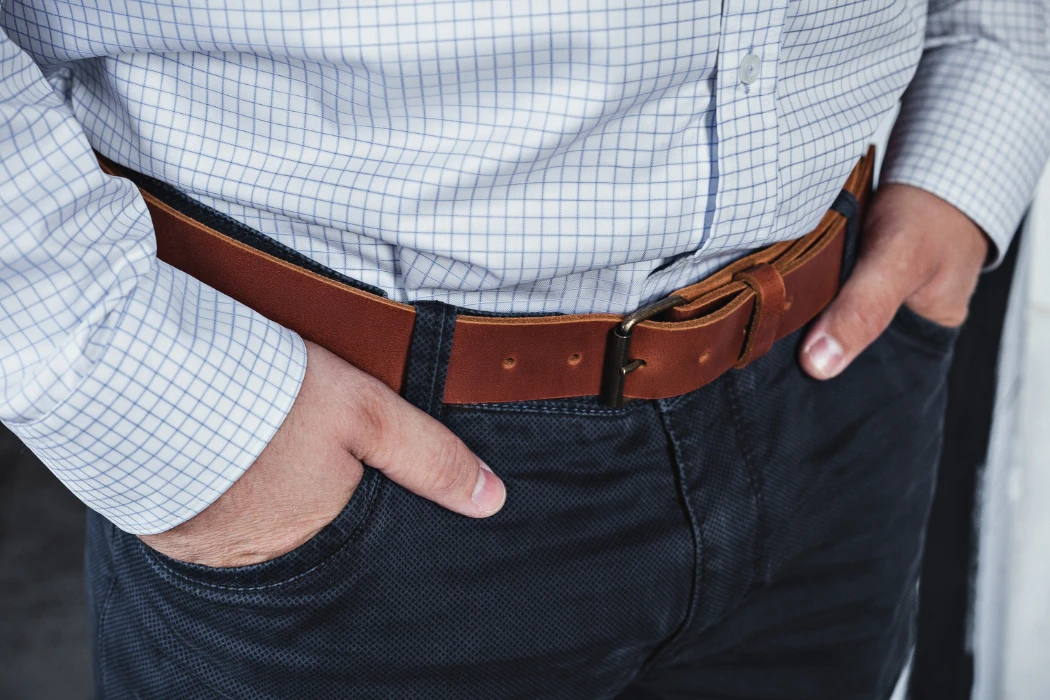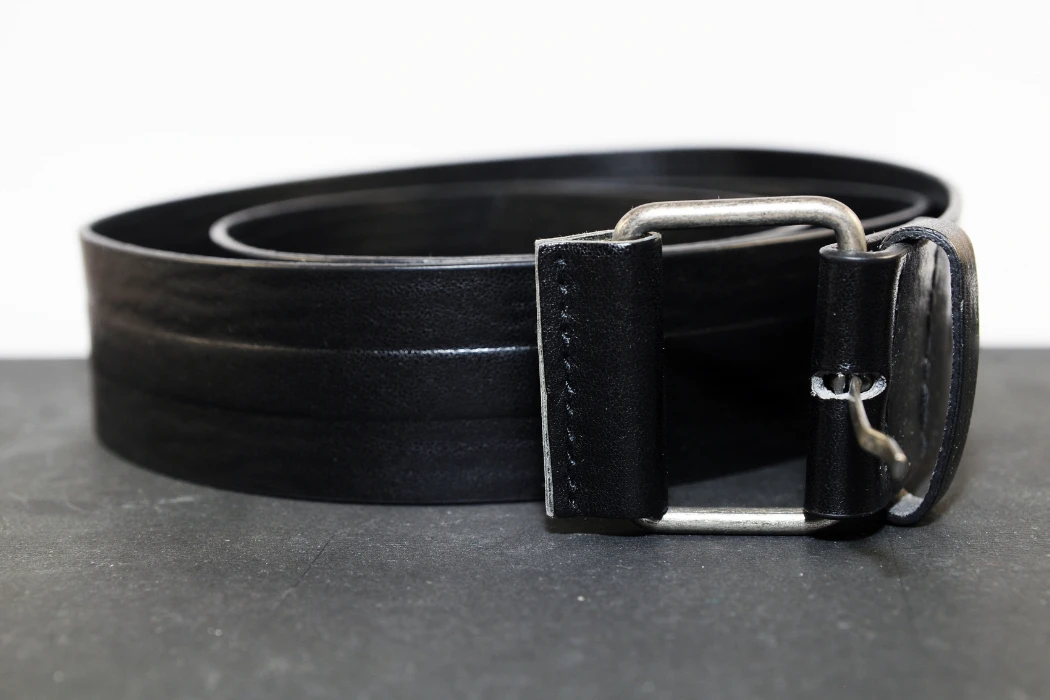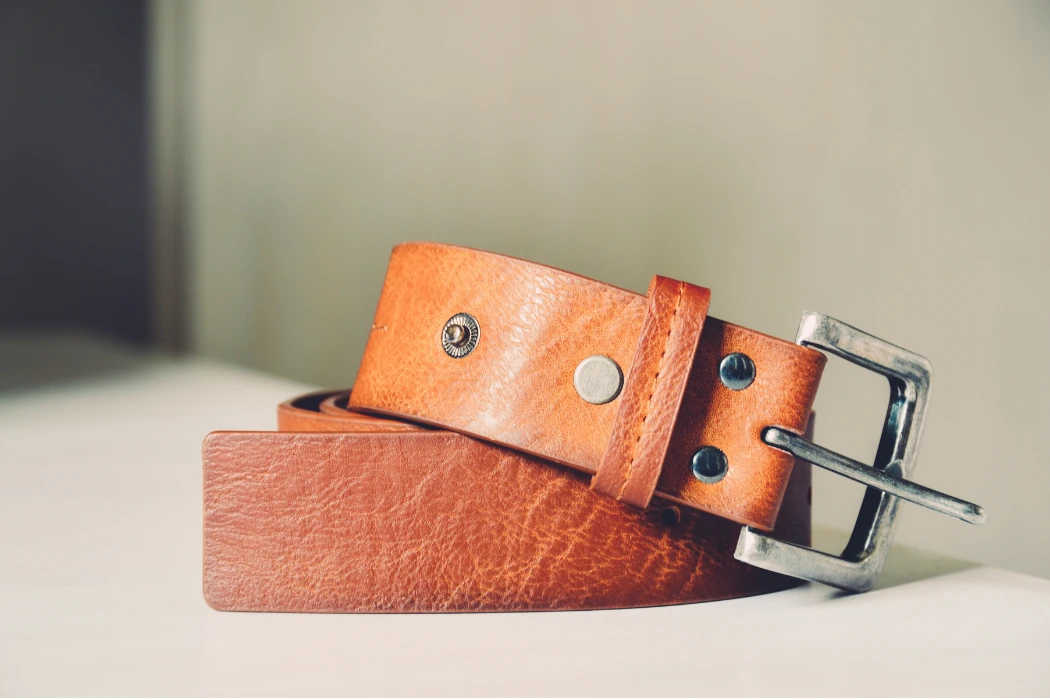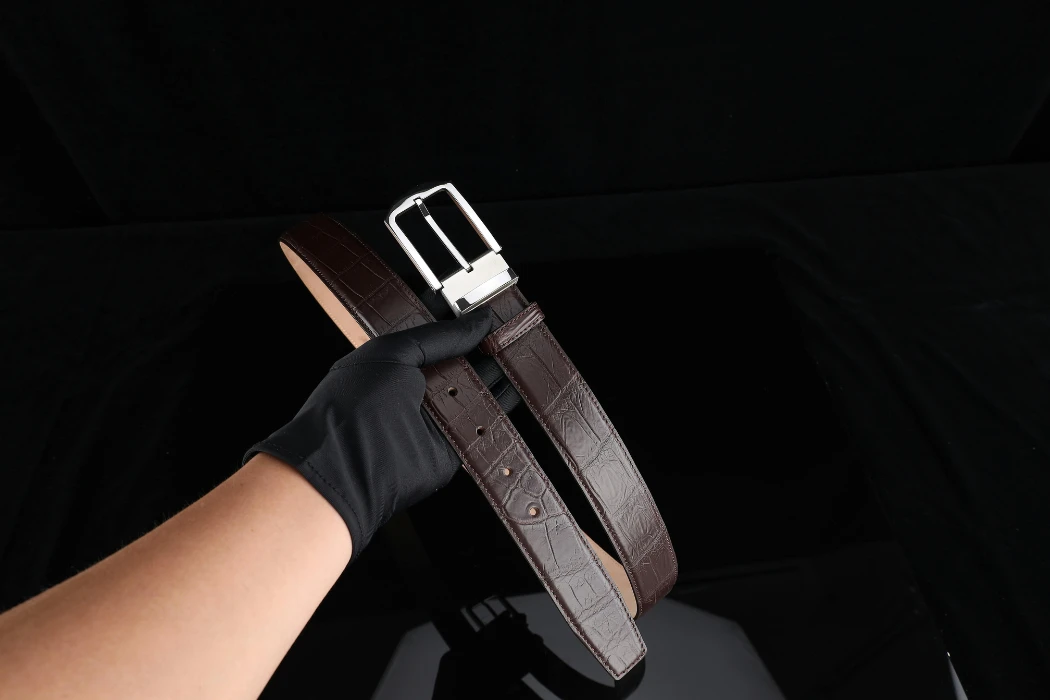
The best length for a leather belt aligns the buckle prong with the middle hole (the 3rd out of 5 holes). This critical positioning ensures you have exactly two holes of adjustment in either direction to accommodate natural weight fluctuation. Aesthetically, the belt tail should extend just past the first belt loop of your trousers, typically adding 2 to 3 inches to your actual waist measurement for the perfect visual balance.
There is a fine line between a polished look and a sloppy one. Why does a belt that is six inches too long make you look unkempt, while one that barely reaches the first loop makes you look like you outgrew your wardrobe? In menswear, the belt is the visual equator of your body; if the proportions are off, the entire outfit looks unbalanced.
We are going to remove the guesswork. In this guide, we will combine simple mathematical formulas with visual “Golden Ratios” to help you nail your size. By the end, you will know exactly how to measure for a fit that is comfortable, functional, and aesthetically flawless, ending the cycle of online returns forever.
Why Is the “Middle Hole Rule” Non-Negotiable?
All standard leather belts are engineered with exactly 5 adjustment holes, typically spaced 1 inch (2.54 cm) apart. Selecting the 3rd (middle) hole is not merely for visual symmetry; it is a critical buffer for tolerance. Your waist circumference naturally fluctuates by 0.5 to 1.0 inch throughout the day due to water retention and meals. Anchoring your fit on the middle hole guarantees that the belt remains perfectly centered and the tail length remains consistent, regardless of these daily micro-changes.
The Mechanics of Symmetry
The geometry of a belt strap is designed around the center point.
- Standard Spacing: The industry standard gap between holes is exactly 1 inch. This means a 5-hole belt offers a total adjustment range of 4 inches.
- The Safe Zone: By aiming for the middle hole, you give yourself a 2-inch buffer in both directions (tighter or looser). If you buy a belt that fits on the last hole, a single heavy dinner could make it unwearable.
Accommodating Weight Fluctuation
Your body is dynamic, not static. A belt needs to breathe with you.
- Daily Expansion: Studies show that an adult male’s waist can expand by up to 1 inch from morning to evening. A belt fitted to the 3rd hole handles this expansion without requiring you to awkwardly punch a new hole.
- Seasonal Shift: Most people fluctuate 3-5 lbs between seasons. The middle-hole fit allows the belt to adapt to these minor long-term changes without becoming obsolete.
Preventing Leather Distortion
Using the wrong hole affects the structural integrity of the leather over time.
- Stress Distribution: When you buckle on the first or last hole, the tension is applied to the very end of the adjustment zone, causing the leather tip to twist or flare outwards (the “dog ear” effect).
- Hole Elongation: Consistently using the last hole puts excessive torque on the leather grain, stretching the hole into an oval shape faster than if the stress were centered on the middle hole reinforced by the surrounding strap.
How to Calculate Your Size: The “Pant Size + 2” Formula
The fastest, though slightly imperfect, method to determine your fit is the “Pant Size + 2 Inches” rule. If your jeans are labeled size 34, you should generally purchase a size 36 belt. This formula compensates for “Vanity Sizing”—where pants are labeled smaller than they measure—and provides the necessary circumference to accommodate the belt’s own material thickness and underwear, aiming to land the buckle prong exactly on the 3rd middle hole.
Vanity Sizing Explained
You cannot trust the tag on your denim. Clothing brands artificially deflate sizes to flatter customers.
- The Label Lie: Industry measurements reveal that a standard pair of men’s trousers labeled “34 Waist” typically measures 35.5 to 36.5 inches in actual physical circumference.
- The Gap: Because your “34” pants are actually closer to 36 inches, buying a size 34 belt would essentially be a tourniquet. Adding 2 inches bridges this gap between marketing labels and physical reality.
The Thickness Variable
The belt itself takes up space. A heavy-duty leather strap eats up its own length when wrapped.
- Circumference Loss: A robust full-grain belt often measures 4mm to 5mm in thickness. When curled into a circle, the outer diameter is significantly larger than the inner diameter.
- Compensation Math: For every 4mm of leather thickness, you effectively lose approximately 0.5 inches of usable length. This is why a thin dress belt might fit at size 36, while a thick work belt usually requires a size 38.
Quick Reference Size Chart
| Pant Size (Label) | Recommended Belt Size | Est. Total Strap Length |
|---|---|---|
| 30″ | 32″ | 38″ (95cm) |
| 32″ | 34″ | 40″ (100cm) |
| 34″ | 36″ | 42″ (105cm) |
| 36″ | 38″ | 44″ (110cm) |
| 38″ | 40″ | 46″ (115cm) |
The Precision Method: Measuring an Old Belt
If you demand 100% accuracy, do not measure your waist body; measure the belt that is currently holding up your pants. Take your most frequently worn belt and lay it flat on a table. Measure from the inner fold of the buckle (where the leather wraps around the metal bar) straight to the hole you use most often. This specific linear measurement—for example, 36 inches—is your true, absolute belt size, bypassing brand inconsistencies and vanity sizing entirely.
Where to Start Measuring
The most common mistake is measuring the entire length of the belt, including the buckle.
- The Pivot Point: You must start your tape measure at the fold (the end of the leather strap), not the tip of the metal buckle. Buckles vary in length (from 1″ to 3″), so including them adds variable error.
- The Anchor: The fold represents the point where the buckle pin engages. This is the mechanical zero-point of the belt’s circumference.
Identifying the “Wear Hole”
Your belt tells a story. Even if you think you are a size 34, your belt knows better.
- The Kink: Look for the hole that has a distinct crease, bend, or darkening around it. This is your “Wear Hole.” It represents your actual waist size under tension.
- Ignore the Label: Even if the old belt is stamped “34,” if the distance to the wear hole is 36 inches, order a size 36. Leather stretches over time, often elongating by 1 to 1.5 inches after years of use.
Why Tape Measuring Your Waist Fails
Wrapping a tailor’s tape around your waist often yields a number that is too small.
- The Tension Gap: A tape measure sits gently on the skin. A belt is cinched tight to hold up heavy denim. This difference in tension (roughly 3 to 5 lbs of force) usually compresses the soft tissue of the waist, resulting in a belt size that needs to be 0.5 to 1.0 inch tighter than a loose tape measurement.
- Rise Variation: You likely measured at your navel, but your jeans sit 2 to 3 inches lower on your hips. Measuring the belt accounts for exactly where your pants sit.
How Long Should the Belt Tail Be?
Aesthetically, the belt tail (the tip) must pass through the first belt loop of your trousers but never touch the second loop. The ideal visual overhang measures 2 to 3 inches (5 to 8 cm) from the buckle frame. If the tail is too short to reach the first loop, it creates a visual “stumped” effect that looks accidental; if it is long enough to flap around or tuck into the second loop, it signals a lack of professional tailoring.
The Visual Golden Ratio
In menswear, balance is everything. The belt tail acts as a visual finish line for your waist.
- The Minimum: The tail needs to extend at least 1 inch past the first belt loop to stay secure. Any shorter, and it will constantly pop out, catching on your arm as you walk.
- The Maximum: The absolute limit is 4 inches of overhang. Beyond this point, gravity takes over, causing the leather tip to droop downwards, ruining the horizontal line of your waist.
Formal vs. Casual Tail Length
The rules relax slightly depending on the occasion, but precision remains key.
- Formal Wear: For suits, the tolerance is tight. Aim for a short, crisp tail of 2 to 3 inches. Excess leather here bulks up the jacket silhouette.
- Casual / Workwear: With jeans and heavy leather boots, a slightly longer tail of 3 to 4 inches is acceptable. The thicker leather (often 4mm+) holds its shape better and fits the rugged aesthetic.
Tail Length Guidelines
| Belt Style | Ideal Tail Length | Loop Position Target | Common Mistake |
|---|---|---|---|
| Formal / Dress | 2″ – 3″ (5-8cm) | Just past 1st loop | Too long (sloppy) |
| Casual / Denim | 3″ – 4″ (8-10cm) | Past 1st loop | Too short (stubby) |
| Knotted / Fashion | 5″ – 6″ (12-15cm) | Hangs down (Intentional) | Stiff leather (won’t knot) |
What If You Are Between Sizes?
If your precise measurement lands on an odd number (e.g., 35 inches) and the brand only offers even sizes (34, 36), the golden rule is to always round up to the larger size. Purchasing a size 36 belt means you might buckle on the 4th hole, which is visually acceptable and leaves room for tailoring. Conversely, buying down to a size 34 risks the belt being too short to fasten comfortably, leaving you with zero margin for error or dinner.
The “Round Up” Rule
Leather can be shortened, but it cannot be stretched (intentionally) without damaging it. Always err on the side of excess material.
- The Logic: A size 34 belt typically fits a range of 32″ to 36″. If you measure 35″, you are at the absolute limit. A size 36 fits 34″ to 38″, placing your 35″ waist safely within the adjustment zone.
- The Safety Net: Having extra length allows a cobbler (or you) to shorten the strap from the buckle end, maintaining the factory finish of the tip. You cannot add length to a cut strap.
Modifying a Long Belt
Many high-quality belts feature a screw-post construction (Chicago Screw) rather than permanent stitching, allowing for easy DIY resizing.
- The Mechanism: Look at the back of the buckle. If you see a flathead screw, you can unscrew it, cut the excess leather with shears, punch a new hole for the screw, and reattach the buckle. This entire process takes about 5 to 10 minutes.
- Limitation: Stitched belts cannot be shortened this way without professional restitching machines. Always check the buckle attachment before buying if you plan to resize.
Adding Holes Correctly
If you must add a hole to tighten a belt, strictly avoid using a kitchen knife, nail, or electric drill.
- The Tool: Use a rotary leather punch. These specific tools create a clean, circular cut that prevents the leather from tearing under stress. A jagged knife hole will split within weeks.
- Spacing Precision: Measure exactly 1 inch (2.54 cm) from the center of the existing last hole to maintain the aesthetic rhythm. A hole punched visually at 0.8 inches or 1.2 inches looks immediately amateur.
Frequently Asked Questions
No, belt size is not the same as waist size; it is typically 2 inches larger to account for material thickness and clothing. Yes, you can cut a leather belt to make it shorter if it has a screw-post buckle, but stitched belts require professional cobbling. Furthermore, expect high-quality full-grain leather to stretch approximately 0.5 to 1.0 inch (1.2 – 2.5 cm) over its lifetime, so a snug initial fit is preferable to a loose one.
Is belt size the total length of the belt?
No. Belt size is the specific distance from the buckle fold to the middle hole. The “Total Length” includes the tail (tip) and is typically 6 to 8 inches longer than the size number. Buying a “Size 34” belt believing it is 34 inches long total will result in a belt that cannot even wrap around your waist.
Do different brands have different sizing?
Yes, unfortunately. Due to inconsistency in “Vanity Sizing,” a size 34 in Brand A might measure 35.5 inches, while Brand B measures 36.5 inches. This variance of 1 to 2 inches is why we strongly recommend measuring your old belt with a tape measure rather than relying on the printed numbers on the leather.
How much does a leather belt stretch?
Leather is an organic fiber structure that relaxes under tension and body heat. A premium Full-Grain belt will typically elongate by 3% to 5% over the first year of daily wear. On a standard size 36 belt, this translates to roughly 1 inch of stretch, often requiring you to tighten the belt by one hole eventually.
Should I buy a size 34 belt if I wear size 34 pants?
Almost certainly not. If you buy a size 34 belt, you will likely be fastening it on the very last hole or not at all. Because jeans labeled “34” usually have an actual waistband circumference of 36 inches, you need a size 36 or 38 belt to comfortably clear the fabric thickness and underwear.
Where should the belt tip end?
For a tailored appearance, the tip should end between the first and second belt loops. This usually equates to 2 to 4 inches of excess leather extending from the buckle. If the tip touches or goes past the second belt loop, the belt is visibly too big.
Conclusion: Measure Twice, Buy Once
A perfect belt is not just about keeping your pants up; it is about maintaining the visual integrity of your outfit. Whether you rely on the quick “Pant Size + 2” formula or the precision method of measuring an old belt, the goal remains singular: anchoring the buckle on the middle hole. This ensures you possess the necessary tolerance for life’s natural fluctuations while keeping the tail length neat, professional, and visually balanced.
Stop settling for “good enough.” At Hoplok, we offer precision custom sizing down to the inch. Furthermore, our designs feature removable screw-post buckles, empowering you (or your customers) to easily trim the strap length at home for a 100% bespoke fit without special tools. Contact Hoplok today to stock your shelves with belts that solve the sizing headache for good.