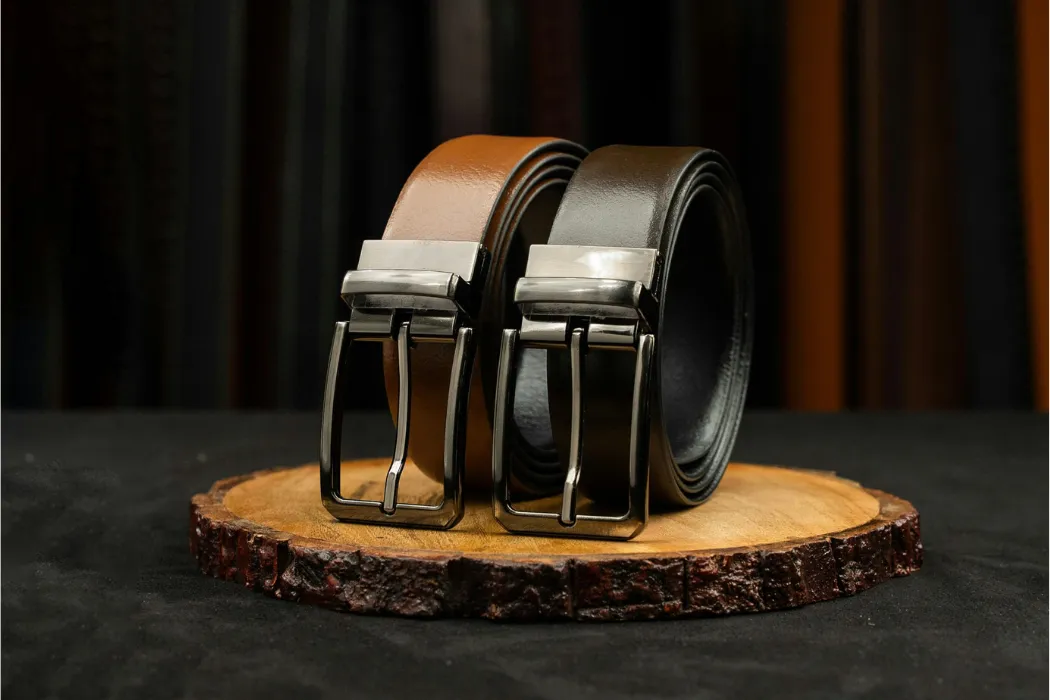
A reversible fashion belt provides two usable faces, so its material stack, edge treatment and fastening mechanism must work in both orientations. The development brief should identify how reversal happens and which appearance and functional checks apply.
A design may use bonded or stitched layers, reinforcement and a rotating or detachable buckle. The construction is a design choice, not a mandatory three-layer formula. Approve the complete assembly rather than judging the face materials separately.
This guide covers material compatibility, lamination, buckle operation, stitching, edge finishing and inspection for reversible fashion belts. Numerical test settings must be agreed for the actual construction; they are not universal durability guarantees.
What Distinguishes the Anatomy of a Reversible Belt from Standard Belts?
Both faces must meet the appearance and functional requirements of the design. Specify each face, any core or reinforcement, the edge and the attachment in a cross-section. Standard belts also vary in construction and should not be assumed to have one fixed layer arrangement.
The “Sandwich” Construction: Core Filler vs. Single-Ply
A laminated design may combine two face materials with a core or reinforcement, but a core is not compulsory in every reversible belt. Select the stack to achieve the required hand feel, dimensions and performance. Name hidden components in the BOM.
Feather Edge vs. Cut Edge: Structural Profiles for Reversibility
Define the actual edge cross-section. A feathered or raised profile is not automatically a folded edge. Compare folded and painted cut-edge samples for appearance, bulk, flexing and separation under the agreed test conditions.
Flatness Engineering: Balancing Tension on Both Sides
Uneven material response, processing or assembly can contribute to curling. Evaluate both faces together, control preparation and handling, and define acceptable flatness under agreed conditioning. Grain direction alone cannot guarantee a perfectly flat strap.
How is Leather Selection Optimized for Dual-Sided Reversible Straps?
Select two materials that can function together in the proposed construction. They need not behave identically, but their combined thickness, flexibility, finishing and bonding response must be validated.
Matching Shrinkage Rates on Side A and Side B
Assess the proposed pairing under relevant conditioning and exposure. Tannage can affect material behavior, but pairing vegetable- and chrome-tanned leathers does not automatically cause failure. Approve compatibility through samples and the relevant tests.
Split Leather vs. Full Grain: Material Compatibility for Bonding
Identify the actual bonding surfaces and their preparation. Full-grain status describes the grain surface, not a guaranteed flesh-side bonding quality. Select adhesive and application conditions from supplier guidance and material trials rather than prescribing a double coat for every split.
Precision Splitting: Matching the Finished Thickness to the Buckle
Set total thickness and layer tolerances from the buckle and desired feel. Check the finished strap in the attachment and through the keeper on both sides. Use the tolerance agreed for the specific assembly.
Material Combinations: Durability vs. Flexibility in Reversible Belts
| Combination | Development focus |
|---|---|
| Leather + leather | Compatible feel, thickness, finish and bonding |
| Leather + PU | Coating/backing identity and interlayer compatibility |
| Split-leather construction | Actual finish, reinforcement and attachment performance |
| Reconstituted-fiber material | Composition, labeling, flexing and bond performance |
Why Is Lamination the Most Critical Process in Reversible Belt Manufacturing?
Where the design relies on lamination, bond quality affects appearance and integrity. Identify which surfaces are being joined; two finished outer faces do not mean the outward finishes are the internal bonding surfaces. Validate the adhesive system on the actual stack.
Preventing “Bubbling”: Adhesive Selection for Two Finished Faces
Investigate surface preparation, material compatibility, application uniformity, trapped air and curing if bubbles appear. Follow the adhesive supplier’s technical guidance and run trials. Solvent-based chemistry, a primer or a specific coat count is not mandatory for every material pair.
Temperature Management During the Dual-Sided Pressing Phase
Develop temperature, pressure, dwell and curing conditions for the selected adhesive, leather and equipment. Record the approved process window and inspect for distortion or finish damage. Avoid a universal temperature threshold or pressing recipe.
Bonding Strength vs. Reversible Bending Stress
Agree relevant flexing and bond tests with the factory or laboratory. Check separation, edge damage and face appearance after conditioning and testing. Define the test conditions explicitly; a cycle count alone does not establish service life.
How Does the Swivel Buckle Mechanism Function Under Stress?
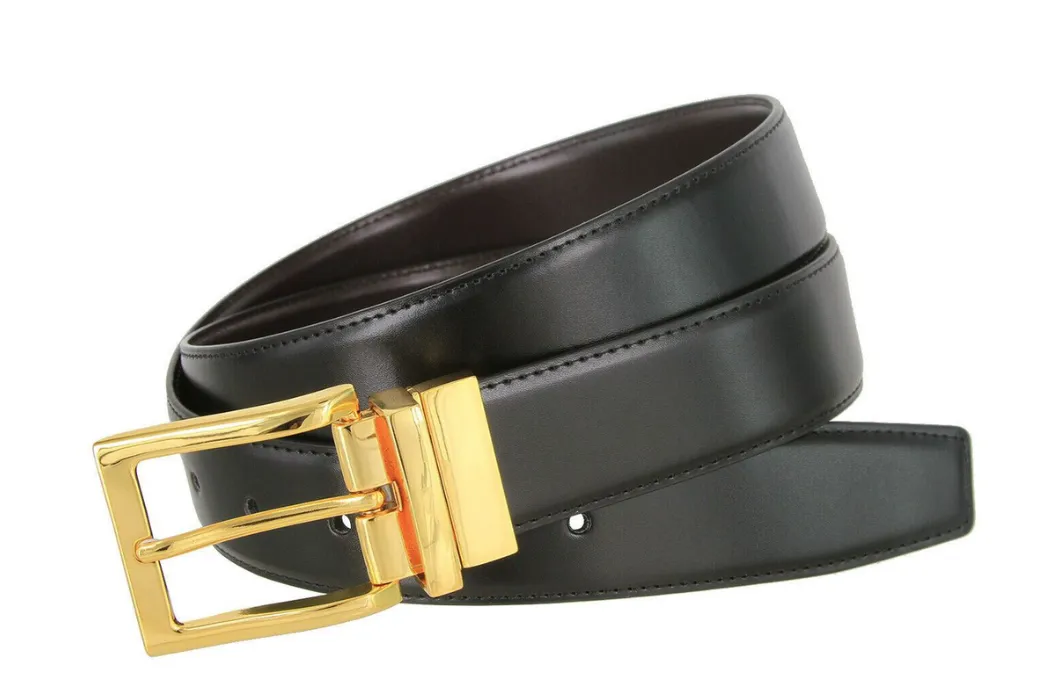
For a rotating design, the buckle changes orientation to present the other face. Inspect attachment, pivot movement and locking behavior in both positions. A detachable design may use a different reversal method and needs its own checks.
The Pivot Shaft: Spring and Ball Bearing Mechanics
Obtain the mechanism drawing or component specification. Some designs use springs and detents, while others use different arrangements. Define acceptable play, engagement, release and retention; a component description alone does not establish reliability.
Zinc Alloy vs. Stainless Steel: Durability in Moving Parts
Compare the actual alloy, geometry, tolerances, finish and interacting surfaces. Brass and stainless steel do not necessarily match a shaft’s hardness, and a metal name alone cannot predict wear. Use the relevant component and assembly results.
Clamp Reversible vs. Pin Reversible: Assembly Differences
Specify the exact attachment rather than assuming “pin” always means screw-on. A clamp needs compatible strap thickness and secure engagement; a screw or other fixing needs its own retention requirements. Resizing should be offered only where the design and instructions support it.
What Stitching Techniques Are Required for Double-Sided Reversible Durability?
Where stitching is used, define acceptable appearance on both visible faces. Hidden areas of a standard belt still require proper workmanship; visibility does not excuse functional defects.
Balancing Thread Tension for Identical Appearance on Both Sides
Approve stitch formation, tension and appearance using the actual material stack and thread. Check for loose loops, skipped stitches, puckering and visible imbalance. The design may use different colors on each face, so “identical” appearance is not always the requirement.
Lock-Stitching to Prevent Layer Delamination
Stitching can help retain layers, but it is not a substitute for an approved bond where the construction requires one. Specify thread material, size, stitch type and seam layout. Approve thread selection with the seam sample.
Stitch Density (SPI) Requirements for High-Motion Straps
Choose stitch density together with needle, thread, edge margin and material. Agree the target and tolerance on a sample and inspect relevant strength and appearance. Record the approved density in the specification.
How Are Textures and Colors Engineered for Reversible Compatibility?
Approve both surfaces as one product. Trade names such as Saffiano or Nappa do not by themselves establish stiffness or guarantee that a pairing will warp. Review the selected material references and finished sample.
Pairing Smooth (Formal) with Embossed (Casual) Surfaces Effectively
Specify the substrate, texture, finished thickness and temper on each face. Adjust the stack through development trials if the assembled belt is too stiff or unbalanced. An embossed appearance does not automatically require a softer or thicker opposite layer.
Thickness Compensation for Heavy Grains
Agree how thickness is measured on textured material, including instrument, contact area and relevant locations. Check actual fit at the clamp, pivot and keeper. Measuring only texture valleys or peaks without a method can misrepresent the assembly.
Color Fastness: Preventing Dye Transfer Between Layers
Evaluate color transfer and migration where the selected materials and use create a risk. A barrier layer may be considered if validated, but it is not an automatic solution. Test the complete stack under agreed conditions, particularly with contrasting colors.
Texture Compatibility Matrix for Reversible Designs
| Pairing | Checks to approve |
|---|---|
| Smooth + smooth | Surface variation, rub fastness and appearance |
| Smooth + embossed | Combined feel, thickness and flexing |
| Suede + grain | Contact transfer, surface wear and care guidance |
| Two embossed faces | Actual internal bond surfaces, edge and hardware fit |
Why Does Edge Finishing Require Special Treatment for Reversible Functionality?
The edge must remain acceptable with either face outward and through the intended reversal operation. Check contact with hardware and garment loops. Reversible use does not establish a fixed doubling of wear.
Inking vs. Folding: Which Edge Type Survives Twisting Better?
Compare folded and painted edges on the chosen construction. Define the desired profile and test relevant flexing, adhesion and surface wear. Assess the finished edge under the relevant conditions rather than relying on a coating description alone.
Solving Paint Cracking in High-Torsion Zones
Investigate preparation, compatibility, application and curing where cracking occurs. Approve the edge system on the actual leather stack. “Italian-grade” or “elastomeric” wording does not replace a supplier specification and test evidence.
The Multi-Layer Painting Process for Flexible Adhesion
Record the approved preparation, primer if required, color layers, drying/curing and final finish. Coat counts and heat treatment depend on the chosen system. Validate appearance and relevant performance rather than imposing one five-step recipe.
What Specific Quality Control Tests Validate Reversible Belt Integrity?
Build the inspection plan around the selected strap and mechanism. Define method, conditioning, test settings, acceptance criteria and the report needed for each risk. Test results apply to the tested construction.
Reversal Operation and Torque Testing
Agree the rotation or reversal motion, operating cycles and post-test checks for the buckle design. Inspect play, locking, release and attachment. Specify torque in a suitable torque unit where it is measured, with the method and limit defined.
Peel Strength Testing: Ensuring Layer Bond Stability
Select an applicable peel method with the laboratory, including specimen preparation, width, speed and conditioning. Record the result and failure mode. Set the acceptance criterion for the selected construction and exposure.
Hardware Fatigue: Testing the Spring Mechanism
Where a spring is part of the design, agree how its function is evaluated within the mechanism. Set the operation and retention criteria for the actual component. Record the agreed test settings and rejection criteria in the quality plan.
QC Testing Standards: Reversible vs. Standard Belts
| Check | Reversible-design focus |
|---|---|
| Flexing | Both orientations and visible faces |
| Operation | Reversal, lock/release, play and retention |
| Bonding | Actual stack and defined peel/conditioning method |
| Finish | Edges, rub transfer and relevant corrosion checks |
Frequently Asked Questions
The following answers address purchasing and quality decisions for reversible fashion-belt programs.
How should buyers investigate reversible buckle failures?
Investigate the actual failure: component damage, excessive play, attachment movement or locking problems. Review the mechanism specification and test evidence rather than blaming one alloy without examination.
How should buyers handle a delaminated batch?
For a quality issue in an order, document the affected batch and seek an approved repair or replacement disposition. Any rebonding process should be validated on the actual materials and re-inspected before release.
Can you cut a reversible belt to size?
Only offer this feature where the buckle and strap were designed and validated for it. Provide approved instructions and the supported adjustment range; a clamp appearance alone does not establish safe or reliable resizing.
Are reversible belts less durable than regular belts?
They introduce additional interfaces or moving parts to evaluate, but performance depends on the actual construction and use. Compare relevant results rather than assigning an inherent lifespan ranking.
Conclusion
Approve a reversible belt as a complete assembly: both faces, hidden layers, bond, edge and mechanism. Hoplok can review custom reversible fashion belt requirements and confirm materials, sampling and tests. ProPelli supports leather finishing of externally sourced crust; final-product performance still needs project-specific validation.