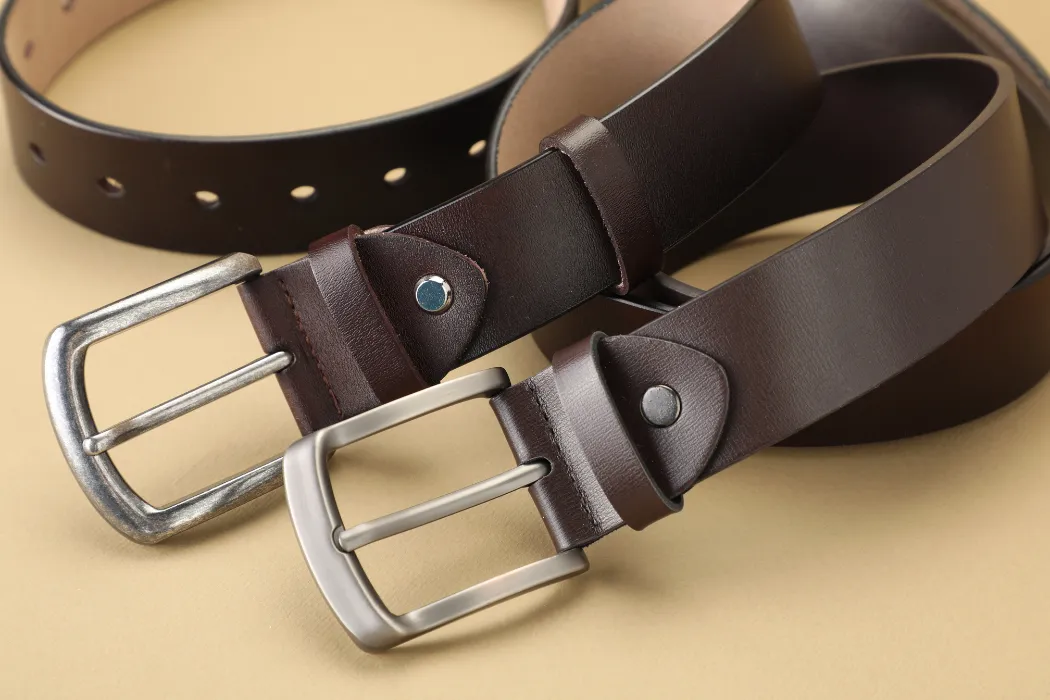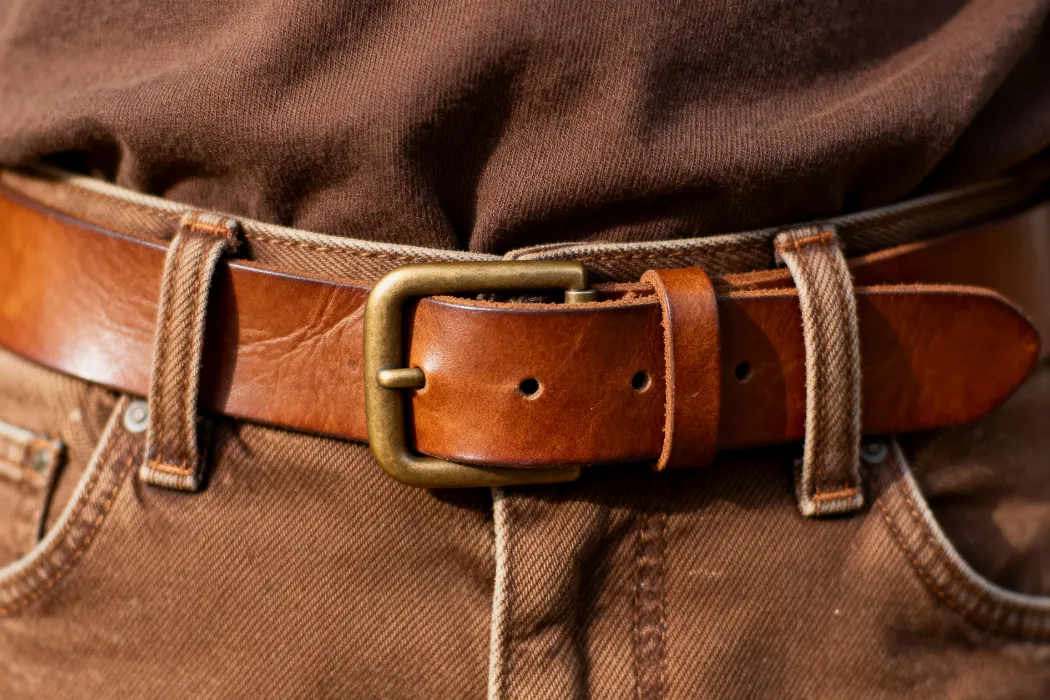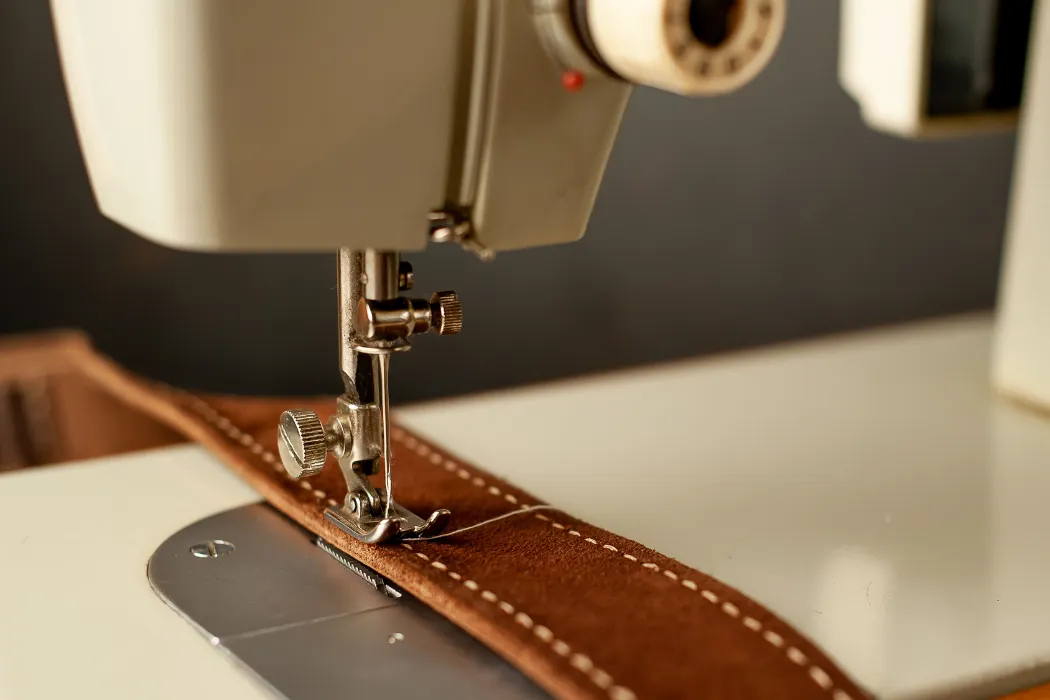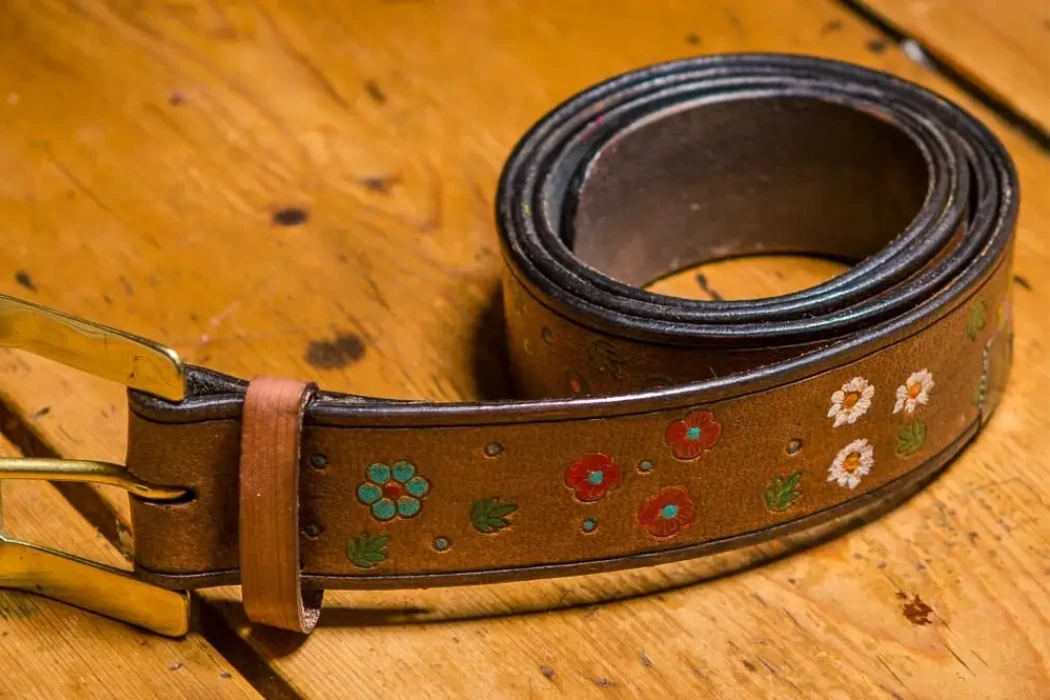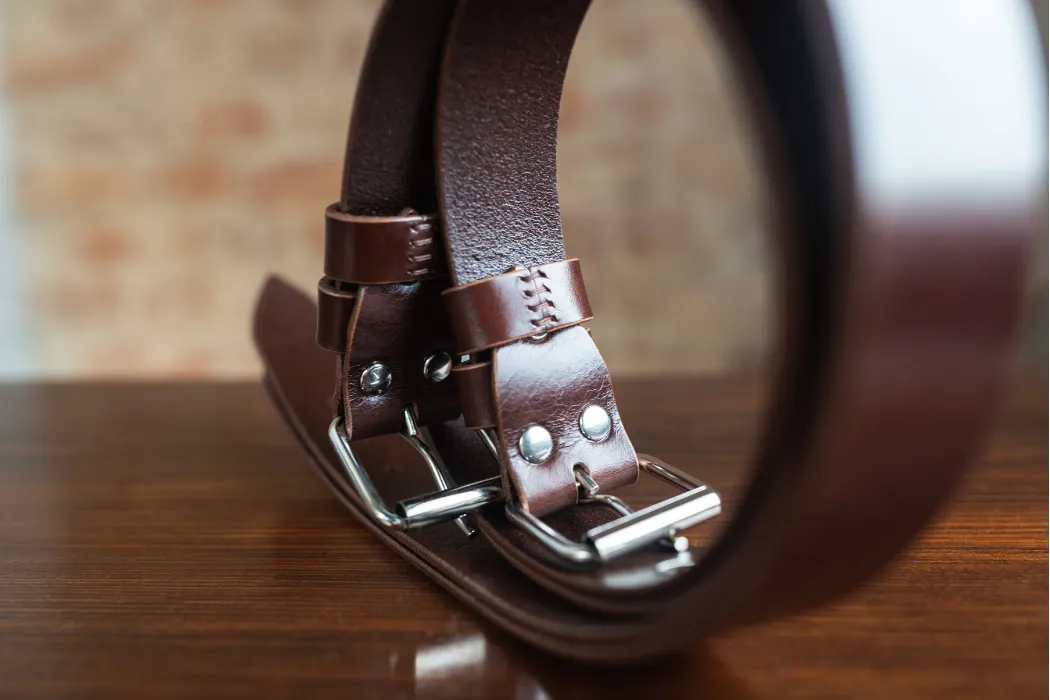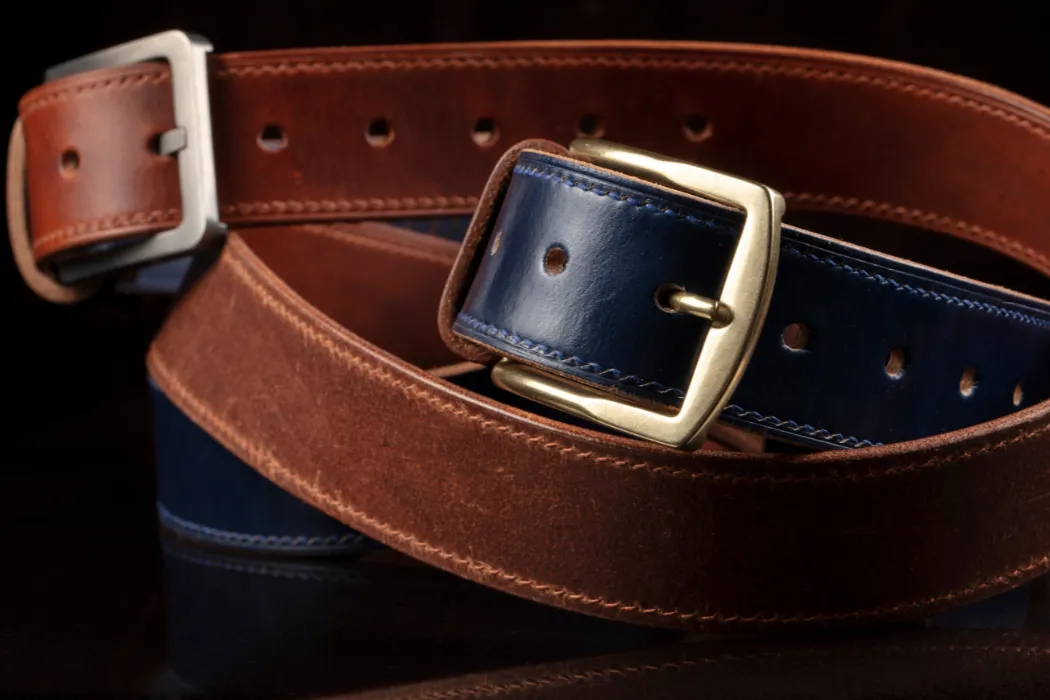
The global leather goods market is currently saturated with “fast fashion” accessories, creating a significant void for authentic, high-specification luxury products. While mass-market brands often rely on bonded or corrected-grain leathers to reduce costs, the modern discerning consumer increasingly demands transparency regarding material origin, vegetable-tanning processes, and hardware durability. Launching a successful luxury belt business today is no longer solely about aesthetic design; it is fundamentally an engineering challenge that requires rigorous adherence to material physics and supply chain integrity.
A “Luxury Belt Business” is defined by its ability to consistently source and convert premium Full-Grain hides—typically 3.5mm to 4.0mm in thickness—into durable accessories without compromising the leather’s natural fiber structure. Success in this niche requires a manufacturing ecosystem capable of executing precise splitting, high-pressure bonding, and edge burnishing that withstands years of daily friction. Unlike fashion belts, which prioritize trend cycles, a luxury belt brand is built on the technical assurance of tensile strength, corrosion-resistant PVD hardware plating, and leather that develops a proprietary patina over time rather than degrading.
This guide serves as a technical blueprint for navigating the complex lifecycle of luxury belt production. It moves beyond basic branding concepts to examine the critical operational pillars: sourcing Italian or South American raw hides, engineering precise Tech Packs with +/- 0.5mm tolerances, and navigating the Minimum Order Quantities (MOQs) required to access top-tier OEM manufacturing facilities.
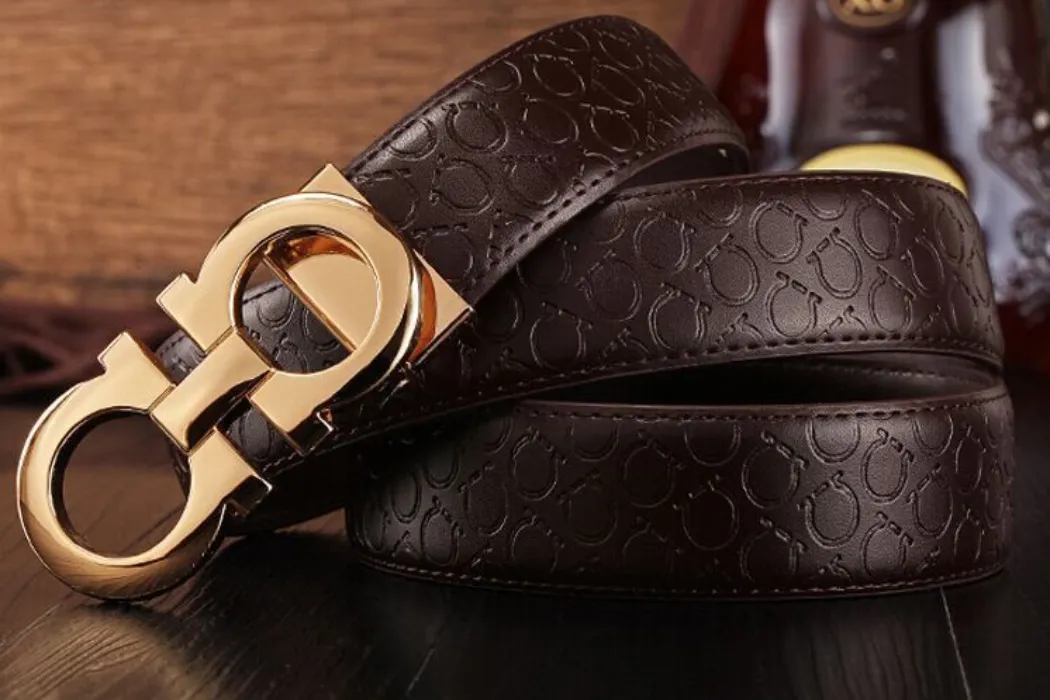
What Defines a “Luxury” Belt in Technical Specifications?
Technically, a luxury belt is defined by the preservation of the hide’s full corium structure and the density of its fiber weave. It must be constructed from Full-Grain Leather (the topmost layer of the hide) with a minimum thickness of 3.2mm for dress belts and 3.8mm+ for casual styles. The material must demonstrate a Tensile Strength exceeding 20 N/mm² (approx. 2900 PSI) and utilize hardware cast from Solid Brass or 316L Stainless Steel, avoiding brittle zinc alloys common in mass production.
The Hierarchy of Leather Grades: Full-Grain vs. The Rest
In luxury manufacturing, “genuine leather” is a marketing term often used to disguise inferior quality. To engineer a true luxury product, you must specify Full-Grain Leather in your Bill of Materials (BOM). This grade includes the densely packed vertical fibers of the epidermis, providing maximum durability and water resistance.
- Full-Grain Leather: The unadulterated surface of the hide. It retains natural markings and develops a rich patina. It is the only grade suitable for high-end price points ($100+ MSRP).
- Top-Grain Leather: The surface has been sanded or buffed to remove imperfections. While uniform, the removal of the top fibers reduces the leather’s lifespan and prevents patina development.
- Genuine/Bonded Leather: Often composed of scrap leather fibers glued together with polyurethane. These materials possess low tensile strength and will delaminate (peel) within 6-12 months of use.
Technical Comparison of Leather Grades
| Specification | Full-Grain (Luxury Standard) | Top-Grain (Mid-Market) | Bonded/Genuine (Mass Market) |
|---|---|---|---|
| Hide Layer | Epidermis & Corium Junction | Split Corium (Sanded) | Fiber Scrap + Polyurethane |
| Typical Thickness | 3.5mm – 4.5mm (Single Strap) | 1.2mm – 2.0mm (Requires Filler) | Variable (Artificial) |
| Tensile Strength | > 2500 PSI | 1500 – 2000 PSI | < 800 PSI |
| Aging Profile | Develops Patina, Darkens | Remains Static, Coatings Crack | Peels, Delaminates |
Thickness Standards and Structural Integrity
A luxury belt must possess substantial hand-feel without being overly rigid. The engineering challenge lies in balancing thickness with pliability. Sourcing hides from specific regions, such as the shoulder or butt (croupon), ensures consistent density.
- Casual/Denim Belts: Should be constructed from a single strip of heavy-weight vegetable-tanned leather, ranging from 3.8mm to 4.2mm. This thickness prevents the belt from “rolling” or warping under the tension of belt loops.
- Formal/Dress Belts: Often require a “feathered” edge construction. This involves splitting the leather to 1.2mm for the top and bottom layers and inserting a domed filler material. The total center thickness should aim for 3.5mm, tapering to 2.5mm at the edges.
- Elongation Rate: High-quality vegetable-tanned leather should have a low elongation rate (stretch) of less than 25% at grain crack, ensuring the belt holes do not deform significantly over time.
Tactile and Olfactory Validation
Beyond the lab data, luxury is validated by the senses. The tanning method dictates these properties.
- Scent Profile: A luxury belt must smell of natural tannins (bark, wood, earth). A chemical or plastic odor indicates the use of chrome salts or heavy polyurethane coatings, which are immediate disqualifiers for the luxury tier.
- Hand (Temper): The “temper” refers to the leather’s firmness. Luxury belts typically require a “firm” to “semi-firm” temper. When bent 90 degrees, the grain should not form loose wrinkles (known as “pipey” leather), which indicates separation between the grain and the corium.
How Do You Select the Correct Tanning and Finishing Processes?
The choice of tanning agent fundamentally alters the leather’s protein structure. For luxury belts, the industry gold standard is Vegetable Tanning, a process utilizing natural tannins derived from tree barks like Quebracho and Chestnut over a period of 30 to 60 days. This yields a dense, rigid fiber structure that molds to the wearer’s waist. In contrast, Chrome Tanning uses Chromium(III) sulfate salts to stabilize hides in 24 to 48 hours, resulting in a softer, heat-resistant material better suited for handbags or lined dress belts rather than standalone straps.
The Chemistry of Tanning: Chromium vs. Vegetable Tannins
Engineers must select the tanning method based on the required physical properties of the final product (e.g., stiffness vs. drape). The tanning agents crosslink with the collagen fibers differently.
- Vegetable Tanning (The Heritage Choice): This traditional method is non-negotiable for “rugged” or “heritage” style belts. The slow saturation of tannins preserves the leather’s thickness and allows for edge burnishing (friction polishing). Veg-tan leather is hydrophilic and will absorb oils, darkening and developing a unique patina over time. Ideally, specify “Double Butt” cuts for maximum density.
- Chrome Tanning (The Modern Standard): Accounting for 80-90% of global leather production, this method produces “Wet Blue” stock. It is highly resistant to heat (stable up to 100°C) and water. However, purely chrome-tanned leather is often too soft for a single-layer belt and requires a stiffener or filler layer to maintain structure.
- Combination Tanning (Re-Tan): A hybrid approach where hides are chrome tanned first for softness and heat resistance, then “re-tanned” with vegetable extracts to add body and burnish-ability. This is often an excellent technical compromise for dress-casual crossover belts.
Surface Finishing: Aniline Transparency vs. Pigment Load
Once tanned, the leather requires finishing. The thickness and opacity of this finish define the product’s classification as “Luxury” or “corrected.”
- Full Aniline (Luxury Tier): The leather is dyed exclusively with soluble dyes without covering the surface with a topcoat paint or insoluble pigments. This requires the highest grade of flawless hides (Grade A/B), as natural markings are visible. The finish thickness is negligible (< 0.01mm), allowing the leather to breathe.
- Semi-Aniline: A light surface coating containing a small amount of pigment is applied to ensure color consistency across large production runs. This is the industry standard for high-end fashion brands that require uniformity while maintaining a natural feel.
- Pigmented (Protected): The surface is coated with a heavy layer of polymer paint containing opaque pigments. While this creates a uniform color and high stain resistance, it creates a plastic-like feel and obscures the natural grain. This is generally unacceptable for belts marketed as “premium” or “luxury.”
Functional Treatments: Hot Stuffing and Pull-Up Oils
To enhance durability and water resistance without synthetic coatings, engineers utilize hot-stuffing techniques. This involves impregnating the fibers with a blend of oils and waxes.
- Pull-Up Leather: Heavily oiled and waxed. When the belt is bent or stretched, the oils displace, causing the color to lighten in the creased areas. This dynamic color change is a hallmark of high-quality leather finishing.
- Hot Stuffing: A process where a mixture of tallow, microcrystalline wax, and oils is drummed into the leather at elevated temperatures (approx 40-50°C). This saturates the core fibers, ensuring the leather remains supple for decades without cracking.
Scale Your Brand with Premium Belts
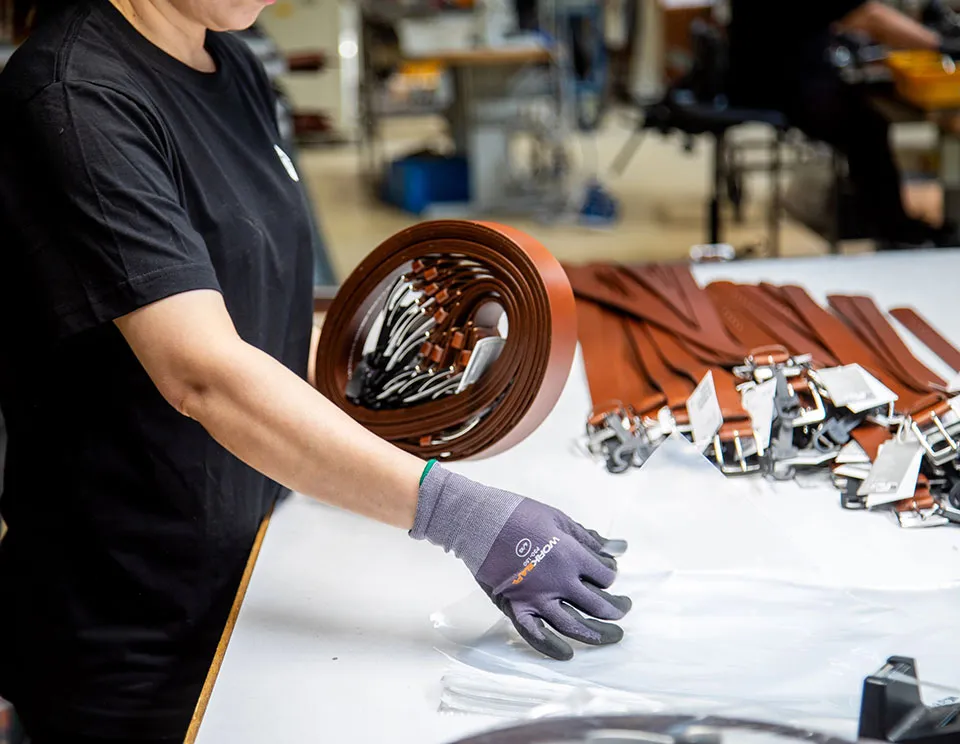
What Hardware Specifications Distinguish High-End Belts?
A luxury leather strap is worthless if its mechanism fails. In the luxury tier, hardware is not merely “gold-colored metal”; it is precision-engineered metallurgy. High-end hardware is distinguished by its base material (Substrate) and its plating thickness. Standard fashion belts use Zamak (Zinc Alloy), which is brittle and prone to pitting. A true luxury specification requires Solid Brass or 316L Marine-Grade Stainless Steel finished with PVD (Physical Vapor Deposition) plating to guarantee corrosion resistance for 5-10 years.
Base Metal Metallurgy: Zinc vs. Brass vs. Steel
The “heft” and durability of a buckle are determined by the base metal. Engineers must specify the substrate clearly in the Tech Pack to avoid catastrophic failure under tension.
- Zamak (Zinc Alloy): The industry standard for mass-market fashion (Zara, H&M). It is injection-molded, cheap, and lightweight. However, it is brittle. Under torque loads exceeding 15kg, the prong can snap. Furthermore, once the plating scratches, the zinc oxidizes rapidly, causing “bubbling” under the finish.
- Solid Brass: The heritage luxury choice. Brass is heavy, malleable, and naturally corrosion-resistant. If the plating wears off after decades, the underlying brass develops a desirable patina rather than rusting. It provides a substantial “hand-feel” weight that consumers associate with quality.
- 316L Stainless Steel: The modern engineering choice. Used in high-end watchmaking (e.g., Rolex), 316L is hypoallergenic and virtually indestructible. It requires CNC machining rather than molding, which increases costs, but it offers the highest tensile strength (> 500 MPa).
Plating Technology: Electroplating vs. PVD
The method used to apply color (Gold, Silver, Gunmetal) determines whether the hardware will fade within months or last for years.
- Rack Electroplating (Standard): The buckle is hung on a rack and dipped in an electrolytic solution. For luxury belts, you must specify a minimum thickness of 0.1 to 0.2 microns for Gold or Palladium finishes, often with a clear electrophoretic lacquer (E-coating) on top for sealing.
- PVD (Physical Vapor Deposition): The gold standard for durability. This vacuum coating process bonds the finish at a molecular level. It is 10x harder than standard electroplating and is highly resistant to scratches. While expensive, it is mandatory for black or gunmetal finishes to prevent chipping.
- Barrel Plating (Avoid): Used for low-cost items. Buckles are tumbled in a barrel during plating. This results in uneven coverage and surface scratches (“chatter marks”). Never accept this for a luxury product.
Corrosion Resistance Testing: The Salt Spray Standard
To verify the quality of the plating, hardware must undergo standardized corrosion testing. This is a non-negotiable step in the QC process.
- 24-Hour Salt Spray Test: The minimum requirement for mid-range belts. The hardware is exposed to a saline mist. No visible oxidation (rust) should appear after 24 hours.
- 48-Hour Salt Spray Test: The standard for luxury brands. Hardware passing this threshold ensures resistance to sweat, humidity, and coastal environments.
- Lead & Nickel Compliance: Hardware must be tested to ensure Lead content is below 90 ppm (CPSIA standard) and Nickel release is below 0.5 µg/cm²/week (REACH standard) to prevent allergic reactions.
How Should You Engineer the Edge Paint and Stitching for Durability?
A luxury belt’s lifespan is often determined by its edges, not just the strap. Poor edge finishing leads to peeling within 3 to 6 months of daily use due to flex fatigue. To engineer for longevity, you must specify either a 3-layer Italian edge paint protocol or a high-friction beeswax burnish. Furthermore, stitching is not merely decorative; it must utilize Bonded Nylon 6.6 thread with a specific tensile rating to withstand daily torque without snapping or rotting.
Edge Finishing: The Paint vs. Burnish Debate
The method of sealing the raw leather edge depends entirely on the tanning method chosen in the previous steps. Your Tech Pack must explicitly state the process to avoid factories using cheap “spray-on” finishes.
- Burnishing (For Veg-Tan): This is the hallmark of artisanal luxury. The raw edge is sanded smooth, treated with Gum Tragacanth or water, and then subjected to friction using a wood or canvas wheel spinning at 1500-2000 RPM. This heat fuses the collagen fibers together. A final layer of Beeswax is applied to waterproof the seal. It creates a natural, organic edge that cannot peel because there is no paint to separate.
- Edge Painting (For Chrome/Re-Tan): Chrome leather fibers do not burnish well. Instead, a flexible polymer paint is applied. A luxury specification requires a minimum of 3 coats: a primer (for adhesion), a base coat (for leveling), and a color topcoat. Brands should specify high-grade paints like Fenice or Giardini which have a high “Flex Resistance” rating, preventing cracks even after 20,000 flex cycles.
Thread Mechanics: Tensile Strength and Rot Resistance
Standard cotton thread is forbidden in luxury leather goods as it rots with moisture and sweat. You must specify synthetic filaments engineered for high-stress environments.
- Bonded Nylon 6.6: The industry standard for durability. “Bonded” means the plies are resin-coated to prevent fraying during high-speed sewing. It has high abrasion resistance and tensile strength.
- Thread Weight (Size): For belts, you cannot use thin garment thread.
- Tex 90 (Size 92): The standard for heavy casual belts. Diameter approx 0.33mm. Breaking strength approx 14 lbs.
- Tex 70 (Size 69): Used for finer dress belts. Diameter approx 0.28mm. Breaking strength approx 11 lbs.
- Polyester (Alternative): If UV resistance is the primary concern (e.g., outdoor gear), High-Tenacity Polyester is preferred over Nylon, as Nylon can degrade under prolonged direct sunlight.
Stitching Geometry: SPI and Edge Distance
The aesthetics of the stitch are defined by the “SPI” (Stitches Per Inch). This metric controls the visual refinement of the product.
- 7 to 9 SPI (3.0mm – 3.5mm length): The luxury standard. This density provides a refined look without perforating the leather so closely that it creates a “tear strip” effect.
- Low SPI (< 6): Looks crude and “fast-fashion.” The long stitches are prone to snagging.
- Edge Distance: The stitch line must be set exactly 2.5mm to 3.0mm from the edge. If it is too close (< 2.0mm), the leather edge may tear out. If it is too far (> 4.0mm), the edge layers may separate (delaminate).
- Grooving: For maximum durability, specify that the stitching channel be “grooved” (slightly carved out). This countersinks the thread so it sits flush with the leather surface, protecting it from surface abrasion.
How Do You Structure a Tech Pack for Accurate Sampling?
A Tech Pack is not a suggestion; it is a binding engineering contract between brand and manufacturer. To start a luxury business, you cannot simply send a photo of a competitor’s belt and ask for a copy. You must generate a comprehensive technical dossier that includes CAD blueprints, a precise Bill of Materials (BOM), and defined Allowable Error limits. A professional Tech Pack reduces sampling iterations from an industry average of 3-4 rounds to a streamlined 1-2 rounds, saving months of development time.
The Engineering Blueprint: CAD vs. Sketches
Hand sketches are insufficient for high-end manufacturing. You must provide vector-based files (Adobe Illustrator .AI or AutoCAD .DXF) that the factory can feed directly into their laser cutters or use to cast steel clicking dies.
- 2D Technical Drawings: Must show the belt strap in full extension. Call out specific dimensions for the “Center Hole” (the 3rd hole typically), the distance from the buckle bar to the first hole, and the exact shape of the belt tip (English Point vs. Square vs. Tapered).
- Hardware 3D Models: If you are developing a custom buckle, you must provide a 3D STEP or IGES file. This allows the mold engineers to simulate the flow of molten metal and identify weak points before cutting the expensive steel mold ($800 – $1500 investment).
- Exploded View: For complex padded or lined belts, include a cross-sectional diagram showing the layering stack: Top Leather + Domed Filler + Bottom Lining. Specify the thickness of each individual layer, not just the total thickness.
The Bill of Materials (BOM): Defining Every Molecule
The BOM eliminates ambiguity. It is a line-item list of every raw material required to build one unit. In the luxury tier, “Black Leather” is not a specification; “Italian Full-Grain Vegetable Tanned Shoulder, 3.5mm, Color Code #000” is.
| Component | Generic Spec (Avoid) | Luxury Tech Pack Spec (Required) |
|---|---|---|
| Strap Material | “Real Leather” | Art. 405 Veg-Tan Double Butt, 3.8mm, Temper: Firm |
| Thread | “Matching Color” | Bonded Nylon 6.6, Size Tex 90, Color Pantone 19-4005 TCX |
| Edge Paint | “Black Edge” | Fenice Section 4, Matte Finish, 3 Coats + Primer |
| Buckle | “Silver Buckle” | Solid Brass, PVD Palladium Plating, Brushed Finish |
Color Standards and Lab Dips
Screen colors vary. To ensure the leather matches your vision, you must use a standardized physical color system.
- Pantone TCX/TPG: Reference standard Pantone codes from the Fashion, Home + Interiors system. Do not use coated/uncoated (C/U) graphic design codes as they do not translate accurately to dyeing organic substrates.
- Lab Dips: Require the tannery to send “Lab Dips” (small 5x5cm swatches) of the dyed leather for your approval before they tan the full hide batch. Inspect these under three light sources: D65 (Daylight), TL84 (Store Light), and A (Home Tungsten) to check for metamerism (color shifting).
Tolerance Settings: The +/- Golden Rule
Leather is a natural material that expands and contracts with humidity. Zero tolerance is impossible, but “loose” tolerance is unacceptable.
- Strap Length: Standard luxury tolerance is +/- 5.0mm. Anything beyond this affects sizing accuracy.
- Strap Width: Critical tolerance of +/- 0.5mm. If a 35mm belt is cut to 36mm, it may not fit through the buckle hardware, rendering the product useless.
- Stitch Density: Tolerance of +/- 1 SPI.
- Thickness: Tolerance of +/- 0.2mm. Variations greater than this affect the flexibility and hand-feel of the final product.
What Are the Critical Sizing Standards for Men’s and Women’s Markets?
Sizing is not merely about length; it is about “Fit Geometry.” In the luxury sector, the fit is engineered around the Center Hole Rule. A size “34” belt is not 34 inches long from end to end; it measures exactly 34 inches (86.36cm) from the inner edge of the buckle to the middle hole. This ensures that when worn correctly, the belt has a symmetrical overhang. Failure to adhere to global sizing conventions (EU vs. US) is the leading cause of e-commerce returns, often exceeding 30% for new brands.
The Geometry of the 5-Hole System
The standard luxury belt configuration features 5 holes (or 7 for casual/braided styles). The precision of their placement dictates the range of adjustability.
- Hole Spacing: The industry standard distance between holes is exactly 1 inch (25.4mm) center-to-center. This offers a total adjustment range of 4 inches (2 inches up, 2 inches down).
- Tip Length (Overhang): The distance from the last hole (tightest fit) to the tip of the belt should measure between 3.5 inches to 4.0 inches (9cm – 10cm). If this is too short, the belt won’t tuck into the first belt loop; if too long, it looks sloppy.
- The “True Size” Offset: Most consumers do not know their true waist size. A “Size 34” pant usually corresponds to a 36-inch waist due to vanity sizing. Therefore, your size chart must advise customers to “Size Up +2 inches” from their pant size.
Global Luxury Belt Sizing Chart
Use this standardized conversion table for your Tech Pack. Note that the “Belt Size” refers to the distance from the buckle fold to the Center Hole.
| US/UK Size (Inches) | EU Size (CM) | Total Strap Length (Approx) | Target Pant Size |
|---|---|---|---|
| 30″ (XS) | 75 cm | 90 cm / 35.5″ | 28″ Waist |
| 32″ (S) | 80 cm | 95 cm / 37.5″ | 30″ Waist |
| 34″ (M) | 85 cm | 100 cm / 39.5″ | 32″ Waist |
| 36″ (L) | 90 cm | 105 cm / 41.5″ | 34″ Waist |
| 38″ (XL) | 95 cm | 110 cm / 43.5″ | 36″ Waist |
| 40″ (XXL) | 100 cm | 115 cm / 45.5″ | 38″ Waist |
Width Conventions: Defining the Category
The width of the strap immediately communicates the belt’s formality. Deviating from these norms confuses the consumer.
- 30mm (1.18″): The standard for formal suit belts. It is sleek and unobtrusive.
- 35mm (1.38″): The “Hybrid” width. Suitable for both chinos and suits. This is the safest SKU for a launch collection.
- 40mm (1.57″): The standard for casual/denim belts. It fills the loops of raw denim jeans completely. Never pair a 40mm belt with a suit.
- Women’s Specifics: While fashion varies, the core “Classic” women’s belt is typically 25mm (1 inch) or 30mm. Wide waist-cinching belts often range from 50mm to 70mm and require specialized curved patterns to fit the female hip-to-waist ratio.
Understanding the “Why” behind Minimum Order Quantities (MOQs) is crucial for negotiation. In luxury manufacturing, MOQs are dictated by the tannery, not the sewing factory. A standard drum of vegetable-tanning liquor is calibrated for a specific weight of hides (typically 1,000 sq ft). Therefore, demanding a run of 50 belts is physically impossible for a custom leather color without paying a massive surcharge. Success requires balancing your SKU count against the factory’s “Economic Order Quantity” (EOQ) to achieve a viable unit cost.
The Tannery Constraint: Hide Yield Math
To calculate your minimums, you must work backward from the raw material. A single high-grade Double Butt (approx 14-16 sq ft) yields approximately 10 to 12 flawless belt straps after accounting for neck wrinkles and belly flank defects.
- Standard MOQ: Most professional OEM factories require 300 pieces per style (often split into 2 colors, e.g., 150 Black / 150 Brown). This consumes roughly 25-30 hides, which is a small but manageable batch for a tannery.
- Surcharge Thresholds: Orders below 100 pieces often incur a “Sample Line Surcharge” of 150% to 200% because the leather must be sourced from stocklots (generic inventory) rather than custom-tanned to your specific formulation.
Tooling Investments: The Cost of Custom Hardware
If you intend to use a proprietary buckle design (which is recommended for brand differentiation), you must budget for “Opening Molds.”
- Steel Molds (Die-Casting): Required for Zamak or Brass. Cost ranges from $800 to $1,500 per buckle design. Lead time is 25-30 days.
- CNC Programming (Machining): For Stainless Steel 316L, there is no mold fee, but the unit cost is significantly higher (often $15 – $25 per buckle) due to machine time.
- Debossing Dies: For stamping your logo into the leather, a copper or magnesium die costs approximately $50 – $80.
The “Landed Cost” Multiplier
Novice founders often fixate on the Ex-Works (EXW) factory price. However, the retail strategy must be built on the Landed Duty Paid (LDP) cost.
- Target Cost Ratio: A healthy luxury business model targets a manufacturing cost that is 15% to 20% of the Retail Price (MSRP). If your belt retails for $150, your target Ex-Factory price should be roughly $22 – $30.
- Duty & Tariffs: Leather goods are highly taxed. Importing into the US often incurs duties ranging from 3% to 10% depending on the HTS code (typically 4203.30 for leather belts). Factoring this into your margin analysis is mandatory before placing a PO.
What Compliance and Testing Standards Must Your Belts Meet?
Compliance is the legal passport for your product. To sell internationally, your belts must pass rigorous chemical screenings for restricted substances and physical durability tests. A luxury belt must meet REACH Annex XVII standards (EU) or California Proposition 65 (US) limits. Failing these tests does not just result in a return; it can lead to customs seizure, lawsuits, and the destruction of inventory. Technically, a belt must also sustain a tensile load of at least 400N and resist cracking after thousands of flex cycles.
Chemical Safety: The “Big Three” Regulations
Leather tanning involves potent chemicals. You must ensure that no harmful residues remain in the final product. Your purchase order must explicitly state: “All materials must be REACH/Prop 65 Compliant.”
- Chromium VI (Cr6+): The most critical test for leather. Trivalent Chromium (safe) can oxidize into Hexavalent Chromium (carcinogenic) if tanned improperly.
- Limit: Strict limit of < 3 mg/kg (ISO 17075 standard). Exceeding this is the #1 reason for leather recalls in Europe.
- Lead (Pb) Content: Found in surface paints and hardware base metals.
- Limit: < 90 ppm (parts per million) for surface coatings (US CPSC standard) and < 300 ppm for substrates.
- Phthalates: Plasticizers often found in edge paints or bonded leather glues.
- Limit: Sum of restricted phthalates must be < 1000 ppm (0.1% by weight) under REACH.
Physical Performance: Determining “Luxury” Durability
A belt undergoes unique stressors: tension (pulling), torsion (twisting), and friction. You must mandate these ASTM/ISO physical tests in your Tech Pack.
| Test Name | Standard Method | Luxury Criteria (Pass/Fail) |
|---|---|---|
| Tensile Strength | ASTM D2209 / ISO 3376 | Breaking force > 400 Newtons (approx 40kg) |
| Flex Resistance | ISO 5402 (Bally Flex) | No cracking after 20,000 cycles (Dry) |
| Color Fastness (Rub) | ISO 11640 (Crocking) | Grade 4/5 (Dry Rub); Grade 3/4 (Wet Rub) |
| Adhesion of Finish | ISO 11644 | Adhesion strength > 2.5 N/10mm |
The “Golden Sample” Protocol
Never rely on a “Factory Guarantee.” You must execute third-party testing.
- Pre-Production Testing: Send the raw material swatch (from the exact batch to be used) to an accredited lab (e.g., SGS, Intertek, BV). Cost is approx $150 – $300 per colorway.
- Top of Production (TOP) Sample: Pull one finished belt from the first 5% of the bulk run and re-test hardware functionality. This ensures the factory didn’t swap materials after the sample was approved.
How Do You Execute a Final Quality Control (QC) Inspection?
Quality Control is not about “checking every belt”; it is about statistical validation. In professional manufacturing, you must utilize the AQL (Acceptable Quality Limit) standard. This international system (ISO 2859-1) determines how many units you must inspect randomly to accept or reject the entire shipment. For luxury leather goods, the industry standard is Inspection Level II, with an AQL of 2.5 for Major Defects and 4.0 for Minor Defects.
Defect Classification: What is Acceptable?
You must provide your inspector with a “Defect Manual” containing photos of acceptable vs. unacceptable imperfections. In Full-Grain leather, not all marks are defects.
- Critical Defects (Zero Tolerance): Issues that render the product dangerous or unsellable. Examples: Sharp buckle edges (safety hazard), broken prong, mold growth, missing logo. Action: Reject entire shipment.
- Major Defects (AQL 2.5): Issues that affect the product’s usability or aesthetics significantly. Examples: Deep scratches (> 1cm), wrong color (delta E > 1.0), edge paint peeling, crooked stitching.
- Minor Defects (AQL 4.0): Slight cosmetic issues that do not affect saleability. Examples: Small glue mark (removable), slightly messy packing tissue, natural neck wrinkles (acceptable in full-grain leather if not excessive).
The Functional “Bend Test”
Before packing, every sampled belt must undergo the Bend Test to verify the lamination quality.
- Method: Bend the strap 180 degrees backwards (grain side in).
- Pass Criteria: The leather should offer resistance and spring back. The grain should remain tight.
- Fail Criteria: If the leather wrinkles loosely like a deflated balloon (“piping”), the grain has separated from the corium due to poor tanning or glue failure. If the edge paint cracks, the finish lacks flex agent.
Hardware Functionality Check
Hardware failure is the primary cause of customer returns. Inspectors must manually test the mechanism.
- Prong Alignment: The prong must rest naturally on the frame. If it sticks or floats above the frame, it is defective.
- Roller Spin: If using a roller buckle, it must spin freely without friction.
- Screw Tightness: If the buckle is attached via Chicago Screws (for strap swapping), ensure they are secured with Threadlocker (Loctite) to prevent loss during vibration/transit.
Frequently Asked Questions (FAQ)
Q: How much capital is required to launch a luxury belt line?
A: To launch a custom line with proprietary hardware, budget between $15,000 to $25,000. This covers mold fees ($2k), sampling rounds ($1k), and an initial bulk order of 300-500 units ($10k-$15k), plus logistics and marketing buffer.
Q: What is the difference between full-grain and genuine leather belts?
A: Full-grain uses the entire outer hide layer, offering maximum strength (2900 PSI) and patina potential. “Genuine leather” typically refers to split layers or bonded scraps glued together, which have weak structural integrity and will peel quickly.
Q: How do I find a reliable luxury leather belt manufacturer?
A: Look for factories certified by BSCI or SMETA that specifically own “splitting” and “edge inking” machinery. Avoid general trading companies. Ask for their “Leather Working Group” (LWG) tannery partners to verify supply chain legitimacy.
Q: What is the standard production lead time for custom belts?
A: Standard timelines are: Sourcing/Lab Dips (15 days) + Mold Opening (25 days) + Sampling (10 days) + Bulk Production (30-45 days). Total “Concept to Warehouse” time is typically 3 to 4 months.
Q: Do I need to patent my belt buckle designs?
A: If the design is unique, a Design Patent protects the visual ornamentation. However, utility patents for standard buckle mechanisms are rare. Owning the physical steel mold offers practical protection, as competitors cannot use your tooling.
Q: What is the minimum leather thickness for a heavy-duty belt?
A: For a single-layer casual belt, specify a minimum of 3.8mm (9-10 oz). Anything thinner will warp under the weight of denim or gear. Dress belts are often thinner (3.0mm) but use a filler for stiffness.
Q: How many SKUs should a new belt brand launch with?
A: Start lean to manage inventory. A “Core Collection” of 2 Styles (1 Dress, 1 Casual) in 2 Colors (Black, Brown) is sufficient. This equals 4 SKUs, allowing you to hit MOQ requirements without overextending capital.
Conclusion: The Engineering of Desire
Starting a luxury belt business is an exercise in precision. It requires moving beyond the romance of “craftsmanship” into the reality of supply chain engineering. From enforcing a +/- 0.5mm width tolerance to mandating PVD plating on solid brass hardware, every specification is a deliberate choice that separates a heritage brand from a disposable commodity. The data is clear: consumers will pay a premium for products that offer transparency, durability, and tactile excellence.
Partnering for Scale: The Hoplok Advantage
Navigating the complexities of vegetable tanning, custom metallurgy, and international compliance requires a manufacturing partner who speaks the language of engineering. This is where Hoplok Leather Goods excels.
With over 22 years of industry experience and a strategic dual-factory footprint in China and Cambodia, Hoplok offers a unique competitive edge. Our Cambodia facility enables clients to mitigate international tariffs, while our self-owned finishing facility, Pro Pelli, ensures direct control over leather aesthetics—guaranteeing that every strap meets the 3.5mm+ luxury standard. Unlike transactional factories, we position ourselves as a technical growth partner, offering US-based design support for concept refinement and in-house compliance officers to navigate REACH standards.
Whether you are scaling a global retail program or launching a boutique label, Hoplok provides the turnkey OEM/ODM solutions required to bring rigorous technical specifications to life.
Ready to engineer your legacy? Contact the Hoplok technical team today to discuss your Tech Pack and begin the sampling process.