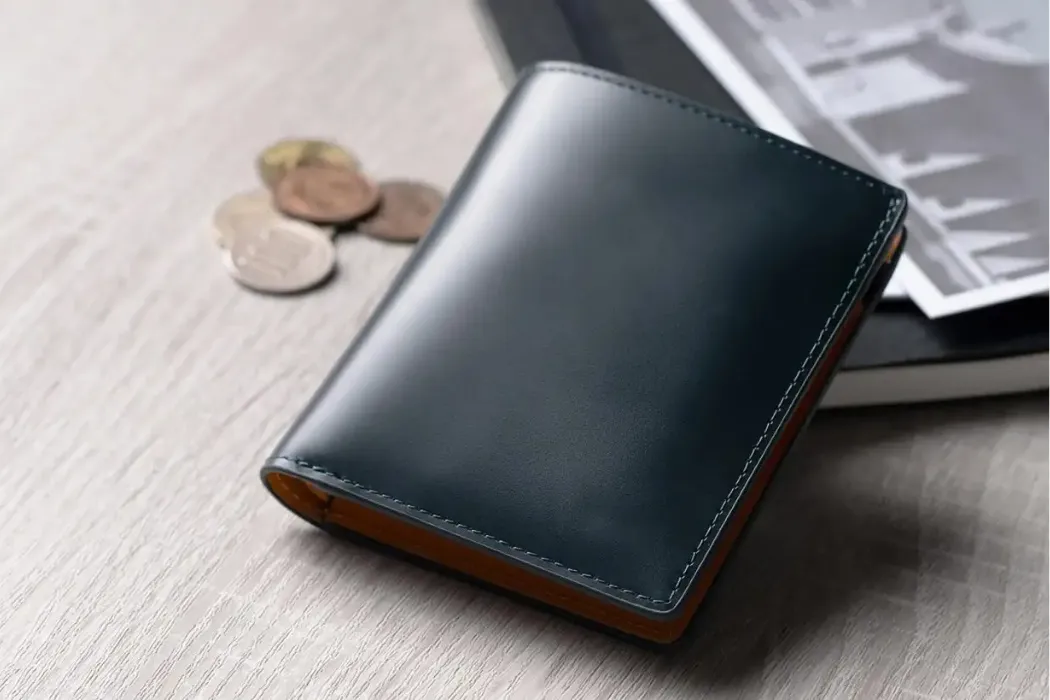
A private-label wallet quotation is meaningful only when the construction is defined. Two bifolds can look similar in a photograph but use different pocket layers, linings, reinforcements and edge processes. Those differences affect consumption and assembly time before the brand adds packaging or import costs.
Start with a bill of materials and a sample brief, then request a price for a stated quantity and delivery term. This guide shows how to compare quotations and build a first-order budget. It does not assign a universal factory price or profit margin to “premium leather wallets.”
What should a wallet quotation include?
Send a drawing or reference sample showing the closed dimensions, opening direction, card slots and compartments. Identify which surfaces must be leather and which may use a lining or other material. A request for “full leather” can otherwise produce different interpretations from different suppliers.
| Specification | Cost question | Approval evidence |
|---|---|---|
| Outer material | Which leather or PU article, finish and thickness? | Named material and color reference |
| Interior | Leather pocket faces, lining, hidden layers and reinforcement? | Section drawing or opened sample |
| Assembly | Folded, painted or burnished edges; stitch details? | Finished construction sample |
| Hardware | Zippers, snaps, logo plates and tooling? | Component references and approved finish |
| Packaging | Sleeve, box, insert, labels and pack quantities? | Complete packed sample |
| Commercial terms | Quantity, delivery term, named place and validity? | Written quotation with inclusions |
Keep one approved specification when comparing factories. A cheaper quote may exclude a lining, use a different edge process or spread a tooling charge across more units. Ask for the differences explicitly instead of comparing the headline price alone.
Leather cost depends on consumption as well as price
The relevant material cost is the purchased area required for one wallet multiplied by the material price on the same area basis. Consumption includes the actual pattern pieces, cutting restrictions and agreed allowance for unusable areas. Do not infer it from the wallet’s closed dimensions.
A compact exterior can hide several overlapping card pockets and dividers. An all-leather interior may consume more material and require more thinning than a lined construction. Ask the factory to identify which specification changes affect consumption rather than assuming every wallet uses the same number of square feet.
Compare grades on the finished sample
Full-grain, corrected-grain and split leather can serve different appearance and price requirements. The terms do not establish a fixed price multiple. Request the actual material reference, surface treatment, thickness and permitted variation.
For a natural-looking exterior, agree how visible marks will be handled. For a uniform collection, review whether the proposed finish matches the appearance you want. Material selection should also consider flexing at the fold, pocket edges and rubbing against clothing.
Keep the costing units consistent
Check whether the material is quoted by square foot, square meter, hide or another unit. Record usable yield separately from the purchase price. Leather thickness described in ounces should not be confused with a purchase weight when comparing area prices.
Construction determines where labor is spent
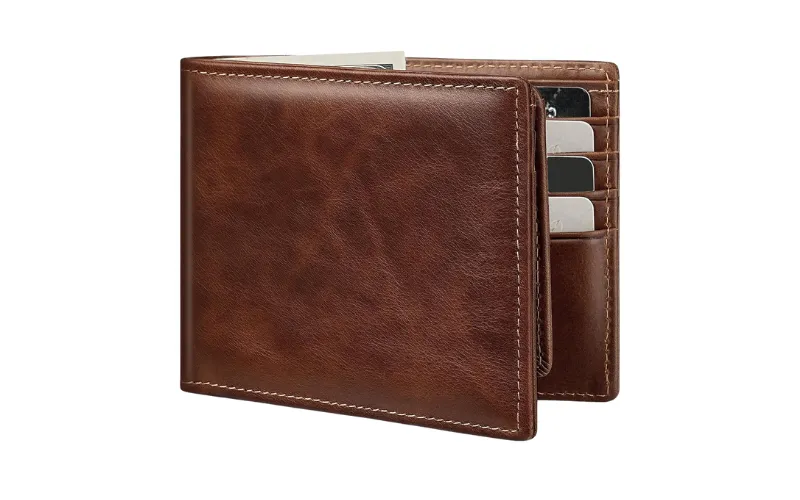
Pocket count alone is not enough to estimate labor. Curved openings, folded edges, turned seams, alignment and logo placement can add operations. Ask the supplier which features drive the quoted assembly cost and which changes can be sampled without altering the overall design.
Painted, folded and burnished edges
Edge painting can involve preparation, multiple applications, drying and sanding. A folded edge requires suitable thinning, adhesive work and alignment. Burnishing depends on the material and desired appearance. None of these processes has a universal labor-cost multiplier.
Compare edge treatments on the selected wallet construction. A lower process cost is of little use if the edge does not meet the appearance or flex requirement. Approve the finish at corners and pocket openings, where a flat material swatch tells you less.
Bulk and pocket fit
Test the sample with the intended cards and notes. Interior layers can make the wallet too thick or keep it from closing comfortably. Any thinning or construction change should preserve the agreed feel and function, then be recorded before the production quote is finalized.
Hardware and branding can create separate development charges
An existing zipper or logo plate may be quoted differently from a custom component. Ask which tooling already exists, whether it is available for your order and who owns any new mold. Confirm replacement availability for future orders.
For metal decoration, approve the base material, surface finish, color and attachment. PVD and electroplating are process descriptions, not fixed prices or guarantees against returns. Compare the actual supplier proposal and relevant performance evidence for the selected finish.
Approve branding on the intended leather or PU. Foil, embossing and other marking methods can behave differently across finishes. The quote should distinguish artwork setup, tooling, unit application and any revision charges.
Order quantity affects setup allocation and material buying
A larger order spreads an agreed setup cost across more units. It can also change material purchasing and line planning, but the saving should come from a quotation. There is no universal quantity at which cutting waste or logistics costs fall by a fixed percentage.
Hoplok’s minimum order is 300 leather wallets or 1,000 PU wallets. Confirm style and color allocation in the quotation; the stated figures do not establish a per-color minimum. Request separate prices for the initial assortment and a realistic reorder quantity.
Bulk production takes 60–90 days. Wallet sampling time requires project confirmation. Allow separately for approval rounds, material readiness and shipping rather than treating production time as the date the stock reaches your warehouse.
Build a development budget before the unit-price comparison
List sampling, material sourcing, logo tooling, hardware tooling and packaging development separately. Ask how many revisions are included and which changes create a new charge. Confirm whether any sample fee is credited against a later order rather than assuming an automatic refund.
A first sample can resolve fit and construction, while a later approval sample uses the final materials and components. Record the purpose of each stage. Selling from an early prototype before the final construction is approved can lock the brand into a cost or feature the quote never included.
Calculate delivered cost with verified import assumptions
Start with the quotation’s delivery term and named place. Add only costs outside that scope: freight, insurance, clearance, applicable duties and local delivery. Packaging or origin transport may already be included, so check before adding them again.
For a US order, classify the actual wallet and check origin and entry-date treatment in the current US tariff schedule. A broad reference to leather goods or Chapter 42 is insufficient for calculating the final duty.
For EU imports, use the product and route in Access2Markets. Cambodia production does not establish blanket zero duty: the European Commission describes a partial EBA withdrawal. Check applicable origin and documentation requirements.
Ask the importer or finance team how taxes should appear in the cash budget and margin calculation. Recoverable tax and nonrecoverable acquisition cost may need different treatment. Keep those assumptions beside the figures so a quote revision can be evaluated consistently.
A worked cost example
The figures below are invented for arithmetic only, not a Hoplok quotation or market benchmark. Suppose a 1,000-wallet order has a quoted product cost of $12 per unit, including retail packaging. Assume verified freight and import costs total another $3 per unit, with $1,000 in separate development charges.
| Item | Math | Amount |
|---|---|---|
| Products | 1,000 × $12 | $12,000 |
| Freight and import costs | 1,000 × $3 | $3,000 |
| Delivered inventory cost | $12,000 + $3,000 | $15,000, or $15 each |
| Separate development | Agreed one-time charge | $1,000 |
| Initial outlay in this example | $15,000 + $1,000 | $16,000 |
If net selling revenue is $30 per wallet and all units sell, the difference before development and other business expenses is $15 per unit. That is a 50% gross margin on the stated $15 inventory-cost basis. The selling-price multiple is 2×; markup on that cost is 100%.
The example is not a net-profit forecast. Account for advertising, fulfillment, fees, discounts, unsold stock, returns and overhead; avoid counting an amount already deducted from net revenue twice. Model sell-through and cash timing before committing to a larger quantity for a lower factory price.
Reduce cost by changing one approved feature at a time
Start with the item that buyers will notice least: hidden-layer choices, an existing hardware shape, packaging complexity or an unnecessary pocket. Request a priced alternative and a sample where the change affects fit or feel. Keep the original version as the comparison reference.
Hoplok coordinates leather finishing and finished-goods manufacturing across China and Cambodia. ProPelli finishes crust received from partner tanneries and holds a current LWG Gold rating. This facility information does not establish a wallet’s price, test result or retail margin.
Send Hoplok the wallet drawing, materials, pocket layout, branding, packaging, quantity and destination. Ask for a quotation with separate development charges and a sample approval plan. That gives you a cost you can check against the product you intend to sell.