Floral decoration gives a leather belt character, but the production route should match the design and order. Hand carving builds a pattern through individual cuts and tool impressions. Machine stamping or embossing transfers a pattern from a die, plate or roller. Both require suitable material and controlled finishing.
The choice affects development, repeatability, labour and tooling costs. It does not establish a universal quality ranking or a fixed depth. For a wider view of decorative options, see the belt embellishment guide.
This comparison explains the processes, the material questions to resolve and the evidence buyers should request before approving a floral belt programme.
What Is Leather Tooling and How Does It Work?
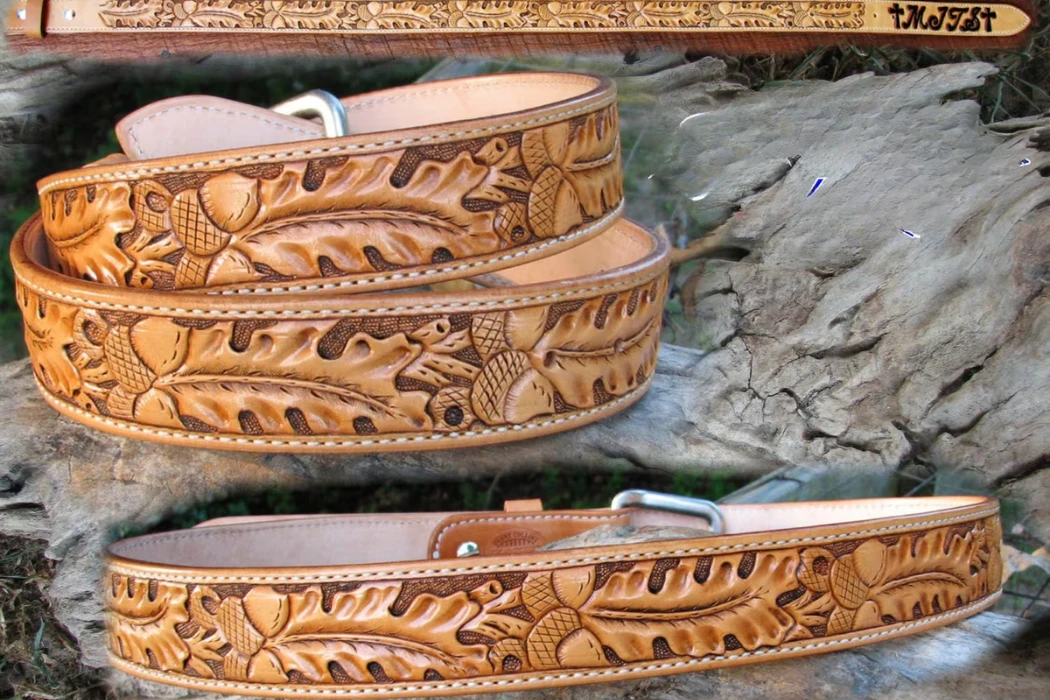
Tooling is a broad decorative term that can include carving and stamping. In traditional floral handwork, a craftsperson may cut outlines with a swivel knife, then use individual stamps to shape relief and texture. Not every tooled design uses the same sequence or every tool.
The Swivel Knife and Basic Carving Motion
A swivel knife allows controlled cuts along the design. Blade shape, sharpness, handling and the condition of the leather influence the result. The cut must leave enough material for the belt’s function; it should not be set to one depth or angle for every pattern.
Tandy’s swivel-knife information illustrates purpose-built carving tools. Tool sizes and numbering vary by supplier, so specify the desired result and choose a suitable tool rather than treating a numbered blade as an industry-wide standard.
Casing Leather: Why Moisture Matters
Casing means preparing suitable tooling leather with moisture so it can be worked. Too much or too little moisture can impair the result, but there is no universal moisture percentage for every tannage, finish and workshop condition.
Establish the preparation method on a trial piece and inspect the dried result. A fingernail impression or cool feel can be a craft observation, not a calibrated moisture measurement. Repeated wetting can also affect colour and shape, so include drying and finishing in the sample review.
Common Stamps Used in Floral Patterns
Bevelers depress selected areas beside cuts to create relief. Veiners add repeated vein-like impressions, while pear shaders shape shaded areas. Background tools can texture recessed space and help separate motifs.
These tools are chosen and combined according to the artwork. A camo stamp and a background tool are not identical, and a floral pattern does not require a mandatory four-tool sequence. Tandy’s carving instruction cards show how different tools contribute to decorative effects.
How Does Hand-Carving Differ from Machine Stamping?
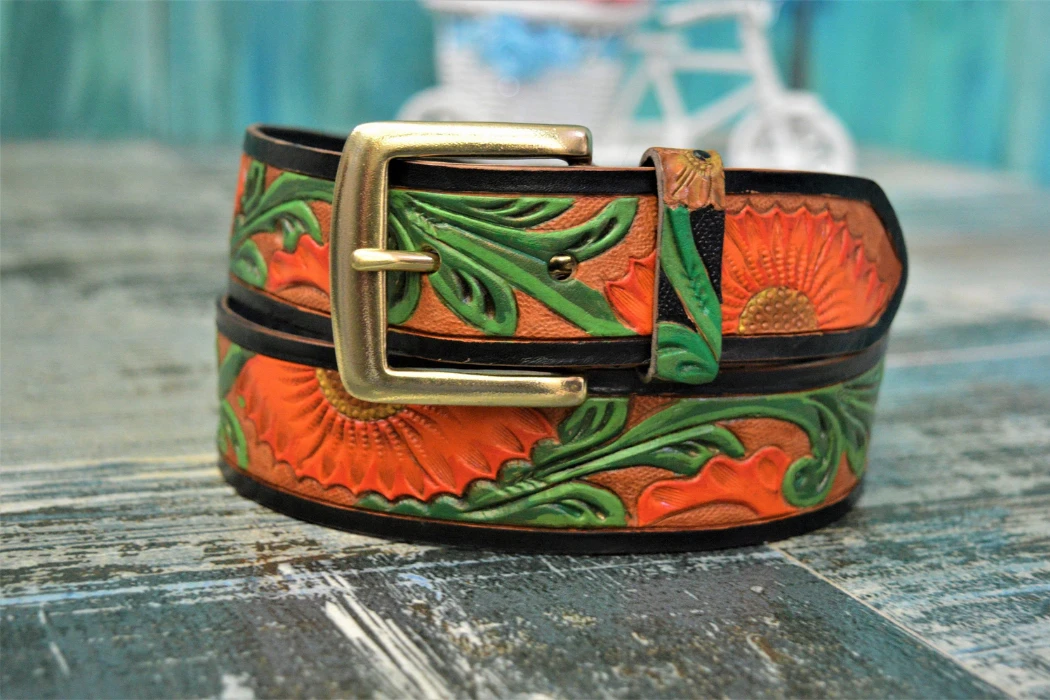
Hand carving develops the design through individual operations. Machine stamping transfers the tooling geometry through a controlled pressing process. Both can produce relief and both can show variation; the approved sample should define what is acceptable.
Depth and Dimension: Carving and Embossed Relief
Hand tooling can create local shaping and small differences between pieces. A well-made die can also contain detailed relief rather than only a flat outline. Depth depends on the tool, material and process, not simply whether the operation is manual or mechanised.
Compare the actual samples under consistent lighting and after the intended finish. Excessively deep cuts can compromise a thin strap, while a shallow pattern may be a deliberate design choice. Avoid a fixed millimetre threshold for “handmade quality.”
Tooling Plates and Press Setup
Die material and manufacture should suit the artwork, finish, press and expected use. Brass or other tooling materials may be proposed, but no single material or press tonnage is mandatory for every belt pattern.
Define the repeat length, registration, border clearance and treatment of joins in a repeating pattern. Heat, pressure and dwell depend on the material and process. Review the tooling sample before bulk production and agree on tool maintenance and replacement responsibilities.
Skill Requirements and Training
Hand carving relies on control of the tools and the material. Press production also needs skill in setup, alignment, handling and inspection. Training duration cannot be reduced to a universal number of years for one method and days for the other.
Assess demonstrated capability through representative samples and a clear process explanation. Where several operators will contribute to an order, agree on the acceptable variation across the batch.
| Factor | Hand carving | Machine stamping |
|---|---|---|
| Pattern creation | Individual cuts and tool impressions | Transfer from prepared tooling |
| Skill focus | Tool control and local shaping | Tooling, setup, registration and process control |
| Depth | Depends on pattern, leather and technique | Depends on relief, leather and pressing conditions |
| Batch variation | Agree acceptable handwork variation | Control material and process variation |
| Commercial basis | Quote labour and development for the design | Quote tooling, setup and production for the design |
Which Leather Type Works Best for Floral Tooling?
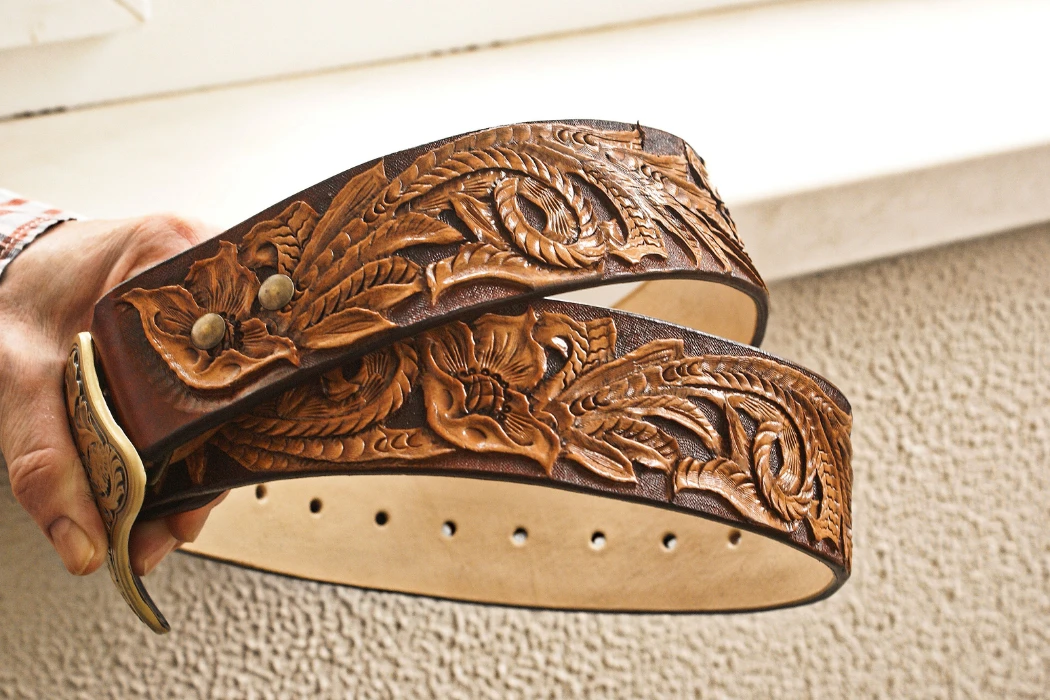
Suitable vegetable-tanned tooling leather is a common starting point for traditional cased carving. Choose a leather intended for that process, then test the pattern and finish. Embossing is a broader process and can be used on other appropriate leathers and synthetic materials.
Why Vegetable-Tanned Tooling Leather Is Common
Tooling leather is selected for its response to cutting, shaping and impressions. For example, Hermann Oak’s natural tooling leather is a supplier-specific material developed for this type of work. That does not make every vegetable-tanned leather equally suitable.
Do not claim that chrome-tanned leather cannot hold any stamped pattern or that its decoration must disappear within days. Machine embossing and traditional damp-leather carving are different processes. Approve the selected method on the actual finish and construction.
Full-Grain, Corrected Grain and Carving
Full-grain describes retention of the grain surface. Top-grain is a broader term and should not automatically be equated with sanding. Ask whether the grain has been corrected, what finish is present and whether the supplier recommends the material for carving.
A heavy or unsuitable finish may affect tool response. Natural variation can also affect the appearance of a floral pattern. Inspect the actual leather and define acceptable marks and pattern placement rather than using a grade label as a guaranteed result.
Leather Thickness in Ounces and Millimetres
In leather trading, ounce weight commonly expresses thickness. Tandy’s thickness chart uses approximately 1/64 inch, or 0.4 mm, per ounce. This convention should not be confused with weighing a finished belt in ounces per square foot.
The pattern, cut depth, lining and buckle fit determine the suitable thickness. Thin leather can support some decoration, while a deep carved design needs enough remaining material. A heavier blank is not automatically the most comfortable or durable belt.
| Trade thickness | Approximate metric equivalent | How to use the figure |
|---|---|---|
| 4–5 oz | 1.6–2.0 mm | Conversion reference, not a universal product recommendation |
| 6–7 oz | 2.4–2.8 mm | Confirm actual thickness and intended decoration |
| 8–9 oz | 3.2–3.6 mm | Evaluate with the complete belt construction |
| 10 oz | About 4.0 mm | Check temper, weight and buckle clearance |
| 12 oz | About 4.8 mm | Do not assume greater thickness means better quality |
Can Machine-Stamped Belts Match Hand-Tooled Quality?
They can meet a high-quality design brief, but the intended appearance and production claims should be clear. Compare the samples for pattern clarity, material integrity, finish and construction. Neither uniformity nor visible hand variation is inherently a defect.
Where the Results Can Differ
Handwork allows local decisions about shaping and detail, while a die repeats its prepared geometry. A pressed pattern can still have substantial relief and natural material variation. Shine or depth alone cannot reliably authenticate the production method.
If the brand story depends on hand carving, request a clear process description and evidence of the work performed. Do not describe a pressed pattern as fully hand-carved merely because dye or finish was applied manually.
Batch Consistency for Private-Label Programmes
Tooling can support repeatability, but material condition, positioning and press settings still need control. Keep an approved reference for motif placement, border alignment and acceptable impression depth.
A stored plate can help a reorder, provided its condition and the material remain suitable. Agree on storage and maintenance, and recheck the first production pieces. Tool wear and material changes can affect a repeat order even when the artwork is unchanged.
Hybrid Approaches: Hand-Finishing After Pressing
A production route may combine a pressed base pattern with selected manual detail or hand-applied finishing. The balance depends on the design and available capability. It is not automatically cheaper or more dimensional than every other approach.
Ask exactly which operations are manual and which use tooling. Approve the resulting sample and use accurate product wording. For colour and antiquing choices, see the belt finish guide.
How Do Production Time and MOQ Change Between Methods?
Compare the full workflow, not a hand-carving estimate against a single press cycle. Material preparation, alignment, drying, finishing, assembly and inspection all contribute to output. Minimum quantities are supplier- and project-specific.
Handwork Time vs. Press Cycle Time
Pattern complexity, coverage and finishing influence manual labour. Press production adds tooling and setup, and the complete cycle includes handling. A universal time per belt cannot describe all floral designs.
Ask the supplier to identify development and production stages separately. If the order requires a particular handmade process, confirm the available capacity for that work rather than assuming additional operators can be added immediately.
MOQ Implications for Small and Large Orders
A tooling fee may be significant in a small order, but handwork does not automatically mean a low MOQ. Material procurement, colour, hardware and production organisation can set minimums for either route.
Hoplok’s stated belt MOQ is 300 leather pieces or 1,000 PU pieces. Discuss the artwork and proposed method during quotation; do not assume the same decorative process is available for every material or order.
Cost Drivers Buyers Should Ask About
Separate artwork development, tooling, labour, leather, finishing and assembly costs. Confirm ownership and permitted use of any custom tooling, plus modification and replacement terms. A “one-time” tool fee should have a defined scope.
For a broader quotation framework, see leather belt manufacturing cost factors. Compare equivalent designs and quantities rather than assuming one method always wins at a fixed volume.
| Planning item | Hand-tooled route | Machine-stamped route |
|---|---|---|
| Development | Pattern and representative handwork sample | Artwork, tool and impression sample |
| Production time | Quote the complete manual workflow | Quote handling, pressing, finishing and assembly |
| Minimum order | Confirm materials and capacity | Confirm materials, tooling and capacity |
| Reorders | Maintain process and appearance references | Check tool condition and material consistency |
| Product claim | Describe verified manual operations | Describe stamping and any additional handwork accurately |
Frequently Asked Questions
What Is the Difference Between Tooled and Embossed Leather?
Tooling can describe decorative carving and stamping broadly. Embossing transfers a pattern through tooling and pressure. Because trade terms overlap, ask for the actual process rather than assuming one word proves hand carving.
Can You Tool Top-Grain Leather?
Suitability depends on the actual grain treatment, finish, tannage and thickness. Top-grain is not a complete process specification. Trial the selected leather with the intended pattern.
What Leather Is Best for Tooling Belts?
Suitable vegetable-tanned tooling leather is a common choice for traditional cased carving. Select thickness and temper for the design, then assess the decorated and assembled sample.
How Long Does It Take to Hand-Tool a Belt?
Time depends on pattern coverage, detail, preparation and finish. Request an estimate for the actual artwork and distinguish hands-on time from the complete production schedule.
Is Tooled Leather Real Leather?
Tooling describes decoration, not proof of composition. Real leather can be tooled, and some synthetic materials can carry embossed patterns. Confirm the substrate separately from the decorative claim.
What Tools Are Needed for Leather Tooling?
Traditional floral carving may use a swivel knife, suitable stamps, a mallet, a firm work surface and controlled casing. The tool selection depends on the artwork and method; not every design requires the same set.
Can Machine-Stamped Leather Look Hand-Carved?
A detailed tool can produce a convincing relief pattern, and some routes include additional handwork. Verify the process if a handmade claim matters. Appearance alone does not establish how the pattern was made.
What Weight Leather Is Used for Belts?
There is no single required weight. Match thickness to the width, pattern, layers, temper and buckle. Use the ounce-to-millimetre conversion as a measurement reference, then approve the actual sample.
Matching Tooling Method to Your Belt Programme
Choose the appearance first, then agree on the material, process, acceptable variation and commercial terms. A full sample makes those decisions concrete and supports accurate descriptions of hand carving, stamping or hybrid finishing.
For a Hoplok decorated leather belt project, share the pattern, finish reference and quantities so the team can confirm the feasible production route. Belt samples typically take 2–3 weeks and bulk production 60–90 days; tooling, material readiness and approvals should be confirmed for the actual order.