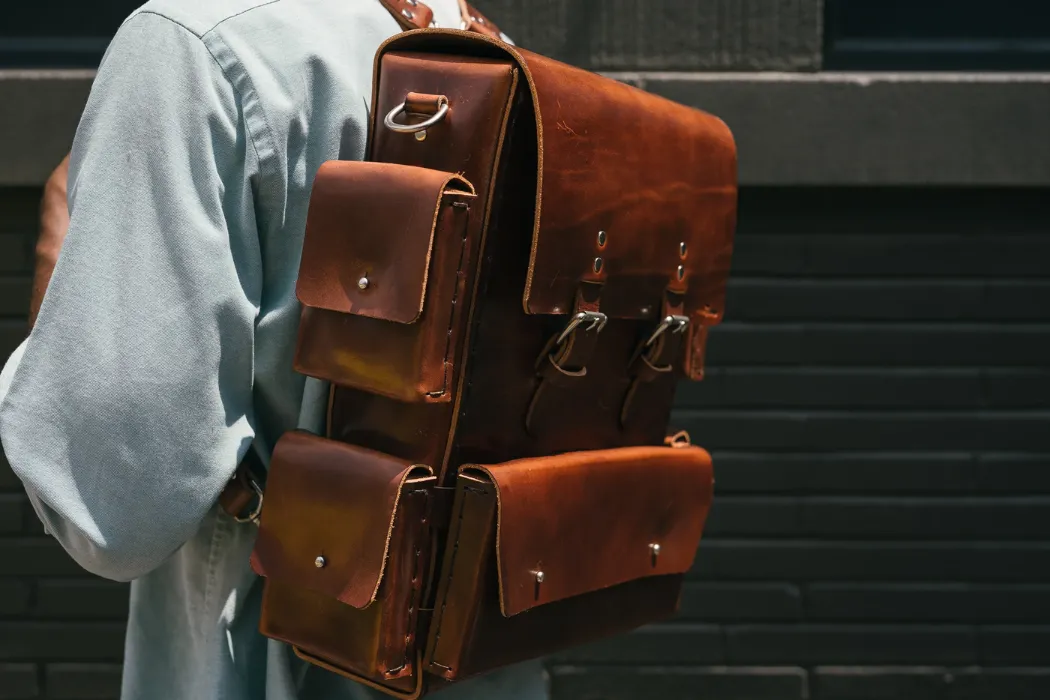
A full-grain leather backpack can be worth considering when its appearance, feel and construction fit the collection’s intended use. It is not automatically the lightest, strongest or best-value choice. Compare the finished backpack—including harness, opening, lining and empty weight—with other candidates under the same brief.
For a brand buyer, paying more for a material makes sense only when the resulting product delivers features customers value and the claims are supported. Avoid building the business case on an assumed twenty-year lifespan.
What full grain tells you—and what it leaves open
Full grain means the grain surface has not been removed by corrective mechanical treatment. It does not specify tanning chemistry, thickness, finish, stiffness or assembled strength. Confirm those details against the material reference.
Commercial use of “top grain” can be imprecise, and “genuine leather” is not a complete quality grade. The Leather Research Laboratory’s terminology explanation helps distinguish grain descriptions from marketing hierarchies. Choose the actual material on its suitability rather than a ladder assigning each label a fixed number of years.
Where full-grain leather may fit a collection
It can support a range built around natural surface character or a particular leather feel. Agree acceptable variation with physical samples, including markings and colour. If customers expect a very uniform surface, discuss how the selected finish achieves that expectation instead of assuming the label alone guarantees it.
Some leathers change appearance with handling; this can be desirable within the design. It is not proof of self-healing, improved strength or guaranteed resale value. Show the intended appearance honestly and separate it from damage at a stress point.
Evaluate comfort and empty weight on the complete sample
Record empty weight, intended contents and the strap adjustment range. Check the backpack when worn with the clothing expected in its market. Look at strap edge feel, access to adjusters, back-panel contact and whether hardware presses against the wearer.
A leather face is not evidence that the complete back panel is breathable. Lining, padding and construction affect the assembly. Likewise, a stiff new sample should not be excused with a promised break-in period if the intended fit has not been assessed.
| Decision | Review together | Avoid assuming |
|---|---|---|
| Body material | Finish, thickness, hand feel and panel support | Full grain is always heavy or always soft |
| Harness | Strap shape, adjustment and attachments | More rivets automatically mean more strength |
| Device compartment | Actual device and sleeve, opening and padding | Screen diagonal alone proves fit |
| Main closure | Access, operation and filled shape | One zipper size suits every backpack |
| Colour and care | Rubbing contact, lining and approved instructions | A label guarantees no dye transfer |
| Weather exposure | Material and finished-article evidence | A treated surface makes the whole pack waterproof |
Ask for evidence at the attachment points
The shoulder straps and top handle connect to specific panels and reinforcement. Review the complete construction and agree an assessment for the intended contents and use. Do not accept a generic leather tensile result as proof that an assembled strap joint meets the brief.
Thread, seam spacing, hardware and reinforcement should work together. Excessively dense stitching or an unsuitable fastener can create problems rather than solve them. Have the supplier document the approved arrangement and the criteria used to evaluate it.
For a proposed carrying-load claim, agree the assessment method and required evidence for the complete design. Record the tested configuration, conditions and result before using it in product information.
Compare ownership and sourcing costs honestly
Compare candidates at the same dimensions, lining, hardware, packaging and order assumptions. A lower unit price may omit a feature, while a higher material price may not improve the feature your customer values. Itemize the differences.
For a commercial case, include observed returns or repair costs where available. If estimating future use, label the assumptions. Do not promise that a full-grain backpack pays for itself through years of service or a fixed resale percentage.
Approve care and packing with the design
Check that the pack arrives with the intended shape and without hardware impressions. Its care card should match the shell and lining, with no universal oiling or waterproof-spray schedule. For moisture questions, consult the water-resistance guide.
For backpack development, send the contents, drawing, material reference and required checks to Hoplok. Confirmed bag MOQ is 200 leather pieces or 1,000 PU pieces; samples take 3–4 weeks and bulk lead time is 60–90 days.
Frequently asked questions
Is full grain always the strongest finished backpack?
No. The harness, attachments, material properties and assembly all need assessment.
Can I assume a leather backpack is breathable?
No. Evaluate the complete back-panel construction, including lining and padding.
Is a full-grain backpack guaranteed to hold resale value?
No. Resale depends on the particular product, condition and market, not the leather name alone.