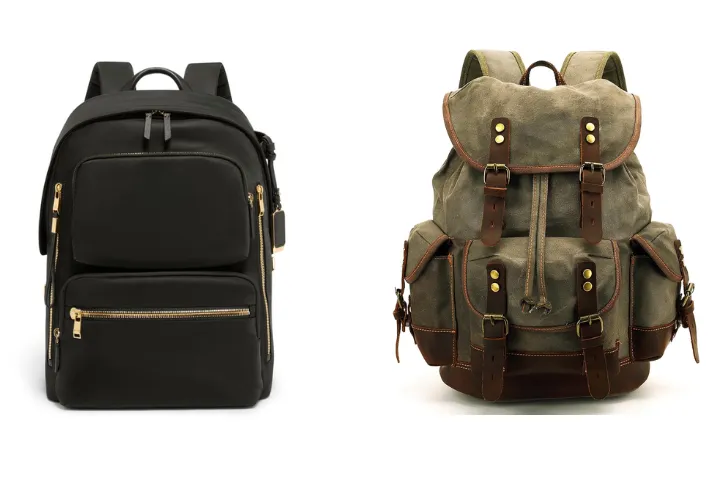
Backpack and rucksack are often overlapping names for a bag carried on the back. The word “rucksack” does not by itself establish a larger capacity, a frame, a hip belt or a higher load rating. Compare the actual opening, organization, fit and construction rather than treating the names as two fixed technical categories.
For a brand, this distinction prevents an imprecise style reference from becoming a misleading product claim. A heritage-looking flap bag can be an everyday fashion backpack; its appearance does not certify it for specialist outdoor use.
Why the terms cause confusion
Merriam-Webster treats rucksack, backpack and knapsack as overlapping terms. Usage varies by region and brand. Some retailers use rucksack for a flap or drawstring style, but that naming convention is not a universal engineering rule.
Use the term your customers understand, then publish the features that matter. A catalogue entry should not force buyers to infer capacity, closure or support from one word.
Compare opening formats
| Format | Potential benefit | Question to check |
|---|---|---|
| Zip-opening pack | A defined access path to one or more compartments | Does the opening clear the actual contents and remain accessible when filled? |
| Flap with drawstring | A gathered opening and a particular visual style | How are small items contained and how many actions are needed for access? |
| Roll-top | An opening that closes by folding or rolling | What is the usable capacity in the specified closed condition? |
| Separate device access | Access to a dedicated compartment | Can the actual device and sleeve be removed as intended? |
A flap is not automatically more weather-resistant than a zipper. Seams, gaps, lining and closure construction matter. Likewise, an opening that looks wide in a photograph can narrow when the pack is loaded.
Capacity and carrying fit need measurements
Record outside dimensions, usable internal space and the reference contents. If a litre value is published, use a stated method consistently. A screen-size label does not establish laptop fit; check the actual device with its sleeve and the entry route.
Review strap length, adjustment range, shape and back-panel contact on the complete sample. Evaluate it with the intended clothing and contents. Do not infer comfort from a leather label or promise that one style prevents back pain.
Specialist expedition or load-carrying equipment requires a separate brief and appropriate evidence. Naming an everyday bag a rucksack does not supply those features.
Construction points for an everyday collection
Inspect shoulder-strap attachments, the top handle, base and closure under the agreed evaluation conditions. Check whether a pocket creates a hard pressure point, whether loose strap ends are managed and whether the lining shifts into the zipper.
Materials and reinforcement should suit the design. A heavier fabric, additional rivets or denser stitching is not a universal improvement. Specify the relevant material and component references, then assess their combined function.
What about knapsacks and daypacks?
These terms can also overlap. “Daypack” commonly communicates a bag intended for a day’s contents, but it still needs dimensions and a feature description. “Knapsack” may suggest a simpler or traditional style in a particular catalogue; it does not establish a standardized maximum capacity.
For an enquiry, include a drawing or photograph annotated with the desired features. “A flap-top everyday pack with a device compartment” is clearer than asking for a rugged rucksack without defining the use.
Care, travel and product-page limits
Provide care instructions for the shell, lining and attachments. Do not copy a machine-washing instruction from one fabric bag to a leather assembly. Any water-resistance claim needs evidence for the stated material or finished product.
Airline fit depends on the actual packed dimensions and the current carrier requirements. Avoid claiming that every pack within a litre range qualifies as a personal item or cabin bag.
Prepare a development brief
- Identify the everyday use and reference contents.
- Specify opening, compartments and actual dimensions.
- Define material, lining, strap arrangement and adjustment range.
- Agree appearance and functional assessment criteria.
- Approve care wording and packing with the sample.
For Hoplok bag development, discuss the proposed everyday leather or PU design through the contact page. Confirm feasibility for the actual construction rather than treating a style name as a capability commitment.
Frequently asked questions
Is every rucksack a heavy-duty outdoor pack?
No. Usage overlaps with backpack, and the word alone establishes no frame, support system or rated performance.
Are rucksacks always larger than backpacks?
No. Read the actual dimensions, usable capacity and feature description.
Does a flap make the bag waterproof?
No. The complete closure, seams and construction need evidence for any water-protection claim.