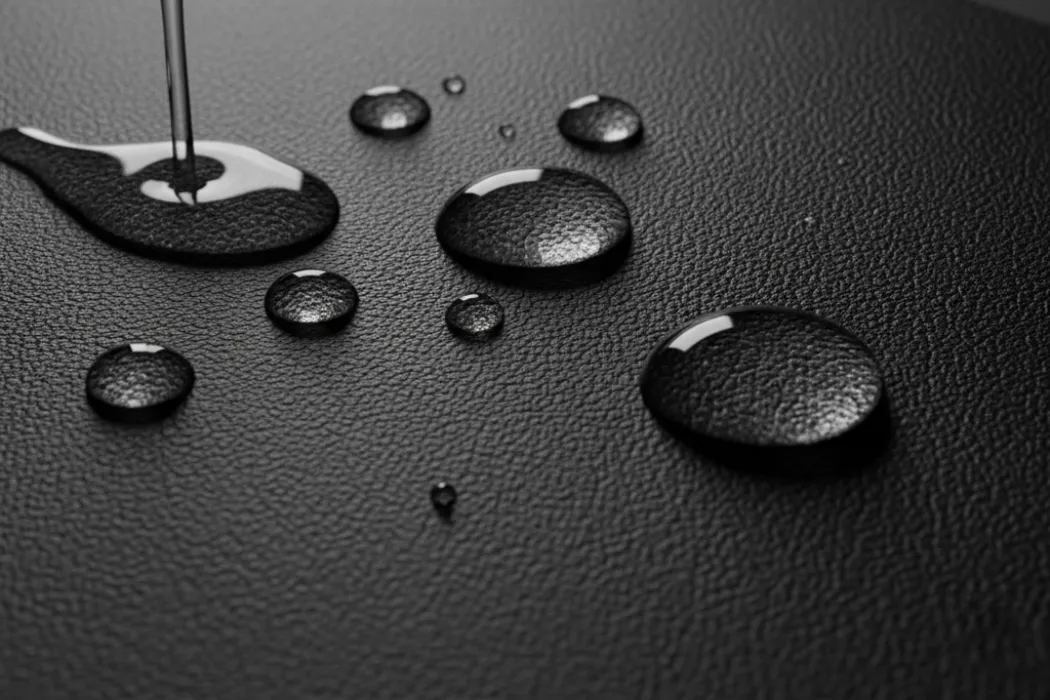
Leather is not automatically waterproof. Some finished leathers resist brief surface wetting, but water can still affect the material or enter a finished bag through seams, edges, openings and hardware. Water beading on a panel does not prove that a wallet will keep cards dry or that a bag can withstand sustained rain.
For a buyer, start with the exposure the product must handle. For a brand, make any water-resistance claim specific to the tested material or complete product and the conditions demonstrated.
Water-resistant and waterproof are different claims
“Water-resistant” should describe resistance under specified conditions, rather than mean unlimited protection. “Waterproof” is a stronger claim that needs a clear scope and supporting evidence. Neither should be assigned solely because the leather has a smooth finish.
Distinguish the exposed face material from the assembled article. A coated panel may resist wetting while an unprotected edge absorbs moisture. A bag may use a resistant shell yet admit water at the zipper or seams. A care instruction to wipe off a splash is not a test report.
| Question | Evidence needed | What it does not prove |
|---|---|---|
| Does liquid bead on the surface? | Observation under a defined surface-wetting method | No leakage through seams or prolonged rain protection |
| How much water does a material absorb? | Applicable material method with conditions and results | Protection of contents in an assembled bag |
| Does water enter the finished product? | Complete-product evaluation for the stated exposure | Resistance to every duration, pressure or orientation |
| Does appearance change after wetting? | Conditioned comparison of colour, feel and finish | No future change under other exposure or care conditions |
Why leather type alone is not enough
The tannage, finish, oils or waxes, thickness and construction can influence water behaviour. A grain description does not establish that a particular leather is rainproof. Suede, nubuck and absorbent finishes need special care because wetting may visibly change their appearance.
PU-coated materials also vary. A water-resistant face does not make the backing, cut edges or stitching waterproof. Compare named material references and actual reports instead of deciding from “real” versus “faux” alone.
Define the buying requirement before choosing a test
Write down whether the expected event is an incidental splash, brief rain during everyday travel or a more demanding exposure. Identify what must be protected: external appearance, dimensional stability, hardware function or the contents. Include orientation and how the product is closed.
Ask a qualified laboratory to recommend a method that answers that question and agree the applicable edition, sample preparation, conditioning and acceptance criteria. The ASTM leather standards catalogue includes different methods for different water-related properties. For example, ASTM D2099 concerns dynamic water resistance of shoe-upper leather; citing it alone would not establish that a handbag is waterproof.
Likewise, a flex-resistance result and a whole-product leakage result are different evidence. Do not turn a surface spray rating or a test on a flat swatch into a storm-duration guarantee for a finished bag.
Can a spray or wax make leather waterproof?
A compatible treatment may change how a surface wets, but it should not be assumed to seal stitching or closures. Treatment can also change colour, gloss or feel. Use only a product approved for the actual leather and finish, including any restrictions for pale colours, suede or nubuck.
Test the intended treatment on a representative sample and assess it after drying. If the brand plans to recommend repeat treatment, validate the proposed instructions and check compatibility with the rest of the article. Do not make a chemical-compliance claim from the word “water-based,” “natural” or “eco” on a bottle; obtain the relevant information for the formulation and market requirement.
What to do when leather gets wet
Remove surface water gently with a clean absorbent cloth and empty a wet bag or wallet. Support the intended shape without overstuffing, allow it to dry away from direct heat and strong sunlight, and follow the brand’s instructions for the lining and finish. Do not accelerate drying with a hairdryer or place the article on a radiator.
Once dry, check for stiffness, colour change, edge lifting and closure problems. Do not apply oil automatically to hide a change. If contents were soaked or moisture remains within layered areas, seek product-specific advice before reuse. A controlled care response cannot guarantee reversal of every water mark.
Use precise product-page wording
A statement such as “wipe occasional splashes promptly; avoid soaking” is a care boundary, not a performance certification. If your claim is supported by a test, identify what was evaluated and the limits relevant to the customer. Keep laboratory records with the corresponding material and product reference.
For bag, wallet or belt sourcing, send the intended exposure and required assessment through the Hoplok contact page. Agree the materials, construction and claim evidence during development.
Frequently asked questions
Do water droplets on leather prove it is waterproof?
No. Beading does not establish absorption, seam leakage or protection of the contents under longer exposure.
Can a water-resistance result for shoe-upper leather certify a bag?
Not on its own. The method and specimen need to address the finished bag’s claimed exposure and performance.
Should a wet leather item be dried with heat?
Avoid direct heat and follow its care instructions. Support the shape, remove surface moisture gently and assess the article after drying.