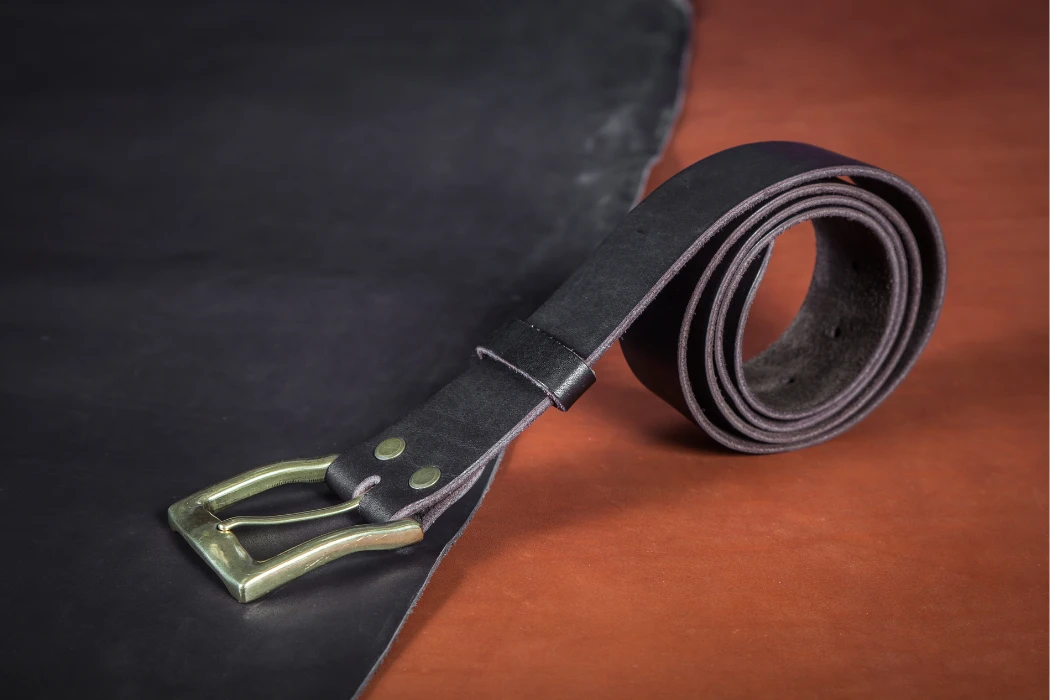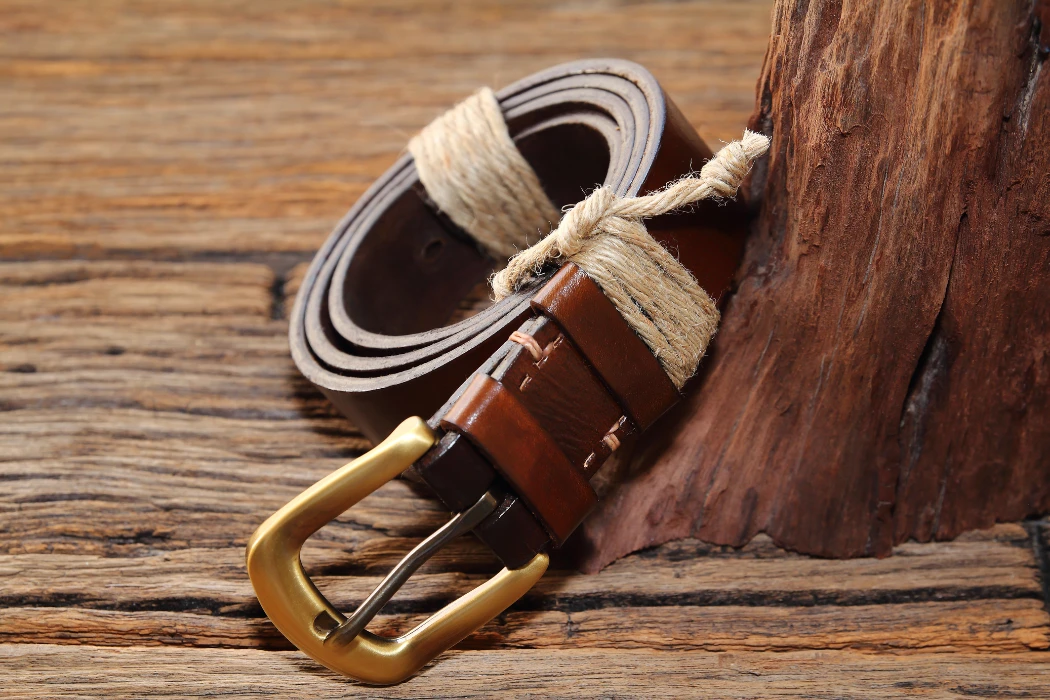
Making a leather belt involves seven core stages: selecting and inspecting the hide (preferably full-grain), precision strap cutting, shaping the tip, beveling and burnishing the edges, punching holes, assembling the hardware, and applying the final finishing. While a DIY project takes several hours using hand tools, professional manufacturing utilizes precision machinery to ensure consistent durability and aesthetics at scale.
We’ve all experienced the frustration of a “genuine leather” belt that cracks, splits, and delaminates after just 6 to 12 months of use. This is the disappointing result of bonded leather scraps glued together. In contrast, a properly crafted full-grain leather belt isn’t just an accessory; it’s an investment that can last 10 to 15 years, developing a unique patina over time. The global leather goods market, valued at over $420 billion, is increasingly seeing a consumer shift back toward durability and timeless craft.
In this comprehensive guide, we will bridge the gap between craft and industry. We will walk you through the simple steps for a DIY project, but more importantly, we will pull back the curtain on the professional manufacturing process. You will learn not just how to make a belt, but how to identify and build a high-quality belt worthy of a top brand.
What Is the Best Leather for Belt Making? (Material Selection)
The best material for a durable, high-quality belt is vegetable-tanned full-grain leather. This is because it offers the highest possible tensile strength and durability, as it uses the entire, uncorrected hide structure. Unlike cheaper “genuine” or bonded leathers, full-grain leather will not crack or split and develops a rich patina over its 10-15 year lifespan.
Understanding Leather Grades (Full-Grain vs. Genuine vs. Bonded)
The term “leather” is used to describe materials of vastly different quality. A belt’s lifespan is almost entirely determined by the grade of the hide it was cut from. Understanding this is the single most important part of belt making.
- Full-Grain Leather: This is the “gold standard.” It comes from the very top layer of the hide (the “grain”) and includes all the natural markings. It is the strongest, most durable, and most breathable part of the hide. A full-grain belt won’t break; it will break in.
- Top-Grain Leather: This is the second-best quality. It is also from the top layer, but the surface has been sanded or “corrected” to remove imperfections. This makes it slightly weaker than full-grain but still a very durable choice, often used for formal dress belts.
- Genuine Leather: This is the most deceptive marketing term in the industry. “Genuine leather” is technically real leather, but it’s made from the weaker inner (suede) layers of the hide, known as the “split.” It lacks the grain’s strength and is often heavily painted and embossed to look like full-grain. These belts typically crack within 6-12 months.
- Bonded Leather: This is not leather; it’s the “particle board” of the industry. It’s an aggregate of leather dust, scraps, and glue, pressed together. Bonded leather belts often fail (delaminate or split) in as little as 3-6 months.
Pro-Tip for Brands: The customer return rate on bonded or genuine leather belts can be as high as 15-20% due to cracking. In contrast, the return rate for full-grain belts due to material failure is typically less than 1%.
Vegetable Tanned vs. Chrome Tanned: Which Should You Choose?
How the leather is made is as important as which part is used. The two most common methods are:
- Vegetable Tanned (Veg-Tan): This is the traditional method, using natural plant tannins (like tree bark) in a process that can take up to 60 days. Veg-tan leather is firm, strong, and has a classic, earthy smell. It’s the only type of leather that can be tooled or stamped, and it burnishes (polishes) beautifully at the edges. It’s the top choice for classic, high-end belts.
- Chrome Tanned (Chrome-Tan): This is the modern, fast industrial process, using chromium salts. It’s much faster (often done in 1-2 days) and produces a softer, more flexible leather that comes in a vast array of colors. However, it’s not as strong as veg-tan and the edges do not burnish well, often requiring them to be painted.
For classic, “buy-it-for-life” belts, veg-tan is the clear winner. For softer, colorful fashion belts, chrome-tan is a common choice.
Determining the Right Thickness (Weight)
Leather thickness is measured in “ounces” (oz) or millimeters (mm). In this context, an ounce is a unit of thickness, not weight, where 1 oz. ≈ 0.4mm. The right thickness depends entirely on the belt’s intended use.
- Lightweight (6-7 oz / 2.4-2.8mm): This is too thin for a sturdy belt but is often used for formal, suit-style dress belts where flexibility is prioritized over ruggedness.
- Standard Duty (8-9 oz / 3.2-3.6mm): This is the “sweet spot” for 90% of all belts. It’s thick and durable enough for daily wear (like jeans or casual pants) without feeling overly bulky.
- Heavy Duty (10-12 oz / 4.0-4.8mm): This is a very thick, rugged leather. It’s used for workwear, gun belts, or heritage-style belts where a robust, stiff feel is desired.
Below is a quick comparison of the leather grades available to a manufacturer.
| Leather Grade | Average Lifespan | Avg. Wholesale Cost (per sq/ft) | Recommended Use | Manufacturing Difficulty |
|---|---|---|---|---|
| Bonded Leather | < 6 Months | $0.50 – $1.00 | Mass-Market (Avoid) | Very Low (Pressed scraps) |
Which Tools and Machinery Are Required for Production?
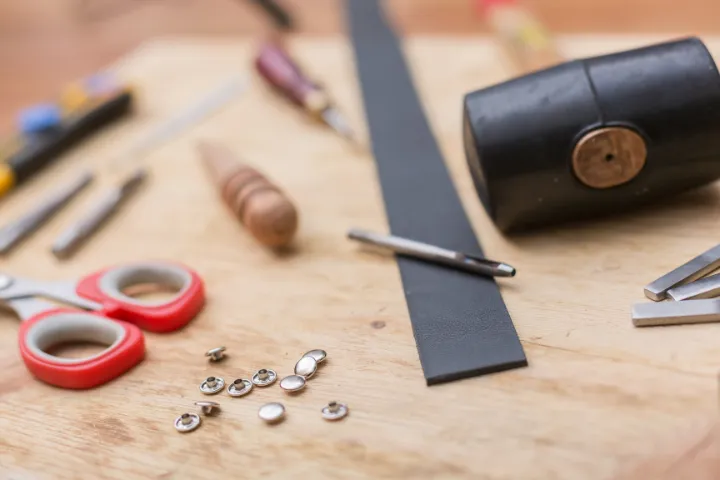
To make a leather belt, you need tools for cutting, shaping, finishing, and assembly. A basic DIY setup includes a strap cutter, edge beveler, skiving knife, wood burnisher, and a hole punch. In contrast, professional manufacturing uses specialized machinery like hydraulic presses, automatic skivers, and high-speed edge painters to achieve precision and efficiency at scale.
The Essential DIY Kit for Beginners
For a hobbyist, the barrier to entry is relatively low. You can achieve great results with a small set of hand tools, most of which can be bought in a kit for under $100 – $150.
- Utility Knife & Straight Edge: For making initial straight cuts on the hide.
- Strap Cutter: A simple hand tool that ensures your belt strap is cut to a consistent width (e.g., 1.5 inches).
- Edge Beveler: Removes the sharp 90-degree corner of the leather, rounding it for comfort. A #2 or #3 size is most common.
- Hole Punch: A rotary punch or drive punch to create the buckle and adjustment holes.
- Skiving Knife: A very sharp, angled knife used to thin the leather at the buckle fold.
- Wood Slicker / Burnisher: A wooden tool used with water or gum tragacanth to polish the belt’s edges.
Professional Machinery for Mass Manufacturing
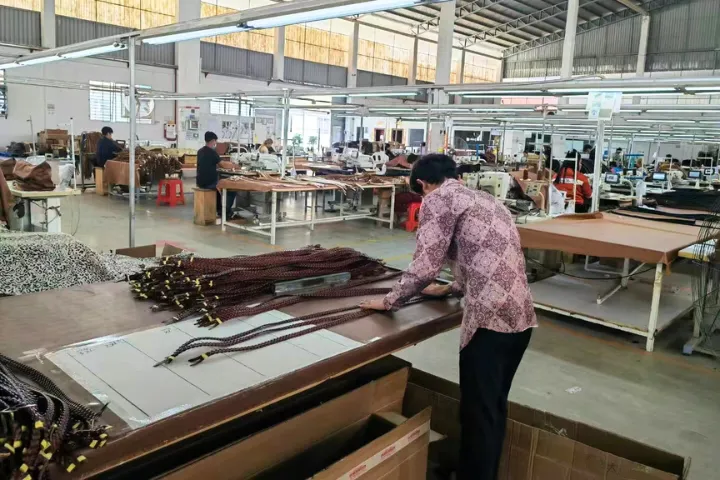
While hand tools provide character, industrial machinery provides the flawless consistency and speed required for global brands. The difference is staggering: a craftsperson might spend 2 hours on a belt; a factory line produces one in under 5 minutes.
In a 50,000 square meter facility like Hoplok’s, automation and specialized machines are key:
- Hydraulic “Clicker” Press: Replaces the utility knife. This press uses a steel die (a “cookie cutter”) to instantly punch out a perfect belt strap and tip shape. One press can cut a strap in < 1 second.
- Automatic Strap Cutting Machine: For high-volume orders, these machines feed an entire hide and cut it into multiple straps of perfect width in one pass.
- Splitting & Skiving Machines: These motorized machines thin leather to a precise, uniform thickness (e.g., 3.5mm) across the entire length, something impossible by hand.
- Automatic Edge Painting/Burnishing Machine: A conveyor system feeds the strap through rollers that apply paint or burnishing compound, ensuring an even finish that is 100% consistent from the first belt to the 1-millionth.
Hardware Selection (Buckles, Rivets, and Screws)
A $100 belt with a $0.50 buckle will fail. The hardware is just as critical as the leather.
- Solid Brass: This is the premium choice. It is rust-proof, extremely strong, and develops a beautiful patina. It will not break, ever.
- Stainless Steel: Another top-tier option, offering a modern look with similar rust-proof durability.
- Zinc Alloy: This is the most common material for budget and mid-level belts. It is a “pot metal” that is plated (e.g., with chrome or nickel). The problem? The plating often flakes off within 12-18 months, and the underlying metal is brittle and can snap under stress.
- Hardware Fasteners: Chicago screws allow the customer to change buckles, while high-quality rivets or saddle stitching provide a permanent, extremely durable bond.
What’s Included in a Good DIY Belt Kit?
For beginners, a “DIY Belt Kit” is an excellent starting point. It removes the guesswork of sourcing individual components. While brand offerings vary, a high-quality beginner kit should generally include:
- A Pre-Cut Belt Blank: A 1.5-inch wide, 50-60 inch long strip of full-grain vegetable-tanned leather.
- Hardware: A solid brass or stainless steel buckle, a matching leather keeper loop, and Chicago screws (which are easier for beginners than rivets).
- Finishing Tools: A small punch for the screws and holes.
- Finishing Agents: A small amount of edge finishing compound (like beeswax or Gum Tragacanth) and a canvas cloth or wood slicker.
- Instructions: A step-by-step guide.
More advanced kits may include stamps, dyes, and a mallet, but the items above are the core components needed for a simple, durable belt.
Pro-Tip for Brands: The perceived value of a belt is often judged by the “hand feel” of its buckle. Using solid brass adds a tangible heft and quality that justifies a higher retail price, often $50-$80 more than a zinc alloy equivalent.
The table below highlights the massive gap between a hobbyist’s bench and a professional factory floor.
| Process Step | DIY Hand Tool | Hoplok Factory Machine | Speed & Precision Difference |
|---|---|---|---|
| Strap Cutting | Hand Strap Cutter | Hydraulic Press / Auto-Cutter | Speed: 500x faster. Precision: Guarantees 1.50″ width, no variations. |
| Edge Finishing | Wood Slicker (by hand) | Automatic Edge Burnishing Wheel | Speed: 100x faster. Precision: 100% consistent heat & pressure. |
| Buckle Fold | Skiving Knife (by hand) | Motorized Skiving Machine | Speed: 50x faster. Precision: Perfect 0.1mm accuracy. |
| Hole Punching | Rotary Punch (1 by 1) | Pneumatic Multi-Hole Press | Speed: 30x faster. Precision: All 5 holes punched simultaneously. |
How Do I Start Making My Own Belt at Home? (A 7-Step Guide)
This is the simple, “start-to-finish” guide for a beginner using a basic DIY kit. This process focuses on assembly and finishing, assuming your leather strap is already pre-cut.
Step 1: Determine Your Size
Take your “pant waist size” and add 2 inches. This is your “Belt Size.” (e.g., Pant size 34″ = Belt size 36″). This 36″ mark will be your center hole. You will need a total strap length of about 45-50 inches to have enough room for the fold and the tip.
Step 2: Prepare the Buckle End
Using your utility knife, cut one end of the strap straight. Measure about 2.5 inches from this end and use your hole punch to make two holes for your Chicago screws. Use an oblong punch (or cut a small slot) between them for the buckle’s tongue.
Step 3: Shape the Tip
Go to the other end of the strap. Use your knife to cut an “English Point” (a gentle round) or a “Tapered” point. This makes it easier to buckle. You can use a coin or cup to trace a perfect curve.
Step 4: Bevel and Burnish All Edges
This is the most important step for quality. Run your edge beveler tool along all four long edges of the belt (top and bottom, front and back) to round them off. Then, dampen the edges with water, apply your beeswax or gum, and rub them *very* fast with your canvas cloth or wood slicker until they become dark, smooth, and shiny. Do this for the strap and the tip.
Step 5: Punch the Adjustment Holes
Find your “Belt Size” mark (from Step 1). This is your center hole. Punch a hole there. Now, punch two more holes on each side, spaced exactly 1 inch apart. You will have 5 holes total.
Step 6: Attach the Hardware
Slide your pre-made keeper loop onto the strap, followed by your buckle (make sure the tongue is facing the right way!). Fold the end of the strap over the buckle bar, lining up the holes you made in Step 2. Push your Chicago screws through and tighten them. Your belt is now assembled.
Step 7: Final Finish
Give the entire belt (surface and edges) a final buff with a clean cloth. If you are using unfinished veg-tan leather, you can now apply a leather conditioner or balm (like Obenauf’s or Smith’s) to seal the leather and give it a slight, rich darken-ing. Your belt is complete.
How Do You Cut and Shape the Leather Strap? (The Process Part 1)
Cutting and shaping the strap is a game of precision. To ensure a straight cut, a DIY-er uses a hand strap cutter guided by a straight edge. For sizing, the standard rule is adding 2 inches to the wearer’s pant size. In mass production, hydraulic presses use steel dies to cut a perfect strap and tip in one motion, eliminating human error.
Measuring and Sizing the Belt
Incorrect sizing is one of the most common mistakes in belt making. A customer’s “pant size” is not their “belt size.”
- The +2 Rule: The simplest industry standard is Pant Waist Size + 2 inches = Belt Size. For example, a person who wears size 34 pants needs a size 36 belt.
- Measuring: A belt is measured from the fold where the buckle attaches (do not include the buckle) to the center hole (usually the 3rd or 4th hole).
A standard belt has 5 holes, spaced 1 inch (2.54 cm) apart. This gives the wearer 2 inches of adjustment in either direction. For a size 36 belt, the holes would be at 34″, 35″, 36″ (center), 37″, and 38″.
Cutting the Strap from the Hide (The Back/Butt Section)
Not all parts of a cowhide are equal. The location of the cut is critical for the belt’s longevity, as leather fibers have a “grain direction” and stretch differently.
- The “Belly”: This is the weakest, stretchiest part of the hide. A belt cut from the belly will warp, stretch, and deform within months. Budget manufacturers use this area to save money, resulting in a faulty product.
- The “Butt” and “Back”: This is the strongest, firmest area with the tightest fiber structure, running along the spine. All high-quality belts MUST be cut from this section. This ensures the belt has minimal stretch and maximum strength.
Hoplok Pro-Tip (Nesting): In mass manufacturing, a single hide is analyzed by computer software for “nesting.” The software maps out how to cut the maximum number of straps from the hide’s butt section, avoiding flaws and the belly. This optimization can reduce material waste from 25% down to just 10-15%, significantly lowering cost while maximizing quality.
Shaping the Tip
The “tip” is the end of the belt that passes through the buckle. The shape is both functional (making it easy to buckle) and aesthetic. Common styles include:
- English Point: A classic, rounded point. This is the most common style for dress belts and many casual belts.
- Square Tip: A flat, 90-degree cut. This gives a very modern, minimalist, or sometimes industrial look.
- Tapered Tip: The strap gradually narrows toward the tip. This is common in women’s fashion belts.
In a factory, these tips are not cut by hand. They are stamped out by a hydraulic “clicker press” using a steel die, ensuring every tip is identical.
Skiving the Buckle Fold
“Skiving” is the process of thinning leather in a specific area. When you fold the end of a 4.0mm thick belt back on itself to hold the buckle, you create a bulky 8.0mm lump. This is clumsy and unprofessional.
To solve this, a skiving knife (or a motorized skiving machine) is used to shave off 50-70% of the leather’s thickness on the flesh side, only in the ~2-inch area that will be folded. This allows the buckle fold to lay flat, creating a slim, strong, and professional-looking connection that doesn’t bulge under clothing.
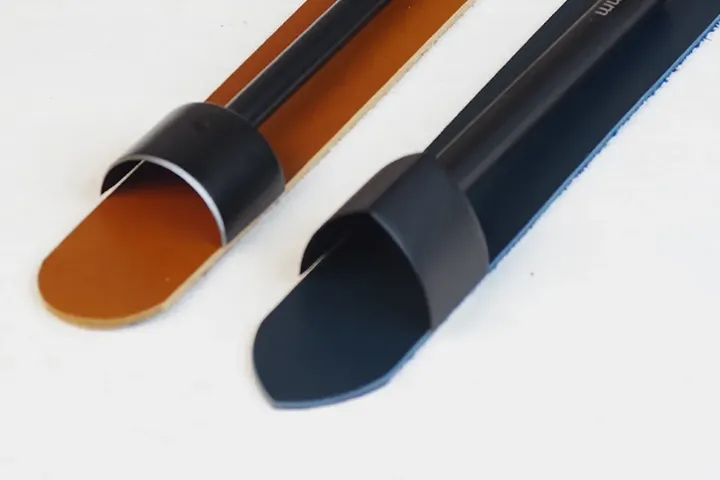
Why Is Edge Finishing Critical for Durability and Aesthetics? (The Process Part 2)
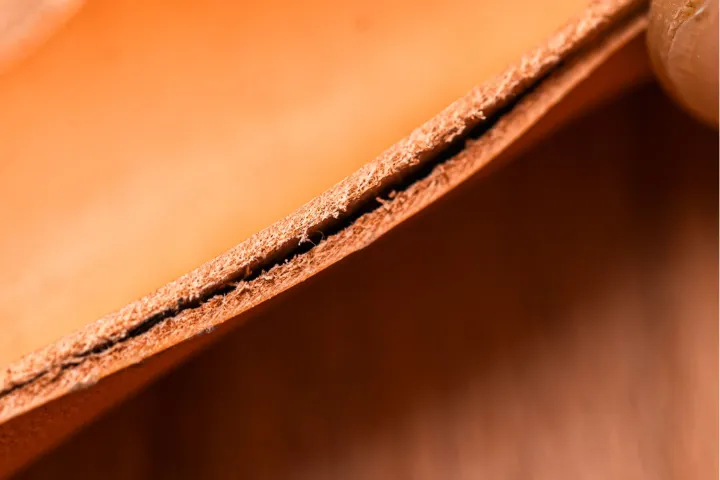
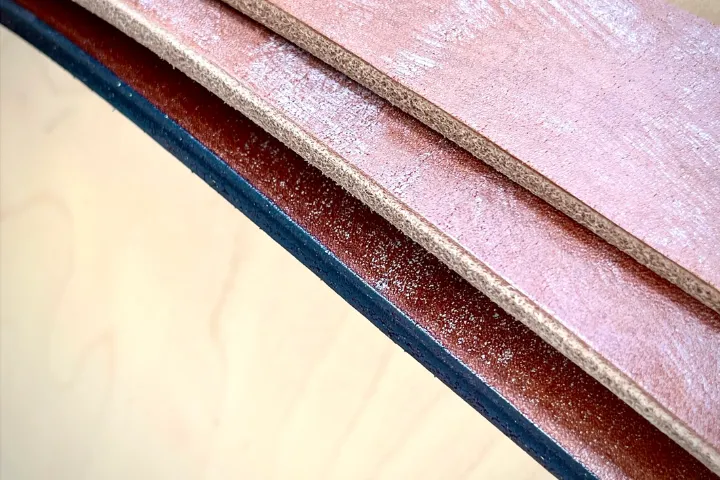
Edge finishing is critical because a raw, unsealed edge acts like a sponge, absorbing moisture, oil, and dirt. This leads to fraying, swelling, and eventual rot, causing the belt to look cheap and fail prematurely. A finished edge, whether burnished or painted, seals these exposed fibers. This single step can increase the belt’s usable lifespan by 50-100% and is the primary difference between an “amateur” and a “professional” grade product.
Beveling the Sharp Edges
Before any finishing can begin, the sharp 90-degree corners of the cut strap must be removed. This is done with an “edge beveler” tool.
- Function: Beveling rounds the edges, preventing them from digging into the wearer’s side and making the belt far more comfortable.
- Aesthetics: It creates a smooth, rounded profile that looks professional and is easier to finish. A standard size #2 (0.8mm) or #3 (1.0mm) beveler is used for most belts.
Skipping this step results in a “blocky” belt that looks and feels unfinished.
The Art of Burnishing (Slicking)
Burnishing is the classic finishing method for vegetable-tanned (veg-tan) leather. It uses friction and heat to seal the edge’s fibers into a smooth, dark, glass-like finish.
- DIY Process: A hobbyist will dampen the edge with water or Gum Tragacanth (a natural sealing agent) and then vigorously rub it with a wood slicker or canvas cloth. This can take 10-15 minutes of hard rubbing per belt.
- Hoplok’s Factory Process: In a high-volume setting, this is automated. Straps are fed through high-speed polishing wheels made of canvas or wood. These wheels spin at 1,000+ RPM and are coated with a hard wax compound. The machine uses consistent heat and pressure to create a perfect, durable seal in seconds, something a hand process cannot replicate.
A well-burnished edge is water-resistant and will not fray, even after 5+ years of daily use.
Edge Painting (For Chrome Tanned or Luxury Belts)
Chrome-tanned leather (used for softer, colorful fashion belts) does not burnish. The fibers are too soft and will just fuzz up. The professional solution is “edge painting.”
This is a meticulous, multi-step process. A cheap, single-coat paint job will crack, peel, and flake off within months. A high-end finish, like that required for luxury brands, is very different:
- Step 1: Sanding. The edge is sanded perfectly flat.
- Step 2: Priming. A flexible primer (base coat) is applied and dried.
- Step 3: Painting. A layer of specialized, flexible edge paint is applied.
- Step 4: Curing. The paint is heat-cured or air-dried.
- Step 5: Sanding (Again). The dried edge is lightly sanded with 400-600 grit sandpaper to remove any imperfections.
- Step 6: Final Coat. A final, perfect layer of paint is applied, followed by a clear top coat if desired.
Hoplok Pro-Tip (Compliance): This process is where many budget factories fail, leading to high defect rates. Hoplok’s LWG-certified process and adherence to REACH/CPSIA standards ensure our edge paint is not only durable but also non-toxic. This multi-layer process is key to maintaining our <1% defect rate on finished goods.
This table compares the three main edge finishing methods.
| Finishing Method | Appearance | Durability | Time Cost / Unit | Best For |
|---|---|---|---|---|
| Burnishing (Slicking) | Natural, glossy, darkens leather | Very High (10+ Years) | High (Hand) / Low (Machine) | Vegetable-Tanned, Heritage Belts |
| Edge Painting | Smooth, uniform, opaque color | High (5-8 Years) / Can be re-coated | Very High (Multi-step process) | Chrome-Tanned, Luxury, Fashion Belts |
| Raw (Unfinished) | Fuzzy, rough, cheap-looking | Very Low (<1 Year) | None | Budget / Fast Fashion (Avoid) |
How Is the Hardware Assembled and Secured? (The Process Part 3)
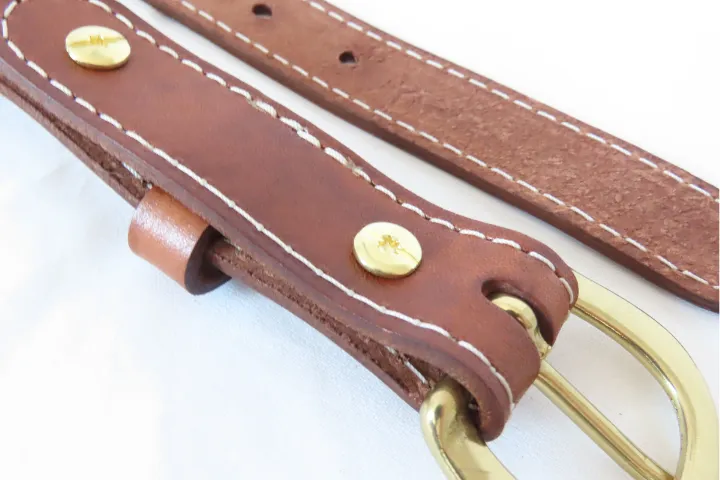
Securing the hardware is the final construction step. The buckle is typically attached using Chicago screws, rivets, or permanent stitching. Chicago screws or snaps allow for interchangeable buckles, which is a popular feature for DIY and heritage belts. In contrast, high-end luxury belts almost always use permanent saddle stitching, which offers a cleaner, more durable, and tamper-proof finish.
Punching Holes Precision
Precision is essential for a belt to function correctly. All holes must be perfectly aligned and spaced.
- Spacing Standard: The industry standard for adjustment holes is 5 holes, spaced exactly 1 inch (2.54 cm) apart. This provides a 4-inch range of adjustment for the wearer.
- Hole Shape: While DIY-ers use a simple round punch, many high-end manufacturers use an **oval punch**. An oval hole allows the buckle’s tongue to sit flatter and puts less stress on the leather, preventing the hole from stretching into a “keyhole” shape over time.
- Factory Precision: A hobbyist punches one hole at a time. A factory uses a pneumatic press that punches all 5 adjustment holes and the buckle slot simultaneously, guaranteeing perfect alignment and spacing every time.
Chicago Screws vs. Snaps vs. Stitched Keepers
How the buckle is held in place determines the belt’s style and serviceability.
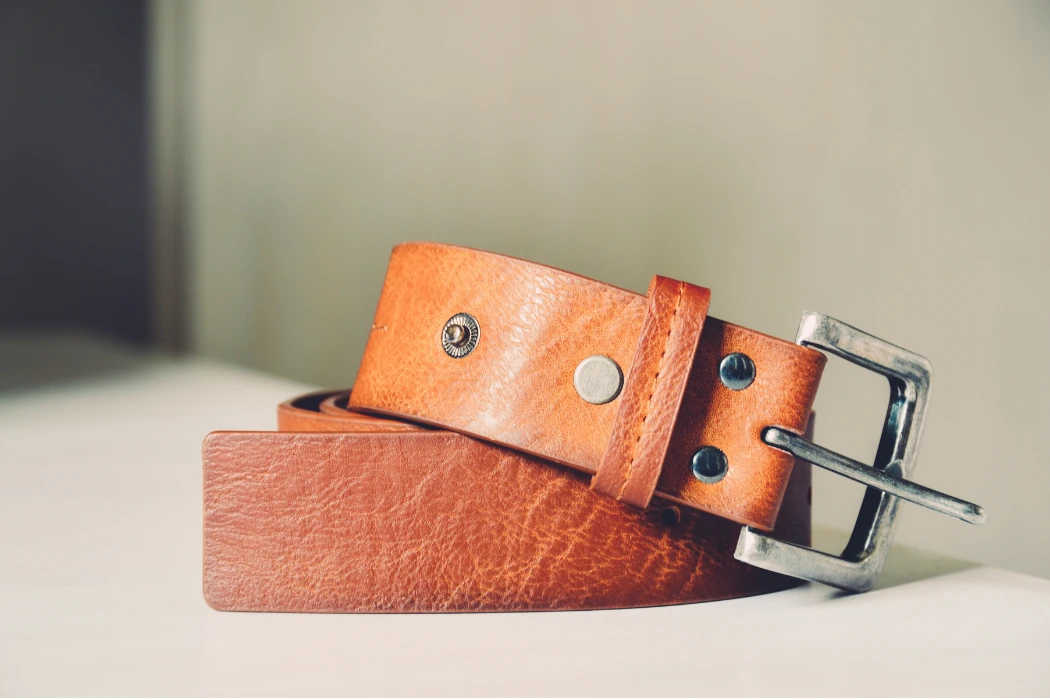
- Chicago Screws: These are metal posts that screw together, securing the buckle. Their main advantage is that they are removable, allowing the customer to easily swap out the buckle. This is a highly desirable feature for heritage or casual belts.
- Rivets: These are permanent metal fasteners. They are very strong and fast to install in a factory setting, offering an industrial and rugged aesthetic.
- Stitched Keeper: This is the hallmark of a luxury or dress belt. The buckle is held in place by stitching the fold-over permanently. This is the sleekest, most formal, and most durable method, as there is no metal hardware that can unscrew or fail.
Saddle Stitching for Reinforcement
If a belt is stitched, the *type* of stitch matters. Most machine-sewn items use a “lockstitch,” which is fast but has a critical weakness: if one thread breaks, the entire seam can unravel.
High-end belts use **saddle stitching** (done by hand or specialized heavy-duty machines). This method uses two needles passing through the same hole in opposite directions, creating a knot in every single hole. If one saddle stitch breaks, the rest of the seam remains 100% intact.
Hoplok Pro-Tip (Craftsmanship at Scale): True saddle stitching is labor-intensive, but it’s a non-negotiable mark of quality. With a skilled workforce of **4,500 artisans**, Hoplok can execute intricate hand-stitching for ultra-luxury lines or utilize high-precision “cylinder arm” sewing machines that replicate this durability at scale, ensuring every belt meets top-tier brand standards.
How Much Does It Cost to Make a Custom Leather Belt? (Business Analysis)
The cost to make a custom leather belt varies dramatically based on materials, hardware, and labor. A single DIY belt can cost between $40 and $70 in raw materials alone, not including tools. In contrast, a brand manufacturing 500 units can leverage economies of scale and vertical integration, dropping the landed cost per unit significantly, often to $10 – $20 for a premium full-grain belt.
Breaking Down Material Costs (Leather & Hardware)
Let’s do a basic cost analysis for a single full-grain veg-tan belt (1.5″ wide, 40″ long).
- Leather: A high-quality veg-tan “double shoulder” hide (approx. 12-14 sq. ft.) might cost $150 ($10.70/sq. ft.). You can cut approximately 10-12 belts from this.
- DIY Material Cost (Leather): $150 / 12 belts = $12.50 per belt.
- Hardware: A solid brass buckle from a retail supplier might cost $15 – $20.
- DIY Material Cost (Total): $12.50 (Leather) + $15.00 (Buckle) = $27.50+.
- Factory Sourcing: A manufacturer like Hoplok buys leather direct from tanneries (or owns one) at a fraction of that price and buys buckles in bulk for $1.50 – $3.00. The raw material cost plummets.
Labor Time vs. Factory Efficiency
This is where the math truly changes. Time is money.
- DIY Labor: A skilled artisan, working by hand (cutting, beveling, hand-burnishing, hand-stitching), will spend 2 to 4 hours making one belt. At a modest $25/hour, the labor cost alone is $50 – $100.
- Factory Efficiency: With hydraulic presses and automated finishers, a factory line can produce a belt in a fraction of that time. The total “touch time” (time a human is actively working on the belt) might be as low as 5-10 minutes per unit on an optimized line.
A 4-hour craft project becomes a 10-minute manufactured product. This 95% reduction in labor time is the single biggest factor in reducing cost for brands.
Why Sourcing from a Manufacturer Reduces Cost
The savings come from “economies of scale” and “vertical integration.”
1. Economies of Scale: Buying 1,000 buckles costs less per buckle than buying one. A factory’s ability to buy materials by the shipping container, not the square foot, creates immense savings.
2. Vertical Integration (The Hoplok Advantage): This is the ultimate cost-control strategy. Hoplok doesn’t just buy leather; we finish it at our self-owned ProPelli leather finishing facility. We control the supply chain from the raw hide to the finished product. This eliminates the “middleman” markup from the tannery, which can account for 20-30% of the material cost. This advantage allows us to offer premium, full-grain belts at pricing that competitors using sourced leather cannot match, even at a flexible MOQ of 100 units.
This table breaks down the cost comparison for a brand owner.
| Expense Category | DIY Cost (1 Unit) | Brand Manufacturing Cost (Est. 500 Units) | Savings % |
|---|---|---|---|
| Leather (Full-Grain) | ~$12.50 | ~$5.00 (Vertically Integrated) | ~60% |
| Hardware (Solid Brass) | ~$15.00 | ~$2.50 (Bulk Rate) | ~83% |
| Labor (Est. 2 hours DIY) | ~$50.00 (@ $25/hr) | ~$2.00 (10 min @ $12/hr factory wage) | ~96% |
| Consumables (Dye, Wax, etc.) | ~$2.00 | ~$0.25 | ~87% |
| Total Estimated Cost | ~$79.50 | ~$9.75 | ~87.7% Savings |
Frequently Asked Questions (People Also Ask)
1. What weight leather is best for belts?
The best leather weight depends on the belt’s purpose. For 90% of standard daily-wear belts (e.g., for jeans or casual wear), an 8-9 oz. (3.2mm – 3.6mm) full-grain leather is the “sweet spot” of durability and flexibility. For heavy-duty work belts or rugged heritage styles, a 10-12 oz. (4.0mm – 4.8mm) leather is preferred for its rigidity and strength.
2. Can I make a belt without specialized tools?
You can make a functional belt with very basic tools: a sharp utility knife, a ruler, and a hammer-driven punch or even a drill. However, you will sacrifice quality. Without a strap cutter, your width may be uneven. Without a beveler, the edges will be sharp and uncomfortable. And without burnishing tools, the edges will be left raw and prone to fraying.
3. How do I stop leather edges from fraying?
You must seal the exposed fibers using a proper edge finishing technique. As we covered in this guide, you have two primary methods. For vegetable-tanned leather, you must **burnish (slick)** the edge by applying friction and a sealing agent (like water or Gum Tragacanth) to create a smooth, glassy, and water-resistant edge. For chrome-tanned leather, you must use **edge painting** in a multi-step process (sand, prime, paint, sand, paint) to create a durable, flexible seal.
4. What is involved in a “Full Turnkey Service” for belt manufacturing?
A “Full Turnkey Service,” like the one offered by Hoplok, means managing the *entire* supply chain for a brand, from concept to delivery. This includes:
- Design: Using market trend data (from our NY & CA-based teams) to create 3D models and prototypes.
- Material Sourcing: Direct control via our ProPelli leather finishing facility.
- Manufacturing: Production in our ISO 9001 and BSCI-certified facilities.
- Quality Control: Ensuring a <1% defect rate and compliance with REACH/CPSIA standards.
- Logistics: Managing global shipping and delivery.
It allows a brand to focus on marketing while we handle the entire production.
5. Is sewing a belt necessary?
No, it is not. Many high-quality, durable belts use mechanical fasteners instead of sewing. Chicago screws are a popular choice as they allow the user to change the buckle. Rivets offer a very strong, permanent industrial look. Sewing (specifically **saddle stitching**) is considered a luxury, premium finish that offers a sleek, formal look with no metal on the fold, but it is one of several valid construction methods.
6. How Do I Care For and Maintain My New Leather Belt?
Proper care is essential for a long life.
- Conditioning: Apply a quality leather conditioner (like Smith’s Leather Balm) every 6-12 months, or if the belt feels dry. This replenishes natural oils and prevents cracking.
- Storage: Do not store in a humid closet. The best way is to hang it straight by the buckle or loosely roll it. Avoid folding it, which can cause creases.
- Moisture: If your belt gets soaked in rain, do not use a hairdryer. Let it air dry naturally at room temperature, away from direct heat.
7. How long does it take to manufacture 100 belts?
For a manufacturer like Hoplok, 100 units is our flexible Minimum Order Quantity (MOQ). While a standard bulk order lead time is 45-90 days, a small, dedicated run of 100 units can be produced much faster. After the design is approved (which takes 2-7 days for a sample), the production for 100 belts can often be completed in as little as 15-20 days.
Conclusion: The Art and Science of a Perfect Belt
Understanding how to make a leather belt gives you a deep appreciation for the craft. As we’ve covered, every single decision—from selecting the 8-9 oz. full-grain hide to the multi-step painting of an edge—is a choice between “good enough” and “built to last.” A DIY project is a fulfilling way to create a single, personal item that can last for years.
But scaling that craft into a globally recognized brand requires something more: consistency, efficiency, and industrial-grade quality control. The difference between a hobby and a brand is the ability to deliver that same flawless finish and durability in the 1,000th unit as in the 1st. It requires the machinery, the vertical integration, and the certified processes (like LWG and BSCI) that we’ve discussed.
Your brand’s reputation is built on your manufacturer’s standards. Understanding the process is the first step; finding a partner who has mastered it is the second.
Hoplok is built to be that partner. We apply these principles of quality at scale, helping brands translate their vision into durable, premium products. If you are ready to build a custom belt collection based on these high standards, our team is ready to assist with your manufacturing needs.