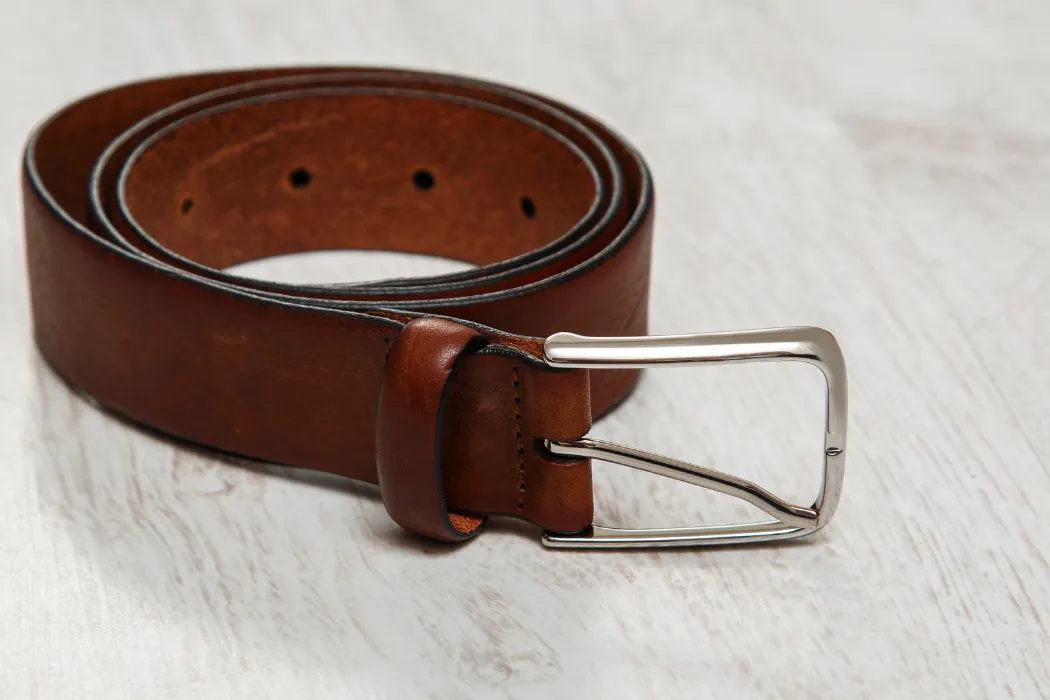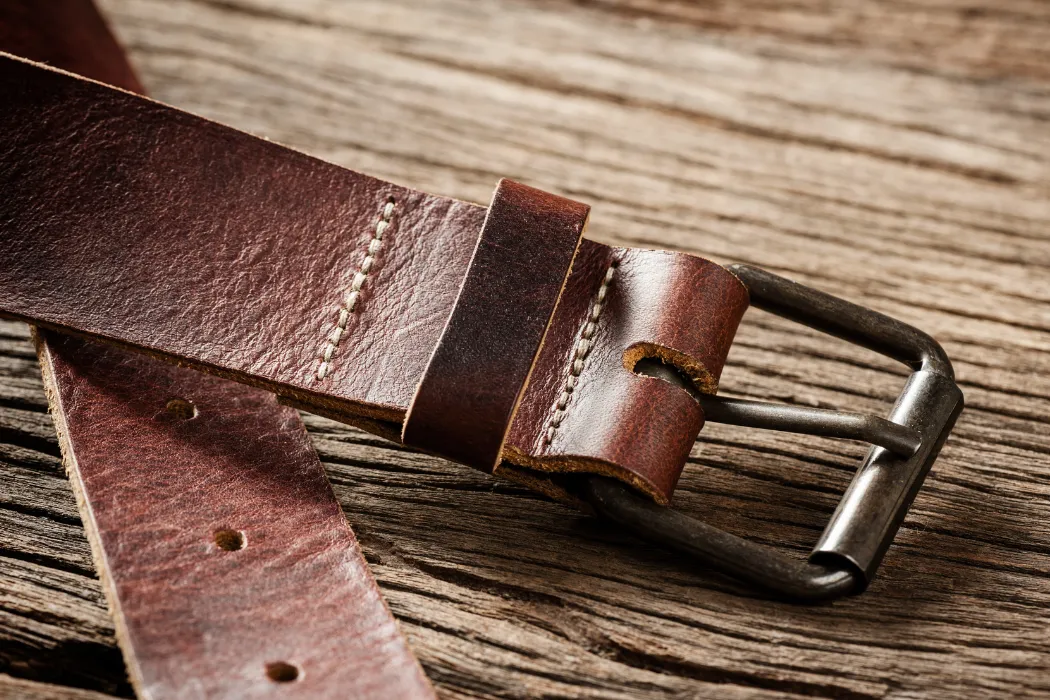
A precise leather belt manufacturing cost analysis is critical to preventing margin erosion. Focusing only on a raw Bill of Materials often leads to sourcing low-durability products, triggering costly warranty claims and eroding brand equity with every customer return.
This breakdown benchmarks costs against key quality standards, including LWG certified leather and salt spray tested hardware. We analyze how a supplier’s vertical integration and factory location affect your final unit price, helping you secure a scalable supply chain.
The BOM: Leather vs. Hardware vs. Labor
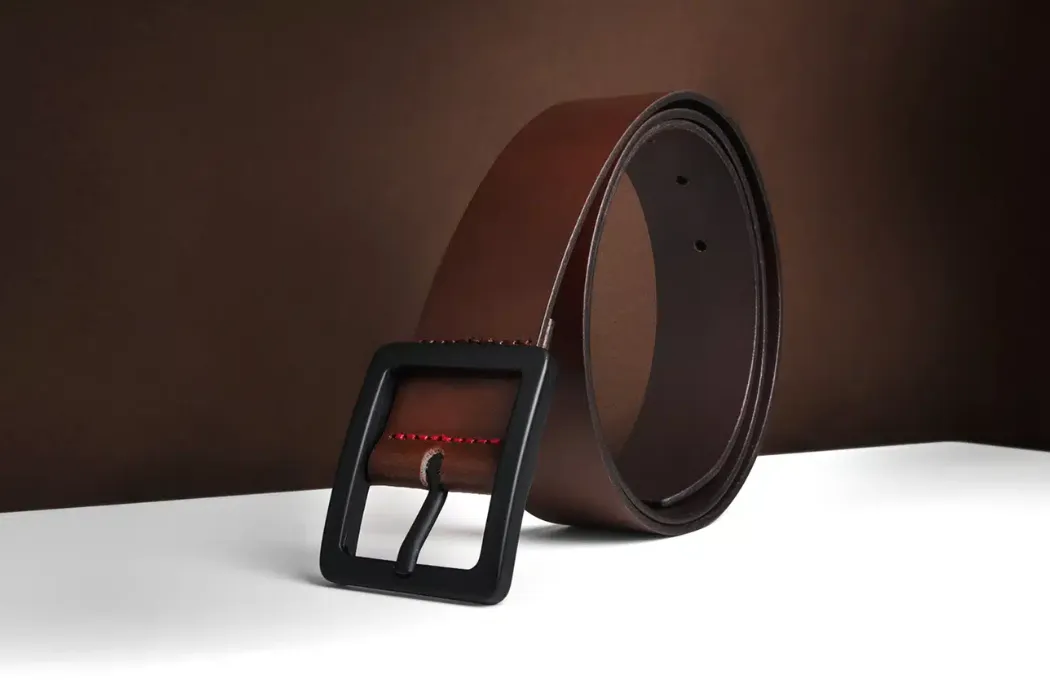
A belt’s unit price is a direct result of three variables: the grade and cutting yield of the leather, the material used for hardware, and labor complexity.
| Component | Key Cost Drivers | Unit Cost Impact |
|---|---|---|
| Leather | Grade (Full-Grain vs. PU), Tannery Certification (LWG), Cutting Yield/Wastage | High (Often 40-50% of total cost) |
| Hardware | Base Material (Zinc Alloy vs. Solid Brass), Plating/Finishing, Mold Opening Fees | Medium to High (Brass can cost 3x+ more than Zinc) |
| Labor | Assembly Complexity (e.g., hand-painting), Stitching detail, Manufacturing Location | Variable (Location can shift labor costs 30-40%) |
Leather: The Primary Material Cost
Leather is the single largest expense on a belt’s Bill of Materials, frequently making up 40-50% of the final unit cost. The price isn’t just about the material itself. It’s also about how much of that material you can actually use. Natural hides have blemishes, so the unusable waste, or cutting yield, directly inflates the effective cost per belt.
- Grade Dictates Price: Full-Grain leather sourced from LWG-certified tanneries costs significantly more than high-quality PU or bonded leather. Full-grain can run $4.50–$5.50 per square foot, while utility grades are closer to $2.50.
- Cutting Yield is Key: A natural leather hide might only have a 70% utilization rate. This means 30% of the material you pay for is discarded. Synthetic rolls offer much higher yield, leading to a lower effective cost per unit.
Hardware: Buckles, Loops, and Finishes
Buckles introduce massive cost variance. The choice between a standard zinc alloy buckle and a solid brass one can multiply the component cost several times over. This doesn’t even account for custom designs or specialized durability treatments that B2B clients require.
- Material and Tooling: A standard Zinc Alloy buckle might cost $0.60–$0.90 per unit. A solid brass equivalent starts at $2.50. If you need a custom shape, a one-time mold opening fee can range from $150 for zinc to over $500 for brass.
- Finishing Adds Value: We require all hardware to be anti-rust treated and pass strict salt spray testing. These processes guarantee durability for the end user but add to the component’s cost structure.
Labor: Assembly and Finishing Work
Labor isn’t just about putting a belt together. The cost scales directly with the number of “touches” required. Intricate, manual processes demand more time and skill, which is reflected in the unit price. Where that work happens is just as important.
- Complexity Drives Cost: A simple belt with a cut edge is cheap. A belt with hand-painted edges, complex stitching patterns, or detailed logo embossing requires more skilled labor and time.
- Location Creates Opportunity: Our dual-country manufacturing strategy allows for cost optimization. Production in our Cambodia facility can offer a 30-40% labor cost advantage for certain styles compared to China, along with potential duty-free benefits.
- Vertical Integration Stabilizes Cost: Our in-house Pro Pelli tannery in Cambodia gives us direct control over leather quality and finishing. This vertical integration helps manage material costs and consistency right from the start of the production chain.
How Leather Yield (70% vs 85%) Affects Price
Lower leather yield means more wasted material, directly increasing your cost per belt. A factory getting 85% usage from a hide buys far less leather than one getting only 70%.
Understanding Leather Yield: From Hide to Cut Parts
Yield is simply the percentage of a leather hide that a factory can actually turn into belt straps. No factory achieves 100% yield. Material loss is a built-in part of leatherwork because cutters must navigate around natural defects like scars, insect bites, or branding marks. Skilled workers also discard inferior sections of the hide, especially the stretchy belly area, to ensure every belt has consistent strength and won’t deform with use.
How Material Grade Determines Usable Yield
The type of leather you choose directly impacts the achievable yield. Premium Full-Grain leather, especially from LWG Certified tanneries, has a completely unaltered surface. This preserves the hide’s natural character but also means its yield is typically lower, around 70-75%. Cutters have to be more selective.
In contrast, lower-grade or corrected grain leather can produce a much higher yield, often up to 85%. Its surface is sanded down and coated to hide imperfections. This industrial process creates a uniform material that is easier to cut with less waste. This presents a clear trade-off for brand owners between raw material cost, final product quality, and brand positioning.
Calculating the Cost Impact: The Price of Waste
The math is straightforward. A factory operating at a 70% yield must purchase approximately 43% more raw leather to produce the same number of belts as a factory achieving 85% yield. This “wastage premium” is a major line item in your bill of materials and directly inflates the factory-direct price you pay.
Accepting a transparent wastage calculation is a sign of a good manufacturing partner. It means the factory is committed to using only the highest quality parts of the hide for your product. Resisting this cost often pressures a factory to use those inferior belly sections, leading to belts that stretch, warp, and ultimately damage your brand’s reputation.
Mold Costs: Zinc Alloy ($300) vs. Brass ($800)
Zinc alloy molds cost around $300 and are ideal for speed and budget projects. Brass molds cost about $800, a premium investment for durability and high-end collections.
Zinc Alloy Molds: The Cost-Effective Starting Point
A zinc alloy mold represents a lower one-time tooling investment, typically around $300. The material’s lower melting point allows for faster casting cycles and less complex tooling. This combination makes it the standard choice for projects that need to balance budget with customization. It’s particularly effective at capturing sharp details in complex or custom logo buckle designs.
This option is ideal for:
- Fashion-focused lines where designs change frequently.
- Initial market testing for a new buckle concept.
- Brands managing a tight budget for a new collection.
Brass Molds: The Premium Standard for Durability
A brass mold requires a higher initial investment, with a tooling cost near $800. You are paying for superior durability. Brass offers greater strength and natural corrosion resistance, resulting in a significantly longer mold lifespan compared to zinc alloy. The density of brass also imparts a heavier, more substantial feel to the final buckle, which enhances its perceived value.
This is the best choice for:
- Core product collections intended to be sold for years.
- Heavy-duty belts where hardware longevity is critical.
- Brands building a reputation based on premium quality and feel.
Making the Right Investment: Which Mold Fits Your Project?
The decision depends on your production volume, brand positioning, and business goals. The tooling cost is a fixed expense that you amortize over the entire production run. The more belts you produce, the lower the per-unit impact of the mold fee.
- Choose Zinc Alloy for: Flexible MOQs, achieving a faster speed-to-market, and projects where designs may evolve seasonally.
- Choose Brass for: Establishing a timeless core product, serving markets that demand high durability, or building a premium brand identity.
As part of our turnkey manufacturing service, our factory-direct model supports custom mold opening for both zinc alloy and brass. We can help you determine the best option to align with your project’s financial and quality targets.
Manufacture Premium Custom Belts at Scale
The Hidden Costs: Packaging, Testing & Duty
Final costs aren’t just materials. Budget for retail packaging, mandatory safety testing (REACH/CPSIA), and import duties, where factory location offers significant tariff savings.
Beyond the Polybag: The Cost of Retail Packaging
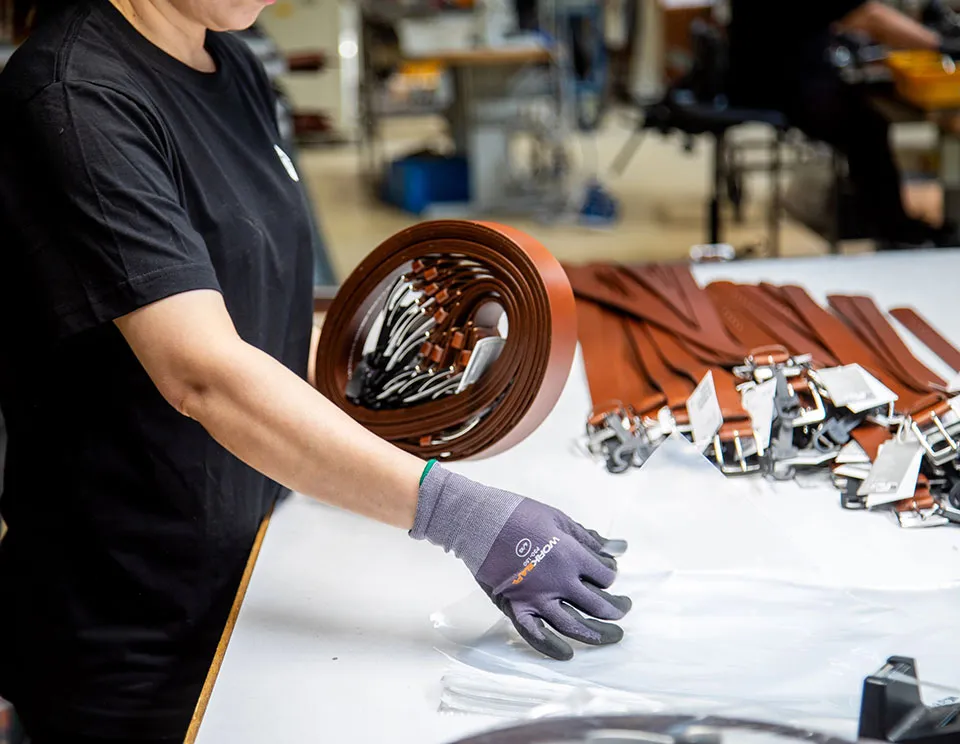
A belt’s final price isn’t set until the packaging is decided. The baseline cost includes our standard bulk packaging: each belt in an individual polybag, packed into 5-ply export cartons. This is the most cost-effective option for pure wholesale.
For private label brands building a retail presence, packaging is part of the product. Custom options add to the unit cost but create a much higher perceived value.
- Gift boxes for a premium unboxing experience.
- Printed hang tags to communicate brand story and product features.
- Belly bands to add branding directly to the belt itself.
Budgeting for Quality: Compliance & Durability Testing
Gaining market access isn’t free. Mandatory compliance testing is a non-negotiable cost for brands selling into the EU and US. We ensure all materials are REACH and CPSIA compliant, a process that can account for 10-15% of the final budget but protects your brand from recalls and fines.
Beyond compliance, we conduct our own durability checks to maintain a defect rate below 1%. This includes rigorous salt spray testing for all buckles to prevent rust and degradation. These QC steps are factored into the unit cost, but they prevent far more expensive problems down the line.
Calculating Tariffs: Import Duty and the Cambodia Advantage
The last major external cost is import duty. This is a tax your country levies on imported goods, calculated based on the product’s Harmonized System (HS) Code. For leather belts, the code is 42033000. Forgetting to budget for this can wipe out your margin.
This is where factory location becomes a strategic tool. Manufacturing in our Cambodia facility gives clients the ‘Cambodia Duty Advantage.’ For importers in specific regions, this can mean tariff-free access, potentially reducing your total landed cost by 15-20%. It’s a direct boost to your bottom line.
MOQ Impact: Why 300pcs is Cheaper than 50pcs
Ordering 300 belts instead of 50 can cut your unit cost in half. Fixed costs like a $300 buckle mold get spread thin, and we use entire leather hides without waste.
Clients often ask why they can’t just order 50 belts at the same unit price as a 300-piece run. The answer isn’t about supplier preference; it’s about hard manufacturing math. While we offer flexible MOQs to help growing brands, understanding the 300-piece benchmark is critical for your long-term margins. The cost difference between a small workshop run and an efficient industrial order is stark.
| Metric | Workshop Run (50 pcs) | Industrial Run (300 pcs) |
|---|---|---|
| Amortized Setup Fee | ~$6.00/unit | ~$1.00/unit |
| Material Sourcing | Inefficient (Deadstock/Waste) | Efficient (Full Hide Use) |
| Labor Flow | Stop-Start Cycles | Optimized Rhythm |
| Estimated Unit Cost | ~$15.00 | ~$7.00 |
The Role of Fixed Costs: Setup and Amortization
Every custom production run has one-time setup costs. A custom buckle mold, for instance, might be a fixed $300 fee. For a 50-piece order, that adds $6 to every single belt. But on a 300-piece order, it adds only $1. This principle, amortization, applies to everything from creating cutting patterns to machine setup. Spreading these fixed costs over a larger volume drastically lowers your per-unit price.
Material Efficiency: Full-Hide Utilization
We source genuine leather from LWG-certified tanneries in large, irregular hides, typically 20-25 sq. ft. each. A 300-piece order is large enough to plan cuts across multiple full hides, achieving high material yield (75% or more) and consistent quality. A 50-piece order is too small to justify using a full hide. This forces the use of expensive leftover pieces (deadstock) or creates significant waste, driving up your material cost. Sourcing from deadstock also risks color and finish inconsistencies across your products.
Labor Optimization and Production Flow
Setting up a production line for cutting, stitching, and finishing takes a fixed amount of time. It doesn’t matter if we’re making 50 belts or 300. With a larger run, our workers get into a rhythm, maximizing efficiency and minimizing downtime between tasks. Small batches are plagued by constant stop-and-start cycles, which inflates the total labor time allocated to each individual belt, and that cost gets passed on to you.
How to Value Engineer to Target Price
Hitting a target price means making smart trade-offs. Balance leather and buckle materials, use manufacturing locations for duty advantages, and adjust finishing details and packaging.
Strategic Material & Hardware Trade-Offs
The bill of materials (BOM) for a belt is driven almost entirely by the leather and the buckle. Small changes here have the biggest impact on the final unit price.
- Leather Selection: The fastest way to lower cost is to swap Full-Grain leather for more economical options like Split Leather, Recycled Leather, or high-quality PU. Full-grain can cost over $4.50 per square foot, while utility grades or splits are closer to $2.50.
- Hardware Choices: Opting for Zinc Alloy buckles over Solid Brass is a major cost-saver. A zinc buckle might cost $0.60–$0.90 per unit, but an equivalent in solid brass can easily be $2.50 or more.
- Yield Optimization: Material waste from cutting can account for 40-50% of your unit cost. Working with a factory to improve the cutting yield on a hide is a direct way to reduce the amount of leather you pay for.
Adjusting Construction and Finishing Details
The small details in the manufacturing process add up. Deciding which finishing steps are essential for your market and which are just “nice-to-haves” is key to hitting a price target.
- Edge Finishing: A premium belt might get three coats of edge paint with sanding in between. Reducing this to a standard single coat significantly cuts down on labor and material costs.
- Stitching Complexity: Intricate stitching patterns require more time and setup. Using a simple, straight stitch with standard heavy-duty nylon thread is more efficient and lowers cost.
- Plating Standards: For buckles, barrel plating is cheaper than rack plating. The trade-off is durability—it may not pass a 24-hour salt spray test. You must decide if that standard is critical for your customer.
Leveraging Manufacturing Location
Where your belts are made directly affects the final landed cost. Our dual-country factory setup is designed to give you strategic options.
- China vs. Cambodia: We use our China factory for complex initial development. Once the design is locked, we can shift large-scale production runs to our Cambodia factory to take advantage of lower labor costs.
- Cambodia Duty Advantage: For clients in the US, Canada, and parts of the EU, manufacturing in Cambodia may offer significant tariff savings. This can reduce the final landed cost by 15-20% compared to producing in China.
- Vertical Integration: Our in-house leather finishing facility in Cambodia, Pro Pelli, gives us direct control over material costs. This allows us to create custom, cost-effective leather finishes without relying on third-party tanneries.
Optimizing Packaging and Order Volume
Price-per-unit is also a game of logistics and scale. How belts are packed and how many you order at once can be adjusted to fit a budget.
- Packaging Choices: Custom retail-ready gift boxes and hang tags add cost. Opting for standard factory packaging—an individual polybag per belt, packed in 10-piece inner boxes—is the most economical route.
- MOQ Impact: Economies of scale are real. Increasing an order from 300 pieces to 1,000 pieces allows for better material pricing and more efficient production setups, directly lowering the price-per-unit.
- Compliance Testing: Instead of testing every single SKU for REACH and CPSIA compliance, you can batch-test common materials across multiple styles. This consolidation saves money while ensuring your products meet market regulations.
Final Thoughts
While generic belts offer a lower upfront cost, relying on untested hardware and non-compliant materials creates significant risk. Our REACH & CPSIA compliant standard with salt spray tested hardware eliminates product returns and protects your margins. This is an investment in dealer trust, not just a line item.
Don’t guess on quality—verify it. We offer 2-7 day fast sampling so you can inspect our LWG-certified leather and hardware finish firsthand. Contact our team to get a factory-direct quote for your next private label collection.
Frequently Asked Questions
How much does it cost to manufacture a leather belt?
The cost to manufacture a leather belt varies widely depending on material quality, hardware, order quantity, and labor. Key factors include the choice between genuine leather (like LWG-certified) and PU, the buckle material (zinc alloy vs. brass), and production volume. While general case studies show wholesale prices from $9.95 to over $22.95, a final price is determined by your specific design and Bill of Materials (BOM).
What is the typical markup on leather belts?
Markup can range from 2x to 10x the manufacturing cost. Direct-to-consumer (DTC) craft brands often use a 2-3x markup. In contrast, luxury brands may apply an 8-10x markup to account for branding and marketing. The wholesale markup is generally lower, often around 1.2x to 1.8x the production cost.
How much does a custom belt buckle mold cost?
A custom buckle mold is a one-time tooling investment. For a zinc alloy buckle, the mold typically costs around $300. For a higher-quality solid brass buckle, the cost is around $800. This fee covers the creation of a unique mold for your custom buckle design and logo.
How is the landed cost of imported belts calculated?
The landed cost is the total price of getting a product to your warehouse. The formula is: Landed Cost = EXW Unit Price + Shipping Costs + Import Duties. Sourcing location matters; for example, manufacturing in Cambodia can offer significant duty savings for importers in some regions compared to other countries.
Does ordering a larger quantity reduce the unit cost?
Yes, ordering in larger quantities significantly reduces the per-unit cost. Fixed costs like mold fees and production line setup are spread across more units, making each belt cheaper to produce. An order of 300 pieces, for example, will have a much lower unit price than an order for 50 pieces due to these economies of scale.