Designing a leather belt that feels comfortable and looks sleek is a difficult challenge for many brands. Heavy belts often feel stiff around the waist, but thin belts stretch and break easily over time.
Leather splitting and precision skiving solve this exact problem in manufacturing. Splitting slices a thick, heavy raw hide into thinner, uniform layers across the entire surface. Then, precision skiving shaves down specific edges of the leather strap. This targeted thinning makes the ends thin enough to fold neatly around metal buckles. Because the edges are thin, the assembly process does not create uncomfortable, bulky lumps.
Tapered belts usually need complex 3D profiles to fit perfectly through belt loops. Factories must rely on these specific cutting techniques to achieve that smooth, elevated shape. So, understanding how splitting and skiving work helps designers create better, longer-lasting accessories. Let us explore the mechanical steps and quality controls behind these essential leather manufacturing processes.
What Is Leather Splitting in Belt Manufacturing?
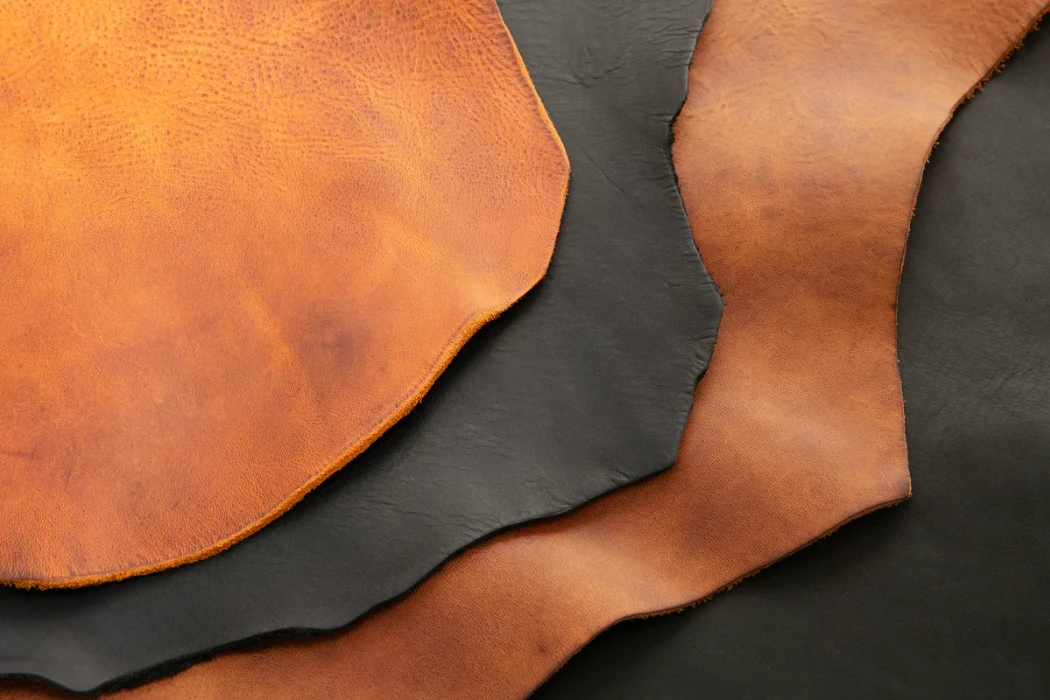
Leather splitting is a mechanical process that cuts a thick animal hide into two or more horizontal layers. A machine uses a fast, rotating blade to slice the leather from edge to edge. The top layer becomes strong full-grain leather, and the bottom layer becomes suede or split leather. This step is critical because it gives the belt a completely flat and uniform thickness.
The Core Purpose of Leather Splitting
Splitting machines act as the foundation of belt manufacturing because they ensure the entire leather hide has an identical thickness from top to bottom before any other work begins.
- Raw cow hides naturally vary in thickness depending on the animal’s age and diet, often ranging wildly from 4.0mm at the neck down to a much thinner 2.5mm at the belly.
- The splitting machine uses high-pressure rollers to flatten the hide, and then sets a strict cutting tolerance to shave the leather down to a precise 3.0mm or 3.5mm for standard daily belts.
- This mechanical blade removes the loose, fibrous, and uneven bottom layer completely, so the back of the finished belt will feel perfectly smooth against clothing and skin.
- By separating the top grain from the bottom split, factories can repurpose the bottom layer for suede products, which reduces material waste significantly.
Creating this uniform thickness across the whole strap stops the belt from stretching unevenly when a person wears it tightly around their waist.
Understanding Grain Direction and Cutting
Engineers must align the heavy leather hide very carefully before they feed it into the massive splitting blade.
- Leather fibers possess a strong natural grain direction, and cutting against this natural flow damages the structure and weakens the final strap by up to 30%.
- Skilled operators always feed the leather into the machine parallel to the animal’s backbone line to keep the internal fibers intact and strong.
- The heavy steel splitting blade spins at incredibly high speeds, often exceeding 400 RPM, because a slow blade will pull and tear the delicate fibers instead of slicing them.
- The machine also sprays a light mist of water or lubricating oil onto the blade so it glides smoothly through the dense animal hide without causing friction burns.
Proper grain alignment and clean cutting guarantee the belt will hold heavy buckles and resist cracking when it bends sharply.
Inspecting Raw Hides for Thickness Consistency
Quality control teams inspect the split leather surfaces immediately after the hide exits the fast cutting machine.
- Workers use precise digital calipers to measure the left edge, right edge, and the direct center of the hide, actively checking for any thickness variations larger than 0.2mm.
- Inspectors look very closely at the newly exposed grain for hidden natural imperfections, like deep scars or old insect bites, that the splitting blade might suddenly uncover.
- They run their bare hands over the texture of the newly cut bottom surface to confirm the blade remained perfectly sharp and left no deep grooves.
- If a hide shows inconsistent thickness, technicians instantly recalibrate the machine’s tension rollers so the next batch of leather cuts perfectly flat.
Catching these tiny thickness errors early stops weak or defective leather from moving forward into the complex edge skiving phase.
How Does Precision Skiving Work for Leather Belts?
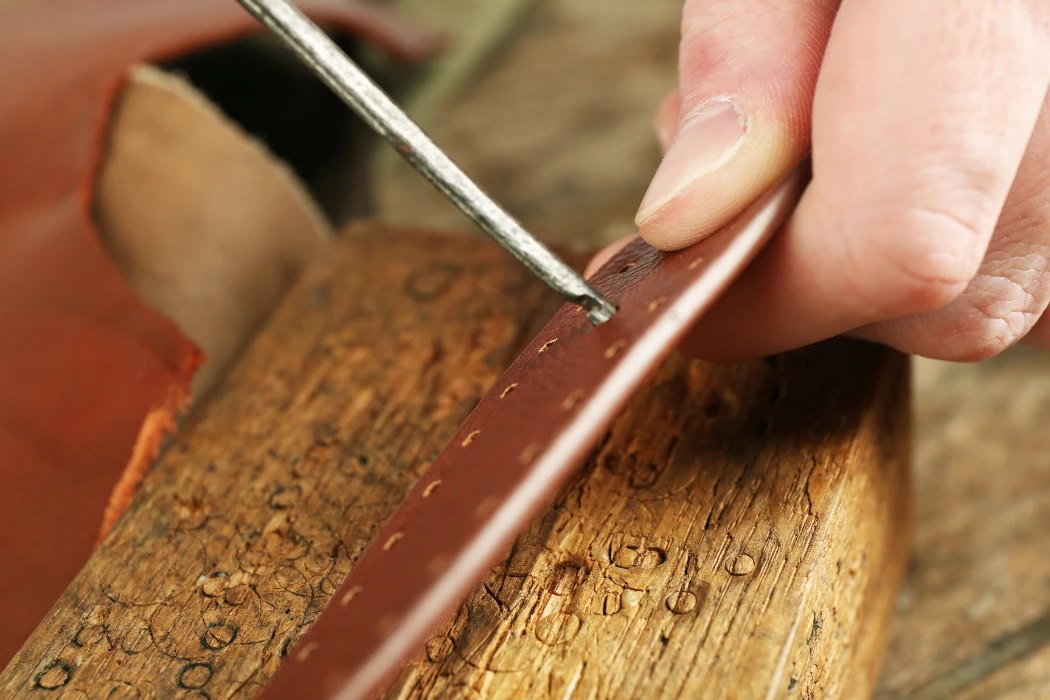
Precision skiving is a targeted cutting process that shaves down only the specific edges or ends of a leather belt. Unlike splitting, which thins the whole hide horizontally, skiving tapers the leather at a specific angle. Operators use a bell-knife skiving machine to remove bulk from the folding points around the buckle. This creates a flexible, thin edge that folds perfectly without adding ugly, uncomfortable bumps to the finished belt.
The Mechanics of the Skiving Machine
The bell-knife skiving machine uses a unique circular blade to shave the leather precisely where it needs to bend.
- The spinning blade operates at a sharp angle, usually set between 10 degrees and 25 degrees, depending on the required taper.
- Operators feed the edge of the stiff 3.5mm leather strap into the machine, and a small metal presser foot holds the material firmly in place.
- The sharp bell-shaped knife shaves off a tiny, angled strip of leather, reducing the edge thickness down to exactly 1.2mm or 1.5mm.
- Machines often feature an integrated grinding wheel that sharpens the blade constantly while it spins at 1200 RPM, so it never rips the delicate edges.
This precise, angled cut allows the heavy leather to transition smoothly from a thick center to a thin, flexible edge.
Thinning the Edges for Seamless Assembly
Assembly workers absolutely rely on this skiving step to fold and stitch the belt parts together cleanly.
- When a buckle requires a leather fold, folding a raw 3.0mm strap creates a massive 6.0mm block of stiff leather that looks terrible.
- By skiving the folding end down to 1.0mm, the folded section only measures 2.0mm thick, so it sits flat against the waist.
- Skiving also removes the top grain layer specifically at the glue joints, which increases the liquid adhesive’s bond strength by more than 50%.
- Workers carefully skive the belt tip as well, so it slides easily into the tiny 5.0mm gap of the metal belt loop without jamming.
Proper thinning prevents bulky joints, so the final belt maintains a sleek, professional appearance from the buckle to the tip.
Why Tapered Belt Ends Need Precise Skiving
Tapered belts require extra skiving because their complex shapes must look elegant and feel completely comfortable.
- Many high-end fashion belts taper down from a wide 40mm body to a narrow 25mm tip, and the thickness must reduce gradually to match the visual proportion.
- If the manufacturer leaves the narrow tip at the full 3.5mm thickness, the design looks completely wrong and the tip feels extremely rigid.
- Technicians use specialized computerized skiving machines to program a gradual thickness reduction that spans exactly 15 centimeters along the tapered end.
- This gentle slope removes up to 40% of the leather’s mass at the tip, so the belt fastens smoothly and lies beautifully flat against the trousers.
Creating this perfect gradient requires highly calibrated machines, but it directly controls how luxurious the finished accessory feels to the touch.
| Feature | Leather Splitting | Precision Skiving |
|---|---|---|
| Primary Purpose | Thins the entire leather hide horizontally. | Thins only specific edges or folding points. |
| Machine Type | Band knife splitting machine with heavy rollers. | Bell-knife machine with a small circular blade. |
| Cutting Area | 100% of the hide’s surface area. | Usually 5% to 10% of the belt’s total area. |
| Target Thickness | Creates a uniform base, e.g., exactly 3.0mm. | Creates a gradient or thin edge, e.g., down to 1.0mm. |
Why Do Tapered Belts Require Complex 3D Profiles?
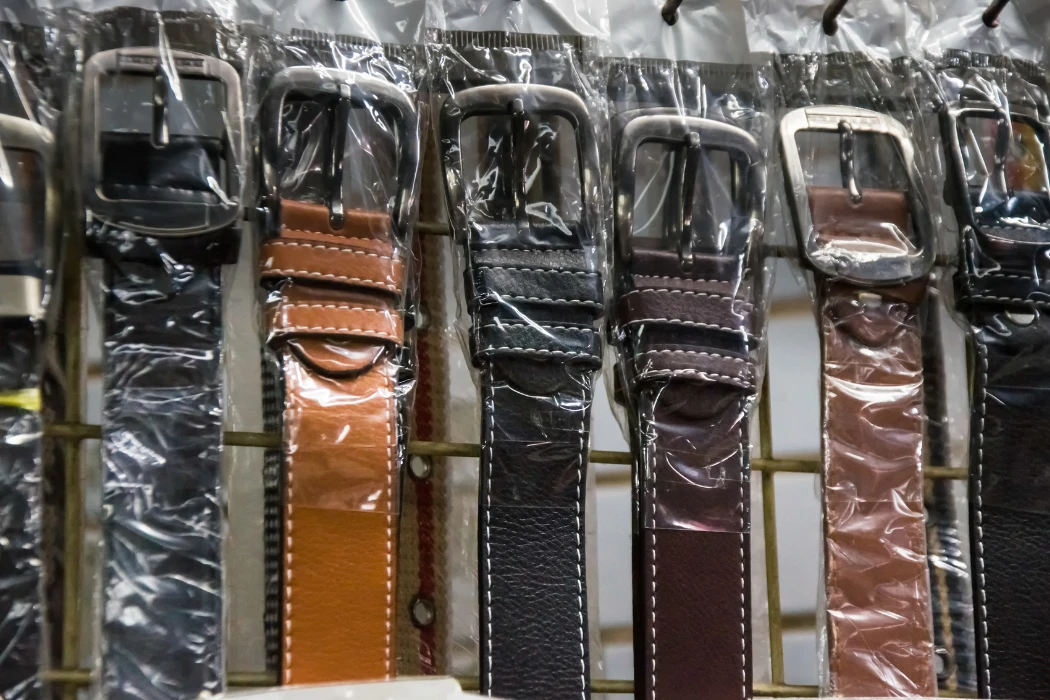
Tapered belts need complex 3D profiles because flat leather often looks cheap and feels stiff around the waist. To fix this, engineers build up the center of the belt while keeping the edges incredibly thin. This domed profile adds luxurious visual depth and structural strength exactly where the belt bends. Complex skiving techniques allow the heavy leather to transition smoothly down to a narrow tip without losing its elegant shape.
Creating Domed and Raised Belt Structures
Luxury belts rarely use a single flat piece of leather because a raised center looks much more sophisticated.
- Technicians insert a specialized filler material, often exactly 2.0mm thick, directly into the center of the leather strap.
- The bell-knife skiving machine then shaves the outer leather edges down to 0.8mm so they wrap tightly around the bulky center core.
- This contrast creates a classic domed effect, pushing the center thickness to 4.5mm while keeping the folded edges thin and flexible.
- A domed shape prevents the belt from creasing deeply when a person sits down, increasing the lifespan by at least 40%.
Wrapping thin skived leather over a raised core creates a beautiful 3D profile that flat leather simply cannot match.
Managing Layers of Linings and Backings
High-quality tapered belts actually contain multiple layers of different materials stacked together.
- A premium belt usually features a 1.5mm top grain leather face, a flexible internal stiffener, and a soft 1.2mm nubuck backing.
- If factories stack these layers without skiving, the final edge becomes a massive 4.0mm block that feels rigid and uncomfortable.
- Engineers use precision splitting machines to thin the internal stiffener specifically at the tapered tip, dropping the internal volume by 50%.
- Then, they apply liquid adhesive and press the layers under high-pressure heated rollers to bond them securely.
Controlling the thickness of each internal layer ensures the tapered end remains flexible enough to glide through metal buckles.
Ensuring Even Stitching on Tapered Profiles
Sewing complex 3D shapes requires absolutely consistent edge thickness along the entire tapered gradient.
- Heavy industrial sewing machines guide needles through the leather edges at precise speeds of 800 stitches per minute.
- If the skived edge suddenly jumps from 1.0mm to 2.5mm thick, the machine needle will deflect, bend, or break entirely.
- Uneven thickness also causes the stitching line to wander, creating terrible visual flaws along the delicate 25mm tapered tip.
- Engineers measure the skived edges with digital tools to guarantee a strict 0.1mm tolerance before any stitching begins.
Maintaining a perfectly uniform edge profile allows the sewing machine to lock every stitch tightly and beautifully.
How Does Quality Control Monitor Skived Belt Edges?
Quality control monitors skived belt edges by physically measuring the leather and testing its strength. Inspectors use digital tools to check the exact thickness of every cut. They also bend the leather to ensure the thin edges do not crack. Because precise skiving removes a lot of material, rigorous testing guarantees the belt remains strong enough to hold a metal buckle securely every single day.
Monitoring Cutting Accuracy and Waste
Engineers strictly monitor the skiving machines because inaccurate cutting ruins expensive leather very quickly.
- Inspectors use digital calipers to measure the skived edge, demanding a strict tolerance of just 0.1mm.
- If the blade cuts too deeply, it destroys the top grain, which reduces the belt’s structural strength by over 30%.
- Workers also weigh the removed leather scraps constantly to calculate the exact material waste.
- A highly calibrated machine usually keeps scrap waste below 8% per production run.
Catching cutting errors immediately saves raw materials and keeps the assembly line moving smoothly.
Checking Edge Finishing and Texture
Quality teams physically inspect the shaved leather surface so it feels perfectly smooth against the skin.
- A dull skiving blade often leaves deep scratches or rough fibers on the leather surface.
- Inspectors run their bare fingers along the tapered 15 centimeter tip to find any hidden bumps.
- They also verify the angle of the cut matches the exact 15 degree slope specified in the design blueprint.
- Smooth edges are essential because rough textures will completely reject the liquid edge paint applied later.
Perfectly smooth skived edges guarantee the final painted belt looks clean and highly professional.
Testing Belt Durability and Tensile Strength
Thinning the leather always removes strength, so engineers must test the final folded edges heavily.
- Technicians place the skived belt tip into a tensile testing machine and pull it with extreme force.
- The thinned edge must withstand at least 15 kilograms of direct pulling force without tearing.
- Inspectors also fold the skived edge completely flat and apply heavy pressure for 24 hours.
- When they release the pressure, the folded leather must bounce back without showing any deep cracks in the top grain.
These brutal physical tests ensure the thin tapered edges will survive years of daily bending and pulling.
| Inspection Type | Tool Used | Target Metric |
|---|---|---|
| Thickness Accuracy | Digital Caliper | Strict ±0.1mm tolerance along the edge. |
| Surface Smoothness | Visual & Touch Check | Zero visible blade marks or loose fibers. |
| Tensile Strength | Pull Testing Machine | Must withstand 15 kg of direct pulling force. |
| Fold Endurance | Crease Press | Zero grain cracking after 24 hours of flat folding. |
Which Materials Respond Best to Skiving and Splitting?
Full-grain and top-grain cow leathers respond best to splitting and skiving because their dense internal fibers hold sharp edges perfectly. Suede and nubuck also cut well but require sharper blades to avoid tearing. Artificial materials like PU leather and bonded leather need lower machine speeds because fast friction melts their plastic layers. Matching the machine settings to the specific material ensures clean cuts and strong edges.
Skiving Full-Grain and Top-Grain Cow Leather
Premium cow hides feature incredibly dense fiber structures that cut very cleanly.
- Full-grain leather requires heavy steel splitting rollers because the hide density often exceeds 0.9 grams per cubic centimeter.
- The bell-knife skiving machine slices top-grain leather easily, leaving a perfectly smooth edge that bonds with liquid adhesive in 15 seconds.
- Because top-grain fibers remain tightly packed, the skived 1.0mm edge retains 85% of its original tensile strength.
- Operators can push full-grain leather through the skiving machine at high speeds of 20 meters per minute without causing any fiber damage.
These dense natural fibers create the sharpest, strongest tapered edges for luxury belt designs.
Handling Suede and Nubuck Variations
Suede and nubuck possess softer, looser fibers that behave differently under a fast cutting blade.
- When splitting suede, technicians must sharpen the band knife every 2 hours because dull blades will stretch the soft leather instead of cutting it.
- Skiving a soft 2.5mm nubuck strap requires reducing the machine pressure by 30% so the feed roller does not crush the delicate surface texture.
- Because suede fibers pull apart easily, the skived edge thickness should never drop below 1.2mm to prevent tearing during assembly.
- Workers often apply a temporary stiffening tape to the back of the suede before feeding it into the spinning 1200 RPM skiving blade.
Adjusting the blade sharpness and roller pressure prevents these soft materials from fraying during the cutting process.
Processing Split Grain and PU Leather Alternatives
Synthetic layers and split grain materials require strict temperature controls during mechanical cutting.
- High-quality PU leather contains plastic layers that will melt if the skiving blade friction exceeds 60 degrees Celsius.
- To prevent melting, operators slow the bell-knife rotation down to 800 RPM when processing artificial or vegan leather belts.
- Split grain leather often features an artificial painted top layer. So, the skiving blade must cut at a shallow 10 degree angle to avoid chipping the paint.
- Bonded leather creates a lot of dust during splitting, so factories install heavy vacuum systems that remove 99% of the airborne particles.
Controlling heat and friction allows machines to shape affordable synthetic materials just like real natural leather.
How thick should a leather belt be?
A standard daily leather belt should measure between 3.0mm and 3.5mm thick. Heavy-duty work belts often reach 4.0mm, while dress belts are thinner at 2.5mm to remain flexible.
Why do leather belt edges crack?
Leather belt edges crack when factories fold thick leather without skiving it first. Bending a stiff 3.5mm edge places massive stress on the top grain, causing the fibers to snap over time.
What is the exact difference between a split and a skive?
Splitting cuts the entire leather hide horizontally to create one flat, uniform thickness. Skiving only shaves down specific edges or ends at an angle to help the leather fold neatly.
Can you skive full-grain leather?
Yes, you can skive full-grain leather easily. Because full-grain leather has very dense and strong fibers, it cuts cleanly and holds a sharp, tapered edge better than any other material.
How do you finish a skived leather edge?
Factories finish a skived edge by folding it, gluing it flat, and sewing it tight. Then, they apply layers of liquid edge paint and burnish the edge at 500 RPM for a smooth seal.
Does skiving weaken the leather belt?
Skiving does remove material, so it naturally reduces the edge strength. But engineers only skive the specific 15 centimeter sections that overlap, so the finished, stitched joint remains incredibly strong.
Elevating Belt Design with Precision Engineering
Mastering leather splitting and precision skiving transforms heavy raw hides into elegant, durable accessories. Splitting guarantees a perfectly uniform base thickness across the entire strap. Then, targeted edge skiving creates sleek 3D profiles and prevents bulky, uncomfortable joints. Testing these thinned edges ensures they can withstand years of daily tension. For fashion brands seeking these exact strict manufacturing standards, Hoplok Leather provides the ultimate turnkey solution. We combine advanced machinery with decades of expertise to craft premium custom leather goods that elevate your brand’s reputation.