In today’s competitive accessories market, B2B buyers need men’s leather belts that meet diverse lifestyle demands—bridging the gap between formal refinement and rugged durability. Yet, balancing these needs requires precision: from standardized widths around 35 mm that suit both dress trousers and denim, to buckle engineering that aligns with global sizing norms across the US and EU. Without clear technical benchmarks, brand consistency and production efficiency quickly falter.
This article outlines the key technical specifications that define scalable, high-demand men’s leather belt lines. It explores critical specs like 1–1.5 inch formal widths versus 1.5–1.75 inch casual profiles, global sizing methods (US inch-based vs. EU 5 cm increments), and the mechanics behind pin versus ratchet buckle systems. Whether you’re refining design standards, sourcing materials, or scaling manufacturing, this guide delivers data-backed insights for developing a cohesive, market-ready belt program.
How to design a men’s belt line that balances formal and casual needs?
Balancing formal and casual belt needs involves selecting versatile widths (around 35mm), mixing formal materials like full-grain smooth leather with casual textures, and designing modular buckle systems. A well-planned line covers dress, business-casual, and weekend aesthetics in unified proportions.
Core design principles for bridging formal and casual aesthetics
Formality in men’s belts is shaped through proportion, surface texture, and finishing details. Each design element contributes to the perceived dressiness or casualness of the product, defining where it fits in a man’s wardrobe.
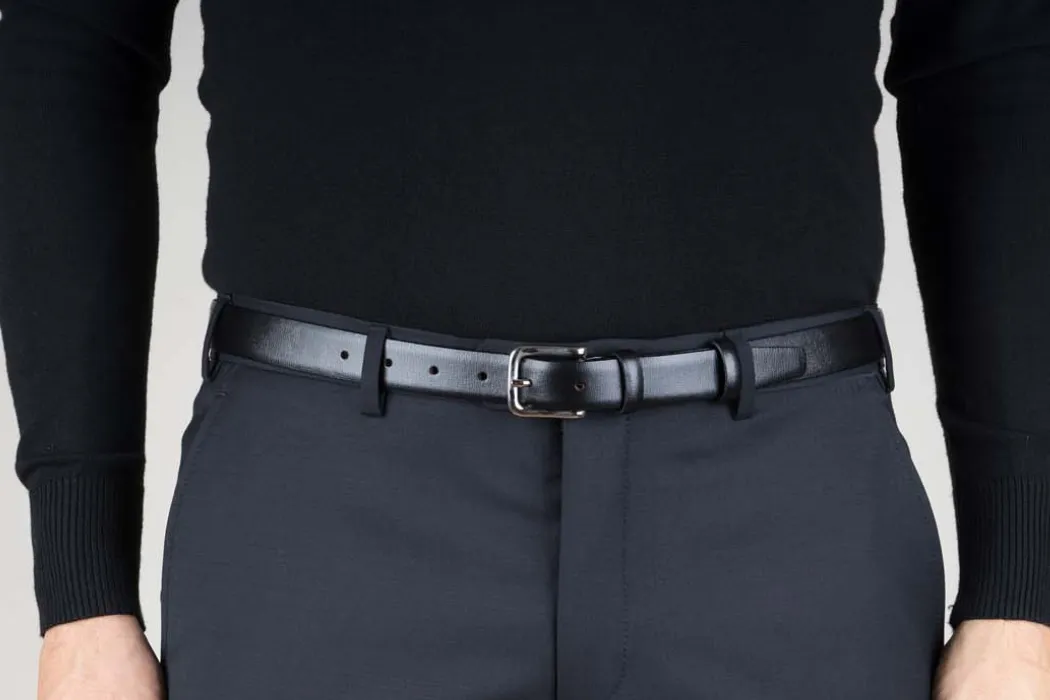
- Formal belts maintain narrow widths (25–32mm) with smooth full-grain or top-grain leather and polished buckles to convey refinement.
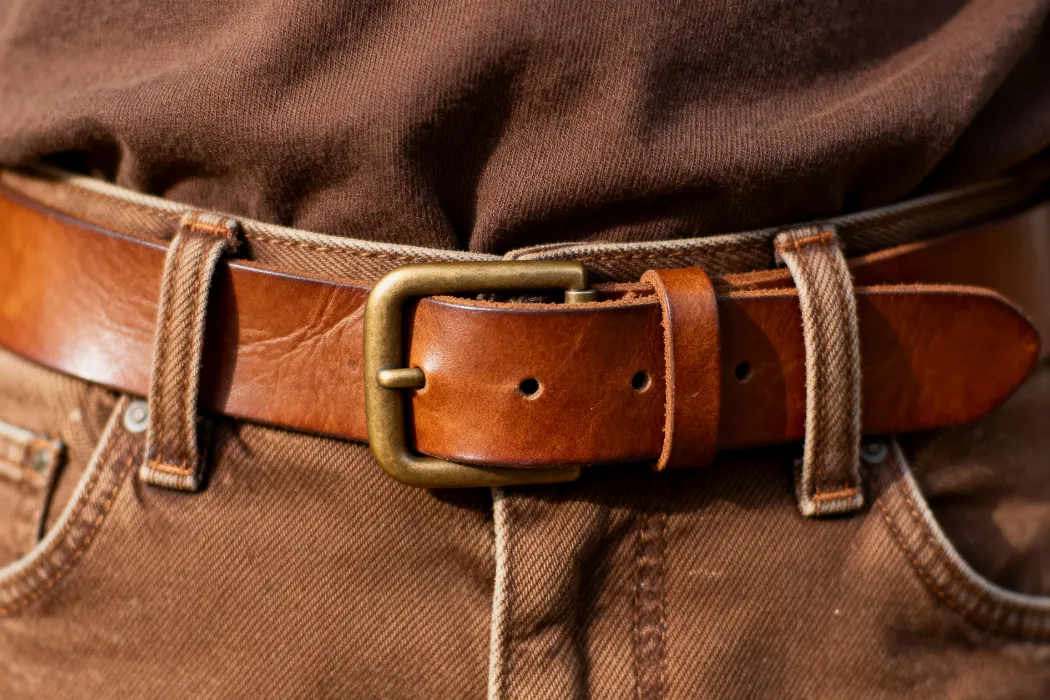
- Casual belts expand to 38–44mm, often in grainy, matte, or suede textures with larger, brushed or plate buckles.
- A 35mm strap serves as the transitional width for business-casual or smart-casual appeal.
- Edge treatments—stitched flattened edges for formal versus raw or plain for casual—reinforce design language without changing core structure.
These proportional relationships allow the same collection to serve multiple contexts—suiting, chinos, or denim—without fragmenting design language, supporting a cohesive line that still meets diverse lifestyle needs.
Technical specifications and modular features for a balanced belt line
Balancing formal and casual functionality also requires dimensional precision and thoughtful engineering. The following specifications ensure functional compatibility and consistent visual coherence across the line:
- Typical overlap width: 30–35mm (1.2–1.4″), enabling compatibility with most pant loops and supporting both dress and denim styles.
- Buckle dimensions range from 1.5–2″; polished frame styles for formal lines, matte or ratchet mechanisms for business-casual convenience.
- Use consistent sizing logic: belt length equals pants size plus 2″ with middle-hole alignment to optimize fit.
- Manufacturing integration at certified facilities such as Hoplok’s ISO 9001 and BSCI plants ensures quality uniformity across both formal and casual product variants.
When paired with modular buckle systems or reversible strap designs, these technical standards create a platform for interchangeable styling—letting users move between formal and casual aesthetics with minimal product differentiation.
Research sources consistently place the 30–35mm width range as the optimal overlap between dress and leisure styles. Material sheen, texture variation, and proportional consistency—rather than distinct materials—are the subtle mechanisms that merge these style territories into one coherent belt line.
What are the standard sizing and width specs for global men’s markets?
Men’s belt sizing varies globally: US markets use inch-based systems where belts are 1–2 inches longer than pant waists, while EU markets use centimeter ranges. Width standards divide belts into formal (1–1.5 in.) and casual (1.5–1.75 in.) categories. Measurements are taken from buckle fold to center hole for consistent fit.
| Region / Category | Measurement System | Typical Range & Notes |
|---|---|---|
| US / UK | Inches; belt = pant waist + 1–2 inches | Even sizes from 30″–46″; measured from buckle fold to middle hole |
| EU (Continental) | Centimeters; 5 cm increments | 80–120 cm typical; corresponds roughly to 32″–46″ pants |
| Formal Belts | 1–1.5 in. (2.5–3.8 cm) | Slimmer appearance; suited for suits and small waists |
| Casual Belts | 1.5–1.75 in. (3.8–4.4 cm) | Heavier buckles and jeans-appropriate proportions |
Global Belt Length Standards and Conversion Rules
Belt length conventions differ between regional markets, which can make conversions slightly confusing for international buyers. The US and UK rely on an inch-based system, while the EU uses centimeter measurements in clear 5 cm steps. Despite the difference in units, the logic of measuring and fitting remains remarkably consistent worldwide.
- US/UK sizing: Belt size equals pant waist size + 1–2 inches (e.g., 40″ pants → 41–42″ belt).
- EU sizing: Uses a centimeter-based scale with 5 cm increments (80–120 cm), each roughly matching 2-inch waist jumps.
- Belts are measured from the buckle fold to the middle hole, not tip to tip, to ensure sizing consistency.
- Rule of thumb: Total belt length is about 15–25% longer than waist circumference.
Across premium leather brands, you’ll see subtle variations but consistent logic. US and UK brands use even inch sizes like 34″ or 36″, whereas EU systems focus on direct body metrics—offering metric alignment with trouser sizes. Many luxury manufacturers, such as those in Germany and Italy, emphasize measuring from the buckle fold to the center hole to standardize between regions.
Width Specifications for Formal and Casual Belt Categories
Width is an essential part of a belt’s design, affecting both aesthetic balance and functional use. Generally, lightweight slimmer belts complement formal attire, while wider styles pair with more robust fabrics like denim or canvas.
- Formal belts: Typically 1–1.5 inches (2.5–3.8 cm) wide — slimmer widths under 1.25 inch complement tailored suits and smaller waists.
- Casual belts: Broader, ranging from 1.5–1.75 inches (3.8–4.4 cm), best suited for denim or heavier fabrics.
- A standard overlap of 2–3 holes ensures comfortable adjustability without breaking design symmetry.
- Wider belts require proportionally larger buckles; some designs incorporate tapers from 1.25″ to 1″ near the buckle.
Most manufacturers avoid strict adherence to mechanical standards like tensile ratings, instead focusing on visual proportion and user comfort. The common denominator worldwide is an emphasis on proportion—balancing the belt width to the trouser loop size and formality of the outfit.
Why is the choice between pin buckles and ratchet systems critical?
The choice between pin buckles and ratchet systems is critical because they fundamentally differ in fit precision, wear patterns, and mechanical design. Pin buckles offer a traditional aesthetic with fixed holes, while ratchet systems use fine incremental tracks for micro-adjustments and improved durability.
| Mechanism Type | Adjustment Method | Durability & Wear Pattern |
|---|---|---|
| Pin Buckle | Fixed prong inserted through pre-punched holes spaced 0.5–1 inch apart | Localized wear around holes; traditional simplicity but limited precision |
| Ratchet System | Track-based micro-adjustments with ~1/8 inch increments via spring-loaded mechanism | Even tension distribution; improved durability though sensitive to debris exposure |
Functional Differences Between Pin and Ratchet Buckles
Pin and ratchet buckles diverge primarily in how they manage tension and fit precision. Pin buckles use a classic prong-and-hole system, while ratchets rely on a mechanically engineered track for incremental control. Each offers distinct benefits aligned with user preferences and attire context.
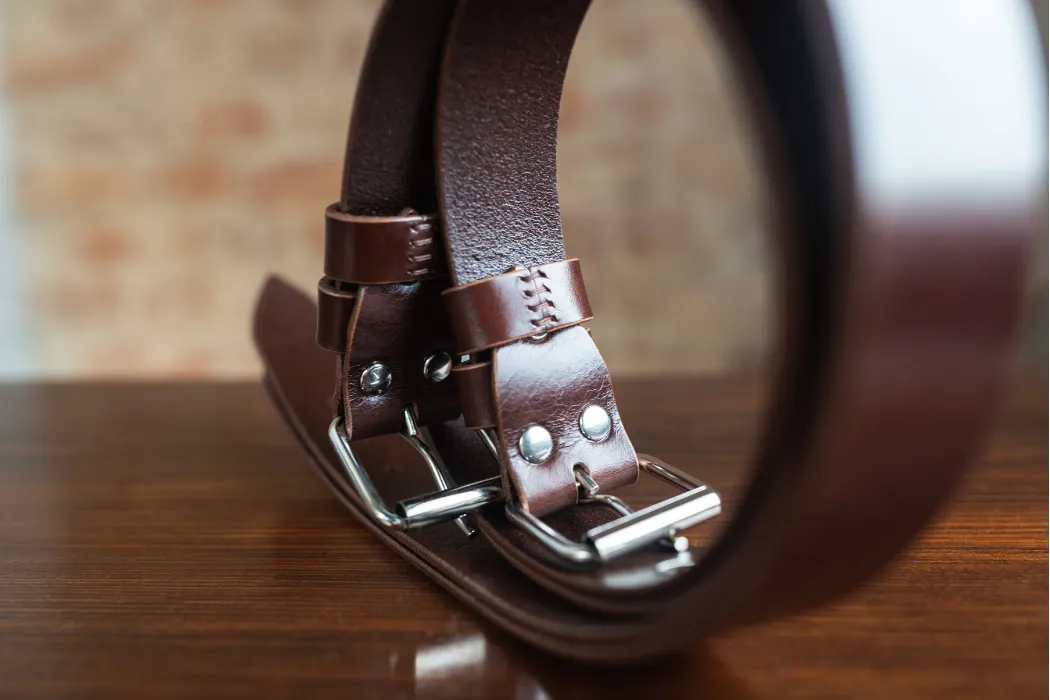
- Pin buckles rely on a metal prong inserted into one of 5–7 pre-punched holes spaced about 0.5–1 inch apart, giving a classic design favored in formal wear.
- Ratchet systems employ a spring-loaded track mechanism allowing micro-adjustments (~1/8 inch increments) for a more precise fit and reduced hole wear.
Engineering, Durability, and Material Considerations
From an engineering standpoint, buckle material selection and stress distribution patterns determine the belt’s lifespan and comfort level. Ratchet systems integrate more advanced metallurgy and precision mechanics, while pin buckles rely on robust yet simpler physical design principles.
- Ratchet housings are typically made from aerospace-grade aluminum or stainless steel, offering corrosion resistance but adding 1–2 mm bulk compared to pin buckles.
- Pin buckle holes can stretch or wear over time due to localized stress points, while ratchet systems distribute tension evenly along the strap but may suffer if the internal spring mechanism is exposed to debris.
In summary, pin buckles preserve traditional elegance and simplicity ideal for formal contexts, whereas ratchet mechanisms deliver high adjustability and modern performance for daily or active wear. The critical difference lies in their mechanical philosophy—static precision versus incremental responsiveness—each suited to a different type of leather belt user.
Custom Leather Belts That Elevate Your Brand
What are the benefits of using rugged finishes like “Crazy Horse” leather?
Crazy Horse leather, made from full-grain cowhide and treated with oils and waxes, offers exceptional toughness, natural patina development, and water resistance. Its dense fiber structure makes it ideal for rugged men’s belts that age beautifully while maintaining durability.
Understanding the Unique Character of Crazy Horse Leather
Crazy Horse leather is appreciated for its organic authenticity and aged elegance. Its texture and performance derive directly from the full-grain cowhide base—the top portion of the hide that retains every natural grain and marking. This ensures the maximum possible strength and resistance to wear.
- Derived from full-grain cowhide, the strongest top layer of the hide, retaining its natural grain and markings.
- Infused with natural oils and waxes that penetrate the fibers, enabling color shifts and self-healing scratches for a vintage patina.
- Known for its matte, rugged surface that develops richer tones with wear, creating unique character over time.
Technical Benefits and Applications in Men’s Belts
Beyond aesthetics, the technical composition of Crazy Horse leather offers measurable advantages for everyday belt use. Its balanced density and flexibility translate to long-term reliability under tension and movement. The leather’s pre-treated surface also minimizes maintenance over its lifespan.
- Typical thickness of 4–5 oz (1.6–2.0 mm) makes it both sturdy and flexible for daily belt use.
- Oil and wax penetration densifies fibers, improving wear resistance and reducing cracking compared to top-grain leathers.
- Vegetable tanning produces a stiffer structure suited for rugged belts, while chrome-tanned variants improve flexibility.
- Wax coating provides moderate water resistance and reduces drying, ensuring longevity even under stress or moisture exposure.
Research indicates that Crazy Horse leather’s structural integrity arises from the combination of full-grain composition and deep wax infusion. Over time, these elements allow the leather to adapt to use, forming a surface patina that enhances both visual character and functional resilience. Whether vegetable or chrome tanned, its dense fiber network ensures that belts maintain strength, flexibility, and tactile appeal over years of wear.
How to test the durability of heavy-duty work belts for men?
Durability testing for heavy-duty men’s work belts involves evaluating core materials, hardware, and stitching through controlled stress and flex cycles, guided by leather-specific standards like ISO 2419 or ASTM D6775. These methods simulate wear, tension, and environmental exposure to ensure long-term performance.
Core Principles of Durable Work Belt Testing
Understanding durability testing begins with recognizing how materials and construction influence long-term strength. For heavy-duty men’s work belts — often used in occupational or field environments — resilience depends on how leather, buckles, and stitching respond to physical stress.
- Durability depends on the tensile integrity of full-grain or top-grain leather, measured across tensile and flex cycles.
- Testing includes repeated buckle engagement, load pull testing at stress points, and abrasion checks to simulate months of use.
These assessments ensure that belts retain strength and shape without excessive cracking or stretching during sustained occupational wear.
Testing Standards and Practical Procedures
Manufacturers rely on standardized testing methods to quantify durability and ensure consistency across production batches. Compliance with international standards helps validate performance claims and maintain uniform quality control.
- Relevant methodologies include ISO 2419 for leather tensile and tear testing, and ASTM D6775 for fabric seam strength.
- Factories like Hoplok use cycle tests (e.g., 10,000 flex passes) and buckle-pull tests under controlled tension, aligned with ISO 9001 and BSCI-certified QA systems.
Together, these evaluations confirm that each belt can endure repeated strain, torque, and environmental stress comparable to real-world occupational use.
Which hardware finishes (Gunmetal vs. Matte) are currently trending?
Both gunmetal and matte finishes are trending in men’s belt hardware. Gunmetal offers a bold, contemporary look, while matte surfaces convey understated elegance and pair well with casual or formal wear. Designers favor matte/brushed metal textures for versatility and low maintenance appeal.
Style and Market Appeal of Gunmetal vs. Matte Finishes
Gunmetal and matte finishes have carved clear positions within men’s accessories, each catering to a distinct yet overlapping audience. Their popularity is tied to fashion trends that balance bold expression with timeless subtlety.
- Gunmetal is viewed as a modern alternative to silver, appealing to fashion-forward or urban markets.
- Matte and brushed finishes continue to dominate due to their versatility, pairing with both casual and formal belts.
- Trend analysis for 2025 indicates brushed metallic tones like matte silver, gold, and gunmetal as core style drivers.
- Matte finishes are preferred for minimalist brands promoting timeless, low-gloss aesthetics.
Overall, matte textures signal restraint and polish, while gunmetal provides contemporary edge—together defining the dual design language shaping current men’s hardware trends.
Durability, Maintenance, and Manufacturing Considerations
Beyond visual appeal, the sustainability and quality perception of hardware finishes are heavily influenced by technical processes. Manufacturing precision determines how well each coating resists wear, tarnish, and color distortion over time.
- Gunmetal plating requires precise surface treatment to resist corrosion and maintain hue uniformity.
- Matte finishes typically involve brushing or micro-sandblasting to create a low-reflection surface that hides minor scratches.
- Both finishes depend on base metal quality and are often applied using electroplating or PVD coating for consistent adhesion.
- While no ASTM or ISO data were available, high-end manufacturers rely on internal quality standards aligning with ISO 9001-certified processes.
Technically, both finish types balance visual and performance priorities well—but matte hardware achieves higher favor in long-term wear scenarios due to its ability to conceal surface imperfections and require minimal upkeep.
How to engineer reversible belts to avoid mechanical failure?
Engineering reversible belts requires adhering to standards like RMA IP‑21 and IP‑26, using polyester‑corded structures, minimizing reverse bends, and incorporating reliable fastening systems to maintain flexibility, strength, and reversible function without mechanical breakdown.
Principles of Reversible Belt Design and Material Selection
Reversible belts designed for bi‑directional power transmission must balance tensile strength with flexibility to handle stress from movement in both directions. This requires compliance with established engineering standards and material systems that maintain alignment, grip, and energy efficiency over repeated cycles.
- Follow RMA Engineering Standards IP‑21 and IP‑26 for double‑sided V‑belts transmitting power from both sides with polyester cords and cotton/polyester covers.
- Utilize leather or synthetic layers joined with flexible interlocking snap fasteners that allow belt reversal without buckle relocation, reducing mechanical stress points.
Mechanical Specifications and Failure‑Prevention Methods
Mechanical sustainability in reversible belts relies heavily on dimensional control, pulley configuration, and stress management. Design parameters must reduce the concentration of bending fatigue and maintain structural integrity under cyclic loads.
- Design for minimal reverse bends—use two large‑diameter pulleys and maintain high length‑to‑width ratios to lower bending stress.
- Ensure minimum pulley diameter (d_min) per Habasit data yields a bending arc >30°, use stainless steel tracking guides at ~20 mm height, and keep center distances below 2 m to prevent sagging.
Research Insights and Data Synthesis
Current research emphasizes the synergy between international standards and real‑world mechanical tests. RMA IP‑21 and IP‑26 standards govern reversible drive belts built for serpentine motion, defining strength and structural requirements under dynamic load shifts. Polyester cord reinforcements improve stretch resistance, while cotton/polyester covers preserve friction characteristics essential to dual‑direction drives.
For reversible leather applications, patented constructions use coordinated snap fasteners for detachment and inversion, providing a method of reversal without changing buckle position. This mitigates weak points where detachment commonly occurs under manual stress.
Operational endurance improves by minimizing reverse bends and maintaining two‑pulley configurations with sufficient diameter. Conveyor engineering principles validate that arc angles above 30° and limited center distance below two meters enhance the belt’s longevity and tracking stability. While leather‑specific test data is limited, best practices drawn from V‑belt and conveyor engineering remain valid proxies for minimizing overstress, delamination, and dimensional failure in reversible belt systems.
What are the standard men’s belt sizing charts for US and EU markets?
Men’s belts are sized differently in the US and EU. The US uses inches based on pant size plus a 2-inch rule, while the EU uses centimeters measured directly from the buckle base to the middle hole. Both follow a middle-hole fit standard for comfort and flexibility.
Understanding the core logic behind US and EU belt size measurements
Belt sizing logic differs between the US and EU markets primarily due to the units of measurement and how each system defines the functional length of a belt. While both methods aim to ensure that the middle hole corresponds to the ideal fit, the path to that measurement differs significantly.
- US sizing uses inches, measuring from buckle end to middle hole, with belt size generally equal to waist size plus 2 inches.
- EU sizing uses centimeters, measured from the buckle base to the middle hole, directly representing the belt’s functional length.
This metric-versus-imperial distinction results in slightly different numerical scales, but the intent remains universal: a correctly fitted belt secures comfortably at the middle hole for flexibility during movement or when alternating between garments of similar fit.
Technical specifications and conversion details between US and EU standards
Manufacturers follow consistent dimensional patterns for design, labeling, and production across both markets. Below are the key parameters defining these standard ranges and conversion rules.
- US standard range: 30–44 inches (30″, 32″, 34″, 36″, 38″, 40″, 42″, 44″), corresponding to waist sizes plus 2 inches.
- EU standard range: 75–115 cm (75cm, 80cm, 85cm, 90cm, 95cm, 100cm, 105cm, 110cm, 115cm), matching US equivalents from 30–44 inches.
- Belt width standards typically 35mm (1 3/8″) or 40mm (1 1/2″), with five-hole design centered on the middle hole for ±2–3cm adjustment.
From a design engineering perspective, this uniformity supports efficient conversion between regions and minimizes return rates due to fit discrepancies. Although no globally enforced ISO or ASTM specifications exist for leather belts, consistency among brands like Roger Ximenez, Crockett & Jones, and Rodd & Gunn indicates a well-established de facto standard. These conventions make it easy for consumers to find accurate belt sizes regardless of where they are purchased.
How to scale men’s belt production for large-scale retail programs?
Scaling men’s belt manufacturing for retail demands precise standardization in width, thickness, hole pattern, and sizing ratios. Factories typically reach 30,000 units per cycle using automated cutting, edge finishing, and buckle assembly lines aligned with standardized packaging procedures.
Scaling men’s belt production requires a delicate balance between production automation and consistency in material quality. The process depends on fixed specifications for width and thickness, reliable input leather grades, and controlled production workflow. Research from Asian manufacturing facilities shows clear benchmarks for how small-to-medium factories reach industrial-scale outputs while maintaining retailer standards.
Core principles for scaling leather belt production
To scale belt production efficiently, factories depend on standardized measurements and clear ratios across every manufacturing stage—from cutting and punching to packaging. This ensures predictable outcomes in both fit and finish while maintaining steady material consumption rates.
- Use fixed belt widths of 3 inches or 1.5 inches and thickness ranges of 3.6–4.2 mm to maintain uniformity.
- Adopt mixed sizing ratios (32:36:40:44 = 2:4:4:2) to balance inventory and meet retail demand.
- Implement standardized hole spacing at 1 inch (2.5 cm) intervals with 5 holes to enable semi-automated punching.
- Control material sources—chrome tanned or full grain 8.5–9.5 oz hides—for consistent durability across batches.
These principles keep production lines predictable, allowing automated machines to process hundreds of straps per hour without manual adjustment. It also helps brands align multiple supplier factories under unified measurement systems for easier quality control.
Technical setup, production benchmarks, and packaging standards
In large-scale production environments, machinery configuration and process sequencing drive both efficiency and uniformity. Automation minimizes error rates in repetitive operations such as strap cutting, edge skiving, and buckle mounting.
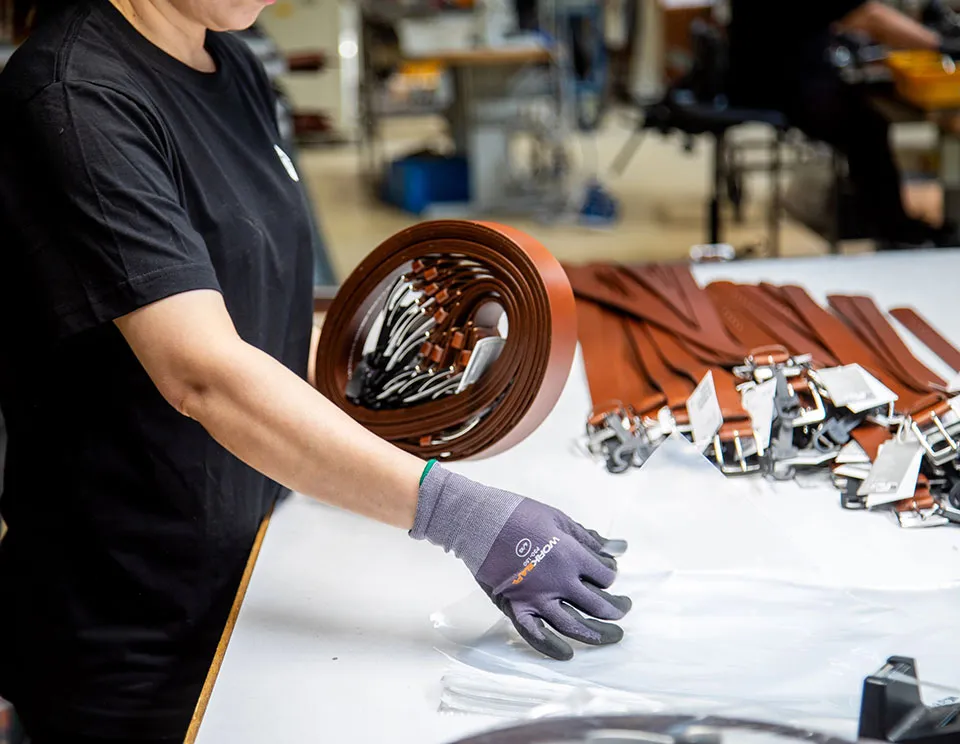
- Typical factory setup achieves capacity of about 30,000 units per full utilization cycle using strap cutting and edge finishing machines.
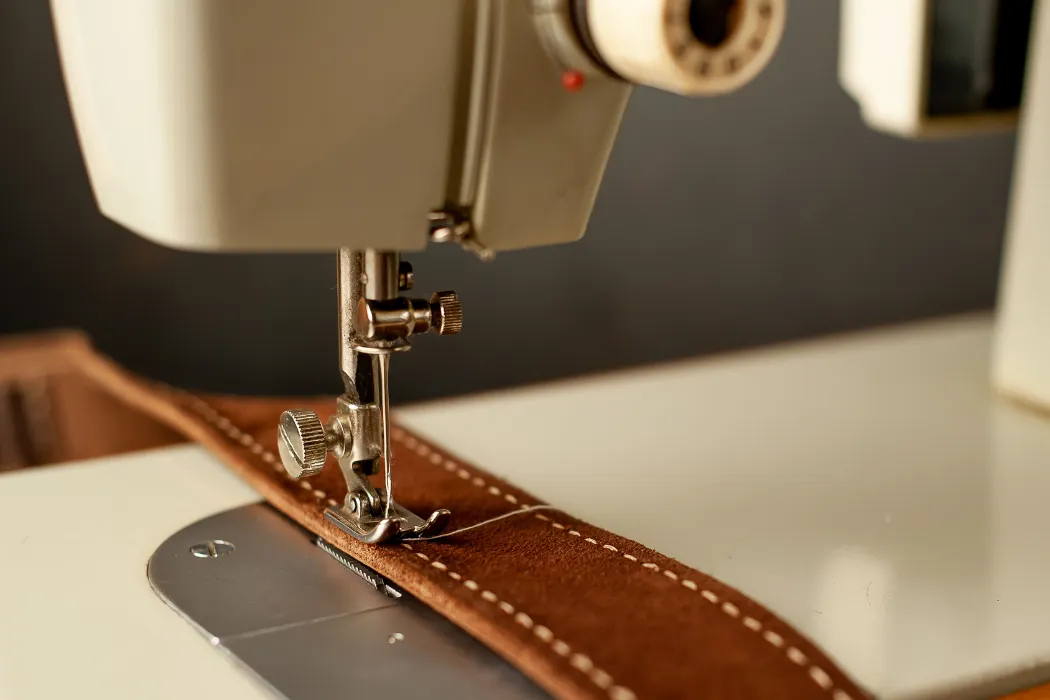
- Manufacturing flow includes cutting, skiving, pasting, stitching, trimming, buckle fixation, and inspection for edge and hole alignment.
- Factories like Hoplok operate vertically integrated systems with an in-house tannery (ProPelli) and ISO 9001-certified processes.
- Apply packaging standards: 10–12 belts per plastic bag and 100–144 belts per outer box for shipping bulk retail orders efficiently.
This integration—from tanning to cutting through packaging—helps remove dependency bottlenecks and ensures synchronized turnaround times. Each operation is monitored for hole alignment, edge finishing, and visual uniformity, ensuring that every batch meets the aesthetic and structural standard expected in retail supply chains.
With these technical and logistical parameters in place, men’s leather belt manufacturing can scale seamlessly to high-volume retail programs without compromising on craftsmanship or consistency.
Final Thoughts
Designing and manufacturing high-demand men’s leather belts requires precision, proportional balance, and a strong grasp of global standards. Success in this category relies on harmonizing craftsmanship with reproducible technical parameters—achieving consistency in materials, hardware, sizing, and finish across both formal and casual lines. Understanding how each design component impacts utility and perception allows brands to create cohesive belt collections that perform well in diverse markets and meet consumer expectations for both style and durability.
From leather selection and width ratios to buckle engineering and scalable production systems, the technical details compiled here underpin a broader design philosophy: refined simplicity supported by data-driven precision. By standardizing specifications and leveraging modular systems, manufacturers can ensure long-term quality control while giving customers flexibility in style and fit. Ultimately, the synthesis of aesthetics, engineering, and global measurement logic defines the next generation of men’s belt lines poised for sustainable, large-scale retail success.
Frequently Asked Questions
What is the standard men’s belt width?
The standard men’s belt width ranges from 1 to 1.5 inches (25–38 mm) for dress belts and 1.5 to 1.75 inches (38–44 mm) for casual belts. The 1.25 inch (32 mm) width is the classic reference standard for formal and professional wear.
How do you measure a men’s belt size?
Measure from the inner edge of the buckle to the middle hole. The industry rule adds 2 inches to waist size (e.g., 32‑inch pants = 34‑inch belt). Most belts have five holes spaced one inch apart, ensuring a centered fit adjustment range.
What leather is best for men’s belts?
Full‑grain cowhide leather from the double‑butt part of the hide, typically 8.5–9.5 oz thick, is preferred for its strength, durability, and natural grain preservation—considered the industry’s premium standard.
How many holes are in a men’s belt?
Most men’s belts have five holes spaced one inch apart, with the middle hole as the reference point for size. Some premium or extended‑fit styles feature six or seven holes for wider adjustment flexibility.
What is a ratchet belt?
A ratchet belt replaces holes with a hidden track and locking mechanism, allowing micro‑adjustments in ¼‑inch increments for a precise fit. It eliminates hole wear while offering 30–40 incremental notches across the belt length.
Should a belt match men’s shoes?
There’s no strict standard, but traditional menswear guidelines suggest coordinating leather type and color—black with black, and similar brown tones for brown. Casual styles allow more contrast or complementary shades.