Manufacturing custom leather goods overseas involves significant financial risk. Buyers want to protect their cash, but factories need upfront money to buy raw materials like full-grain cowhide and hardware. This creates a natural tension between supply chain speed and financial security.
So, how do brands solve this payment problem? They usually choose between Telegraphic Transfers (T/T) and Letters of Credit (L/C). T/T means sending wire transfers directly to the factory bank account. L/C means using a bank document to guarantee payment only after the factory ships the goods.
Both methods control billions of dollars in global trade, but they serve very different purposes. T/T offers speed and low costs, so it works perfectly for fast fashion and ongoing supplier relationships. L/C provides ultimate security for massive retail orders, but it brings high bank fees and heavy paperwork. Let us explore exactly how these payment terms work, so you can choose the best financial strategy for your next leather production run.
What Are T/T and L/C Payment Terms?
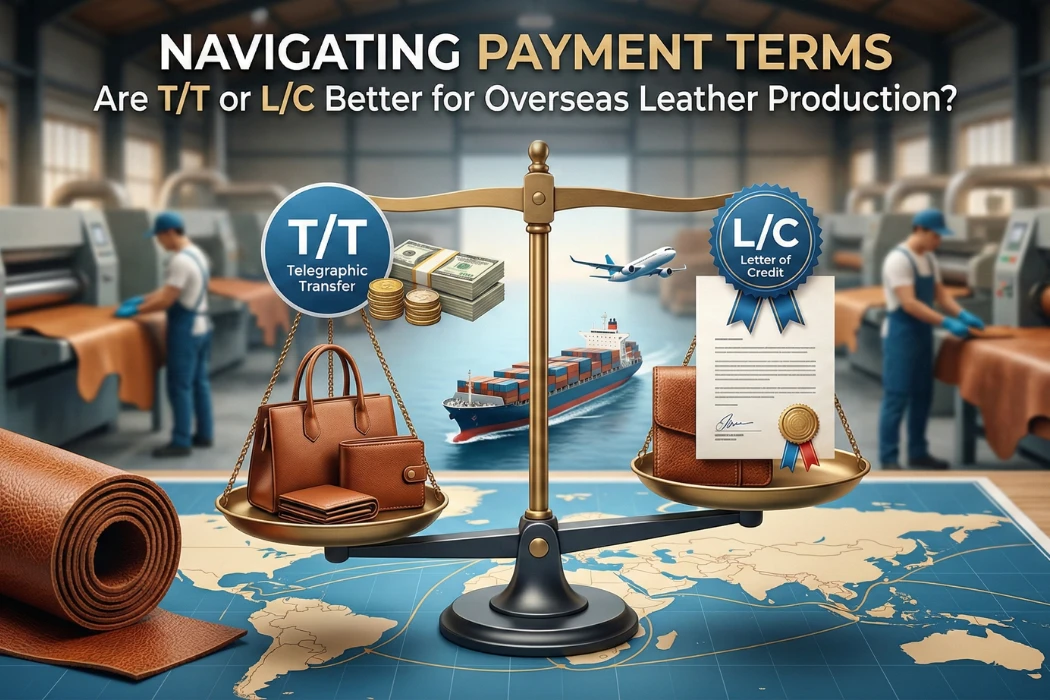
T/T stands for Telegraphic Transfer, which is a direct electronic money wire from the buyer to the manufacturer. L/C stands for Letter of Credit, which is a binding promise from a bank to pay the manufacturer once they prove they shipped the correct goods.
Understanding Telegraphic Transfers (T/T)
T/T is the most common payment method in modern manufacturing because it moves money fast.
- Buyers log into their bank and wire money directly.
- The factory receives the funds in 2 to 5 days.
- Bank fees usually stay under $50 per transaction.
This direct approach keeps the production line moving without bank interference.
Breaking Down Letters of Credit (L/C)
An L/C acts as a neutral referee between the buyer and the seller.
- The buyer’s bank freezes the exact order amount.
- The bank holds the money safely during production.
- The factory ships the leather goods and gives the shipping documents to the bank.
- The bank checks the documents and releases the funds.
The factory knows they will get paid, and the buyer knows the factory actually shipped the bags.
Why Leather Manufacturing Requires Clear Terms
Leather production consumes massive amounts of upfront cash.
- Tanneries demand fast payment for raw hides.
- Factories must buy YKK zippers and custom metal hardware in advance.
- Workers need regular wages during the 15 to 20 days of bulk production.
Without a clear payment structure, factories cannot buy materials, so the entire assembly line stops.
How Does the T/T Payment Structure Work for Leather Bags?
The standard T/T structure splits the payment into two parts. Buyers usually pay a 30% downpayment before production starts. Then, they pay the remaining 70% balance after the factory finishes the bags and passes final quality inspections, but right before the goods leave the port.
The Standard Downpayment Phase
The factory needs your financial commitment before they cut expensive leather.
- The buyer sends a 30% deposit.
- The factory uses this money to order raw materials like top-grain leather.
- This deposit acts as a green light to start the cutting and stitching process.
This initial wire transfer officially locks in your production schedule.
Funding Bulk Production and Raw Materials
Leather goods require specific materials that factories rarely keep in stock.
- The factory buys PU leather or genuine hides from tanneries in Italy or Argentina.
- They order specific hardware based on your tech pack.
- They pay skilled workers to assemble 30,000 to 60,000 bags per month.
The advance payment directly fuels the physical creation of your inventory.
Final Balance and Shipping Document Release
You must protect your final payment until you verify the product quality.
- You hire a third-party inspector to check the finished goods.
- Once the goods pass inspection, you wire the 70% balance.
- The factory then sends you the Bill of Lading, so you can claim the cargo at your port.
Holding the final balance ensures the factory fixes any defects before shipping.
| Production Stage | Payment Action | Factory Action |
|---|---|---|
| Order Confirmation | Send 30% Deposit via T/T | Order leather hides and custom hardware |
| Bulk Production | No payment required | Cut, assemble, and stitch bags (15 to 20 days) |
| Quality Control | Review inspection report | Fix defects and pack goods into cartons |
| Pre-Shipment | Send 70% Balance via T/T | Release Bill of Lading and ship containers |
When Is an L/C the Safest Choice for Buyers?
You should use an L/C when you place massive orders with a new factory. If the order value exceeds $100,000, the bank guarantee protects your cash from fraud or factory bankruptcy. It also guarantees the factory will follow your exact shipping instructions.
Protecting High-Volume Orders
Giant retail brands cannot risk wiring huge sums of cash directly to overseas accounts.
- Big box retailers order 500,000 to 800,000 PU bags at once.
- These massive volumes carry high financial risk.
- The L/C locks the money in the bank until the factory completes the giant task.
Bank supervision prevents the manufacturer from taking the cash and abandoning the project.
Bank Guarantees and Quality Control Links
You can legally tie an L/C to your quality standards.
- You write specific rules into the L/C document.
- You demand a clean inspection certificate from SGS or Intertek.
- The bank will refuse to pay the factory if the bags fail this quality audit.
This legal trick forces the factory to maintain strict quality control.
The Hidden Costs of L/C Transactions
Bank security comes with expensive fees and heavy paperwork.
- Banks charge issuance fees ranging from 0.75% to 1.5% of the total order value.
- They charge amendment fees every time you change a small detail.
- The factory also pays high fees to their local bank to process the documents.
You must calculate these bank fees to see if the financial security is worth the extra cost.
Which Payment Method Fits Your Production Speed?
T/T fits fast production because funds clear in a few days, allowing the factory to start immediately. L/C fits slow, planned production because bank paperwork takes weeks to set up and verify. Choose T/T for speed, and choose L/C for slow, high-value security.
Fast Sampling and T/T Agility
Direct transfers help you hit tight seasonal deadlines.
- The factory receives your T/T deposit almost instantly.
- They move your design to the sample room in 2 to 7 days.
- They finish average bulk orders in just 15 to 20 days.
Avoiding bank paperwork drastically shrinks your lead times.
L/C Delays in Document Verification
Letters of credit slow down every single step of the supply chain.
- Drafting the initial L/C takes up to 10 days.
- The factory must prepare perfect shipping documents with zero typos.
- The bank takes another 5 to 7 days just to read and approve the paperwork.
A single spelling mistake on a packing list can stall your shipment for weeks.
Balancing Cost and Lead Times
You must decide if you value speed or total financial safety.
- T/T gives you cheap transactions and fast shipping.
- L/C gives you expensive transactions and slow shipping.
- Fast fashion brands lean toward T/T, while conservative department stores stick to L/C.
Your choice directly impacts how fast your leather goods hit the retail shelves.
| Feature | T/T (Telegraphic Transfer) | L/C (Letter of Credit) |
|---|---|---|
| Speed | Very Fast (Funds clear in 2-5 days) | Very Slow (Paperwork takes weeks) |
| Cost | Low (Flat wire fees) | High (Percentage-based bank fees) |
| Buyer Risk | High (Cash leaves your account early) | Low (Bank protects your funds) |
| Best Use Case | Trusted factories, fast fashion, agile restocks | New factories, massive volume, high value |
How Do You Choose the Right Term for Custom Leather Projects?
You choose the right term by assessing the factory’s trust level and the total order value. Use T/T for trusted factories with verified compliance audits. Switch to L/C for untested suppliers or massive orders where losing the deposit would cripple your business.
Assessing Supplier Trust and Factory Audits
You can reduce payment risk by researching the factory’s background.
- Check if the factory holds ISO 9001 and BSCI certifications.
- Ask if they work with major brands like Calvin Klein or Guess.
- Factories with strong audit records are much safer for standard T/T payments.
A proven track record replaces the need for expensive bank guarantees.
Order Volume Thresholds for L/C
The dollar value of your order should dictate your payment strategy.
- Small orders under $50,000 cannot justify the high L/C bank fees.
- Mid-size orders work best with a standard 30% T/T deposit.
- Mega orders over $200,000 almost always require an L/C to protect the massive cash float.
Match the strictness of your payment terms to the size of your financial risk.
Structuring Milestones Around Quality Checks
Smart buyers tie their money strictly to production milestones.
- Pay the deposit to start the leather cutting.
- Send an inspector when the bags are 80% complete.
- Send the final wire transfer only after the factory fixes every issue found in the audit report.
Controlling the cash flow forces the manufacturer to meet your quality standards every step of the way.
Frequently Asked Questions
What is the standard T/T payment term in manufacturing?
The global standard is a 30% deposit before production and a 70% balance payment before shipment, often written as “30% T/T advance, 70% T/T before shipping”.
Is T/T safe for new overseas suppliers?
T/T carries a high risk with unverified suppliers because you send cash without guarantees. You should always audit the factory and request product samples before wiring a 30% deposit.
Who pays the bank fees for an L/C?
Typically, the buyer pays the issuance fees at their local bank, and the seller pays the document processing fees at their receiving bank. You can negotiate these terms in your contract.
Can you mix T/T and L/C for a single order?
Yes, buyers often use a hybrid model. They wire a 30% T/T deposit to fund raw materials, and they use an L/C at sight for the remaining 70% to guarantee safe shipping.
How do payment terms affect production lead times?
T/T allows production to start immediately. L/C terms often delay production by 1 to 2 weeks because the factory will not buy materials until the bank officially issues the credit document.
What documents are needed to release an L/C payment?
The bank usually requires a commercial invoice, a detailed packing list, a Bill of Lading, a certificate of origin, and an approved quality inspection report.
Choosing the Right Payment Strategy
Choosing between T/T and L/C shapes your entire supply chain. T/T delivers speed and cost savings, so it fits fast-moving brands. L/C offers ultimate security for massive retail volumes. You just need a reliable manufacturing partner who understands these financial workflows. For brands seeking flexible payment terms and compliant production, Hoplok Leather provides the perfect solution. With large-scale facilities in China and Cambodia, Hoplok supports both agile T/T schedules and secure L/C terms for high-volume custom leather goods.