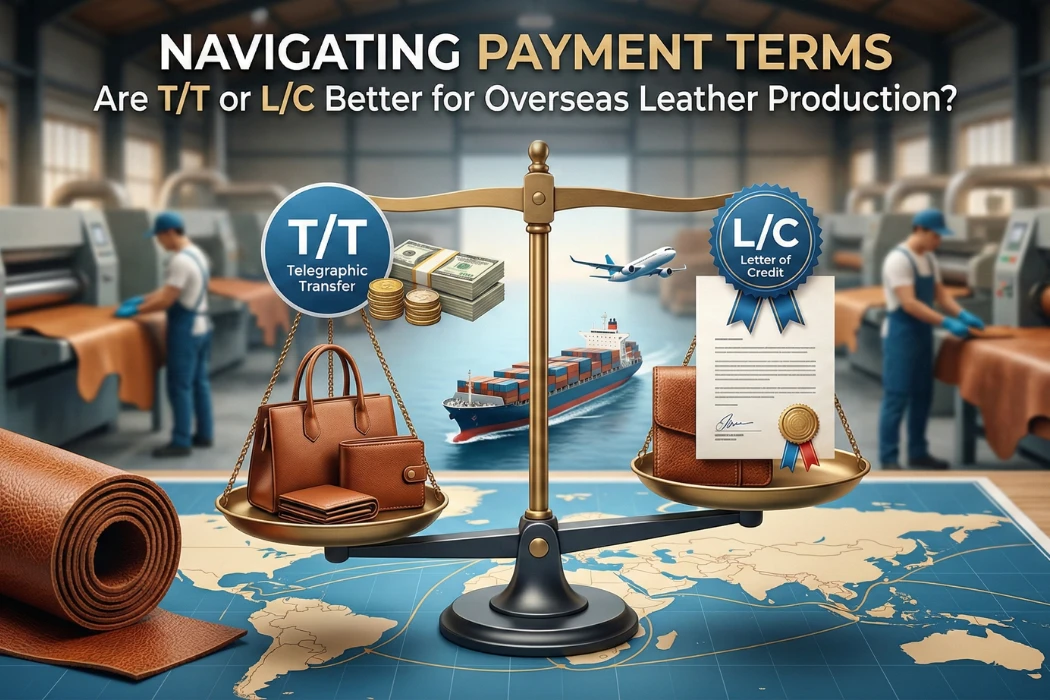
T/T is a bank-transfer method; an L/C is a bank undertaking governed by its terms and required documents. Neither is a complete substitute for supplier qualification, a clear purchase contract and product inspection. The appropriate arrangement depends on payment exposure, bank facilities, document requirements and the parties’ ability to perform.
For overseas leather production, agree who funds material commitments, when each payment becomes due, and what happens if samples, inspections or shipment dates change. T/T does not imply one mandatory deposit percentage, and an L/C does not mean that a bank physically verifies the goods.
This guide compares the two approaches for ordinary leather-goods sourcing and identifies the terms to settle with the supplier and banks. Hoplok’s accepted payment method and milestones must be confirmed in the project quotation.
What Are T/T and L/C Payment Terms?
T/T: the transfer method and the payment schedule are separate
A telegraphic transfer is commonly used to describe an international bank transfer. The purchase contract establishes whether it pays a deposit, a progress milestone, a pre-shipment balance or another amount. Confirm the currency, beneficiary, bank details, fee allocation and when the supplier considers funds received.
Transfer timing and charges depend on the banks, route, currency and checks involved. Obtain the bank’s current estimate rather than promising receipt in a fixed number of days or a universal fee. The US International Trade Administration’s cash-in-advance guidance explains the basic trade-off: advance payment reduces the seller’s non-payment exposure while placing more delivery and cash-flow exposure on the buyer.
L/C: payment against a complying presentation
A documentary letter of credit is an issuing bank’s undertaking to the beneficiary under the credit’s terms. The buyer’s funding or credit arrangements with its bank are separate from the seller’s presentation. The bank does not necessarily freeze the full order value in a neutral escrow account.
The Trade Finance Guide describes payment against stipulated documents and the importance of preparing those documents correctly. The parties should review the draft credit with their banks, including availability, expiry, presentation requirements and any confirmation arrangements.
Banks examine documents, not the goods
Where an L/C expressly incorporates UCP 600, those rules apply. ICC UCP 600, Article 5 distinguishes documents from the goods or performance to which they relate. A complying document presentation does not guarantee the actual quality, quantity or condition of the shipment.
Keep the purchase specification and inspection process in place regardless of the payment method. The supplier’s material and labor commitments should be reflected in the negotiated schedule, without assuming every factory has the same cash requirements.
How Can a T/T Schedule Be Structured for Leather Production?
Agree the amounts and triggers in writing. A deposit-and-balance structure is one possible arrangement, but there is no universal 30/70 rule and no confirmed Hoplok payment ratio in this guide. The schedule should reflect material commitments, production stages and the parties’ agreed risk allocation.
Before a deposit
Confirm the contracting entity, specification, price, currency and beneficiary details. Clarify what the deposit authorizes, whether any materials or tooling are non-cancellable, and how changes or cancellation will be handled. Verify unexpected bank-detail changes through an established contact route before remitting funds.
During production
Tie any agreed progress payment to a defined milestone and evidence. A payment by itself does not prove that materials have been bought or that the factory has started work. Agree what status records the supplier will provide and when the buyer needs to approve samples or changes.
Before the balance
Define the inspection scope, acceptable result, corrective-action procedure and evidence required for the next payment. An inspection reduces uncertainty but is not a guarantee that every unit is defect-free. Avoid leaving “quality approved” undefined or introducing new release conditions after production.
| Milestone | Commercial detail to agree | Evidence or action |
|---|---|---|
| Order confirmation | Deposit, if any, and conditions | Signed specification, quote and verified beneficiary |
| Material or sample approval | Any related payment trigger | Approved references and change record |
| Production review | Progress payment, if agreed | Defined status or inspection evidence |
| Shipment readiness | Balance trigger and release terms | Agreed inspection result and shipping arrangements |
| Document or cargo release | Who authorizes release and when | Relevant carrier and trade documents |
Payment, shipment and document release are different events. An ocean bill of lading, sea waybill or air waybill can involve different release arrangements. Confirm the actual transport document and carrier procedure; do not assume that a supplier always sends an original bill of lading immediately after the final wire.
When Is an L/C Worth Considering?
Consider an L/C when a bank undertaking and a defined documentary process address the risks in the transaction. Order value matters, but there is no universal threshold at which an L/C becomes mandatory or uneconomic. The relevant banks, country exposure, commercial relationship and available financing also matter.
Review the proposed banks and the credit
The seller needs to assess the issuing bank and may request confirmation or other arrangements. The buyer needs to understand collateral or credit-line requirements and its obligations to the issuing bank. Obtain the actual terms before describing the arrangement as secure for both parties.
Define any inspection document precisely
If an inspection certificate is required, agree the issuer, the inspection stage and the document wording with the supplier and banks. The bank examines the required document; it does not conduct the inspection or independently assess whether the goods meet the physical specification. Keep the inspector’s scope and the contract remedies separate from the credit wording.
Make the documentary conditions workable
Match the required documents to the shipment and parties that can issue them. Review dates, descriptions, quantities, transport requirements and any partial-shipment arrangements before issuance. Conditions that the seller cannot document can create disputes without improving product quality.
Obtain a complete bank quotation
Ask about issuance, advising, confirmation if applicable, amendments, examination, discrepancy handling and financing charges. Agree who pays each category. Rates vary by bank, term and transaction; no fixed percentage or flat fee applies to every order.
An L/C can support payment discipline, but it does not eliminate fraud, supplier failure, documentary discrepancies or disputes over actual goods. Evaluate it alongside supplier diligence and the commercial contract.
How Do Payment Arrangements Affect the Schedule?
Payment arrangements can affect when materials are committed or documents are released, but they do not determine the physical production duration. Agree the supplier’s start conditions and allow time for approvals and banking steps. Neither “T/T is instant” nor “L/C always delays production by weeks” is a reliable planning rule.
Plan material and sample approvals separately
A factory may need confirmed funds or an acceptable operative credit before incurring costs, depending on the agreement. It also needs the approved design, materials and hardware. Schedule these dependencies explicitly so that a banking delay is not confused with a pending sample approval.
Prepare the credit and documents early
For an L/C, review the draft before issuance and align the latest shipment date, expiry and presentation requirements with the production plan. Under UCP 600 Article 14, the relevant banks have up to five banking days following presentation to determine compliance. That is not a promised shipment delay or a universal date on which funds reach the seller.
A discrepancy needs assessment under the credit and applicable rules. Do not assume every typographical variation automatically rejects payment, or that a buyer can casually change an operative credit without the required agreement.
| Planning issue | T/T arrangement | L/C arrangement |
|---|---|---|
| Start condition | Agreed payment receipt and production approvals | Acceptable operative credit and production approvals, as agreed |
| Banking time | Confirm the actual transfer route and checks | Allow for issuance, any amendment and document examination |
| Charges | Obtain transfer and receiving-bank terms | Obtain the relevant credit and financing charges |
| Quality evidence | Contract and inspection plan | Contract and inspection plan, plus any required document |
| Shipment release | Agreed payment and carrier process | Credit, contract and carrier process |
For Hoplok projects, belt samples generally take 2–3 weeks and bag samples 3–4 weeks. Confirm wallet sample timing for the design. Bulk production generally takes 60–90 days, with shipping planned separately. A chosen payment method does not convert this into a 15–20 day production promise.
What Should Buyers Settle Before Selecting the Terms?
Start with the exposure at each stage rather than a fixed order-value rule. Consider what has been paid, what materials have been committed, what evidence is available and what remedies the contract provides. Supplier audits are useful for their stated scope, but they are not financial guarantees.
Qualify the supplier and contracting entity
Review the legal entity, facility, relevant product experience, communication and proposed supply route. Independently verify important information and beneficiary details. A social-audit rating, ISO certificate or named brand reference does not establish solvency or remove payment risk.
Match the arrangement to the order
Custom tooling, unusual materials and a large style assortment can create different commitments from repeat production. Agree treatment of development charges, buyer-requested changes, rejected goods and cancellation. Ask the banks to compare workable payment options and their costs against those facts.
Write clear milestones
Record the amount, currency, due event and required evidence for each payment. Define who approves the sample, who conducts inspection, how non-conformities are handled and when documents or cargo are released. Avoid relying on an informal promise that holding the balance will force every defect to be corrected.
- Keep payment terms consistent across the purchase order, invoice and any L/C.
- Record responsibility for bank charges and exchange-rate exposure.
- Allow realistic dates for approvals, inspection and shipment.
- Confirm the process for amendments and verified bank-detail changes.
- Keep evidence of approvals, transfers and release instructions.
Hoplok’s payment method, deposit requirements and any L/C acceptance conditions must be agreed in the quotation and contract. This article does not establish automatic acceptance of an L/C, a fixed percentage deposit or open-account credit.
Frequently Asked Questions
Is 30% deposit and 70% balance a universal T/T term?
No. T/T describes the transfer method. The amounts and due events are commercial terms negotiated for the order. Confirm Hoplok’s proposal in writing rather than assuming a standard ratio.
Is T/T safe with a new overseas supplier?
The exposure depends on timing, the amount advanced and the supplier’s performance. Verify the entity and payment details, approve samples and agree inspection and remedies. An audit or sample does not guarantee delivery after payment.
Who pays L/C bank fees?
The parties should allocate the relevant charges in the contract and credit. Obtain quotations from the banks and identify issuance, advising, confirmation, amendment and other applicable fees. There is no universal allocation for every transaction.
Can T/T and an L/C be combined?
They can be combined if the supplier and banks agree to a workable structure. Clearly separate the amount already paid from the amount covered by the credit, and align the documentary terms. No particular split is assumed here.
Does an L/C guarantee product quality?
No. Banks examine documents under the credit rather than physically checking the goods. A required inspection certificate can be part of the documentary conditions, but the actual inspection scope and contract remedies remain important.
Which documents release an L/C payment?
The credit specifies the documents. They may include an invoice, transport document or other agreed certificates, but the list is transaction-specific. Have the draft reviewed before issuance so the supplier can obtain the required documents within the dates allowed.
Agree the Payment Plan With the Production Plan
Choose terms that the buyer, supplier and banks can carry out, then align the payments with the specification, approvals, inspection and shipping arrangements. A documentary credit and a bank transfer address different payment needs; neither provides total protection against every production or commercial problem.
For a custom bag or leather accessories project, send Hoplok the product brief, quantities, destination and proposed commercial terms. Request confirmation of accepted payment arrangements, material commitments and the production schedule in the quotation before placing the order.