A sustainable belt sourcing brief needs evidence behind specific claims: the material composition, relevant facility certification, sourcing records, product performance and the scope of any environmental comparison. “LWG,” “vegan,” “recycled” and “water-based” answer different questions. None makes every other question disappear.
For buyers, the first step is to define what the brand intends to claim and what information must support it. An accurate, limited statement is more useful than an unqualified promise that a belt has no environmental impact.
What does an LWG facility rating establish?
Leather Working Group operates audit standards for participants in the leather supply chain. A rating concerns the audited facility and its relevant scope. Review the entity, site, validity and standard rather than treating a logo in a presentation as a certificate for every finished product.
Use LWG’s claims guidance when deciding how to describe membership, facility certification or sourcing. Do not turn a supplier’s rating into an unsupported claim that the finished belt is certified for durability, chemical safety or a particular environmental footprint.
Verify the connection between the facility and your order
| Evidence | Buyer question |
|---|---|
| Facility identity and current status | Does the document match the actual entity and site handling the relevant stage? |
| Audit scope | Which operation is covered, and which other stages are performed elsewhere? |
| Material article and order records | How is the supplied leather linked to the stated source? |
| Traceability information | What is known upstream, and what does that information stop short of proving? |
| Claim wording | Does the proposed label or product page stay within the evidence? |
LWG publishes separate information about traceability. Read the scope of that information rather than assuming a medal guarantees complete farm-level traceability or proves every source is deforestation-free. Keep sourcing requirements explicit in the order.
ProPelli’s confirmed role
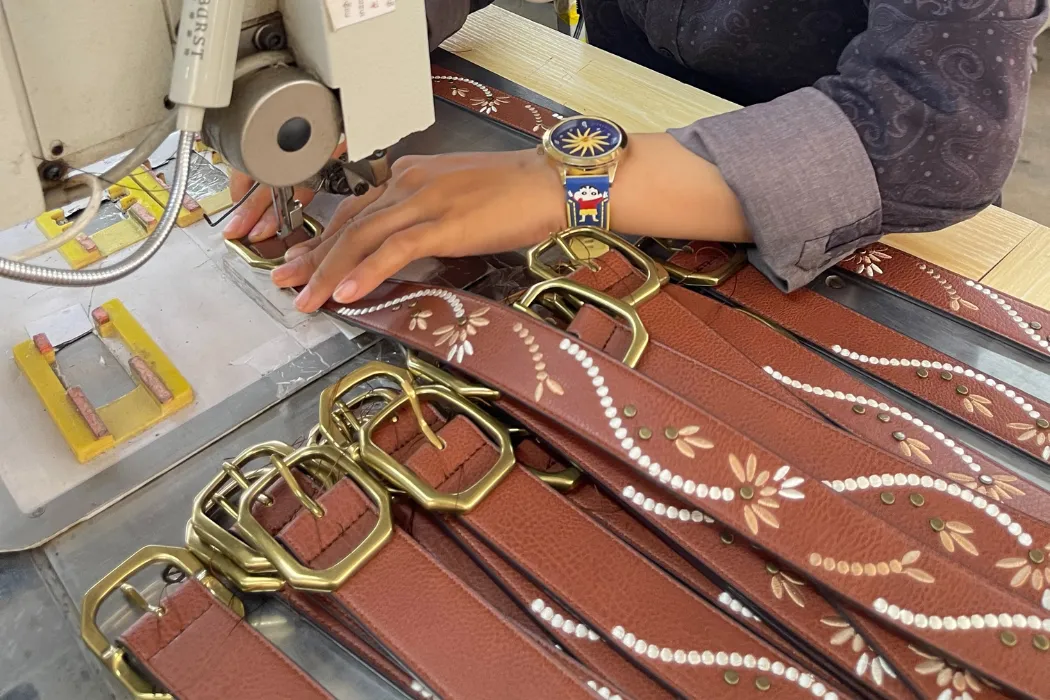
ProPelli is Hoplok’s 5,000-square-metre leather finishing facility in Cambodia and holds a current LWG Gold rating. It receives crust leather from partner tanneries and specialises in belt leather and other leather finishing. It is not a tannery.
Crust has already been tanned and dried before final finishing, and may be dyed or undyed. The sourcing brief should identify the supplied article and remaining finishing work. In-house finishing can support coordination, but it does not by itself prove zero waste, lower emissions or a specific rejection reduction.
Compare materials without assuming a universal environmental winner
Animal leather, fibre composites and synthetic alternatives have different compositions and production routes. An animal-free claim does not establish biodegradability or a low footprint. A recycled-content claim should identify what component contains recycled material, the stated proportion and the evidence supporting it.
Environmental comparisons need a defined scope and comparable function. Do not assume that buying several synthetic belts creates a fixed multiple of the emissions of one leather belt. That calculation would need reliable material, manufacturing, use and end-of-life information rather than invented service lives.
Durability can matter to a product’s use, but a full-grain label does not prove how long the complete belt lasts. Evaluate the strap, buckle, attachments and finish for the intended application. Keep any service-life or repairability claim consistent with the evidence.
Chemical requirements cover the whole construction
A belt can include leather, lining, reinforcement, adhesive, edge paint, thread and coated hardware. Material sourcing evidence for the face does not automatically cover these other parts. Identify the destination and applicable buyer requirements, then agree the appropriate checks with qualified specialists.
Request product information and relevant safety documentation for finishing systems. Water-based does not mean that a formulation contains only water or automatically meets every chemical requirement. Likewise, a vegetable-tanning description is not a substitute for evidence about the finished article.
Document practical improvements and their limits
Agree which measurable changes the supplier can demonstrate, such as material consumption for the pattern or a documented change in a finishing process. Keep the baseline, scope and measurement method. Avoid publishing a percentage reduction until the records support the comparison.
Packaging and aftercare also need specific evaluation. Reducing packaging is useful only if the revised arrangement still protects the product during the agreed route. Repairable hardware must remain functional and have realistic servicing instructions; a removable screw alone does not establish a circular product system.
Prepare a sourcing and claims brief
Send the intended material, product drawing, destination, required documents and proposed environmental wording through Hoplok’s sourcing enquiry. Keep legal applicability and product classification separate from general sustainability goals; current requirements should be checked for the actual goods and market.
Use the quality and compliance brief to connect the approved sample, records and customer-facing claims. The resulting evidence should describe the actual order, with clear limits on what has been verified.