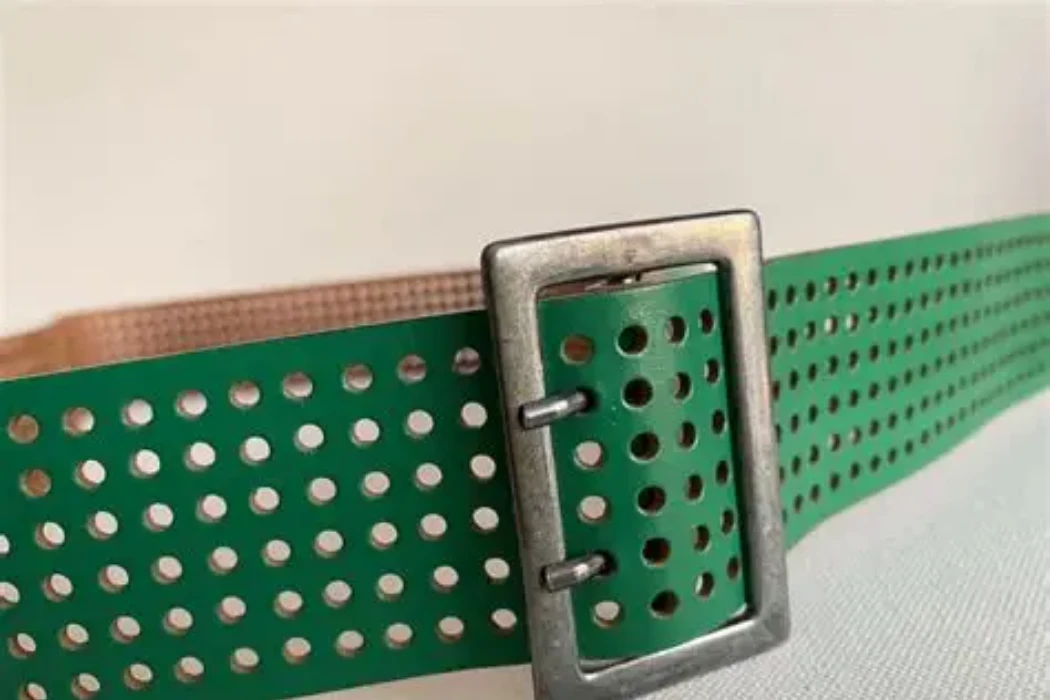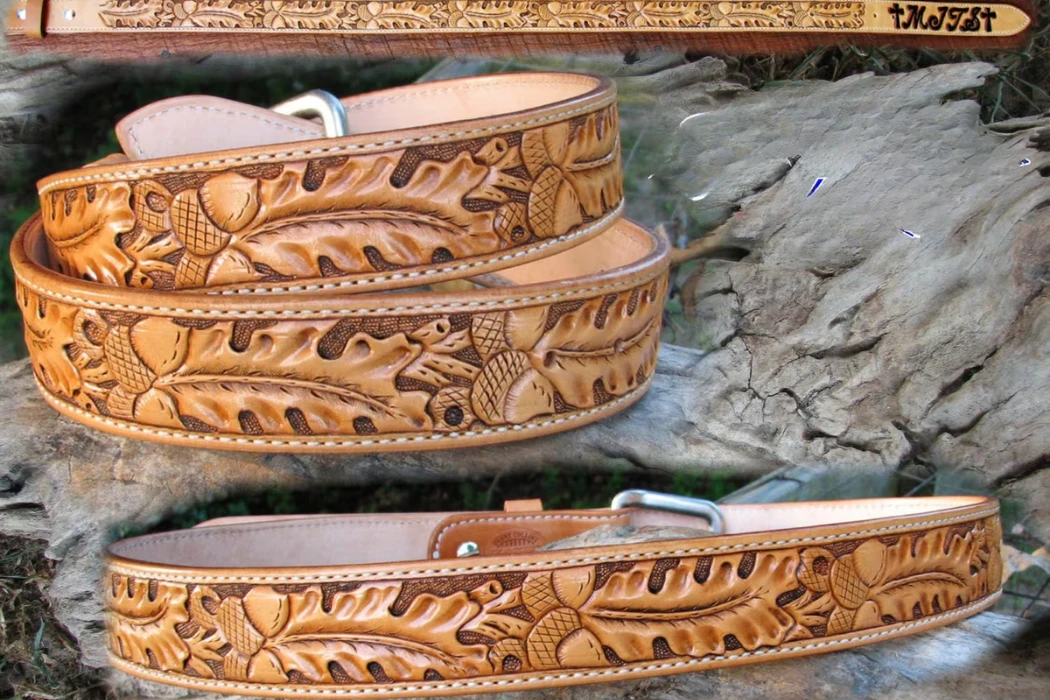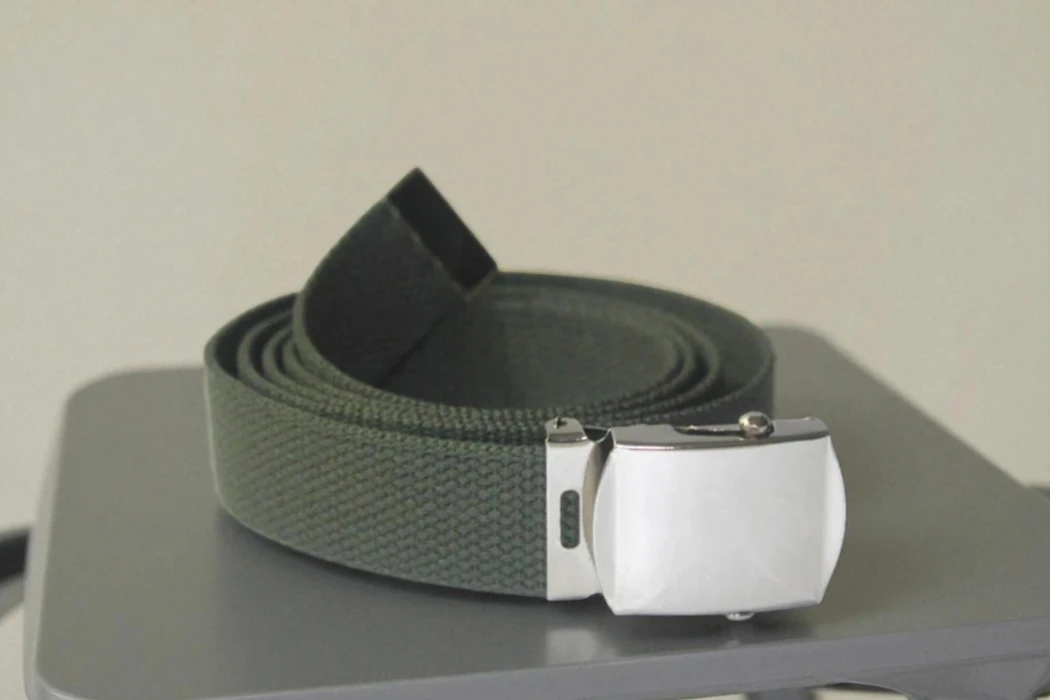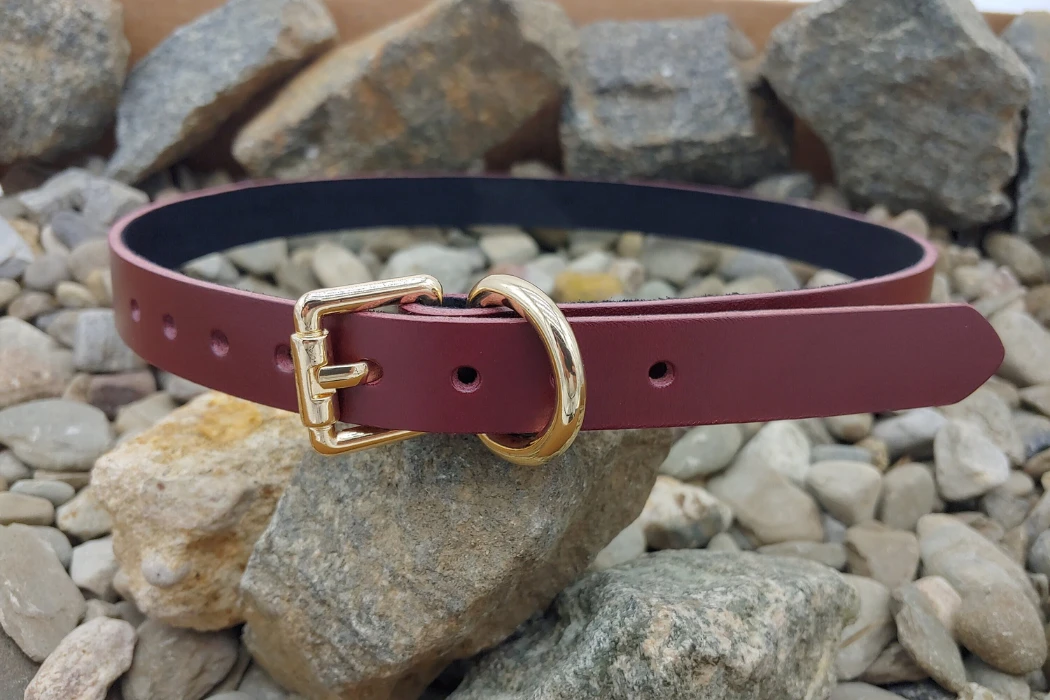
A flexible men’s belt can bend easily, stretch along its length, or offer fine adjustment without stretching much at all. These are different properties. Woven elastic, braided textile and TPU constructions can each create a flexible belt, but the material name alone does not tell a buyer how the finished strap will behave.
For an apparel collection, start with the movement and appearance required, then compare finished samples under the same conditions. A useful specification separates bending feel, extension, recovery, closure grip and care performance.
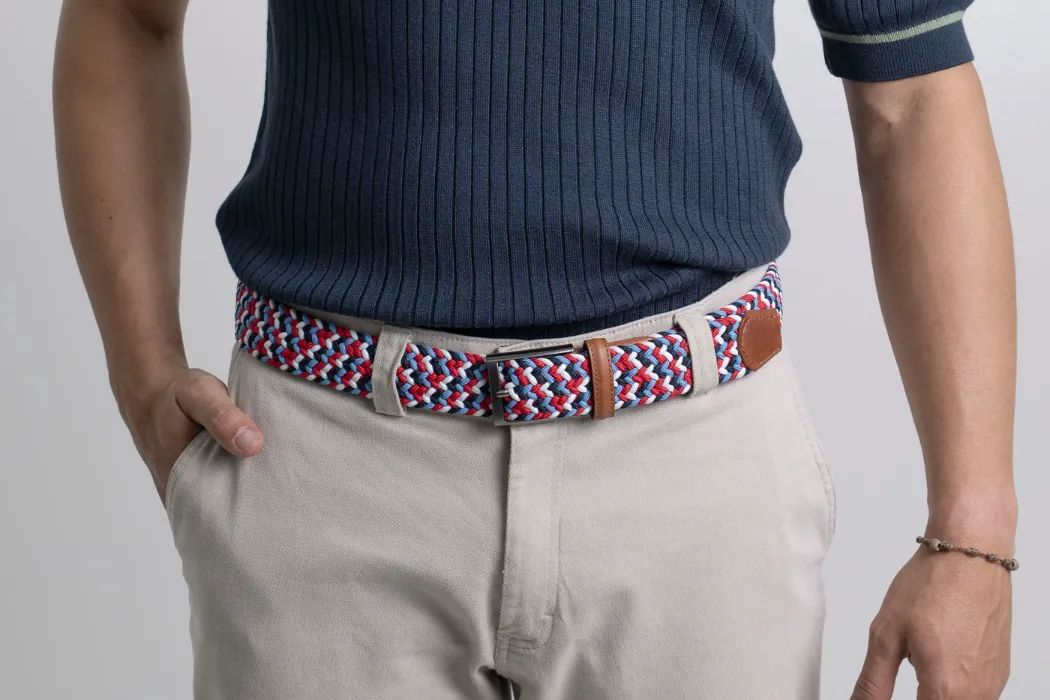
A braided appearance does not identify the yarn composition or demonstrate elastic recovery. Confirm both with the material specification and sample.
Three questions behind the word “flexible”
Does it bend? Bending around the waist depends on the strap’s thickness, structure and stiffness. A leather belt may bend comfortably while showing little useful lengthwise stretch. A thick polymer strap may require more force to bend than a thin one made from the same polymer family.
Does it extend and recover? An elastic construction should extend under an agreed force and return toward its original length after release. A strap that lengthens easily but retains that length can cause fit problems. Maximum extension before failure is different from a comfortable working range.
Can the fit be adjusted finely? A sliding closure or an open braid may allow more positions than spaced holes. That feature does not prove that the strap itself stretches. The closure must also hold without damaging or creeping along the material.
Woven elastic: specify the whole textile structure
Elastic webbing combines an extensible component with a textile structure that controls its behavior. Ask for the declared yarn composition, width, thickness, weave, face finish and edge construction. Do not infer a fixed elastane percentage or working stretch from a product photograph.
Compare tension at a defined extension, residual length after a defined recovery period and changes after repeated extension. Use consistent specimen length and conditioning. ASTM D4964 addresses tension and elongation of elastic fabrics; a laboratory can advise whether it is appropriate for the component and what additional finished-belt checks are needed.
The belt ends deserve equal attention. Sewing or clamping an elastic strap can create a stiff transition or damage yarns. Inspect that transition after bending and adjustment. If a leather tab is added, its finish and care requirements become part of the complete belt specification.
Braided nylon: construction matters as much as fiber
“Nylon” describes a fiber family; “braided” describes how strands are arranged. A braid may contain elastic cores, nonelastic strands or a mixture. Geometric movement in the braid can also change its length and width. Ask for the actual construction rather than assuming every nylon braid is either elastic or nonelastic.
An open braid designed for prong insertion can offer adjustment between conventional hole positions. Check that the prong passes between strands rather than cutting them, and inspect repeated fastening locations for snagging or local distortion. A decorative braid bonded over a backing may not work this way.
Record width under the relevant tension as well as at rest. Assess the finished ends for fraying, loose strands and tab separation. A sharp tip or poorly finished buckle can damage a suitable braid even when the fiber specification is correct.
TPU: separate solid straps from coated webbing
TPU is thermoplastic polyurethane. A solid TPU strap and a textile webbing coated in TPU are different assemblies. The reinforcing webbing can strongly affect extension and shape stability, while the coating affects surface feel and cleaning.
BASF’s TPU range includes different chemistries and hardnesses. Its product information makes clear that flexibility, elasticity and environmental resistance vary by grade. Ask for the actual grade and structure rather than describing every TPU belt as nonstretching, waterproof or immune to creep.
For coated webbing, inspect exposed cut ends, punched holes, coating adhesion and the buckle contact area. For a solid strap, review bending, notch behavior and dimensional change under the intended conditions. A surface that wipes clean does not establish zero water absorption or odor resistance for the complete belt.
Compare candidates with a sample matrix
| Decision | Woven elastic | Braided textile | TPU construction |
|---|---|---|---|
| Lengthwise behavior | Measure working extension and recovery | Identify elastic cores and geometric change | Separate polymer response from any textile reinforcement |
| Adjustment | Confirm closure grip without yarn damage | Confirm safe prong placement if designed for it | Check holes, friction surfaces or the specified closure |
| Hand feel | Inspect face, edge curl and end tabs | Inspect texture, snagging and local bulk | Inspect thickness, surface friction and edge shape |
| Moisture and cleaning | Test the full assembly including trims | Check drying and color transfer after the intended cleaning | Check coating, core, holes and hardware together |
| Appearance | Approve colors, weave and any logos | Approve braid pattern and width variation | Approve gloss, texture, color and visible edge construction |
This matrix identifies what to test; it is not an unsupported material scorecard. There is no reliable universal ranking in which TPU always lasts longest or braided nylon always breathes best. Finished construction, exposure and maintenance can change the result.
Choose the closure after checking the strap behavior
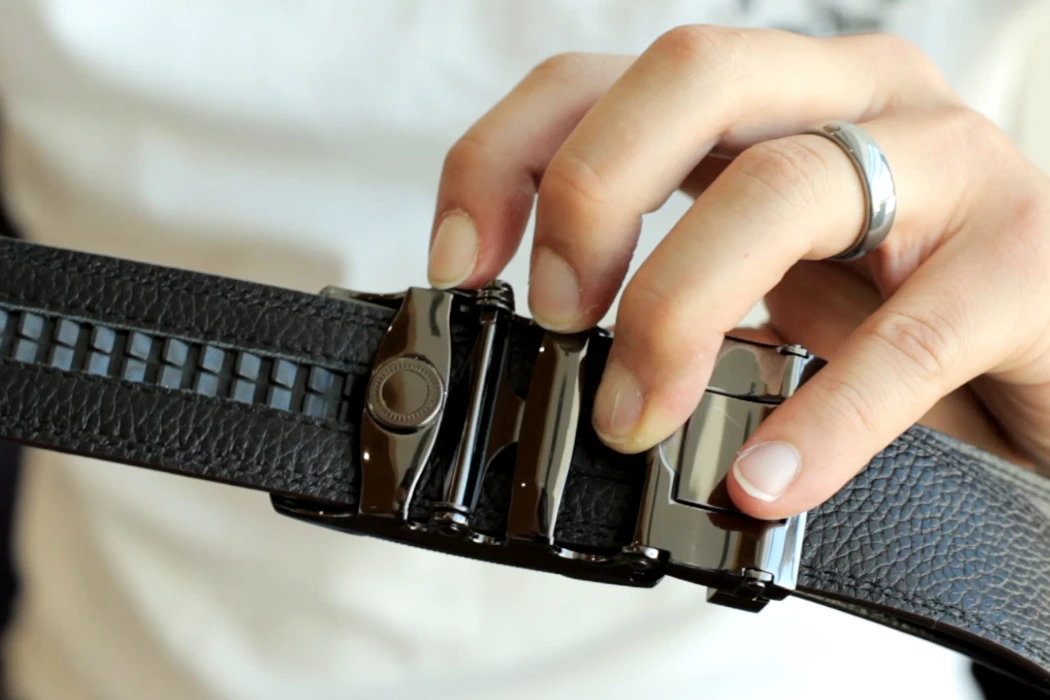
A smooth or narrow strap may slip in a slider that holds a thicker textured one. A prong may damage a dense braid. A ratchet requires a compatible track; attaching a ratchet buckle to ordinary elastic webbing does not create a working system.
Trial the assembled belt through the intended trouser loops. Have wear testers sit, stand and adjust it, noting migration, pressure points, buckle rotation and excess tail. Keep the sizing reference clear: an elastic belt’s relaxed length and its intended fitted range should not be presented as the same number.
Write the sourcing brief without unsupported performance claims
Include composition, construction, relaxed dimensions, intended fitted range, extension and recovery requirements, closure model, end tabs, colors, quantities and care expectations. Ask for separate pricing of the strap, hardware and custom development where useful. Recycled-content claims need documentation for the specified material, and durability still needs evaluation.
Hoplok’s confirmed production information covers leather and PU belts. A specialized elastic, braided textile or TPU program requires a feasibility review before any MOQ, sampling or production commitment. Send the construction reference through the project enquiry page; do not apply leather-belt terms automatically to a different material system.