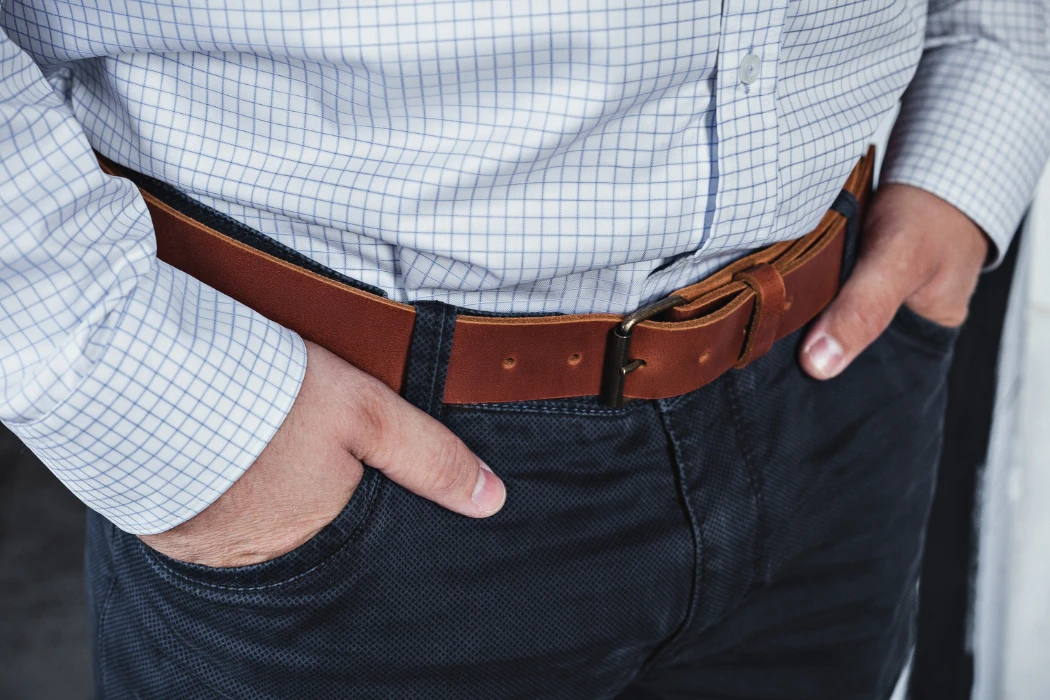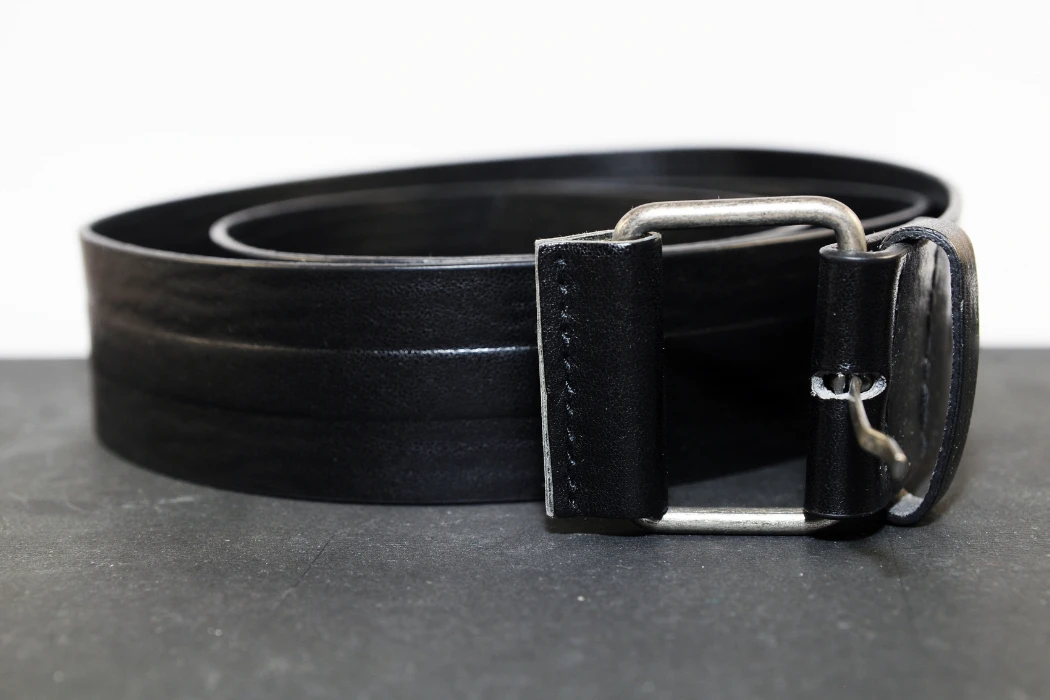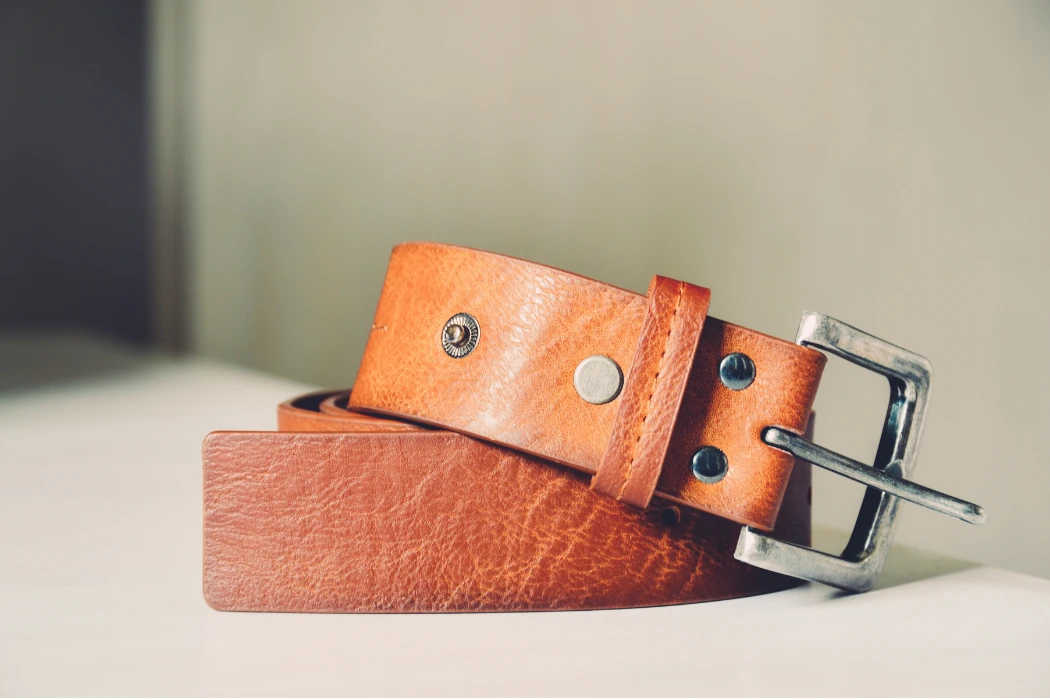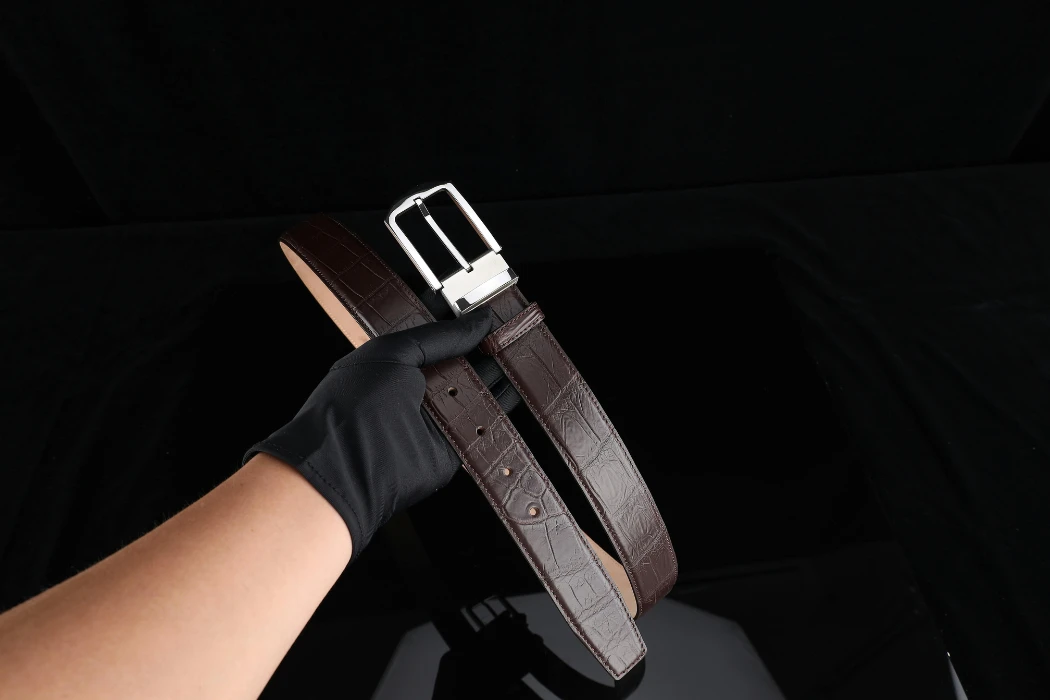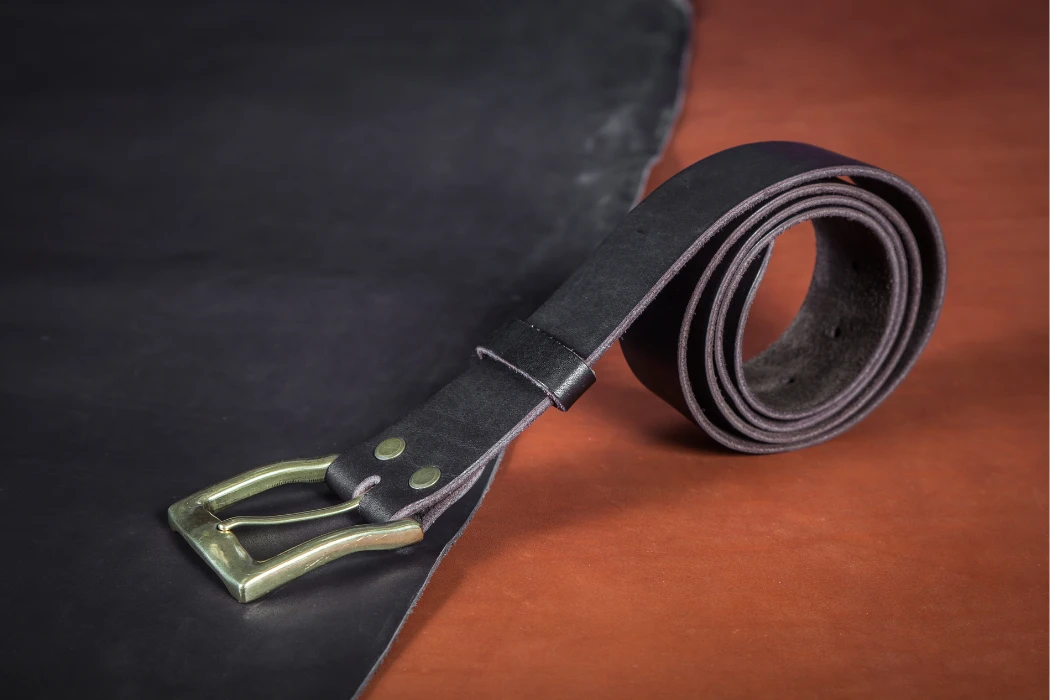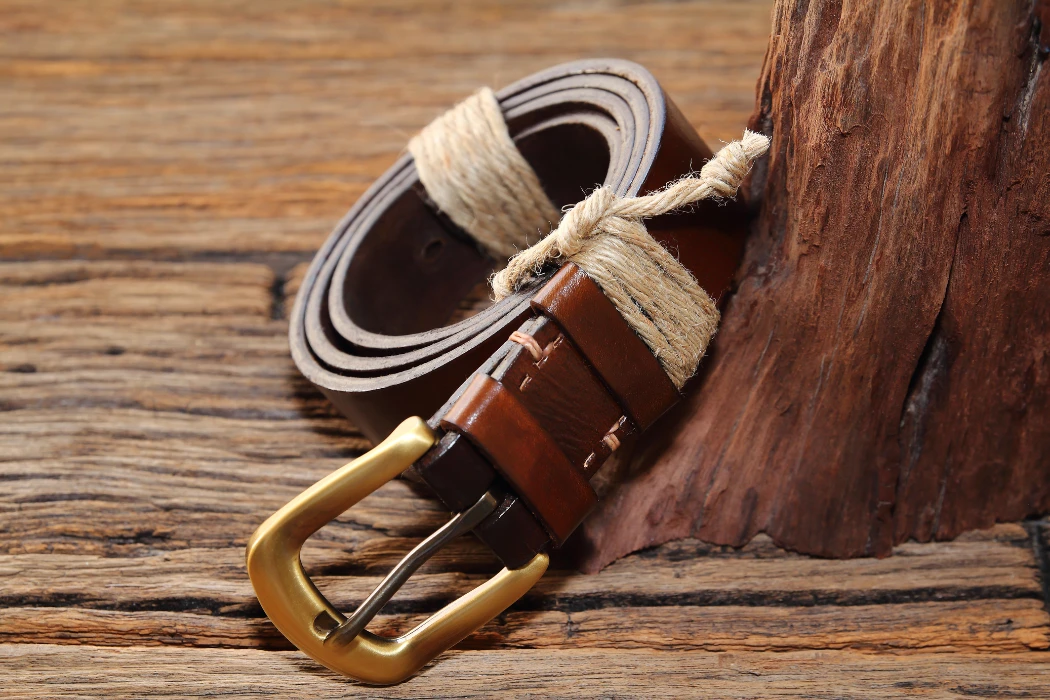
A Split Leather belt is constructed from the fibrous “corium” layer of the hide, which is left over after the premium “Full-Grain” top layer is sliced off. Lacking the dense, protective skin surface, this bottom layer is naturally fuzzy and structurally weak. To simulate a high-quality finish, manufacturers sand it down and apply a thick **polyurethane (PU) coating** or artificial grain embossing. While this mimics the look of real leather, the synthetic topcoat inevitably tends to peel or crack at the buckle holes under daily stress.
It is the most frustrating moment in menswear. You buy a belt stamped “Genuine Leather,” thinking you have made a solid investment. Yet, within 6 to 12 months of daily wear, the surface starts peeling off like old paint, revealing a fuzzy, grey material underneath. Why did your “leather” belt fail like cheap plastic?
The answer lies in the “surgery” the hide underwent. In this guide, we will strip away the marketing disguise of Split Leather. We will explain how a fuzzy byproduct—costing just $1.00 per square foot—is chemically transformed into a belt that looks perfect on the shelf but is chemically engineered to delaminate on your waist.
How Is Split Leather Created in the Tannery?
In the early tanning stages, raw cowhides are typically 4mm – 5mm thick—far too heavy for standard belt production. To maximize yield, tanneries utilize a precision Band Knife Splitter to slice the hide horizontally. The superior top layer (approx. 1.2mm – 1.5mm) is separated as expensive Top Grain, while the remaining bottom layer becomes Split Leather. This fibrous byproduct is incredibly cheap to source (approx. $1.00 – $1.50 / sq ft) and consists primarily of loose, disconnected collagen fibers.
The Mechanical Splitting Process
This is not a crude chop; it is high-precision industrial surgery.
- The Machine: A massive, razor-sharp band blade rotates at high speed while the hide is fed through rollers. The calibration is so precise it maintains a tolerance of +/- 0.1mm across the entire 50 sq ft hide.
- The Result: We get two distinct materials from one animal. The “Grain Split” (top) retains the skin’s natural armor, while the “Flesh Split” (bottom) is just the structural padding—fuzzy on both sides with no natural surface.
Biological Differences: Grain vs. Flesh
Understanding why split leather is weak requires looking at the biology of the cow’s skin.
- Fiber Orientation: The grain layer features tight, vertical fiber bundles designed to protect the animal. The split layer has loose, horizontal fibers designed to allow skin movement.
- Density Gap: Because of this structure, the fiber density of the top grain is roughly 3 to 4 times higher than the split layer. This is why a split leather belt stretches and deforms so easily compared to a full-grain one.
The Cost Advantage for Manufacturers
For fast-fashion brands, the math is undeniable.
- BOM Reduction: Switching from Full-Grain to Split Leather reduces the raw material line item on the Bill of Materials (BOM) to just 20% of the original cost.
- Profit Margin: By coating this cheap byproduct with PU and selling it as “Genuine Leather” for $30, brands can achieve margins exceeding 80%, whereas honest full-grain belts often run on tighter margins.
What Are the Common Finishes for Split Leather Belts?
In its raw state, split leather has a unusable double-sided fuzzy texture. To transform it into a marketable belt, it requires heavy processing. The most ubiquitous finish is the PU Coated Split, where a layer of liquid polyurethane is sprayed on and stamped with a fake grain pattern. Alternatively, manufacturers may create Suede by buffing the surface to enhance its nap, or produce Bycast Leather by laminating a heavy 0.2mm vinyl film on top for a high-gloss, plastic look.
PU Coating (The “Fake Grain” Look)
This is the “standard” genuine leather belt you find in department stores. It is essentially leather particle board with a plastic veneer.
- The Spray Process: A pigmented polyurethane solution is sprayed onto the smoothed split surface. This coating typically creates a layer 0.15mm to 0.20mm thick, accounting for roughly 10% to 15% of the belt’s total thickness.
- Artificial Embossing: While the PU is semi-solid, a heavy steel roller presses a “hair cell” pattern into it. This creates a uniform look that hides all natural defects but looks suspiciously perfect.
Suede Finishing (The Honest Split)
Suede is the only finish that doesn’t try to hide what it is. It embraces the fibrous nature of the split.
- Abrasive Buffing: Instead of coating the leather, tanneries sand the surface using 180 to 220 grit sandpaper. This raises the fibers to create a soft, velvety nap.
- Durability Factor: Because there is no plastic skin to peel off, suede belts don’t suffer from delamination. However, they are highly porous and will absorb sweat and stains instantly if not treated with a hydrophobic spray.
Finish Types Comparison
| Finish Type | Appearance | Coating Material | Wear Resistance | Typical Price |
|---|---|---|---|---|
| PU Coated Split | Smooth, Uniform Grain | Polyurethane (Liquid) | Low (Peels at holes) | $15 – $35 |
| Suede Split | Fuzzy, Matte Nap | None (Buffed) | Medium (Stains easily) | $20 – $45 |
| Bycast / Laminated | High Gloss, Shiny | Vinyl / PVC Sheet | Very Low (Cracks fast) | $10 – $25 |
How Does Split Leather Compare to Full-Grain and Bonded Leather?
In the hierarchy of leather grades, Split Leather occupies the middle ground. It is significantly stronger than Bonded Leather (which is merely leather dust pressed with glue, often containing less than 50% actual hide), as split leather retains a natural fiber structure. However, it is structurally inferior to Full-Grain Leather. While full-grain boasts a tensile strength exceeding 2500 PSI, split leather averages only 800 to 1200 PSI and completely lacks the ability to develop a natural patina.
Structural Integrity Hierarchy
To understand performance, you must look at the microscopic fiber arrangement.
- Full-Grain (The Roof): Features a dense, vertical fiber weave. It is the strongest part of the hide, designed by nature to resist punctures and tears.
- Split Leather (The Basement): Consists of loose, horizontal fibers. While it is real skin, it lacks the tight interlocking structure of the grain, making it prone to stretching.
- Bonded Leather (The Rubble): Contains no fibers at all. It is a slurry of shredded scraps and polyurethane binder, essentially “leather particle board.”
The Longevity Gap
How long will your belt actually hold up your pants before breaking?
- The Decade Belt: A thick Full-Grain belt is a “buy-it-for-life” item, typically lasting 10 to 20 years. It doesn’t break; it just gets softer.
- The Annual Belt: Split leather belts usually fail at the buckle hole within 6 to 12 months of daily use due to coating failure.
- The Temporary Fix: Bonded leather belts often snap in half or peel catastrophically within 3 months.
Belt Material Performance Matrix
| Material Grade | Tensile Strength | Delamination Risk | Avg. Lifespan | BOM Cost Ratio |
|---|---|---|---|---|
| Full-Grain | >2500 PSI | 0% (Solid piece) | 10+ Years | High (100%) |
| Split (PU Coated) | 800 – 1200 PSI | High (Coating peels) | 6 – 12 Months | Low (~20%) |
| Bonded | < 500 PSI | Extreme | 3 Months | Cheap (~10%) |
How Can Consumers Identify a Split Leather Belt?
The key to identification lies in inspecting the Edge and the Backing. A split leather belt typically features thick Edge Paint (often >0.5mm) applied to conceal the fuzzy, layered structure of the core. If the back of the belt feels smooth and plastic-coated rather than having a natural, short suede nap, it is almost certainly a coated split. Additionally, always read the stamp: “Genuine Leather” is the industry code for split material, while premium belts are explicitly stamped “Full-Grain.”
The Edge Paint Inspection
Manufacturers use rubberized paint to hide the truth. Look at the side of the belt.
- The Plastic Cover-up: If the edge looks like a solid, smooth strip of rubber that sits on top of the leather, it is edge paint. On cheap split belts, this layer is often applied heavily (over 0.5mm thick) to prevent the loose fibers from fraying.
- The Natural Burnish: On a Full-Grain belt, you can see the grain layers fused together. The edge is usually burnished (sanded and waxed), allowing you to see the actual skin structure.
The “Wrinkle Test”
Bend the belt backward to see how the surface reacts to stress.
- Micro-Parallel Lines: When you bend a PU-coated split belt, the coating creates tiny, unnatural parallel ripples that look like crinkled plastic wrap. This indicates the coating is separating from the core.
- Tunneling Effect: In severe cases, the top layer will bubble up, creating a “tunnel” between the coating and the leather, a precursor to peeling.
Deciphering Industry Labels
The stamp on the back is legally required but often misleading.
- “Genuine Leather”: This almost always indicates Split Leather. It is the technical term for the third grade of leather.
- “100% Leather”: A vague term often used for Bonded Leather (leather dust).
- “Full-Grain”: The gold standard. If a brand uses Full-Grain, they will brag about it. If they don’t say it, assume it is Split.
Frequently Asked Questions
Is split leather considered “fake” leather?
Technically no, but structurally yes. Split leather is made from 100% real animal hide (the corium layer), so it is organic. However, because the surface grain is removed and replaced with a synthetic polyurethane coating, it behaves more like plastic than skin. Purists often classify it as “inferior” rather than “fake,” though the top layer is undeniably artificial.
Why is my belt peeling like plastic?
Because the top layer is plastic. The peeling is called delamination. It happens when the rigid PU coating separates from the fibrous leather core due to repeated bending stress at the buckle hole. Once the adhesive bond breaks, the plastic skin flakes off. This is a terminal failure mode; it cannot be glued back.
How long should a $20 split leather belt last?
With daily wear, you should expect a lifespan of only 6 to 12 months. The structural integrity of the split fibers is weak, and the coating fatigues quickly under tension. In contrast, a $100 full-grain belt typically lasts 10 to 20 years, making the cheaper belt significantly more expensive in the long run.
Can split leather belts get wet?
You should avoid it. While the plastic topcoat repels water, the raw edges and the fuzzy back are highly porous. If the fiber core absorbs water, it swells and then shrinks upon drying. This expansion/contraction cycle breaks the bond with the coating, causing immediate bubbling and cracking.
What is “Bi-cast” leather?
Bi-cast (or Bycast) leather is a specific type of split leather made by laminating a heavy vinyl or polyurethane film onto the surface. It is distinct because the film is much thicker (often 0.15mm+) and glossier than standard coatings. While it looks shiny and perfect, it is notoriously stiff and prone to snapping in cold weather.
Conclusion: When is Split Leather the Right Choice?
If you need a belt for occasional wear—like a suit you wear twice a year—or you want a specific bright fashion color for under $20, Split Leather is a rational economic choice. It gives you the aesthetic without the heavy investment. However, for a daily driver that holds up jeans or tools, it offers poor long-term value. Mathematically, replacing a cheap split belt every 9 months is far more expensive over a decade than buying one high-quality full-grain strap once.
For Brands and Retailers: The secret to low return rates is aligning consumer expectations with material reality. We advise clearly distinguishing your product lines.
At Hoplok, we support both tiers of your business. For your entry-level, high-volume SKUs, we supply premium Anti-Peel PU Coated Splits with reinforced bonding agents. For your flagship “Heritage” collection, we source exclusively Vegetable Tanned Full-Grain hides. Contact Hoplok today to request our material sample book and feel the structural difference in your own hands.