For many men, the idea of wearing suspenders (or “braces” as they are traditionally known) induces a specific anxiety: the fear of looking like a 1920s cosplayer or a caricature of a stereotypical nerd. This hesitation often leads beginners to stick with belts, even when they constantly find themselves pulling up their trousers or dealing with waist constriction.
At Hoplok, we specialize in manufacturing high-stress load-bearing connectors. We don’t view suspenders as a costume accessory; we view them as a Vertical Suspension System. Unlike a belt, which relies on friction and compression, a suspension system is the ultimate engineering solution for keeping a garment at a fixed height without horizontal pressure. It is physics, not just fashion.
Mastering this accessory doesn’t require a degree in sartorial history. It simply requires understanding three core engineering variables: Attachment Method (how it connects), Strap Width (how it distributes weight), and Trouser Rise (where the anchor point sits). Once you dial these in, the result is cleaner lines and superior comfort.
In this guide, we will walk you through the mechanics of selecting your first pair, explain why material integrity in the leather ends matters more than the fabric itself, and help you avoid the common rookie mistakes that ruin the look.
Why Should You Switch to Suspenders?
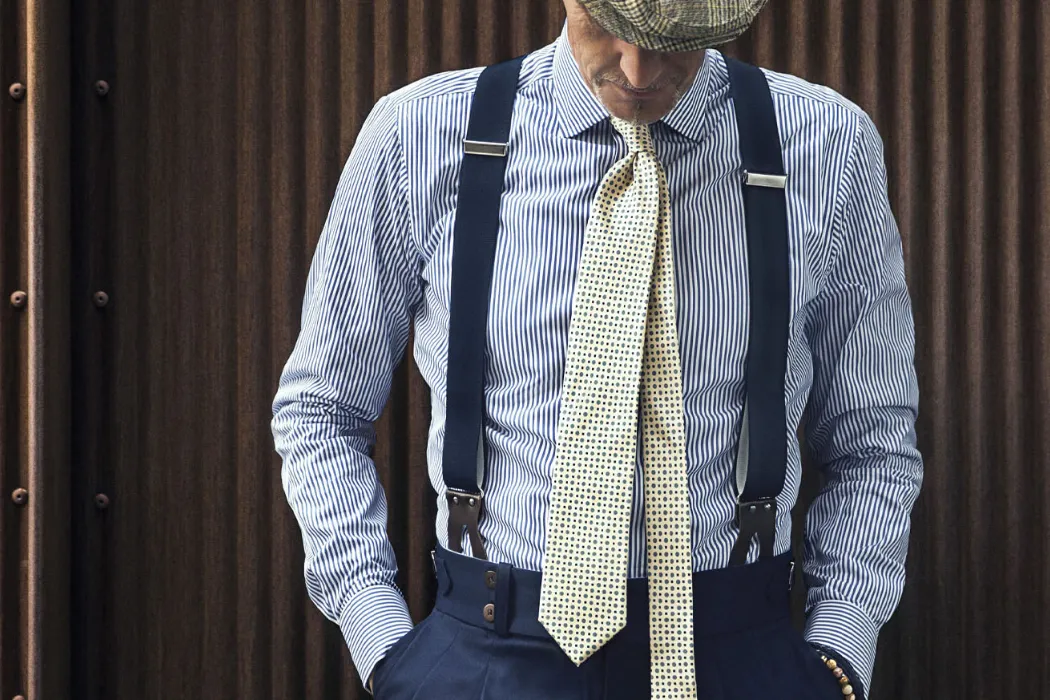
Fundamentally, suspenders offer superior mechanics by transferring the load of your trousers from your waist to your shoulders, eliminating the need for circumferential compression. While belts act as a tourniquet relying on friction to fight gravity, suspenders function as a suspension bridge, allowing garments to hang naturally without restricting your midsection.
The Physics of Vertical Suspension
From a mechanical engineering standpoint, the method of supporting weight drastically changes the stress placed on the body.
- Circumferential Pressure (Belts): To hold up trousers weighing 0.5–1.0 kg, a belt must apply inward pressure greater than the downward pull. This creates a ring of tension around soft tissue.
- Load Transfer (Suspenders): Suspenders bypass the abdomen entirely. They distribute the weight vertically across the trapezius muscles of the shoulders, which are structurally better suited to bear loads than the soft visceral area of the waist.
- Zero Friction Requirement: A belt requires friction against the hips to work. Suspenders require zero friction, meaning your waistband can be slightly loose for breathability without ever falling down.
Posture and Silhouette Benefits
Visual aesthetics are often a result of geometry. Suspenders create vertical lines that alter how the observer perceives the wearer’s height and build.
- The Vertical Line Effect: Belts create a horizontal line that bisects the body, visually shortening the torso. Suspenders create two vertical lines that draw the eye upward, creating an optical illusion of increased height and a slimmer profile.
- Trouser Drape Consistency: Because suspenders anchor the trousers at a fixed height from the shoulders, the “break” (where pants hit the shoe) remains constant. Belts often slide down 1–2 inches throughout the day, causing pants to bunch at the ankles.
- Smoother Transition: By eliminating the cinched waist, suspenders prevent the “muffin top” effect, creating a clean, unbroken line from chest to hip.
Comfort for the Modern Body
For many body types, a belt is mechanically inefficient. We advise clients to look at their own geometry to determine the correct tool.
- The “Waist > Hips” Physics: If your waist circumference is larger than your hip circumference (common in men with higher BMI), a belt has no “shelf” to rest on. It will slide down due to the slope of the body unless tightened painfully. Suspenders are the only mechanically sound solution for this body type.
- Sitting Mechanics: When seated, the abdomen expands. A rigid belt digs in, increasing intra-abdominal pressure. Suspenders offer zero resistance when sitting, making them ideal for office work or long drives.
What Are the Different Types of Suspenders?
Before you buy, you must understand the hardware. The market is divided into two distinct tiers: mechanical clips (casual/utility) and button attachments (formal/structural). Choosing the wrong type is the most common beginner mistake, often resulting in damaged clothing or a “costume” appearance.
Button-On vs. Clip-On Mechanics
The connection point is the critical failure zone. At Hoplok, we test these interfaces for load limits and fabric interaction.
- Clip-On (The “Grip” Hazard): Metal clips rely on serrated teeth to generate approximately 15–20 Newtons of bite force. While convenient, this mechanical bite shreds the delicate fibers of Super 120s wool suits. We strongly advise against clips for anything other than rugged denim.
- Button-On (The Structural Standard): Leather button tabs rely on tensile strength rather than friction. A full-grain leather tab has a tensile limit exceeding 500 Newtons. It creates a secure, non-destructive anchor point that distributes tension evenly across the waistband.
Back Shapes: Y-Back vs. X-Back
The shape of the back yoke determines how the straps interact with your shoulder blades and range of motion.
- Y-Back (3-Point Anchor): The standard for formal and business wear. A single strap runs down the spine, branching into two. This central pivot point offers a streamlined silhouette but requires centered posture.
- X-Back (4-Point Anchor): Common in heavy-duty workwear or for men with very broad shoulders. The two straps cross independently, creating a wider stance that offers greater stability for manual labor but looks cluttered under a suit jacket.
Strap Materials: Elastic vs. Rigid
The “give” of the material dictates the feel of the suspension.
- Elastic Webbing: The entry-level standard. High-quality elastic offers 150% stretch, making it forgiving for beginners. It moves with you but can degrade over time.
- Rigid Boxcloth (Wool Felt): The “Rolls Royce” of suspenders. This dense wool felt has near-zero elasticity. It provides absolute, unyielding support but requires the adjusters to be dialed in with millimeter precision.
| Feature | Metal Clip-On System | Leather Button-On System |
|---|---|---|
| Security | Low (Can slip off under tension) | High (Mechanically locked) |
| Fabric Safety | Destructive (Teeth damage wool) | Safe (Non-invasive loop) |
| Formality Level | Casual / Novelty / Workwear | Business / Formal / Black Tie |
| Durability | Metal fatigue / Spring failure | Depends on leather grade (10+ years) |
How Do You Put on Suspenders Correctly?
Putting on suspenders often feels like a contortionist act for beginners. The most mechanically efficient protocol is to attach the rear anchors before stepping into your trousers, ensuring perfect alignment without blind twisting. This “Pre-Attachment” method turns a frustrating 5-minute struggle into a seamless 30-second routine.
Step 1: Pre-Attachment Strategy
The human shoulder has a limited range of motion behind the back. Attempting to fasten buttons blindly is inefficient and often leads to asymmetry.
- Lay Flat to Start: Place your trousers on a bed or table. Fasten the rear leather tabs (or clips) to the center-back waistband anchor points before putting the pants on.
- Time Efficiency: This sequence saves approximately 30–60 seconds of awkward fumbling. More importantly, it ensures the Y-back junction is perfectly centered on your spine, which is critical for even load distribution.
Step 2: The Shoulder Flip and Adjustment
Once the trousers are pulled up and buttoned at the waist, the straps function as the active tensioning system.
- The Flip: Slide your arms through the straps like a backpack. Ensure the fabric lays flat against your shirt without twisting, which creates localized pressure points.
- Adjuster Positioning: Slide the brass or nickel adjusters until they sit roughly 2–3 inches (5–7.5 cm) below your collarbone. This places the hardware on the flat structural plane of your chest (Pectoralis Major) rather than digging into the shoulder or floating awkwardly low near the stomach.
Step 3: Trousers Rise and Fit
Suspenders function best when the anchor point is geometrically correct relative to your natural waist.
- Rise Requirement (>10 inches): Suspenders are engineered for Mid to High Rise trousers (rise measurement greater than 10 inches / 25cm). They are designed to pull pants up to your natural waist (navel level).
- The Low-Rise Error: Wearing suspenders with low-rise hips (common in fast-fashion jeans) creates a visually elongated torso and shortened legs, destroying the aesthetic “Golden Ratio” of menswear.
- Waist Gapping: Since you aren’t using friction to hold the pants up, your waistband should be 0.5–1 inch looser than a belted fit. This allows for airflow and sitting comfort.
How to Match Suspenders with Your Wardrobe?
Suspenders are a high-contrast accessory that creates strong vertical lines. To wear them successfully, you must coordinate the leather ends with your footwear, select a strap width that complements your body frame, and understand the historical rules of visibility. A well-executed pair enhances your outfit’s geometry; a mismatched pair looks like a costume.
Leather End Coordination
The leather attachment points (tabs) are the visual anchors of the system. In menswear, “leathers must match leathers” is a non-negotiable rule for cohesion.
- The Hoplok Matching Rule: If your shoes are walnut brown, your suspender tabs must be a matching brown tone. Black shoes require black leather tabs. Wearing black suspender ends with brown brogues creates a jarring visual disconnect.
- Material Consistency: The finish matters too. A high-shine patent leather shoe (for tuxedos) requires high-shine silk or moiré suspender tabs, whereas rugged boots pair with matte, vegetable-tanned leather ends.
Strap Width and Formality
The width of the fabric strap dictates both the formality level and the load-bearing capacity. Choosing the wrong width can make you look out of proportion.
- The Standard (1.5 inches / 38mm): This is the engineering “Goldilocks” zone. It provides sufficient shoulder surface area for comfort and fits 90% of business and formal contexts. Ideally suited for average to athletic builds.
- The Fashion/Skinny (1.25 inches / 32mm): Often found in fast fashion. These offer less support and can look flimsy on broad shoulders. Best reserved for casual wear or very slender frames.
- The Workwear (2 inches / 50mm): Designed strictly for heavy loads (tool belts, logging). Wearing 2-inch wide straps with a business suit looks bulky and unrefined.
The Jacket Rule
Historically, suspenders were classified as underwear, meant to be purely functional and hidden from view.
- Formal Invisibility: In 90% of formal settings (weddings, board meetings), your suspenders should remain covered by your suit jacket or vest. Flashing your braces is considered a breach of traditional etiquette, akin to showing your undershirt.
- The Casual Exception: Modern style has relaxed this rule for casual settings. Wearing patterned suspenders over a chambray shirt with jeans is acceptable, but the “underwear” rule still applies strictly to Black Tie events.
| Width (Inches / mm) | Best For | Formality Score | Body Type Suitability |
|---|---|---|---|
| 1.25″ (32mm) | Trendy / Casual / Party | Low (Fashion forward) | Slim / Skinny builds |
| 1.5″ (38mm) | Business Suits / Tuxedos | High (The Standard) | Average / Athletic / Broad |
| 2.0″ (50mm) | Manual Labor / Heavy Denim | None (Utility only) | Heavy set / Large frames |
Is It Worth Investing in Premium Leather Ends?
The short answer is yes, because the attachment point is the mechanical weak link of the entire system. While the elastic or wool strap can last for years, cheap “genuine leather” or synthetic tabs often fail at the buttonhole within months. Investing in full-grain leather ends is not about luxury; it is about ensuring structural integrity under constant tension.
Durability of Button Tabs
The buttonhole on a suspender tab is subjected to concentrated stress every time you sit or bend. At Hoplok, we rigorously test failure points to determine material limits.
- Tear Strength Analysis: A standard “bonded” leather tab (common on sub-$30 suspenders) typically tears at the buttonhole under 50–80 Newtons of force. In contrast, Hoplok’s Full-Grain Vegetable-Tanned leather tabs withstand upwards of 500 Newtons. The interwoven fiber structure of full-grain leather distributes stress, whereas bonded leather simply disintegrates.
- The “Stretching” Failure: Lower-grade leather stretches permanently around the button, eventually becoming so loose that the suspenders pop off unexpectedly. Full-grain leather has memory; it holds tight.
Aesthetics of Full-Grain Leather
Beyond strength, the visual evolution of the material dictates the long-term value of the accessory.
- The “Molding” Effect: High-quality vegetable-tanned leather is hydro-reactive. Over the first month of wear, the button tabs will physically mold to the shape of your specific trouser buttons, creating a mechanical “snap” fit that improves security over time.
- Patina Development: Synthetic leather peels and cracks, revealing a fuzzy grey backing. Full-grain leather absorbs oils and sunlight, developing a rich patina (a soft sheen and darkening color) that signals quality and heritage to the observer.
Hardware Longevity
The adjusters and levers are the moving parts of the engine. Material composition determines whether they freeze up or remain functional.
- Solid Brass vs. Plated Zinc: We prioritize Solid Brass hardware because it is impervious to red rust. Cheaper zinc alloy hardware is often plated; once the plating chips (usually within a year), the base metal corrodes, potentially staining your white dress shirts with oxidation marks.
| Material Grade | Material Composition | Tear Strength | Expected Lifespan |
|---|---|---|---|
| Synthetic / Faux | Polyurethane on fabric backing | Low (< 50N) | 6 Months (Cracks/Peels) |
| “Genuine Leather” | Bonded leather scraps + glue | Medium (80N) | 1–2 Years (Delaminates) |
| Hoplok Full-Grain | Solid Top-Layer Hide | High (> 500N) | 10+ Years (Develops Patina) |
Common Beginner Mistakes to Avoid (Troubleshooting)
Wearing suspenders is a statement; wearing them incorrectly is a mistake that screams “novice.” The most frequent errors stem from a misunderstanding of mechanics (wearing a belt) or geometry (wearing low-rise pants). Avoid these three pitfalls to ensure your suspension system enhances, rather than detracts from, your silhouette.
The Belt Redundancy Error
We cannot stress this enough: Never wear a belt with suspenders. It is the sartorial equivalent of wearing a raincoat underneath an umbrella.
- Functional Redundancy: Both accessories serve the exact same mechanical purpose: resisting the downward force of gravity (approx. 9.8 N). Using both creates unnecessary friction and bulk at the waist.
- The “Clutter” Zone: Visually, the hardware of a belt buckle competing with suspender tabs creates a chaotic center mass. It draws the eye to the waist, disrupting the clean vertical lines you are trying to create.
Incorrect Rise Height
Suspenders rely on the anchor point (the trouser waistband) being positioned correctly on the body’s vertical axis.
- The “Long Torso” Illusion: Suspenders are engineered for Mid to High Rise trousers (rise > 10 inches). Attaching them to low-rise jeans (rise < 9 inches) sitting on the hips visually elongates the torso and shortens the legs.
- Proportional Failure: This destroys the “Golden Ratio” of menswear (typically a 50/50 or 40/60 split between torso and legs). To maximize the height-enhancing benefit of suspenders, the waistband must sit at the natural waist (navel level).
Ignoring Hardware Quality
Cheap hardware is the silent killer of a good outfit. A broken clip in the middle of a workday is a catastrophic wardrobe malfunction.
- Zinc Alloy Fatigue: Mass-market clips are made of brittle die-cast zinc. In cycle testing, the spring mechanisms often fail after 500–1,000 actuations. Once the spring snaps, the suspender is useless.
- The “teeth” damage: Low-quality clips often have sharp, unrefined teeth. Under tension, these micro-serrations act like a saw, gradually cutting through the waistband fabric of expensive trousers.
Frequently Asked Questions
Can I wear suspenders with jeans?
Yes, absolutely, but you must match the aesthetic. Suspenders pair excellently with denim for a rugged, workwear look (think lumberjack or heritage style). However, avoid formal silk braces. Instead, opt for heavy-duty elastic, boxcloth, or non-stretch cotton webbing. While clip-ons are functionally acceptable with jeans, installing bachelor buttons (hammer-on buttons) into the denim waistband provides a far superior, authentic look.
The standard industry placement is exactly 3 inches (7.5 cm) from the center seam. For the front buttons, measure 3 inches to the left and right of your zipper fly; this ensures the straps rise vertically over the chest without splaying outward. For the back, center the buttons on the rear seam. We recommend sewing them on the inside of the waistband for a cleaner, modern look, or on the outside for a traditional workwear vibe.
Are expensive suspenders worth it?
Yes, because the price difference lies in the Leather Grade and Hardware metallurgy. Cheap suspenders ($20 range) use bonded leather ends that tear under tension and zinc clips that lose their grip. Premium suspenders ($80+) utilize Full-Grain Vegetable-Tanned Leather ends (like those Hoplok supplies) and Solid Brass adjusters. The strap fabric may look similar, but the hardware and connection points on premium pairs will outlast the cheap versions by decades.
The Verdict: Elevate Your Style and Comfort
Switching to suspenders is a graduation in menswear. It marks the transition from simply covering your body to understanding the mechanics of how clothes should drape. While the initial fear of looking “old-fashioned” is common, it evaporates the moment you experience the freedom of a waist without constriction. The vertical suspension system offers a level of comfort that no belt can physically match.
Hoplok’s Engineering Perspective
From our manufacturing standpoint, we operate by a simple maxim: “The connection defines the system.” We have seen too many premium wool suspenders ruined by cheap, bonded leather tabs that snap under load. A suspension system is only as reliable as its anchor points. In our view, the leather ends must be engineered to outlast the trousers they support, maintaining their tensile integrity for decades, not just seasons.
Ready to Upgrade Your Components?
If you are an accessory brand or artisan maker seeking tensile-resistant, non-breaking Full-Grain Vegetable-Tanned Leather Ends to elevate your product line, Hoplok is your manufacturing partner. We don’t just cut leather; we engineer components with specific fiber densities to ensure buttons never pull through. Contact our team today for precision die-cut solutions and B2B prototyping.