The benefits of chrome-free leather directly address the business risks of market access and regulatory penalties. For baby and automotive brands, using conventional materials risks failing strict REACH and CPSIA regulations, leading to blocked shipments and costly recalls.
This analysis explains how to use this material to protect your supply chain. We evaluate how leather sourced from LWG-certified tanneries guarantees compliance, securing your brand’s market access in the EU and US while protecting profit margins.
3 Core Benefits of Chrome-Free Leather
Quick Comparison
| Product Name | Best For | Key Feature | Verdict |
|---|---|---|---|
No Risk of Chromium VI (Allergy Safe) |
Health & Safety | Hypoallergenic and Non-Toxic Finish | Prevents common skin allergies and irritation |
Automotive & Baby Standard Compliance |
Regulatory Compliance | Passes Strict Global Safety Tests | Ensures market access in regulated industries |
Better Biodegradability |
Environmental Impact | Reduced End-of-Life Pollution | Aligns with circular economy and sustainability goals |
No Risk of Chromium VI (Allergy Safe)
The Verdict: By avoiding chromium in the tanning process, this leather eliminates the risk of hexavalent chromium (Chromium VI). This makes it inherently safer, preventing common skin allergies and removing exposure to carcinogenic substances.
✅ The Good
- Prevents common skin allergies and irritation
- Eliminates risk from a known carcinogen
⚠️ The Bad
- Final product feel may differ slightly from traditional chrome-tanned leather
Automotive & Baby Standard Compliance
The Verdict: Due to its non-toxic properties, chrome-free leather inherently meets the world’s most stringent safety regulations, such as those for automotive interiors and baby products. It easily passes standards like REACH, CPSIA, and OEKO-TEX, which strictly limit or ban heavy metals.
✅ The Good
- Ensures market access in regulated industries
- Ideal for products with high skin-contact
⚠️ The Bad
- Often a mandatory requirement, not just a benefit, for specific end-uses
Better Biodegradability
The Verdict: By avoiding heavy metals, this leather decomposes more safely at its end-of-life. This reduces the soil and water pollution common with chrome-tanned alternatives that leach toxic materials.
✅ The Good
- Aligns with circular economy and sustainability goals
- Dramatically lowers soil and groundwater contamination
⚠️ The Bad
- Overall biodegradability is also dependent on the dyes and finishes used
What is Chrome-Free Tanning?
Chrome-free tanning is a leather manufacturing process that avoids using chromium salts. This method relies on alternative agents like aldehydes or specific minerals to tan hides, helping brand owners meet strict environmental standards like REACH and CPSIA by eliminating toxic chromium discharge. It produces leather that is soft, durable, and versatile enough for a wide range of products without compromising performance.
A Tanning Method Without Chromium
This is a leather manufacturing process that completely avoids using chromium salts at any stage. It relies on alternative tanning agents such as aldehydes, specific minerals like zirconium and aluminum, or zeolite-based compounds. For brand owners and manufacturers, the key benefit is the elimination of toxic chromium discharge. This simplifies wastewater treatment and helps ensure products are compliant with international environmental standards, reducing regulatory risk for your business.
Characteristics of Chrome-Free Leather
Chrome-free leather produces a final product with a natural look, a soft and light feel, and is particularly good for achieving bright pastel color tones. It offers durability and resilience that can match or even exceed traditional chrome-tanned leather, featuring superior flex strength for long-lasting products. A key technical feature is its high shrink resistance, enabling it to withstand boiling water for minutes without shrinking—a testament to its stability and quality.
Process and Common Applications
Adopting chrome-free methods is straightforward as the process uses the same equipment as conventional tanneries, making it a viable option without major capital investment. The technology is both mature and commercially available. It is often specified for products with strict safety requirements, such as those for the EU and US markets, including automotive interiors, military footwear, and baby shoes. This aligns with our ability to manufacture REACH & CPSIA compliant goods for our partners.
The Trade-off: Is it Less Durable?
A common question is whether sustainable leather options compromise on strength. The answer is no. Chrome-free tanning delivers leather with durability and resiliency equal to traditional methods. The primary trade-off isn’t in performance but in the balance between initial manufacturing costs and a significantly smaller environmental footprint—a key advantage for modern brands.
Durability and Resiliency: A Direct Comparison
Many assume that sustainable processes lead to weaker products, but this isn’t true for leather. Chrome-free tanning does not sacrifice durability; its resiliency and overall quality are equal to those of traditionally tanned leather. The choice of tanning process doesn’t change the inherent quality of the hide. For demanding products like our heavy-duty work belts, the key to strength remains the quality of the raw material, such as using premium full-grain hides from LWG certified tanneries.
Beyond raw strength, day-to-day performance is critical for reducing customer claims. Our chrome-free leathers maintain similar water, stain, and heat resistance to conventionally tanned options. This means the tanning method does not limit a product’s application. Whether your brand creates high-end fashion accessories or durable workwear, the performance characteristics meet demanding industry standards, ensuring your final products are built to last.
The Real Trade-Off: Cost vs. Environmental Impact
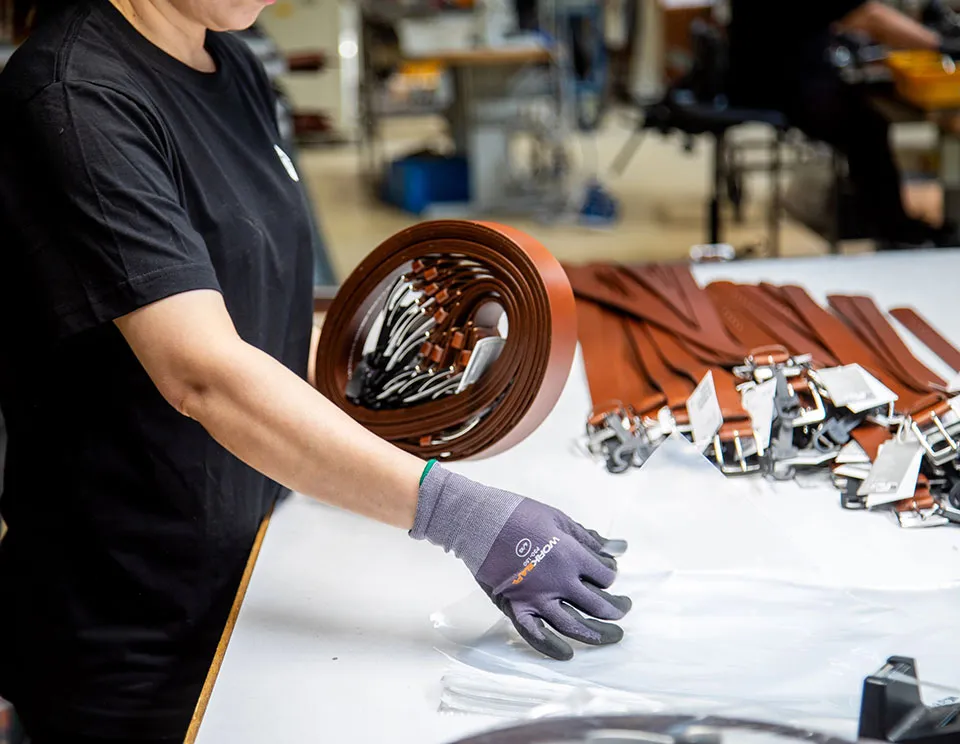
If performance isn’t the trade-off, what is? The primary consideration is the balance between manufacturing cost and environmental compliance. Chrome-free tanning often has a higher initial expense because it avoids chromium and other regulated chemicals, resulting in a much more sustainable product. We help our partners manage this. Through our vertical integration, including the in-house Pro Pelli leather finishing facility, we control the entire process. This allows us to offer factory-direct pricing that helps protect your profit margins while delivering a superior, eco-conscious product.
Premium Custom Leather Belts, Made to Scale.
Cost Impact: Is it Worth the Premium?
While some tanning methods have higher initial material costs, this premium is often a strategic investment for our brand partners. We help manage this through our vertical integration and direct factory control. For clients targeting specific regions, potential tariff savings from our Cambodia production can offset the premium, protecting your profit margins while meeting market demands for sustainable products.
Analyzing the Production Cost Factors
Alternative tanning processes can involve higher initial chemical costs, but this increase is often small relative to the total price of a finished belt. Our dual-country manufacturing strategy gives our clients a unique advantage. Thanks to our vertical integration and the Pro Pelli in-house finishing facility, we maintain direct control over material costs and can better manage any premium. For our B2B clients, the Cambodia Duty Advantage opens up potential tariff savings for importers, which helps offset higher material expenses in certain regions.
The Trade-off Between Performance and Price
You don’t have to sacrifice quality for a more sustainable material. Our chrome-free leathers deliver durability and a soft texture comparable to conventionally tanned options. A known trade-off is lower resistance to heat aging in some cases, but modern retanning technologies are closing this gap. For most fashion and casual belt applications, the performance is excellent. We work directly with brands to select the right material, as some niche, high-performance waterproof applications may still benefit from other tanning processes.
Where the Premium Delivers Value
The higher cost provides clear value in sectors with strict safety and environmental regulations. Growing consumer demand for sustainable goods also makes the premium a worthwhile investment for brands in fashion, bags, and footwear. For partners selling in the EU and US, choosing chrome-free leather helps ensure products are REACH & CPSIA Compliant, reducing business risk. In highly price-sensitive markets, the premium can be a factor, but for brands focused on safety and forward-thinking values, it offers a distinct market advantage.
How to Test and Verify Chrome-Free Claims
Verifying chrome-free claims requires submitting leather samples to an accredited lab for analysis against official standards. The primary benchmark, NF EN 15987:2015, mandates that chromium content must be below 1,000 mg/kg. Passing this test provides a formal certificate, which allows your brand to confidently meet safety regulations like REACH and CPSIA and guarantee product integrity.
Official Standards and Certifications
The globally recognized benchmark for chrome-free leather is the NF EN 15987:2015 standard. It provides a clear definition: leather must contain less than 1,000 mg/kg of chromium. Accredited third-party laboratories use this standard to issue formal “chrome-free leather” certificates. For our B2B partners, this documentation is critical. It provides the proof needed to comply with strict international safety regulations, including REACH in Europe and CPSIA in the USA, protecting your brand from compliance issues and costly recalls.
Key Laboratory Testing Methods
To ensure both safety and quality, labs use a multi-faceted testing approach. Chemical analysis, such as Fourier-transform infrared spectroscopy (FT-IR), identifies the specific tanning agents used to confirm the absence of chromium. Just as important, a series of physical and mechanical tests measures key performance metrics like tensile strength and tear resistance. This confirms the leather’s durability meets your brand’s standards. Finally, structural analysis with tools like scanning electron microscopy (SEM) offers a visual inspection of the leather’s collagen fiber structure, verifying a proper and consistent tanning process.
The Step-by-Step Verification Process
The path to certification is straightforward and transparent. First, we submit leather samples from a production batch to an accredited laboratory. The lab then conducts the full range of chemical and physical tests according to established protocols. Once the analysis confirms the leather meets the chrome-free threshold, the lab issues an official certificate. This document serves as undeniable proof for your supply chain, providing your business with the trustworthy documentation needed to validate your product claims.
Benefit 2: Automotive & Baby Standard Compliance
Our manufacturing capabilities ensure our leather products comply with the world’s strictest safety regulations, including CPSIA for baby goods and rigorous automotive interior standards. By using compliant materials and processes, we help your brand eliminate risks from harmful substances like chromium VI, lead, and phthalates, ensuring safe market access in the EU and US.
Meeting Strict Baby Product Standards (CPSIA & REACH)
For brands targeting the juvenile products market, safety is non-negotiable. Our processes are designed to meet stringent international regulations like the Consumer Product Safety Improvement Act (CPSIA) in the United States and REACH in Europe. We use LWG-certified and alternative materials that are verified to be free from harmful substances, including lead, phthalates, and the risk of hexavalent chromium. This protects your youngest consumers and shields your brand from costly compliance issues and recalls.
Passing Automotive Interior Material Tests
The automotive industry demands materials that are safe, durable, and stable under extreme conditions. Leather used in vehicle interiors must not release volatile organic compounds (VOCs) that cause windshield ‘fogging’ and must remain free of hazardous substances like hexavalent chromium (Cr VI), which can form when certain leathers are exposed to heat. Our vertically integrated manufacturing allows us to control the tanning and finishing processes, ensuring the finished leather meets the high durability, air quality, and safety specifications required by global automakers.
Automotive & Baby Standard Compliance
We help brand owners meet strict safety and environmental standards for automotive and baby products by manufacturing with compliant materials. Our leathers, including chrome-free options, are sourced from LWG certified tanneries and meet REACH and CPSIA regulations, ensuring your products are safe for sensitive applications and ready for US and EU markets.
Compliance in the Automotive Sector
The automotive industry increasingly demands materials that meet strict environmental and health regulations. We manufacture belts and accessories using chrome-free leather, which helps our B2B partners satisfy OEM requirements for low-VOC (Volatile Organic Compound) emissions in vehicle interiors. This commitment ensures the final products comply with global standards like REACH, a critical requirement for accessing the European Union market.
Meeting Safety Standards for Baby Products
For baby products like stroller components or car seat accessories where direct skin contact is a concern, material safety is non-negotiable. Our chrome-free leather is a preferred material for these applications, allowing brands to comply with stringent safety regulations like the CPSIA (Consumer Product Safety Improvement Act) in the United States. The absence of heavy metals provides a crucial layer of safety for items that infants might touch, giving brand owners and consumers confidence.
Key Certifications for Verification
We provide clear verification for our material compliance. While OEKO-TEX STANDARD 100 often certifies finished goods, our supply chain integrity starts earlier. We source our genuine leather from LWG (Leather Working Group) certified tanneries, ensuring responsible chemical and environmental management from the beginning. This documented compliance, aligned with our own REACH & CPSIA-compliant processes, is a critical selling point for any B2B partner targeting safety-conscious markets in the USA and Europe.
Benefit 3: Better Biodegradability
Our leathers made with specific chrome-free tanning methods, such as vegetable-tanned leather, offer significantly better biodegradability. This process allows the material to break down naturally under composting conditions, avoiding the environmental risks linked to chrome-tanned leather disposal. By choosing these options, your brand supports a more circular economy.
How Specific Tanning Methods Enable Breakdown
Certain tanning methods are key to producing biodegradable leather. We focus on chrome-free processes, like our vegetable-tanned leather, which uses natural tannins sourced from LWG Certified tanneries. This approach avoids the heavy metals that prevent breakdown. Our advanced techniques mean we can produce leather that not only lasts but is also designed to return to the earth, sometimes even achieving compostable qualities.
Performance in Composting Conditions
When tested in compost environments, the difference is clear. Leathers produced without chrome biodegrade far more effectively than their chrome-tanned counterparts. This rapid and complete breakdown reduces landfill waste and ensures the material can integrate back into the natural ecosystem, a significant benefit for brands building on verifiable sustainability claims.
Environmental Context and Circularity
Improved biodegradability is crucial for managing a product’s end-of-life environmental impact. It directly addresses the risk of harmful chromium (VI) leaching into soil from improperly disposed chrome-tanned goods. By opting for our biodegradable leather options, you reinforce a commitment to a circular economy. This builds on leather’s inherent sustainability as a durable byproduct of the meat industry, creating a product that is more responsible from start to finish.
Final Thoughts
While generic materials offer lower upfront costs, a single compliance failure under REACH or CPSIA can destroy your margins with recalls and market access denial. Our verified chrome-free leather is not just a feature; it’s a strategic decision that protects your brand’s reputation in high-stakes automotive and baby product markets. This is how you secure dealer trust and long-term profitability.
Don’t guess on quality—verify it with your own hands. We recommend starting with a fast sample order to test our material’s finish and durability for your specific application. Contact our team to discuss your OEM project and receive production-grade samples in as little as 7 days.
Frequently Asked Questions
Why is chrome-free tanning considered safer?
Chrome-free tanning eliminates the use of chromium, which prevents the risk of forming hexavalent chromium (Chromium VI), a known allergen and carcinogen. This makes the final product safer for end-users, especially for items with direct skin contact. For our partners, this means reduced compliance risks under regulations like REACH and CPSIA, ensuring your products are market-ready for the US and Europe.
Is chrome-free leather as durable as traditional leather?
Yes, modern chrome-free tanning methods produce leather that matches the durability and performance of conventional chrome-tanned leather. It meets the rigorous standards for demanding applications, including our heavy-duty work belts, ensuring the final product is built to last and reducing return rates for your brand.
What are the main environmental benefits?
The primary benefits are reduced heavy metal pollution in tannery wastewater and improved biodegradability at the end of the product’s life. By sourcing from LWG-certified tanneries and using eco-friendlier processes, we help our partners build a more sustainable brand story that resonates with modern consumers.
Are color choices limited with chrome-free leather?
While this was a limitation in the past, technological advances have expanded the color possibilities significantly. Chrome-free leather is now available in a wide spectrum of colors, including difficult-to-achieve pastels and bright shades. We also offer a Pantone Color Choice service to perfectly match your brand’s unique design requirements.
What are the benefits of chrome-free leather?
Chrome-free leather offers environmental, health, and quality advantages while maintaining performance comparable to traditional chrome-tanned leather. It provides environmental benefits by reducing pollution, creating cleaner waste, and improving biodegradability. For health and safety, it protects workers and consumers from heavy metal exposure, making it suitable for products designed for sensitive skin. In terms of performance, it is soft, pliable, and available in a wide array of colors, including light and pastel shades, without sacrificing durability.
Is chrome-tanned leather toxic?
Yes, chrome-tanned leather can be toxic. The process uses sodium dichromate, a carcinogen. While the trivalent chromium used in tanning is generally safe for wearers, it can oxidize into highly toxic hexavalent chromium (chromium VI). This poses significant health risks to tannery workers, including respiratory damage and skin conditions. For consumers, studies show that chromium VI can be present in finished leather products and may be released through contact with sweat. Additionally, chromium-heavy wastewater pollutes the environment and can bioaccumulate in the food chain.
What is the difference between wet white and wet blue leather?
Wet white and wet blue are intermediate stages in leather tanning. The key difference is the tanning agent: wet blue uses chromium salts, giving it a characteristic blue color, while wet white uses alternatives like aluminum or zirconium salts, resulting in an off-white color. Wet blue offers high thermal stability, making it a dominant choice for about 90% of global leather production. Wet white has lower thermal stability but allows for more vivid and pastel final colors.
Why is chrome-free leather more expensive?
Chrome-free leather is more expensive mainly due to longer production times and the need for more specialized labor. While chrome tanning can be completed in about a day, chrome-free methods like vegetable tanning can take 30 to 60 days. This extended process requires more skilled artisans to manage the tanning solutions. Additionally, chrome tanning dominates the market, benefiting from economies of scale that newer chrome-free techniques have not yet achieved.
Is metal-free leather biodegradable?
Yes, metal-free leather is designed to be biodegradable. By using advanced tanning agents that are free of chrome, heavy metals, and aldehydes, the resulting leather can be compostable. For example, some specialized tanning processes allow the leather to compost within 45 days under industrial conditions. These materials can comply with international biodegradability standards like ISO 20136 without sacrificing durability or suppleness.
Does chrome-free leather last as long as chrome-tanned leather?
Yes, chrome-free leather offers the same durability and resilience as chrome-tanned leather. It is a high-performance material suitable for demanding applications like automotive interiors, furniture, and footwear. The main trade-off is not durability but cost, as chrome-free processes are currently more expensive. While it matches the longevity of chrome-tanned leather, neither type develops the unique, extended patina seen in vegetable-tanned leather over many decades.