Full-grain describes leather with its natural grain surface retained. Genuine leather is a broader material description, so the two labels are not mutually exclusive. For belt procurement, ask for the leather layer, finish, thickness and complete strap construction before comparing price or durability.
This guide separates surface grade from tested performance. It explains how to compare hide selection, finish, material identification and finished-belt samples without treating a leather label as a strength rating or service-life guarantee.
What is the Anatomy of a High-Quality Hide?
Leather performance depends on the hide structure as well as processing, finish and belt construction. Inspect the actual cutting area and verify performance on material and finished-belt samples.
Core Structure and Composition of a Premium Hide
Leather is made from the fibrous hide structure after preparation removes hair, epidermis and unwanted flesh tissue. The grain and supporting corium contain collagen, with structure that varies across the hide.
The Leather Naturally manufacturing guide describes a fine grain structure over a coarser supporting corium. Fiber arrangement contributes to strength and stretch, while leather processing modifies the final properties.
Fiber Density, Regional Variations, and Quality Implications
Hide regions can differ in firmness, stretch and visible defects. Select long belt blanks from areas that meet the agreed appearance and dimensional requirements; do not assume every butt or shoulder cut performs identically.
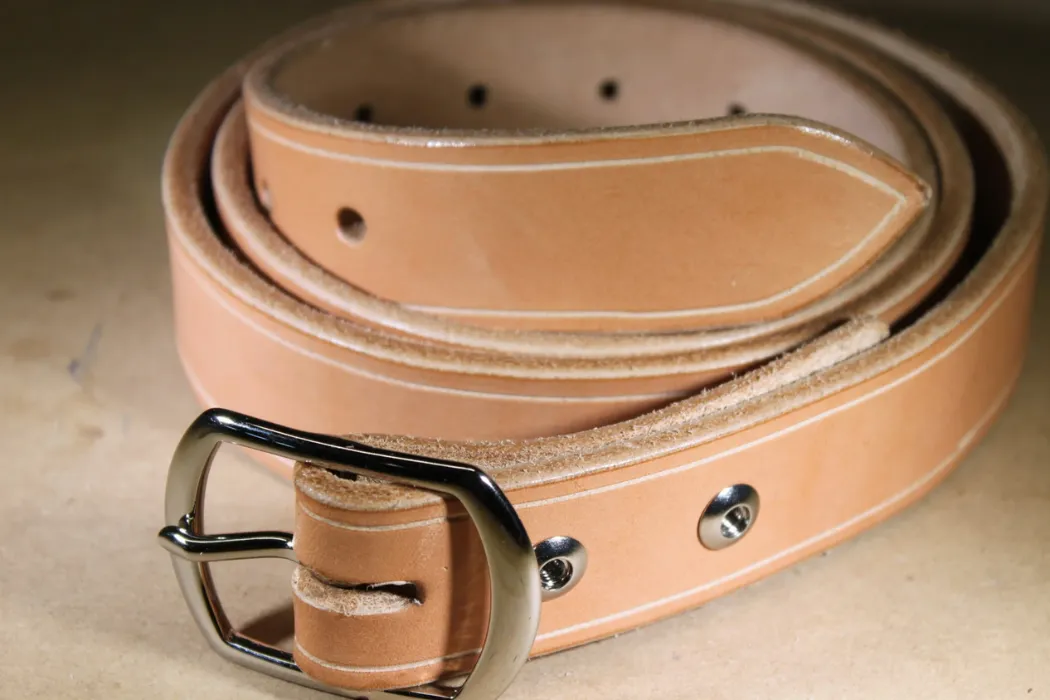
Hide size and usable cutting area vary. Specify finished strap thickness and its tolerance in millimeters, and distinguish a single leather strap from a layered construction when reviewing samples.
Visual grading cannot establish tensile strength or resistance to hole tear-out. Use it to control appearance and cutting yield, alongside the agreed tests on the actual material.
How Should Buyers Compare Leather Grades?
Suppliers may use letter or number grades for surface defects and usable area. These are purchasing classifications, not a universal four-level scale or a finished-belt performance rating.
Ask for the Supplier’s Grading Rules
Request the supplier’s written defect allowances and a sample hide map. A grading name is useful only when both parties understand which scars, brands and loose areas are permitted in the belt cutting zone.
For a plain strap with little surface correction, agree which natural marks are acceptable. Cleaner cutting areas can reduce sorting, but the number of blanks still depends on the size range and cutting layout.
For a lightly finished strap, review representative production samples rather than relying on a grade letter to predict color consistency.
An embossed texture may reduce the visibility of minor marks. It does not make a structurally weak or damaged cutting area suitable for a belt.
Lower-priced hides can produce a higher cost per acceptable strap when defects restrict long cuts. Compare accepted blanks from a trial layout before approving a material substitution.
Technical Standards and Application Insights
Choose thickness and flexibility for the intended fashion belt and buckle. A thicker strap can become too stiff at the fold or fail to fit the buckle opening; approve the complete construction rather than thickness alone.
Ask each supplier to explain its letter or number grades. A matching grade name across two quotations does not establish matching defect allowances or yield.
A clean natural grain surface can support an unembossed design with visible leather character. Confirm the finish and acceptable markings before pricing it as a premium feature.
Calculate cost from the usable cutting area and accepted yield. A lower hide price does not automatically produce a lower finished-belt cost.
Full Grain vs. Top Grain: Which is Better?
Full grain retains the natural grain surface. Top grain may be used broadly for the upper hide layer, including full grain, or commercially for corrected grain. Ask whether the surface was sanded or buffed; the wording alone cannot rank durability.
| Property | Full Grain Leather | Corrected-Grain Leather |
|---|---|---|
| Surface Treatment | Unaltered natural grain, no sanding or buffing | Lightly sanded or buffed to remove imperfections, then coated |
| Mechanical Strength | Measure the specified material; no universal strength multiplier | Measure under the same conditions and at comparable thickness |
| Density / Weight | Depends on thickness, tanning and finish | Depends on thickness, tanning and finish |
| Durability & Patina | Patina and wear depend on the finish and use | Appearance retention depends on the finish and use |
| Typical Use | Fashion belts with visible natural grain | Fashion belts emphasizing smooth finish and uniform appearance |
Understanding Full Grain and Top Grain Leather
Full grain preserves the natural grain surface. It can be selected for natural markings and leather character, while the finish still influences feel, moisture response and wear.
Corrected-grain leather has a surface adjusted by sanding or buffing and finishing. This can provide a more uniform appearance. Its performance must be assessed on the specified material, not inferred from correction alone.
Ask for a finish sample and an agreed appearance standard. An opaque coating can limit visible patina on either construction, while a lighter finish may make changes from handling more noticeable.
The Leather Research Laboratory treats top grain and full grain as equivalent in its definitions. Because trade usage can differ, specify retained natural grain or corrected grain explicitly instead of relying on a label comparison.
Mechanical Performance and Finish Data Comparison
ISO 3376 describes tensile strength and percentage elongation testing. It does not state that full-grain leather is twice as strong as another grade. Compare actual results for the candidate materials under the same method and conditions.
Do not assume a fixed weight difference between leather labels. Compare the specified thickness, area and measured mass where strap weight affects the product brief.
Distinguish rubbing, flexing and finish adhesion when defining tests. Agree the appropriate method and acceptance criteria with the laboratory, then test the production-intent material and finish.
LWG certification concerns the audited operation and its scope. It is not a belt strength grade, proof of full-grain identity or a guarantee that a finished product passes restricted-substance testing.
For a dress or casual belt, select the appearance and hand-feel that fit the design, then verify the material and finished construction. An attractive grain label cannot replace buckle-fold, hole and finish checks.
Custom Leather Belts Crafted for Global Brands
Why Is “Genuine Leather” an Incomplete Specification?
Genuine leather does not identify a single quality grade or require a split-leather construction. It may describe full-grain or other leather, so buyers need a more precise layer and finish declaration. Bonded leather needs its own composition disclosure.
| Leather Type | Composition & Processing | Durability & Performance |
|---|---|---|
| Genuine Leather | Broad leather description; ask which hide layer and finish are supplied | Cannot be determined from the label |
| Full-Grain Leather | Entire outermost grain layer preserved; minimal processing; dense natural fibers intact. | Assess performance for the selected hide, finish and construction |
| Top-Grain Leather | Upper hide layer; clarify whether full grain or corrected grain | Depends on material and construction |
| Bonded Leather | Composed of leftover leather dust/scraps mixed with polyurethane or adhesive binders. | Assess the composite and its backing and finish; disclose composition |
What ‘Genuine Leather’ Actually Means
Use a bill of materials that identifies the face, lining, reinforcement and coating. A belt sold under a broad leather description can have different materials in different layers, which matters to both pricing and product claims.
For US-facing product descriptions, the FTC Leather Guides address misleading composition claims and disclosure of imitation material. Review the complete composition before approving labels.
Compare Construction Instead of Marketing Labels
A belt can fail at the buckle fold, punched holes, stitching or laminated layers. Identify which component failed when comparing samples; do not assign every failure to the words “genuine leather.”
Request the actual test report and material identification. A leather label by itself supplies neither a tensile result nor evidence of service life.
Veg Tanned vs. Chrome Tanned?
Vegetable and chrome tanning are different processing routes. Either can be specified for a fashion belt, with feel, color and moisture response also affected by subsequent processing and finishing.
Understanding Vegetable and Chrome Tanning
Vegetable tanning uses plant-derived tannins. Buyers selecting it for a firm feel or visible aging should approve the specific finish and sample rather than assume all vegetable-tanned material behaves alike.
Chrome tanning uses chromium tanning chemistry. Finished leather can be produced with different softness and finishes, so the process name is not a waterproof or colorfastness claim.
Environmental comparison requires evidence about the actual production route, chemicals and waste management. A tanning name alone does not establish that one material has a lower environmental impact.
Performance, Aesthetics, and Application Contrast
Review vegetable-tanned samples for the intended bend, surface marking and response to moisture. Match care instructions to the approved finish.
Review chrome-tanned samples against the same finished-belt requirements. Color transfer, flexing and surface durability should be evaluated separately.
Evidence from footwear soles should not be used to promise fashion-belt life. The relevant comparison is between the belt materials and constructions under consideration.
How to Test if a Belt is Real Leather?
Appearance and touch can suggest a material type, but coatings and embossing can obscure it. Use the bill of materials, traceability documents and laboratory identification when the composition is uncertain.
Visual and Physical Verification of Real Leather
Inspect a cut edge or cross-section from an approved sample for the declared layers. A surface pattern alone is not proof of leather identity.
Avoid using a water drop as a conclusive authenticity test: finishes can change absorption and the test can mark a saleable item.
Flex a sacrificial sample to inspect coating and layer behavior. This evaluates construction; it does not establish whether every layer is leather.
Do not use smell as a pass/fail authenticity test. Finishing chemicals, adhesives and storage can affect odor.
Laboratory and Certification-Based Leather Testing
Ask the laboratory to specify sampling, conditioning and identification methods suited to the question and construction.
Tensile testing measures mechanical behavior. Set an agreed requirement for the material and belt use rather than applying an unsupported universal threshold.
Ask for material identification when the declared composition is in doubt. A chromium test alone cannot prove that a material is genuine or full-grain leather.
Moisture content can be relevant to material evaluation, but it is not a stand-alone test of leather authenticity.
Check LWG documentation for the named audited operation and request separate records connecting the supplied leather to that operation.
Keep Identity, Performance and Facility Evidence Separate
A useful purchasing file contains three distinct records: what the material is, how the selected construction performs, and what the supplier’s facility evidence covers. One record should not be used as a substitute for another.
Which Leather Grade Fits Your Market?
Choose the leather and finish around the design, retail positioning and acceptable wear behavior. Terms such as full grain, corrected grain and split describe different material features; “genuine” does not define a separate budget tier.
Aligning Leather Grades with Market Tiers
For visible natural grain, agree the tolerated scars, shade variation and surface changes before approving the leather. Check that the finished strap bends comfortably around the selected buckle.
For a uniform dress-belt appearance, compare the finish, lining and edge construction on samples. Obtain quotations for the same specification and quantity.
For a price-led design, specify any coated split or composite openly. Check that the label and bill of materials describe the actual construction.
Quality Standards and Sourcing Metrics
Test methods do not automatically supply universal belt pass/fail limits. Record the method, sample preparation, acceptance criteria and retest process in the purchase specification.
Use a trial cutting layout to check yield. Grade letters cannot guarantee a fixed usable-area percentage across suppliers and belt size ranges.
Review material test reports alongside current facility documents. Accepting a facility certificate does not establish mechanical or chemical compliance for an individual belt order.
What is the “Break-In” Period for Full Grain?
A belt may soften with use, but there is no fixed break-in time for every full-grain construction. Approve the initial hand-feel and flexibility before bulk production.
Understanding the Break-In Behavior of Full-Grain Leather
Stiffness varies with leather thickness, tanning, finishing and reinforcement. A full-grain description alone does not tell the buyer how a belt will feel.
Normal flexing may change feel over time. Excessive stiffness, sharp edges or a buckle fold that stresses the finish should be addressed in sample development.
Assess Comfort on the Finished Sample
Check the strap around the actual buckle and through garment loops. Review whether the belt sits flat and whether the buckle fold or keeper causes discomfort.
Use a defined wear evaluation if comfort or softening behavior is part of the product claim. Boot break-in timetables are not a reliable basis for belt instructions.
How Long Do Full Grain Belts Last?
Full-grain leather does not have a guaranteed number of service years. Wear frequency, fit, finish, construction, moisture exposure and care all affect the useful life of a belt.
Wear Conditions and Care
Repeated bending and tension concentrate around the buckle fold and frequently used holes. Evaluate these areas along with surface finish and edge wear.
Conditioning should follow the instructions for the particular finish. Test any care product on an inconspicuous area; it can change shade or feel.
Avoid promising a lifetime or a fixed replacement interval without evidence for the actual product and use conditions.
Material Strength and Construction Factors Influencing Longevity
Assess the complete belt: leather, lining, reinforcement, stitching, keeper and buckle attachment. A strong strap does not compensate for an unsuitable fastening design.
Tanning duration is not a direct service-life rating. Review the finished material against the agreed requirements instead of using an unverified process time as proof of durability.
Set strap thickness with the design and hardware, then approve the production-intent sample. More thickness is not automatically better when it creates an overly stiff fold or poor buckle fit.
Final Thoughts
Full grain can be a useful choice when the design calls for natural grain and leather character. It should be specified alongside the finish, thickness and belt construction, then assessed against the same agreed requirements as the alternatives.
For a custom leather belt proposal, send the design, size range, material preference, quantity and target market. Hoplok’s confirmed genuine-leather belt MOQ is 300 pieces; belt sampling takes 2–3 weeks and bulk production takes 60–90 days, with the order schedule confirmed for the approved specification.
Frequently Asked Questions
What distinguishes full-grain leather from genuine leather?
Full grain identifies a retained natural grain surface. Genuine leather is broader wording and can include full grain; it does not specify a single grade or construction.
How does hide thickness (oz) correlate to belt longevity?
Thickness affects feel, flexibility and hardware fit, but does not establish service life. Specify the complete strap construction and approve a finished sample.
Why do some full-grain belts peel or crack?
Cracking or peeling can involve the finish, the leather or the bonds between layers. Examine the failed area and compare it with the material declaration before assigning a cause.
Is Top‑Grain or Full‑Grain better for dress belts?
Either may suit a dress belt. Clarify whether “top grain” means corrected grain, then compare the desired appearance, feel and tested finished construction.
How can you identify a fake leather belt?
Inspect the declared layers and supporting records. Surface appearance, smell and water absorption are clues only; use laboratory identification when composition matters.
What is the difference between ‘Butt’ and ‘Belly’ cuts?
Butt and belly identify hide regions with potentially different firmness and stretch. Assess the actual cutting area and sample rather than treating region names as a performance guarantee.