Sourcing leather bags for the US market requires two separate checks: where the bag is made and what business service the supplier offers. A brand selling its own bags, a configurable retail product and a factory developing your private-label pattern are different options.
This guide reviews 15 names that buyers may encounter when researching US leather-bag sourcing. It identifies brand references, stated customization services and Hoplok’s China/Cambodia OEM route. One historical entry is not a qualified current lead. The list is not a factory audit or a tested quality ranking.
Use the profiles to decide which companies merit a service inquiry, then compare the same bag specification, approval sample and delivery requirements. Exact quantities, prices and schedules must come from the proposed supplier rather than a generic directory benchmark.
Define What “US Bag Manufacturing” Means for Your Order
A company may design in the USA, assemble some bags domestically and import other styles. A bag can also combine a US tanning source with overseas assembly or domestic assembly with imported components. Identify the actual production route for the model being quoted.
- For domestic manufacture, request cutting, sewing and assembly locations and the origin information supporting the intended label.
- For a brand or gifting program, confirm which existing models can be ordered or personalized.
- For private-label OEM, establish pattern development, sample approval, tooling ownership and bulk manufacturing responsibilities.
The FTC Made in USA guidance applies an “all or virtually all” standard to an unqualified US-origin claim. A Designed in USA statement does not establish US manufacture. Choose the wording supported by the actual product and supply chain.
Six Criteria for Qualifying a Leather-Bag Manufacturer
1. Material identification and traceability
Request a bill of materials identifying leather type, finish, thickness range, lining, reinforcement, adhesive and hardware. Traceability can help investigate a problem; it does not replace chemical testing or prove that leather is free of natural marks.
2. Construction suited to the bag
Agree stitch spacing, thread, needle, seam allowance and reinforcement for the leather and intended use. More stitches or more edge-paint layers do not automatically make a bag stronger. Approve the actual seam and edge system after flexing and relevant testing, rather than specifying a universal luxury formula.
3. Minimum quantities that fit the assortment
Ask whether MOQ applies by style, color, size or hardware finish and whether material suppliers impose separate minimums. A small retail workshop may not accept outside-label orders. A factory’s minimum is a commercial constraint, not a quality score.
4. Facility evidence and product requirements
Read the scope and dates of any audit or certificate. LWG certification concerns the audited facility and its scope; it does not guarantee finished-bag performance or chemical compliance. SMETA is an audit methodology, not a certification or guarantee of working conditions. Use LWG claims guidance and Sedex’s explanation when interpreting documents.
5. Development and sample control
Review a sample using the proposed leather, lining, hardware and construction. A drawing or digital rendering cannot verify hand feel, seam behavior or carrying comfort. Agree the sample schedule and revision process with the actual development team.
6. Production and component planning
Confirm material availability, factory capacity and any subcontracting. Ask which components need advance ordering and which substitutions require approval. Review stock commitments and delivery records against the proposed schedule.
Specify Leather Structure and Finish for the Bag
Leather descriptions help identify a material but are not a universal durability scale. Grain structure, tanning, thickness, finish, reinforcement and bag design all affect use. The word genuine alone does not identify a particular layer or quality tier.
| Description | What to establish | Bag-development check |
|---|---|---|
| Full-grain leather | Grain surface retained without corrective sanding | Approve visible variation, temper, thickness and panel yield |
| Corrected-grain leather | How the grain has been corrected, coated or embossed | Inspect finish adhesion, flexing and appearance after relevant tests |
| Split leather | Lower split layer and its surface treatment | Check coating, tear behavior and suitability for the load-bearing bag components |
| Bonded/reconstituted material | Fiber composition, binder, backing and truthful material description | Do not describe it as an intact hide; verify the intended application and performance |
For each option, evaluate the assembled bag. Determine expected performance from the material specification, construction and relevant tests, and cost from the actual quotation.
Quick Comparison: Fifteen Bag-Sourcing Names
Business roles are based on the public information linked in the profiles. Numeric MOQs and production times are included only where Hoplok’s confirmed offer is stated; other companies need to quote the specific service.
| Company | Purchasing role | Origin or location context |
|---|---|---|
| Shinola | Brand / gifting inquiry | Confirm origin by bag |
| Filson | Brand / wholesale inquiry | Selected US-made bags with imported material |
| Frank Clegg | Brand; selected modifications only | Fall River, Massachusetts |
| Lotuff Leather | Brand / workshop reference | Providence, Rhode Island studio |
| Ghurka | Brand reference | USA, Italy, Spain and South Africa |
| Saddleback Leather | Brand reference | Mexico factory disclosed |
| J.W. Hulme Co. | Historical reference; not a qualified current lead | Current operating service unconfirmed |
| Hoplok | Private-label bag OEM | China and Cambodia |
| Colonel Littleton | Brand / personalized-product inquiry | Lynnville, Tennessee |
| Go Forth Goods | Brand / gifting inquiry | Marietta, Georgia |
| Rough & Tumble | Brand / configurable bag service | Maine retail contact; confirm production details |
| Billykirk | Custom and corporate-gifting lead | Jersey City studio contact |
| Schott NYC | Brand reference; origin needs clarification | Conflicting product-page origin fields |
| Mission Workshop | Technical textile-bag reference | US-made bags described by brand |
| Coronado Leather | Travel-bag brand reference | San Diego, California |
Fifteen Profiles: Bag Makers, Brands and Service Options
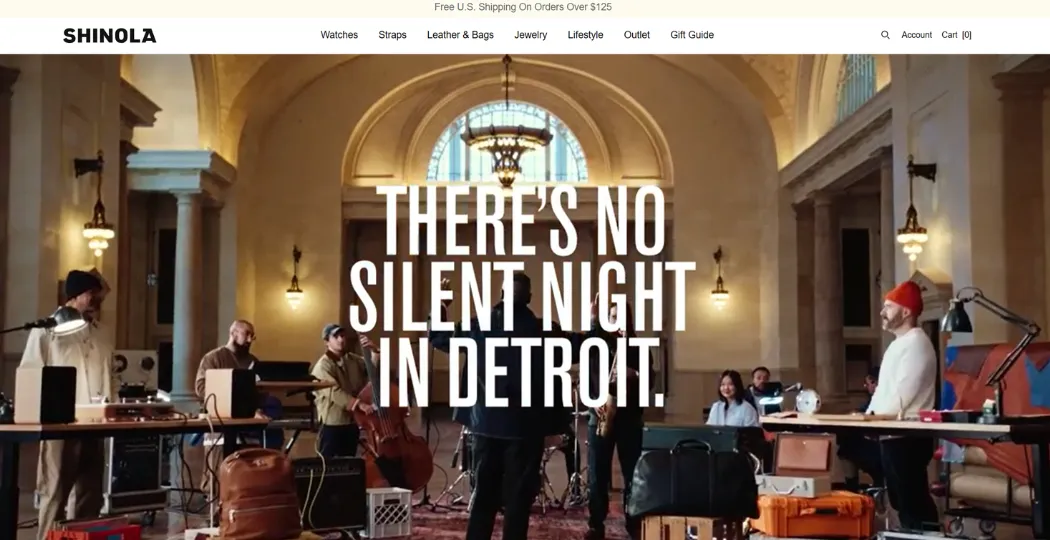
Start with the buyer role before contacting a company. Stated custom or gifting services can justify an inquiry, while a retail brand reference does not establish an available OEM factory. Website screenshots below are historical illustrations; displayed promotions and prices are not current offers.
1. Shinola
Buyer role: Brand / gifting inquiry. Location context: Confirm origin by bag.
Shinola’s Derby Tote page describes its leather, lining, compartments and closure, and uses a Designed in Detroit statement. Its watchmaking story does not establish that the bag is manufactured in Detroit. Confirm the actual bag’s country of origin.
Bag sourcing check: Review the tote’s organization and lining as product references. Ask separately about corporate personalization or wholesale availability; no fixed custom MOQ or factory lead time is established by this product page.
Official product or service information
2. Filson
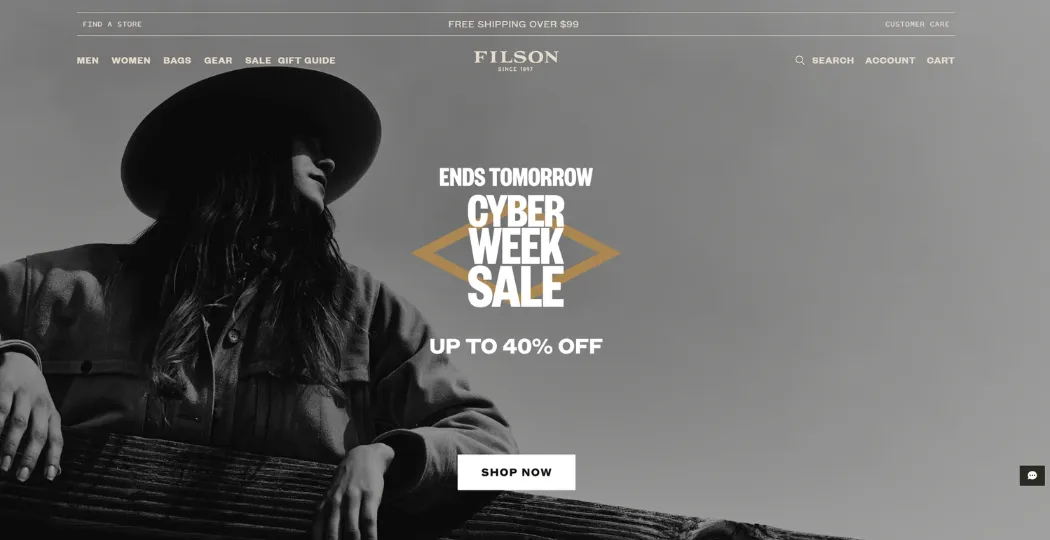
Buyer role: Brand / wholesale inquiry. Location context: Selected US-made bags with imported material.
Filson’s Rugged Twill Tote uses cotton twill and bridle-leather handles and carries a qualified US-manufacture statement with imported material. It is a fabric-and-leather bag reference, rather than an all-leather bag or a blanket origin claim for the brand.
Bag sourcing check: For a similar bag brief, specify textile weight, leather straps, reinforcement and attachment points. Read product-specific care and warranty terms. Confirm any business program directly; rugged styling does not prove a new OEM order will withstand every environment.
Official product or service information
3. Frank Clegg
Buyer role: Brand; selected modifications only. Location context: Fall River, Massachusetts.
Frank Clegg’s FAQ identifies its family workshop in Fall River and materials sourced globally. Its current FAQ says custom work is not offered, though certain modifications may be considered. Do not treat a made-to-order retail item as an open bespoke OEM service.
Bag sourcing check: If purchasing branded executive bags, ask which model and modifications are available. For an entirely new private-label pattern, use a manufacturer that expressly accepts that service. Hardware and workmanship warranty coverage should be checked in the current terms.
Official product or service information
4. Lotuff Leather
Buyer role: Brand / workshop reference. Location context: Providence, Rhode Island studio.
Lotuff describes opening its Providence studio in September 2013 and developing handmade leather goods with a team of artisans. The studio date is not a verified founding date, and its brand story does not establish bulk private-label minimums.
Bag sourcing check: Its bag silhouettes and leather construction can inform positioning and sample assessment. Ask about the actual commercial offer before assuming small-batch OEM service. Confirm acceptable natural leather variation and the current workmanship warranty for the selected model.
Official product or service information
5. Ghurka
Buyer role: Brand reference. Location context: USA, Italy, Spain and South Africa.
Ghurka’s official story identifies craftsmanship in four countries. Its travel bags can be a reference for carrying arrangements, shape and product organization. American heritage and military-inspired styling do not establish US origin or a military test specification.
Bag sourcing check: Check the chosen bag’s origin, construction and any available gifting program directly. Describe measurable requirements in your own development brief rather than relying on a heritage label or assuming that all bags share one lining and hardware specification.
Official product or service information
6. Saddleback Leather
Buyer role: Brand reference. Location context: Mexico factory disclosed.
Saddleback’s own construction account describes its Mexico factory and leather-bag sewing. This is a brand with international production, not evidence of a Fort Worth bag factory. Its bags can be studied for panel layout, closures and carrying systems.
Bag sourcing check: Read the individual product’s materials and warranty scope. A long warranty is not a measured lifetime, and a brand’s published construction philosophy does not verify an outside-label manufacturing program. Confirm the service and order terms directly.
Official product or service information
7. J.W. Hulme Co.
Buyer role: Historical reference; not a qualified current lead. Location context: Current operating service unconfirmed.
Current manufacturing availability and a working official sales route were not verified for this entry. It is excluded from the active supplier shortlist. Historical brand listings do not establish a present-day St. Paul factory, current wholesale service or an available production slot.
Bag sourcing check: If the name appears in another directory or a reseller listing, obtain the current contracting entity, official contact details, factory location and recent production evidence before considering an RFQ. No MOQ, lead time or ongoing warranty service is assumed here.
8. Hoplok
Buyer role: Private-label bag OEM. Location context: China and Cambodia.
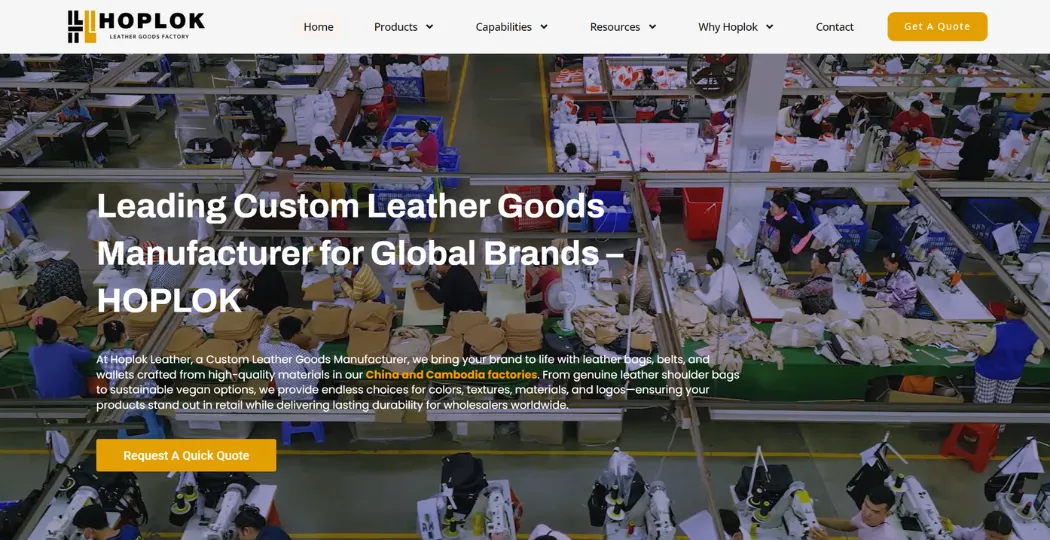
Hoplok manufactures in China and Cambodia. Four facilities total 19,000 m²: HongDing in China, 5,000 m²; Hoplok bags in Cambodia, 4,000 m²; Hongcen Max belts, 5,000 m²; and ProPelli leather finishing, 5,000 m². This is an overseas production option for US buyers.
Bag sourcing check: Bag MOQ is 200 for genuine leather or 1,000 for PU. Bag sampling takes 3–4 weeks and bulk production takes 60–90 days; shipping is separate. Monthly bag capacity is 30,000–60,000 leather and 500,000–800,000 PU bags; confirm allocation. ProPelli finishes externally sourced crust and holds valid LWG Gold certification for its facility and scope, not every bag or all factories.
Official product or service information
9. Colonel Littleton
Buyer role: Brand / personalized-product inquiry. Location context: Lynnville, Tennessee.
The No. 3 Grip Bag page identifies manufacture in the company’s Lynnville workshop, American steerhide, and brass and copper hardware. It also describes personalization. These are product-level details rather than proof of a general private-label factory service.
Bag sourcing check: For gifting, confirm the personalization options, artwork approval and packaging for the selected model. For original development, clarify whether the workshop will consider a new pattern. A distinctive closure should be assessed for usability and relevant design rights, not assumed to be freely reproducible.
Official product or service information
10. Go Forth Goods
Buyer role: Brand / gifting inquiry. Location context: Marietta, Georgia.
Go Forth Goods identifies handcrafted goods in Marietta and lists leather bags, accessories and a corporate-gifting route. These public offerings support a brand or gifting inquiry. They do not establish that every material originates in the USA or that outside-label production is generally available.
Bag sourcing check: Check the selected bag’s leather, finish, pocket construction and carrying options. Specify whether your request is for branded stock, personalization or an original product, then obtain the quantity and delivery conditions for that service.
Official product or service information
11. Rough & Tumble
Buyer role: Brand / configurable bag service. Location context: Maine retail contact; confirm production details.
Rough & Tumble offers an online bag design center and lists a Portland, Maine contact. The ability to configure a bag is a useful customization option, but it does not establish a private-label development contract or a current Brunswick production address.
Bag sourcing check: Clarify the available model, leather, lining, strap and hardware choices. Configuration within a brand’s existing range differs from developing a pattern owned by your company. Confirm branding, production origin and order schedule before treating it as an OEM alternative.
Official product or service information
12. Billykirk
Buyer role: Custom and corporate-gifting lead. Location context: Jersey City studio contact.
Billykirk explicitly offers custom and personalized goods and describes these as made in the USA. Its custom-items page gives a Jersey City studio contact. This is a relevant business-service lead, subject to agreement on the actual item and customization.
Bag sourcing check: Send the intended use, dimensions, material, quantity and artwork. Ask whether the proposal covers a stock model, altered pattern or original design, and who owns any tooling. Published small-minimum wording does not establish a numeric MOQ for a bag project.
Official product or service information
13. Schott NYC
Buyer role: Brand reference; origin needs clarification. Location context: Conflicting product-page origin fields.
Schott’s Americana Messenger Bag page describes leather construction and an organizer interior. The page also contains inconsistent origin information: its overview says U.S.A., while its specifications say Imported. This requires clarification from the brand before a domestic-origin claim is used.
Bag sourcing check: Use ordinary bag layout and leather details only as a product reference. The page does not establish an available outside-label factory service. Hoplok’s offer in this guide covers ordinary bags and accessories; specialized tactical or concealment requirements are outside its scope.
Official product or service information
14. Mission Workshop
Buyer role: Technical textile-bag reference. Location context: US-made bags described by brand.
Mission Workshop’s bag collection emphasizes technical textiles and US manufacture. It is primarily a reference for textile carrying systems, organization and modularity, rather than evidence of a leather-bag OEM factory. Material and construction differ from a conventional leather handbag.
Bag sourcing check: If comparing a technical textile bag with a leather alternative, define the intended use and relevant tests for each construction. Do not transfer the brand’s weather-resistance or lifetime marketing language to another bag, material or manufacturer.
Official product or service information
15. Coronado Leather
Buyer role: Travel-bag brand reference. Location context: San Diego, California.
Coronado’s No. 105 Bison Duffel page identifies its San Diego factory and describes bison leather paired with Horween latigo steerhide. This ordinary travel-bag example is relevant to leather duffel sourcing; it does not establish a broad third-party OEM offer.
Bag sourcing check: Assess the duffel’s panels, zipper access, handle comfort and packed weight against your travel brief. Confirm current business terms directly. Any other specialist product lines sold by the brand are separate from Hoplok’s ordinary bag-manufacturing scope.
Official product or service information
Domestic or Overseas Production: Compare the Actual Bag Brief
Production location matters when your brand requires a particular origin claim, local development access or a specific supply route. It does not establish a fixed retail premium, labor-rate ratio or margin. Compare actual quotations against the same specifications and destination.
- A domestic route may simplify visits and sample exchanges, but materials and production slots still determine the schedule.
- An overseas route requires agreed shipping and import responsibilities in addition to sample and factory qualification.
- A US design office with overseas assembly is a different route from US manufacture; label and evaluate it accurately.
Hoplok offers production in China and Cambodia. Specify the bag, material, quantity and destination, then compare the available capacity, complete quotation and verified import treatment. Cambodia origin does not automatically establish duty-free entry.
How to Verify a Bag Supplier’s Offer
1. Review the complete sample
Record dimensions, material references, lining, pocket access, closure function, handle attachment and edge appearance. Where the use requires performance testing, agree the method, conditioning, loads or cycles and acceptance criteria. A generic scratch or cross-hatch demonstration does not establish years of edge-paint life.
2. Read audits in context
Match documents to the actual production entity, location, scope and date. Check corrective actions where relevant. Social-audit findings, management-system certificates and chemical test reports serve different purposes; none is blanket protection from supply-chain or product issues.
3. Inspect the proposed facility
Use an appropriate site visit, qualified audit or documented remote review. Examine relevant cutting, skiving, sewing, finishing and quality-control work. Confirm what is performed elsewhere. For Hoplok, confirm the exact production facility and the assembly location for the proposed bag order.
4. Assess technical communication
Send a specific construction question and look for a clear, usable response. Confirm the technical contact and change-approval process. Evaluate how clearly the supplier explains the construction and resolves sample issues.
5. Agree workable commercial terms
Confirm the contracting entity, payment milestones, tooling costs, materials commitment and defect-resolution process. Financial information may support due diligence where available, but a supplier’s acceptance of a particular deposit percentage is not a universal measure of reliability.
6. Match traceability and testing to the market
Identify material suppliers and retain the documents needed for the product and destination. Ask the testing provider to identify applicable restrictions and methods. A tannery rating or origin document does not itself demonstrate compliance with all chemical or import requirements.
Sourcing Strategy Matrix and Landed-Cost Worksheet
| Factor | Domestic manufacturing inquiry | Hoplok China/Cambodia inquiry |
|---|---|---|
| Origin | Confirm actual production steps and supported claim | Confirm proposed factory and country of manufacture |
| Bag MOQ | Supplier quote by project and assortment | 200 leather bags or 1,000 PU bags |
| Sampling | Confirm development scope and timing | Bag samples 3–4 weeks |
| Bulk schedule | Confirm materials, capacity and approval dependencies | Bulk production 60–90 days; shipping separately |
| Quality | Approve materials, sample and inspection criteria | Approve the same requirements |
| Cost | Itemized quote including imported inputs where relevant | Itemized quote plus transport and verified import costs |
Build the comparison from the same scope
Use the same bag pattern, bill of materials, quantity, packaging and delivery destination. Record what each quotation includes. A lower unit price can be offset by development charges, unused material minimums or freight; a domestic price can include imported component costs.
| Cost element | Information required | Comparison note |
|---|---|---|
| Goods | Quoted price and delivery term | Do not label every quote FOB regardless of the agreed delivery arrangement |
| Development and tooling | Pattern, samples, molds, dies and ownership | Separate one-time charges from repeat-order costs |
| Transport | Route, weight, volume and service | Include the stages each party pays |
| Duties and taxes | Classification, origin, destination and entry-date rules | Use current broker or official tariff information; no assumed fixed country rate |
| Other costs | Inspection, testing, insurance, clearance and handling | Avoid double counting charges already included in the quotation |
Calculate the landed cost per saleable bag from the confirmed scope and quantities. No illustrative dollar value in a directory should replace an actual quote or current tariff classification.
What Drives a Leather Bag’s Cost?
There is no fixed percentage split that fits every leather tote, briefcase or handbag. A structured design with lining, reinforcement and custom hardware has different cost drivers from a simple unlined bag. Ask the factory to explain the specification behind its price.
| Cost component | What changes it | What to request |
|---|---|---|
| Leather | Grade specification, finish, thickness, usable area and panel size | Material reference and cutting-yield assumptions |
| Lining and reinforcement | Material, pockets, seams and internal structure | Bill of materials and construction drawing |
| Hardware | Stock versus custom parts, finish, quantity and tooling | Component specification and tooling quote |
| Labor | Cutting, skiving, sewing, edge finishing and assembly steps | Explanation of complex or repeated operations |
| Overhead and quality control | Factory process, inspection scope and packaging | Clear included scope, without assuming a standard profit margin |
Budget development and verification
Ask separately about prototypes, revisions, leather samples, logo tooling, hardware molds, laboratory testing and independent inspection. Prices depend on the provider and scope; use current quotations rather than standard sample or inspector-day rates.
Reduce cost through specific design choices
Consider available stock hardware, simpler assembly or a panel layout with better leather yield. Compare material alternatives through swatches and assembled samples. Increasing order quantity may change a quote, but no universal saving percentage applies; avoid ordering excess inventory solely to reach a lower unit price.
Choose a Bag Supplier Around the Product and Service
Use the list to separate branded bags, personalization services and original-pattern production. Confirm factory location, ownership of development work, sample quality and the complete delivery scope before committing. A verified offer is more useful than a ranking built from unconfirmed MOQs, capacity or origin claims.
For Hoplok, provide the bag’s dimensions, material, lining, reinforcement, carrying system, branding, quantities and destination. Confirm sample and inspection requirements, available capacity and the proposed China or Cambodia facility.
Send your brief through Hoplok’s custom leather bag manufacturing page to request a project quotation.