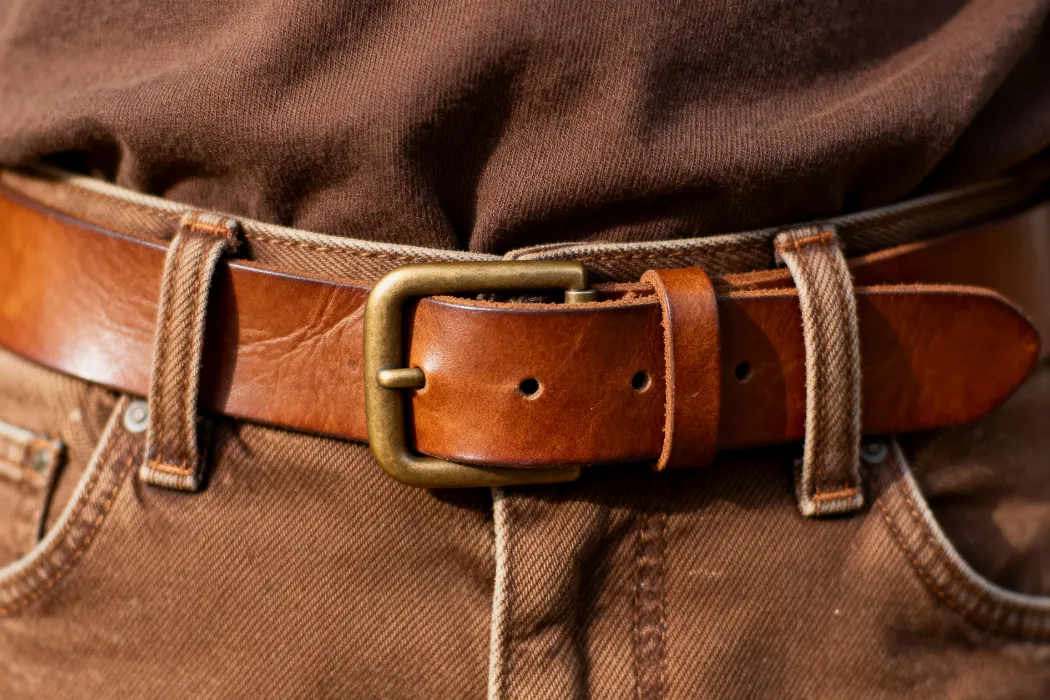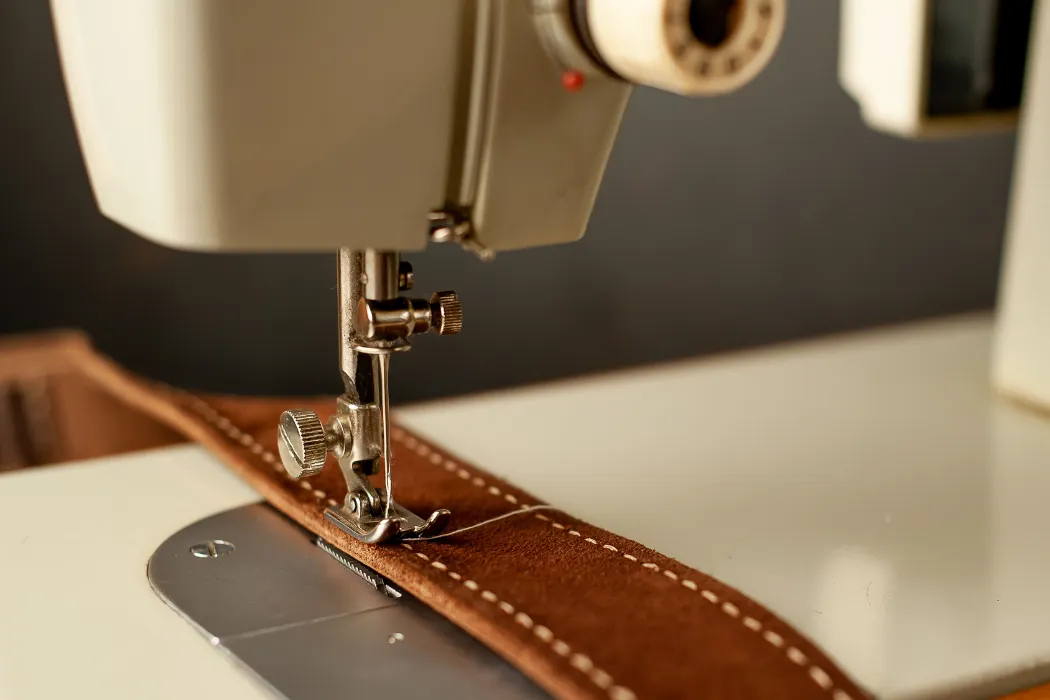
Understanding how to import belts is critical for avoiding costly customs delays and fines. Misclassifying products with the wrong HS code can trap your inventory at the port, eroding profit margins with every passing day.
This guide clarifies the correct HS code—42033000 for leather—and details the tariff implications for manufacturing in China versus Cambodia. We break down shipping documentation and compliance to help you secure a duty-optimized supply chain.

The HS Code: 4203.30 (Leather) vs. 3926.20 (PU)
Use HS code 4203.30 for genuine or composition leather belts and 3926.20 for PU belts. The strap’s core material determines the correct code and duty rate.
| Classification Factor | HS Code 4203.30 | HS Code 3926.20 |
|---|---|---|
| Primary Material | Genuine leather or composition leather | Polyurethane (PU), PVC, or other plastics |
| Official Description | “Belts and bandoliers of leather or of composition leather” | “Articles of apparel and clothing accessories… of plastics” |
| Applies To | Full-Grain, Top-Grain, and Veg-Tanned belts | PU belts, including those marketed as ‘Vegan Leather’ |
HS Code 4203.30: Official Code for Leather Belts
The Harmonized System code 4203.30 is straightforward. It specifically covers ‘Belts and bandoliers of leather or of composition leather’. This is the standard code you must use when importing our genuine leather products, including Full-Grain, Top-Grain, and Vegetable-Tanned belts. The classification holds as long as leather is the belt’s main material, regardless of what the buckle is made of.
HS Code 3926.20: Designation for PU & Plastic Belts
For belts made from synthetic materials, you will use HS Code 3926.20. This category covers ‘Articles of apparel and clothing accessories… of plastics’. This code applies when the primary component of the belt strap is a plastic like Polyurethane (PU) or PVC. Even if a belt has a ‘leather-like’ look and feel, if it’s made of PU, it falls under the plastics chapter, not leather. This is a critical distinction for products often marketed as ‘Vegan Leather’, which are typically plastic-based.
How Material Composition Determines the Correct Code
The rule is simple: identify the primary material of the belt strap itself. If it’s leather, use 4203.30. If it’s PU or another plastic, use 3926.20. Declaring the wrong code leads to customs delays, fines, and payment of incorrect duty rates, which directly impacts your landed cost and profit margin. To avoid this, work with your manufacturer to get a precise material breakdown on your commercial invoice. This document is your proof to support the HS code you select.
US Import Duties: The China Tariff Impact
Section 301 tariffs on Chinese-made belts add significant costs over standard duties. This directly increases your landed cost and squeezes already tight profit margins.
| Cost Component | Sourcing from China | Strategic Alternative (e.g., Cambodia) |
|---|---|---|
| Standard Duty (HS Code 4203.30) | Applies | May be duty-free under GSP programs |
| Section 301 Tariff | Applies (Additional 7.5% – 25%+) | Does Not Apply |
| Total Landed Cost | Significantly inflated and volatile | Lower and more predictable |
| Risk Profile | High (Subject to sudden policy changes) | Low (Stable tariff environment) |
Understanding Section 301 Tariffs
Section 301 tariffs are not standard import duties. They are an additional tax levied by the U.S. government specifically on goods originating from mainland China. For leather belts under HS Code 4203.30, this means you pay the regular Most-Favored-Nation (MFN) rate plus the Section 301 percentage. These punitive tariffs can change with little warning based on trade policy, creating major uncertainty for any business relying solely on Chinese manufacturing.
Calculating Total Landed Cost from China
The price you get from the factory (FOB) is only the starting point. To understand your true cost per unit and protect your margins, you must calculate the total landed cost. This figure determines your breakeven point and final pricing.
- Product Cost: The base price of the belts from the manufacturer.
- Shipping & Logistics: Ocean or air freight, insurance, and domestic transport.
- Standard Duty: The normal import rate for your product’s HS code.
- Section 301 Tariff: The additional percentage applied only to Chinese-made goods.
The Strategic Impact on Your Business
Higher landed costs directly attack the profitability of US-based brands and wholesalers. You’re left with a few tough choices: absorb the extra cost and reduce your margins, pass the price increase to your customers and risk losing sales, or find a more resilient sourcing solution.
This is why a dual-country manufacturing strategy is no longer a luxury but a necessity for risk mitigation. Working with a partner like Hoplok, which operates factories in both China and Cambodia, provides flexibility. Complex development can stay in China, while large-scale production can shift to Cambodia to leverage the “Cambodia Duty Advantage” and completely avoid Section 301 tariffs. This diversifies your supply chain and protects your bottom line from geopolitical volatility.
GSP Status: Sourcing Duty-Free from Cambodia
Sourcing leather belts from Cambodia can offer duty-free importation through GSP programs, directly reducing landed costs and boosting profit margins for brand owners.
Understanding the Generalized System of Preferences (GSP)
The Generalized System of Preferences (GSP) is a trade program that grants duty-free entry for many products coming from designated developing countries. Its purpose is to help stimulate economic growth by giving these nations better access to markets in developed countries. The specific products covered and eligibility rules can change depending on which country is importing the goods.
Hoplok’s Cambodia Factory: Your Gateway to Tariff Savings
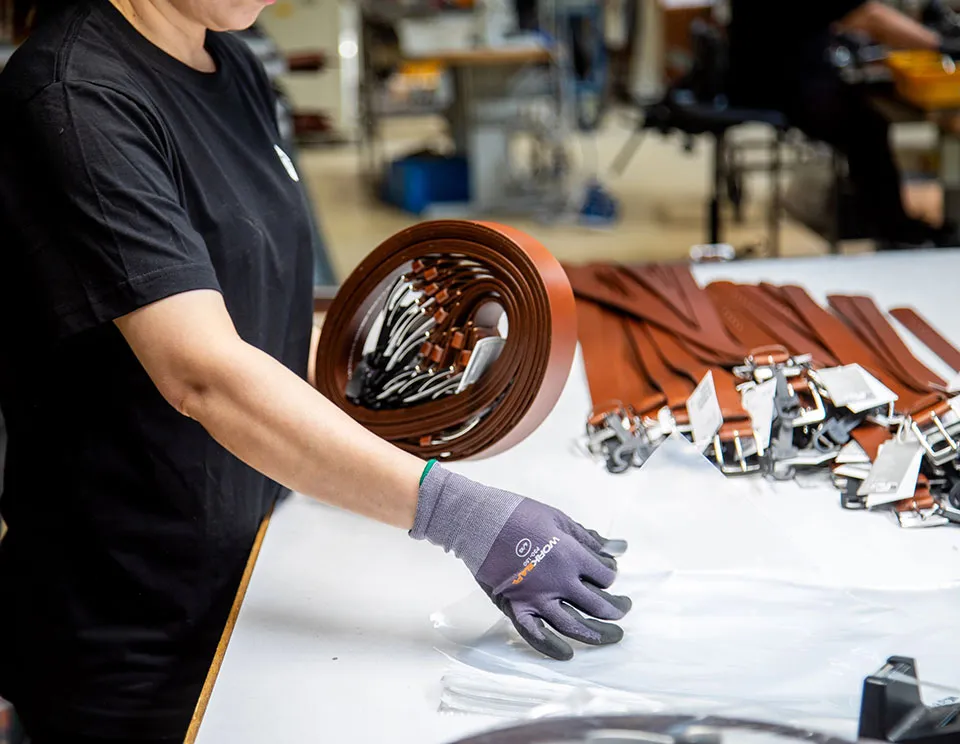
Our Cambodian factory is built for large-scale production, making it the perfect vehicle for leveraging the “Cambodia Duty Advantage” on high-volume orders. This facility has massive monthly capacity for both PU belts (600,000–800,000 pcs) and genuine leather belts (200,000–300,000 pcs). Our dual-country manufacturing strategy lets brands sidestep the tariff risks tied to sourcing from a single country.
How Duty-Free Sourcing Maximizes Your Profit Margins
Eliminating import tariffs directly cuts the landed cost of your products, which immediately increases your gross margin on every unit sold. This cost advantage, combined with our factory-direct pricing, gives you a real competitive edge. A lower cost base gives you more flexibility in your retail pricing or frees up capital to reinvest in marketing and brand development.
Meeting the Rules of Origin for GSP Qualification
To qualify for GSP tax treatment, your products must meet specific “Rules of Origin.” This ensures a significant portion of the value is added and manufacturing takes place in Cambodia. Our vertically integrated process, which includes in-house leather finishing at our Pro Pelli facility, helps satisfy these value-added requirements. We manage all the necessary documentation and certification to prove origin, ensuring your shipments clear customs without any compliance headaches.
Scale Your Brand with Premium Belts
Incoterms 2020: FOB vs. DDP Explained
With FOB, you manage shipping once goods are on the vessel. With DDP, we handle everything door-to-door. Your choice comes down to control versus all-inclusive convenience.
Understanding FOB (Free On Board)
With FOB terms, your responsibility and cost begin the moment we load your custom belts onto the shipping vessel at the port in China or Cambodia. This puts you in the driver’s seat. You choose your own freight forwarder, manage the ocean or air freight, and handle all customs clearance and duties in your country. For experienced importers, this option offers more direct control over shipping costs and timelines.
Understanding DDP (Delivered Duty Paid)
DDP is our complete turnkey solution where we manage everything from our factory floor to your warehouse. Hoplok handles all transportation, insurance, customs duties, and taxes. The price we quote is the final price you pay. This is the ideal option for brands that want predictable, all-inclusive pricing without the headache of managing international logistics.
Which Option Is Right for Your Belt Business?
FOB is a strong choice if you have established logistics partners and want to manage shipping costs directly to protect your margins. DDP is better if you are new to importing or simply want to focus on your brand while we handle the shipping complexities. We can provide factory-direct pricing for FOB orders and transparent, all-inclusive quotes for DDP, giving you total flexibility.
How Our Factory Locations Influence Your Choice
Our dual-factory presence in China and Cambodia adds a strategic layer to this decision. When shipping from Cambodia under DDP terms, our team manages the entire process to help you leverage the “Cambodia Duty Advantage,” simplifying potential tariff savings. If you choose FOB from Cambodia, your freight forwarder must be competent in properly documenting the country of origin to claim any benefits. Our logistics team has shipped thousands of orders from both locations and can advise on the most efficient route for your business.
Shipping Methods: Courier vs. Air Cargo vs. Sea
Couriers are fastest for samples. Air cargo balances speed and cost for medium orders. Sea freight is the most economical for bulk orders but also the slowest.
Courier Services (DHL/FedEx): For Speed and Samples
When time is critical and the package is small, nothing beats a courier. We use these services to get product prototypes and samples into your hands quickly.
- Ideal for high-priority shipments like our 2-7 day fast samples.
- Provides full door-to-door delivery with simplified customs handling.
- This is the most expensive method per kilogram, so it’s not viable for bulk production.
Air Cargo: Balancing Speed and Volume
Air cargo is the middle ground. It’s the right choice for urgent, medium-to-large volume shipments where sea freight is too slow. It’s faster than sea but more affordable than couriers for orders over 100kg.
- A solid option for hitting tight retail deadlines, especially after one of our fast 15-20 day production runs.
- Cuts down inventory holding times and frees up cash flow compared to sea freight.
- This method requires formal airport-to-airport logistics and a customs broker.
Sea Freight: Maximizing Profit on Bulk Orders
This is the standard for any serious importer focused on cost efficiency. If your business model relies on maximizing margins through large volume, sea freight is the only way to go.
- The most cost-effective method, period. It’s how our large wholesale clients order, often at our full capacity of up to 800,000 belts per month.
- Transit time is the longest, typically 30-60 days, so it demands careful supply chain planning.
- You can book a full container load (FCL) for large orders or a less-than-container load (LCL) for smaller volumes.
Customs Bonds and Brokerage Fees
A customs bond is required insurance for imports over $2,500, guaranteeing duty payments. For regular B2B orders, a continuous bond ($400-$600/year) is most cost-effective.
What Are Customs Bonds and Brokerage Fees?
A customs bond is a financial guarantee required by U.S. Customs and Border Protection (CBP) for any commercial import valued over $2,500. It acts like an insurance policy, ensuring the government gets paid for all duties and taxes. Brokerage fees are different; you pay these directly to your customs broker for their service in managing all the clearance paperwork and logistics.
Continuous vs. Single-Entry Bonds for Belt Importers
Choosing the right bond comes down to how frequently you import. For a business placing recurring orders for custom belts, the choice is simple.
- Continuous Bond: This is the standard for B2B importers. It covers all your shipments for a full year and is the most economical option if you plan on importing more than a few times.
- Single-Entry Bond: This covers only one specific shipment. It makes sense for a one-off test order but becomes expensive quickly if you start importing regularly.
Also, all ocean freight shipments require an Importer Security Filing (ISF). An active bond is mandatory for a broker to file an ISF, so for sea shipments, you will need one regardless of the shipment’s value.
Typical Costs and Budgeting
When planning your landed costs, you need to account for these compliance fees. They aren’t part of the product cost but are critical for your budget.
- Continuous Bond Cost: A standard $50,000 continuous bond typically costs between $400 and $600 per year. This is the amount most importers need.
- Single-Entry Bond Cost: The price changes with shipment value, but expect a minimum fee of $75 to $100 per transaction.
- Brokerage Fees: Remember to budget for your broker’s service fees. These are billed separately from the bond cost and are part of your logistics expenses.
Final Thoughts
While generic belts offer lower upfront costs, using LWG Certified Leather and REACH-compliant hardware is the only way to safeguard your reputation against customer returns. Quality inventory protects your profits and secures long-term dealer trust, especially in key markets like the USA and Europe.
Don’t guess on material and construction quality—verify it with our 2-7 day fast sampling. Contact our team to get a factory-direct quote and explore how our Cambodia duty advantage can benefit your next OEM project.
Frequently Asked Questions
What is the HS Code for leather belts?
The primary HS code for leather belts is 4203.30 (or 4203.30.0000). This code specifically covers ‘Belts and bandoliers, of leather or of composition leather.’ It is the standard code used for customs classification when importing genuine leather belts into most regions, including the U.S.
How much is the import duty for belts from China to the USA?
Importing belts from China to the USA involves a standard base duty plus significant additional Section 301 tariffs. This makes the total landed cost considerably higher than sourcing from other countries. For precise rates, importers must verify the current tariffs applicable at the time of shipment.
What is the difference between FOB and DDP Incoterms?
The main difference is who holds the risk and cost. With FOB (Free On Board), the buyer takes responsibility for all costs and risks once the goods are loaded onto the ship. With DDP (Delivered Duty Paid), the seller handles everything—shipping, insurance, customs clearance, and duties—delivering the goods to the buyer’s final destination.
How long does sea freight take from China?
Sea freight from China typically takes 15-25 days to reach the US West Coast and 30-40 days to reach the East Coast (port-to-port). For complete door-to-door delivery, including customs and inland transit, you should plan for a total lead time of 30-40 days on average.
Are there duty-free options for importing leather belts to the US?
Yes. Sourcing from certain countries can provide significant duty savings. For example, leather belts manufactured in Cambodia can qualify for duty-free entry into the United States under the Generalized System of Preferences (GSP), helping importers avoid both standard duties and the extra tariffs applied to Chinese goods.