If you find suspected mould on leather, separate the affected item from clean stock and arrange an assessment before cleaning or reselling it. Removing a visible deposit is not the same as establishing that the article is suitable for use again. The underlying moisture problem also needs attention.
For brands, importers and warehouses, a mould incident is a product-and-storage investigation. This guide explains what information to preserve, what a qualified treatment decision should cover and how to reduce repeat incidents. It does not prescribe a household disinfectant mixture for every leather finish.
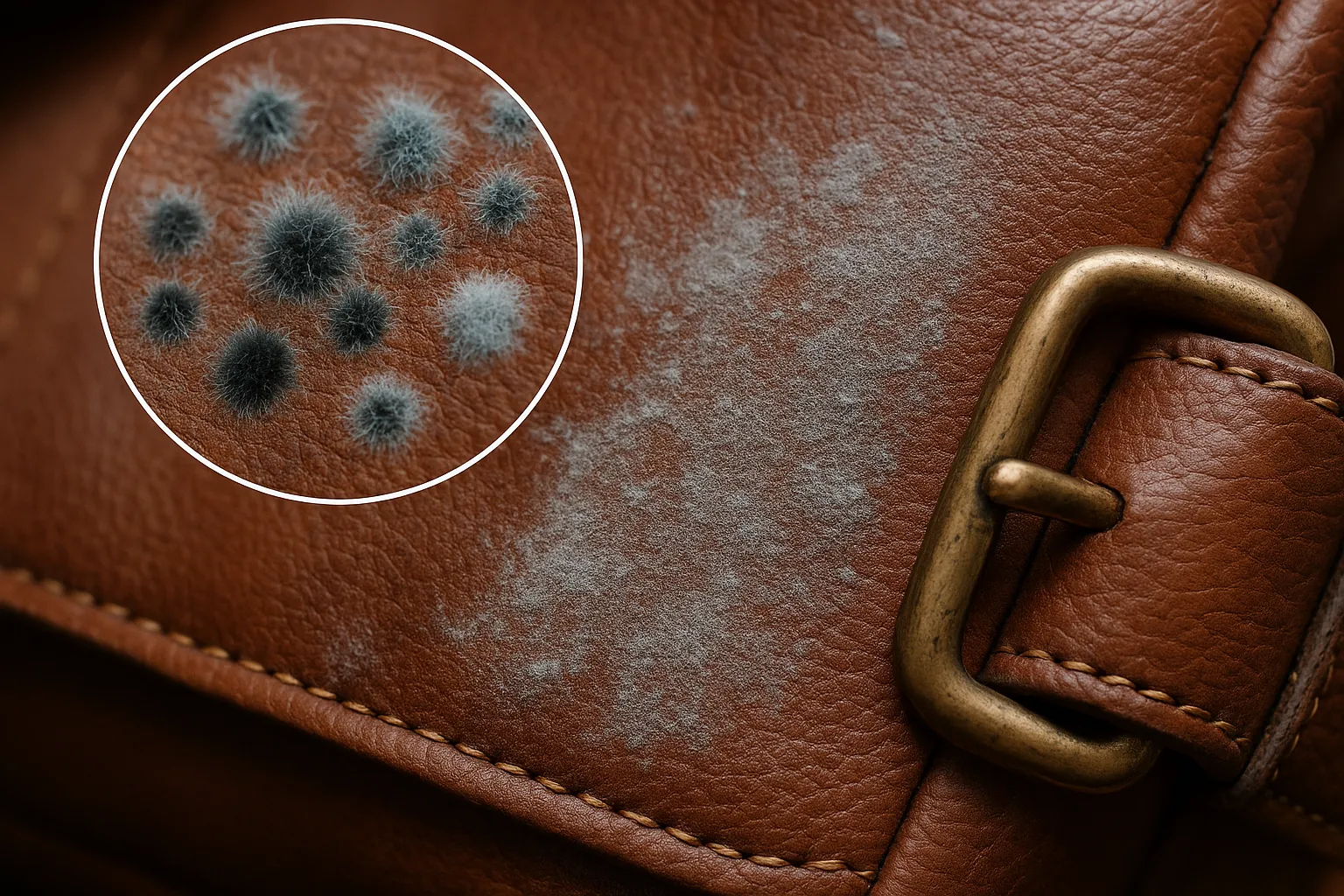
Is the deposit necessarily mould?
A white deposit can also be associated with waxes, oils or other residues. Colour and a photograph alone do not identify its cause. Do not tell customers to rub an unknown solvent over the article to diagnose it, or describe every white bloom as harmless.
The Canadian Conservation Institute’s leather mould guidance distinguishes suspected growth from deposits that can resemble it and emphasises controlled handling. Its treatment guidance is for conservation work; qualified assessment is needed before adapting it to modern finished goods.
What to do when a carton or returned bag is affected
- Put the affected stock on hold. Do not ship it, put it on an open retail display or mix it into a clean return pile.
- Record the evidence. Photograph the article, inner packing and carton. Note the style, batch, location, date and approximate extent of the problem.
- Limit unnecessary handling. Avoid brushing deposits into a shared work area or using compressed air. Follow the site’s approved containment and handling procedures.
- Arrange prompt assessment. A qualified remediation or conservation professional should determine handling, containment and treatment; a leather specialist should assess finish compatibility and product damage.
- Investigate moisture. Check for wet packaging, leaks, condensation and storage conditions while preserving the affected lot’s traceability.
Temporary containment of suspect material and long-term product storage are different tasks. Do not assume that sealing a damp item and leaving it indefinitely will resolve the problem. The assessment needs to account for whether the item is dry or wet and how contamination will be controlled during treatment.
Why a universal alcohol or vinegar recipe is inadequate
A modern bag or belt can combine leather, pigment, clear coating, edge paint, glue, lining and plated hardware. A cleaning liquid can affect these components differently. Wiping the visible face may leave an inaccessible lining or seam unassessed. Adding conditioner or fragrance afterwards can also conceal changes that should be documented.
Do not use bleach, an improvised solvent mixture, direct heat or sunlight as a blanket treatment for leather stock. A concealed-area compatibility check is useful within a qualified procedure, but it does not prove that the whole product has been decontaminated.
What a treatment proposal should specify
| Decision | Information to require |
|---|---|
| Scope | Which panels, lining, pockets, seams and packing are involved |
| Handling | Work area, containment, equipment and personnel requirements set by the responsible professional |
| Compatibility | How leather finish, lining, edge coating and hardware will be assessed |
| Removal | The actual method and its limits, including inaccessible parts |
| Post-treatment review | Appearance, smell, flexibility, seam condition and any remaining damage |
| Disposition | Who decides whether to retain, repair, reject or dispose of the goods |
For porous linings or inaccessible layers, complete treatment may not be practical. The decision should not be reduced to whether a surface looks clean in a photograph. For significant stock contamination, involve the buyer and the responsible specialists before adopting a rework-and-release plan.
Trace the cause without assigning blame prematurely
Compare affected and unaffected cartons from the same shipment. Record when cartons were opened, where they were stored and any signs of wetting. If storage monitoring exists, review the actual records. Compare leather, lining and packing references across lots. A pattern restricted to one area or packing component can help focus the investigation.
A musty smell is a reason for assessment, not proof of a particular fungal species or of which party caused the problem. Likewise, a coated face does not make the entire product mould-proof. Supplier, transit and destination conditions all belong in the review.
Prevention checks for future orders
- Approve suitable storage conditions for the materials and monitor the relevant areas.
- Prevent leaks, floor contact with wet cartons and packing of damp components.
- Check the drying or conditioning requirements of production processes before final packing.
- Validate protective packing and any moisture-control components for the actual route; do not add unqualified chemicals as a substitute for moisture control.
- Retain batch and packing traceability so a later incident can be investigated.
- Review incoming goods promptly instead of leaving a suspect lot closed and unexamined.
These are proposed quality-management actions, not a guarantee that a product can never develop mould. Agree the investigation and release process with the buyer before an incident.
How to brief Hoplok on a storage problem
Send the article reference, photographs, packing details and relevant timeline through the contact page. For new bag or belt projects, include destination storage and packing requirements in the quality-control plan. Routine care guidance should be kept separate from treatment of suspect stock.
Frequently asked questions
Can I identify mould just by its colour?
No. Some residues can resemble mould, and appearance alone does not identify the cause. Treat uncertainty as a reason for assessment.
Is the item ready to sell once the visible spots are gone?
Not on that evidence alone. Review inaccessible parts, material damage and the agreed disposition with the responsible specialists and buyer.
Will a protective leather finish prevent every mould incident?
No. Lining, seams, packing and environmental conditions also matter; a face coating is not a whole-product guarantee.