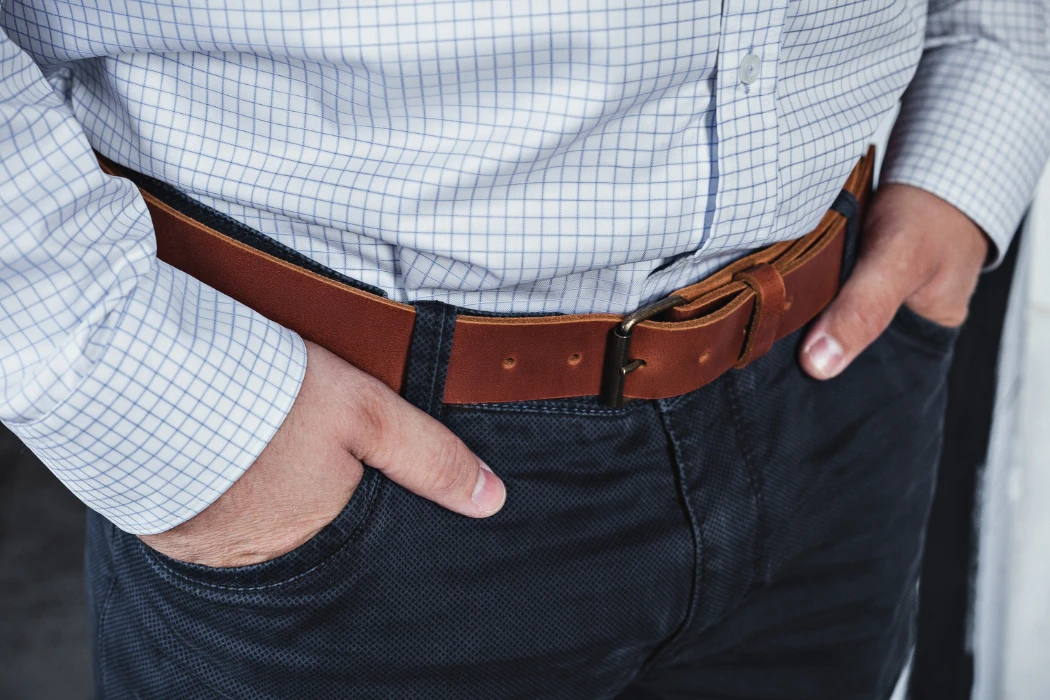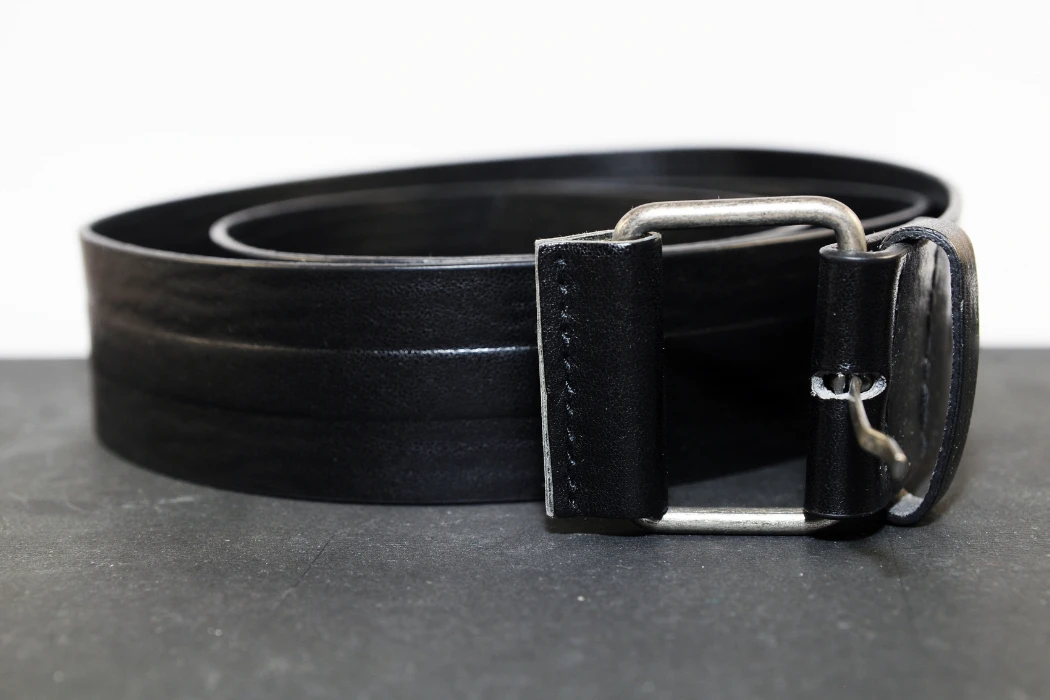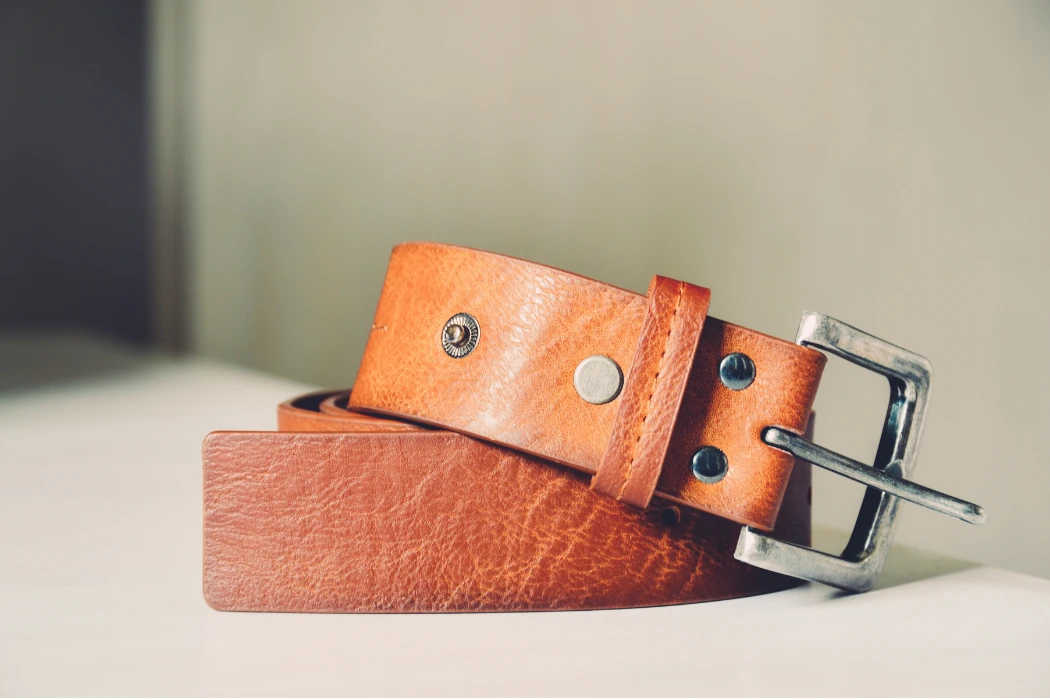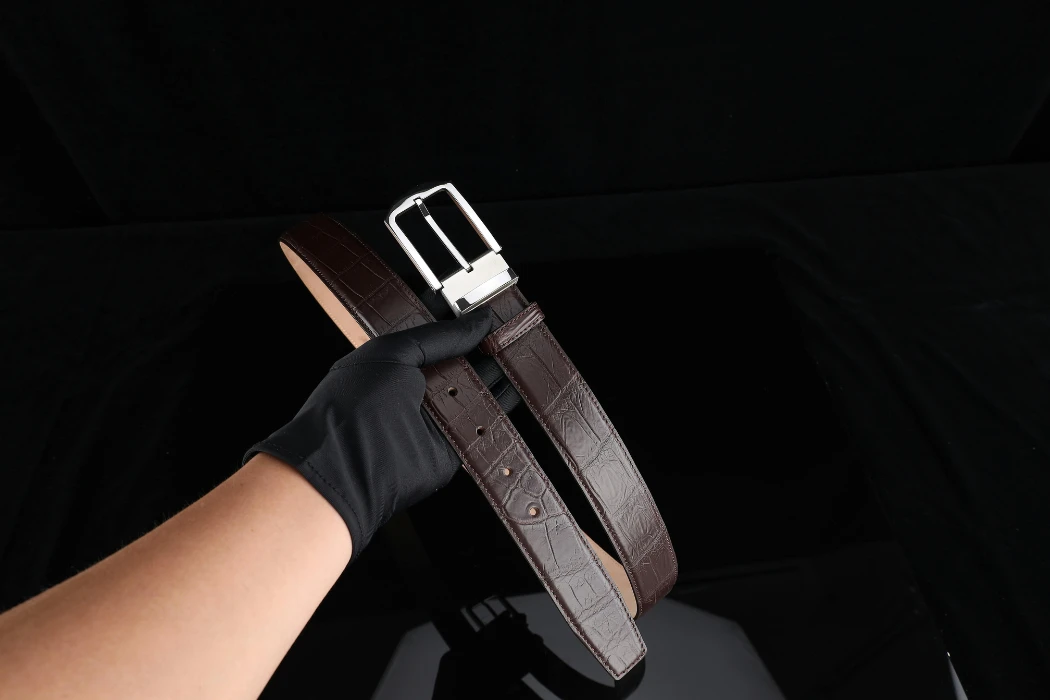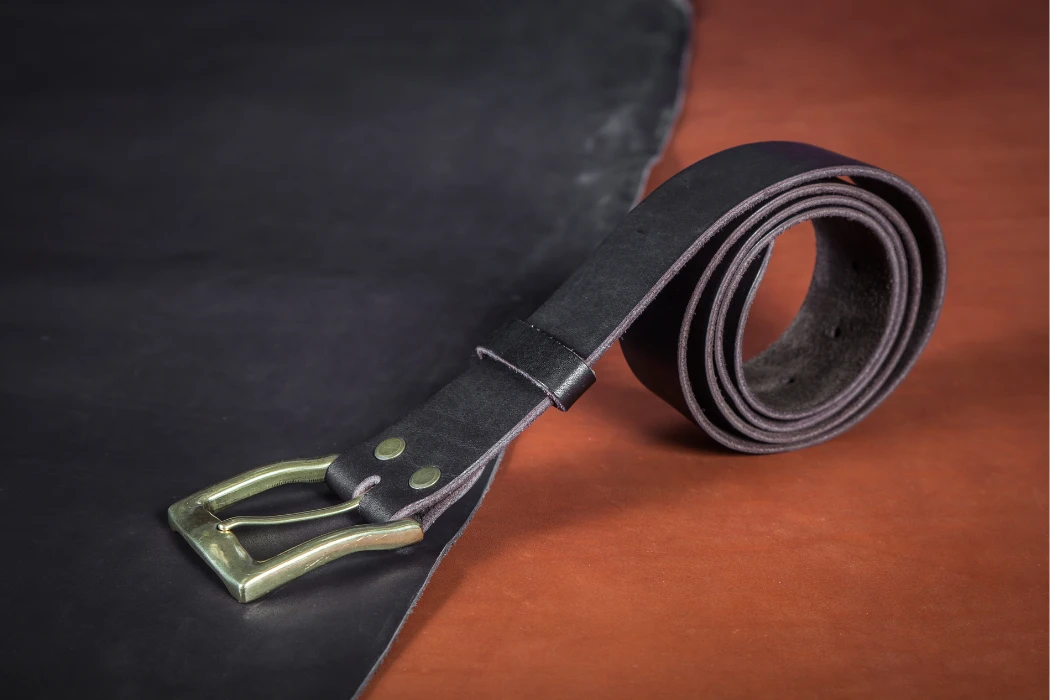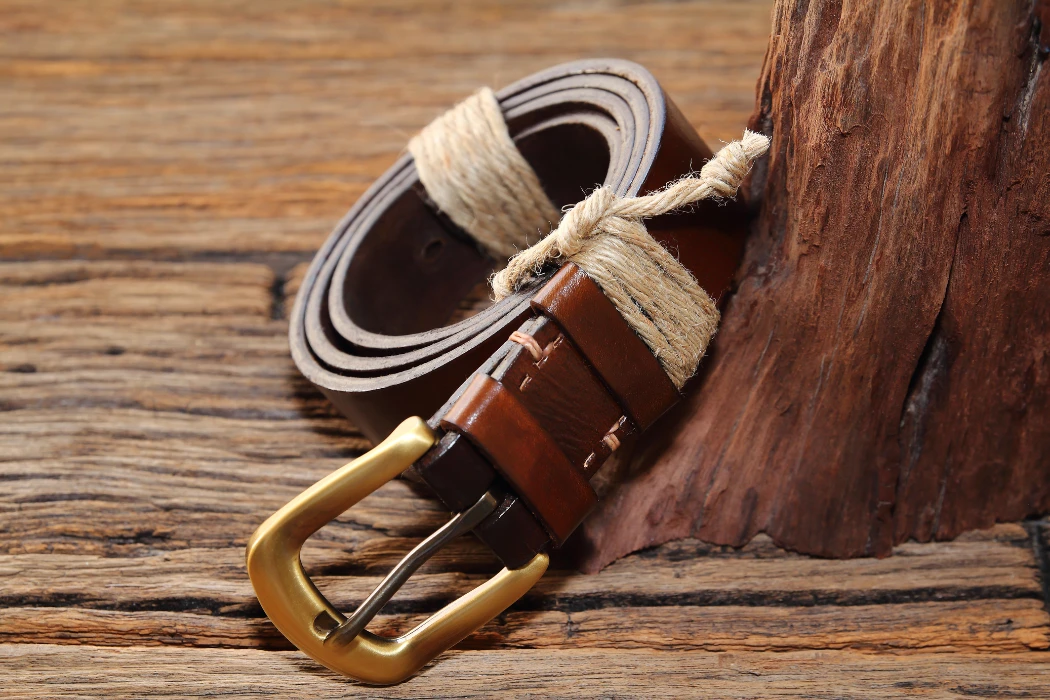
Leather Branding Strategy classifies logo application into two distinct physical paths: Laser Engraving, a subtractive manufacturing process that utilizes high-energy beams to ablate the surface grain; and Hot Stamping (Thermal Compression), a forming process that uses heated brass molds and high pressure to permanently deform collagen fibers. For private label belts requiring heirloom durability, Hot Stamping is regarded as the superior industrial standard due to its physical depth and self-healing “burnishing” properties.
Key Takeaways for Product Developers
- The Physics of Longevity: Hot stamped logos achieve a depth of 0.5mm – 1.0mm. Over time, the compressed fibers release oils, creating a “burnished” contrast that improves with age. Laser engraving is shallow (0.1mm) and prone to surface abrasion.
- Leather Compatibility: Vegetable-Tanned Leather is the ideal substrate for Hot Stamping due to its firmness. Chrome-Tanned Leather (soft fashion leather) often suffers from “spring-back,” making Laser or Foil Stamping the necessary alternative.
- The Cost Curve: Laser offers zero tooling fees, making it perfect for micro-batches (<50 units). Hot Stamping requires a $50–$100 CNC Brass Die investment (NRE), but the processing speed is 10x faster, making it far cheaper for volume production.
- Precision Limits: Laser excels at high-resolution graphics (QR codes, photos). Hot Stamping is limited by metal machining physics; line spacing must generally exceed 0.2mm to prevent the leather from cutting or merging.
What Distinguishes the Physics of Laser Ablation from Thermal Compression?
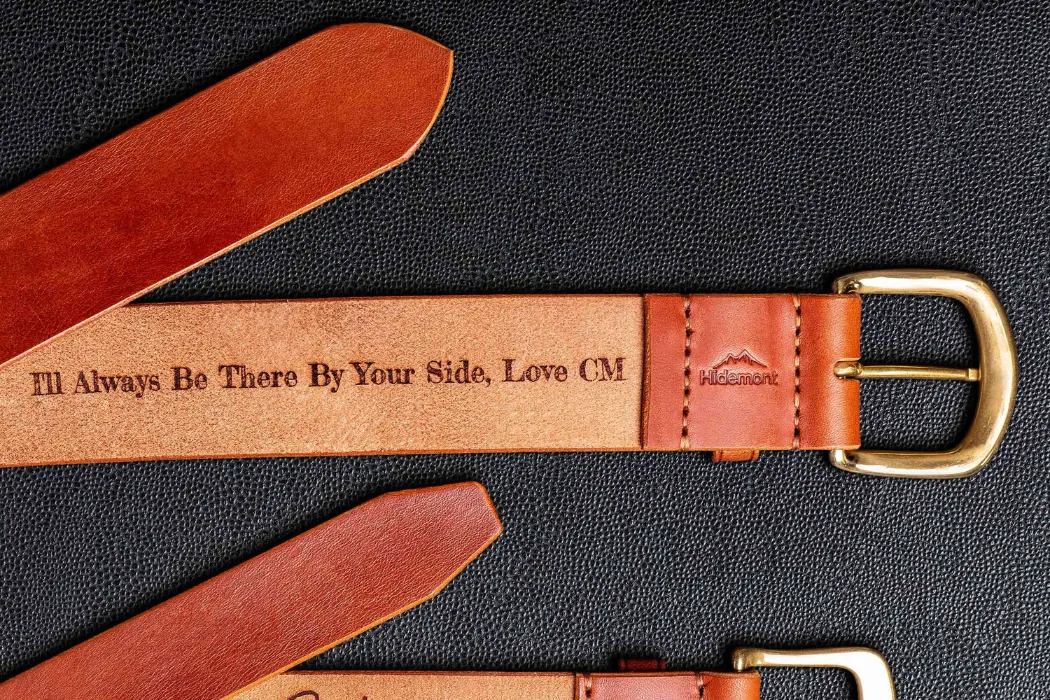
The fundamental difference is removal vs. displacement. Laser engraving uses high-energy CO2 beams to burn and vaporize the top grain, creating a contrasting charcoal mark through carbonization. Hot stamping uses heat (120°C+) and hydraulic pressure (Tons) to compress and fuse the collagen fibers into a dense, sunken relief. Stamping physically alters the structural density of the material, while laser merely scars the surface.
The Thermodynamics of Laser Ablation
Laser engraving is a subtractive manufacturing process. In the leather industry, we utilize CO2 lasers operating at a wavelength of 10.6 micrometers. This specific wavelength is highly absorbed by organic compounds. When the focused beam hits the leather belt, it instantly excites the water and collagen molecules, raising the localized temperature to over 300°C in nanoseconds.
This triggers a violent phase change known as sublimation—the solid leather turns directly into gas (smoke). The residual material undergoes carbonization, leaving behind a black, charcoal-like deposit. This is why laser logos on leather are almost always black or dark gray; you are essentially looking at burnt biological matter. While precise, this process creates a “stress riser” on the surface—a microscopic wound that breaks the grain structure.
The “Holy Trinity” of Hot Stamping
Hot stamping (or Debossing) is a forming process, akin to forging metal. It relies on three critical variables that must be balanced perfectly: Temperature, Pressure, and Dwell Time.
- Temperature (110°C – 150°C): Heat softens the collagen fibers and liquefies the natural fats and waxes within the hide. At Hoplok, we calibrate our brass dies to specific temperatures based on the leather’s moisture content to prevent scorching.
- Pressure (2–5 Tons): Hydraulic force compresses the softened fibers, eliminating air pockets and fusing the layers together into a hardened, dense floor.
- Dwell Time (0.5 – 2.0 Seconds): The duration the die remains pressed against the leather allows the shape to “set.” If too short, the logo rebounds (fades); if too long, the leather burns.
Critical Analysis: The Sensory Impact (The Smell Test)
A factor often overlooked by sourcing managers is the olfactory signature left by the branding process. Laser engraving releases a distinct, acrid odor resembling burnt hair due to the combustion of keratin proteins. This smell can linger on the product for weeks, requiring expensive ozone treatment or airing periods before retail packaging. In contrast, Hot Stamping activates the vegetable tannins and oils, releasing a rich, toasted earthy aroma—often described as “caramelized”—that enhances the sensory perception of genuine leather. One smells like a chemical accident; the other smells like craftsmanship.
| Dimension | Laser Engraving (Ablation) | Hot Stamping (Compression) |
|---|---|---|
| Action Mechanism | Subtractive (Removes material) | Formative (Displaces material) |
| Depth Potential | Shallow (0.1mm – 0.2mm) | Deep (0.5mm – 1.5mm) |
| Color Result | Charcoal Black (Burnt) | Dark Brown / Burnished |
| Edge Definition | Sharp / Digital Precision | Rounded / Soft Shoulders |
| Smell Profile | Acrid / Burnt Hair | Earthy / Toasted Tannins |
Which Method Provides Superior Longevity Under Daily Wear?
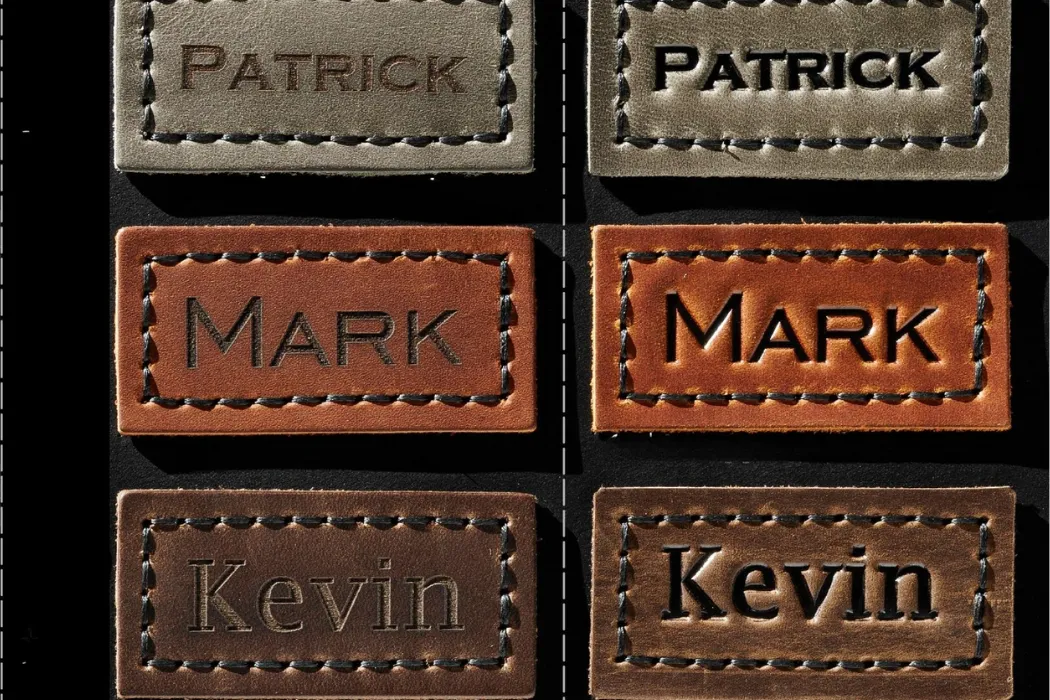
Hot Stamping is the undisputed champion of longevity. Because the logo is pressed deep into the dermis (typically 0.5mm to 1.0mm), it is physically protected from surface abrasion caused by rubbing against belt loops. As vegetable-tanned leather develops a patina, the compressed fibers in the stamped area darken and shine, increasing legibility over time. In contrast, laser engraving relies on surface-level char; it frequently fades or rubs off (“chalks”) after 1–2 years of friction, effectively erasing the brand identity.
The Hoplok Abrasion Protocol
To quantify “durability,” we utilize a modified Martindale Abrasion Tester in our QC lab to simulate the friction of a belt sliding through denim loops.
- Laser Failure Point (1,500 Cycles): Laser engraving creates a layer of carbon ash on the surface. Under friction, this carbon is brittle. Our tests show that after approximately 1,500 abrasion cycles (equivalent to about 6–9 months of daily wear), the sharp black edges of a laser logo begin to blur. On black leather, the “char” rubs off entirely, leaving a faint, undefined grey ghost image.
- Hot Stamp Resilience (10,000+ Cycles): Because hot stamping physically lowers the surface plane of the logo, the surrounding leather acts as a protective wall. The abrasion hits the high points (the belt surface), skipping over the recessed logo. Even after 10,000 cycles, the logo remains crisp. In fact, friction often polishes the floor of the stamp, making it look glossier and more distinct.
Trade-off Analysis: Contrast vs. Permanence
Product developers often choose laser for its immediate visual pop, ignoring how it ages. The choice involves a trade-off between initial contrast and long-term legibility.
- The “Black Leather” Problem: Laser engraving burns leather black. If you are branding a black belt, laser engraving provides almost zero contrast. You get a “Black on Black” mark that is only visible at certain angles. To make it visible, operators often burn deeper, which damages the structural integrity of the strap.
- Blind Deboss (Shadow Definition): Hot stamping is often called “Blind Debossing” because it adds no ink. It relies on light and shadow. While it may have lower contrast from across the room on Day 1, its tactile depth ensures it is always readable. It works equally well on black, brown, or tan hides because it changes the texture, not just the color.
Case Study: Why Heritage Brands Reject Lasers
Look at the waist patches of Levi’s jeans or the shafts of Red Wing boots. You will never find laser engraving on these heritage products. Why?
- The “Future Value” Proposition: Heritage brands sell the promise of aging. They understand that a product must look better in 5 years than it does today. A laser-engraved logo looks its best the moment it leaves the machine and degrades every day thereafter. A hot-stamped logo looks good initially but looks better after years of oil absorption and friction burnishing.
- B2B Sourcing Advice: If your brand marketing uses words like “Lifetime Guarantee” or “Heirloom Quality,” you physically cannot use laser engraving. Using a temporary branding method on a permanent product creates a value disconnect that consumers will eventually notice.
How Do Upfront Tooling Costs and MOQs Impact Your Unit Price?
It is a calculation of Fixed Costs (NRE) vs. Variable Costs. Laser engraving has zero tooling cost but a high “machine time” cost (approx. $0.50/min), making it ideal for samples or customized one-offs. Hot stamping requires a CNC-machined Brass Die ($50–$150), but the cycle time is instant (3 seconds), making it exponentially cheaper for orders exceeding 100 units. Sourcing managers must analyze the amortization curve to determine the correct method for their volume.
The Hidden Economics of “Zero Tooling Fee”
Many startups are attracted to laser engraving because there is no upfront mold fee. However, laser engraving is slow. A complex, high-resolution logo can take 45 to 90 seconds to burn per belt. In manufacturing, time is money. This machine time translates to a higher unit cost—often adding $0.50 to $1.00 per belt. For a production run of 1,000 belts, you are essentially paying $1,000 in “hidden” laser time, far exceeding the cost of a brass mold.
The Brass Die Investment (NRE)
Hot stamping requires a physical matrix. While cheap magnesium or zinc dies ($30) exist, they are brittle and lose definition after a few hundred hits. At Hoplok, we mandate CNC-Machined Solid Brass Dies. Brass conducts heat perfectly and withstands high pressure.
- The Cost Reality: A standard logo mold (up to 2″ x 2″) costs between $50 and $100. This is a Non-Recurring Engineering (NRE) expense.
- Amortization Magic: On an order of 500 belts, a $100 mold adds just $0.20 to the unit price. Combined with the faster processing speed (instant stamping), the total cost per unit drops significantly below laser engraving once you pass the 100-piece threshold.
Scenario Analysis: Personalization vs. Branding
The choice of technology dictates your business model flexibility.
- Personalization (Laser Only): If your business model involves adding individual customer names or initials to each belt (Dropshipping/Customization), laser is the only viable option. You cannot make a new brass mold for every customer name. Laser allows for “Variable Data” printing.
- Brand Identity (Stamping Only): If you are applying your fixed brand logo to a batch of inventory, Hot Stamping is mandatory. It ensures 100% consistency across the batch, whereas laser can vary slightly depending on the density of each hide.
Hoplok’s Lifetime Tooling Guarantee
To mitigate the risk of upfront investment, Hoplok offers a Lifetime Maintenance Policy for brass molds. Once you pay for the die, we clean, polish, and store it in our climate-controlled vault. For all future re-orders, there are zero setup fees. Your mold is your asset, ready to deploy instantly.
| Order Quantity | Laser Cost (High Variable) | Stamping Cost (High Fixed) | Recommended Method |
|---|---|---|---|
| 10 Units (Sample) | $1.00 / unit | $10.00 / unit (due to mold fee) | Laser Engraving |
| 100 Units (Pilot) | $1.00 / unit | $1.20 / unit ($100 mold / 100) | Toss-up / Stamping preferred |
| 1,000 Units (Bulk) | $1.00 / unit | $0.15 / unit (Amortized) | Hot Stamping (Massive Savings) |
| Setup Time | Instant (Digital File) | 15–30 Mins (Physical Alignment) | Depends on Lead Time |
Does the Leather Tannage Type Dictate the Branding Choice?
Yes, tannage is the deciding factor. Vegetable-Tanned Leather is rich in tannins and oils that darken and hold shape permanently under heat, making it perfect for Hot Stamping. Chrome-Tanned Leather (soft fashion leather) has a “spring-back” effect where the fibers rebound, causing stamped logos to vanish or look shallow; for Chrome leather, Laser or Foil Stamping is often necessary.
The “Burnishing Effect” of Vegetable Tannins
Vegetable-tanned leather reacts to hot stamping chemically, not just physically. This hide is impregnated with natural tree barks (mimosa, quebracho) and fats during the 6-week tanning process. When a heated brass die (at approx. 130°C) compresses the grain:
- Thermal Reaction: The heat draws the internal oils and waxes to the surface.
- Friction Polish: The pressure compresses the fibers into a dense, glass-like floor.
- Color Shift: The combination creates a permanent darkening effect known as “Burnishing.” A natural tan belt will develop a rich, dark mahogany logo without a drop of ink. This high-contrast, organic look is the signature of premium leather goods and is impossible to replicate on synthetic or chrome leathers.
Technical Hurdles of Chrome-Tanned Leather
Chrome-tanned leather (used for 80% of fashion handbags and soft belts) presents a nightmare scenario for standard hot stamping.
- The “Memory Foam” Problem: Chrome salts create a loose, flexible fiber structure designed for softness. When stamped, the fibers compress, but once the heat is removed, they “spring back” to their original shape. A logo that looked deep on the factory floor might fade to a shallow ghost image by the time it reaches the retail shelf.
- Thermal Meltdown: Chrome leathers are often finished with heavy acrylic or PU topcoats to seal the color. If the stamping die is too hot (>110°C), it will melt this plastic coating. The coating then sticks to the brass mold, ruining both the product and the expensive tooling. This “tackiness” results in messy, undefined edges.
Hoplok’s Engineering Solution
We do not force a square peg into a round hole. If a client specifies chrome leather but demands a debossed look, we alter the physics.
- Cold Stamping + Stabilizer: Instead of heat, we use extreme hydraulic pressure (Cold Stamping) combined with a chemical “setting agent” sprayed on the leather beforehand to stiffen the fibers temporarily.
- Deep Laser Engraving: For chrome leathers that refuse to hold a stamp, we switch to high-power laser engraving set to a specific frequency that vaporizes the topcoat cleanly without melting the surrounding area, creating the depth of a stamp with the permanence of a burn.
Can High-Definition and Complex Logos Be Achieved on Leather?
Laser Engraving wins on resolution. A CO2 laser beam width is typically 0.1mm, allowing for the precise rendering of intricate graphics, QR codes, or serif fonts as small as 6pt. Hot Stamping is limited by the physical machining strength of the brass metal; lines closer than 0.3mm will merge together under hydraulic pressure, and fine details may cause the leather to crack or cut completely (the “Cookie Cutter” effect).
Design Guide: Engineering Your Logo for the Medium
Designers often create vector files without considering the substrate physics. A logo that looks perfect on a retina screen may be unmanufacturable on a leather belt.
- For Hot Stamping (Bold is Better): Brass molds require structural integrity. We advise designers to thicken all strokes to a minimum of 0.5mm and ensure negative space (gaps between lines) is at least 0.4mm wide. Sans-serif fonts (like Helvetica) stamp cleaner than Serif fonts (like Times New Roman), as the thin tails of serifs often disappear or fail to imprint deeply.
- For Laser Engraving (Pixel Precision): Laser is a digital process. It can reproduce gradients via “halftone” patterns (dithering dots). It is the only viable method for reproducing photographs, QR codes for inventory tracking, or complex heraldic crests with fine cross-hatching.
Risk Factor: The “Cookie Cutter” Effect
One of the most common manufacturing failures with hot stamping is cutting through the product. This happens when the design is too sharp.
- Pressure Concentration: If a logo consists of thin, sharp lines (like a wireframe box), the hydraulic press concentrates 5 tons of force onto a tiny surface area. The brass die acts like a knife blade rather than a stamp, slicing through the grain and weakening the belt’s structural integrity.
- The “Land” Requirement: To prevent cutting, the logo needs sufficient “land” (flat surface area) to distribute the pressure. If your design is delicate, we must lower the pressure, which results in a shallower, less permanent impression.
Visual Translation: Binary vs. Grayscale
Understanding depth perception is key. Hot stamping is binary: a specific area is either pressed down or it isn’t. It handles solid shapes beautifully but cannot do gradients. Laser engraving allows for variable power settings, enabling grayscale shading on the leather surface, although this shading is fragile against abrasion.
| Design Element | Laser Suitability | Stamping Suitability |
|---|---|---|
| Fine Text (< 6pt) | Excellent (Readable) | Poor (Bleeds/Illegible) |
| Bold Shapes / Blocks | Good (Slow process time) | Excellent (Deep & Rich) |
| QR Codes / Barcodes | Excellent (Scannable) | Impossible (Low contrast) |
| Gradients / Shading | Good (Halftone dots) | Impossible (Solid only) |
Why Is Foil Stamping Often a High-Risk Strategy for Belts?
Foil stamping creates a surface bond, not a structural one. While Gold/Silver foil looks premium on rigid box packaging, on a flexible belt, the foil layer creates a rigid film that cannot stretch with the leather substrate. This mechanical mismatch leads to micro-cracking and flaking within months of daily wear. Consequently, Hoplok strongly advises Blind Debossing (No Foil) for any product subjected to high tensile stress like a waist belt.
The Mechanics of Foil Adhesion Failure
Foil stamping is essentially a transfer process. A micron-thin layer of metallic polyester film is bonded to the leather using heat-activated adhesive. The fundamental failure mode lies in the physics of Elongation Differential. Leather is a highly elastic material; it expands, contracts, twists, and bends constantly during use. The metallic foil layer, however, is relatively brittle and has a near-zero elastic limit.
When a belt is wrapped around the waist, the outer grain surface (where the logo sits) undergoes significant tension and elongation. The leather stretches, but the foil cannot. The adhesive bond might hold, but the foil itself shatters into microscopic islands. This results in a “spiderweb” of cracks that dulls the metallic luster and eventually causes the foil to flake off entirely, leaving a patchy, cheap-looking residue that damages brand perception.
The Flex Test Reality
In the Hoplok QA lab, we quantify this failure using the Bally Flexometer, a machine designed to rapidly bend leather samples thousands of times.
- Blind Deboss Performance: A plain hot-stamped logo shows zero degradation after 20,000 flex cycles. The fibers are compressed, not coated, so they move with the leather.
- Foil Stamp Failure: In contrast, foil-stamped logos typically show visible micro-cracking after just 500 to 1,000 cycles. By 3,000 cycles, significant flaking occurs. For a daily-wear item like a belt, this translates to a pristine lifespan of only 3–6 months. This high failure rate creates a massive liability for warranty claims.
Strategic Exceptions and Alternatives
Does this mean foil is strictly forbidden? Not entirely, but it must be engineered into “Low-Flex Zones.”
- The Belt Keeper (Loop): The small leather loop that holds the belt tip is a static component. It does not stretch or bend significantly during wear. Placing a small foil icon here is relatively safe.
- Inner Lining Branding: Stamping the size info or logo on the inside back of the belt is safer because the inner surface compresses (rather than stretches) when worn. However, friction from the waistband still poses an abrasion risk.
- The Metal Badge Alternative: If your design language demands a metallic gold or silver logo, do not paint it on—install it. We recommend using a custom-molded metal badge (riveted or prong-set). A solid brass badge plated in gold offers the high-flash aesthetic you desire with the structural permanence of hardware, completely bypassing the fragility of foil transfer.
Frequently Asked Questions
Will laser engraving weaken the leather belt?
Yes, if the power setting is too high. A laser beam literally removes material, reducing the thickness of the strap at the burn site. If the engraving cuts deeper than 0.3mm, it creates a “stress riser”—a structural weak point where the belt is likely to snap under tension. We calibrate our lasers to a safe surface depth of <0.2mm to preserve tensile integrity.
Can I change my logo size without paying for a new mold?
With Laser, yes; with Stamping, no. Laser engraving is digital. You can resize the artwork file instantly for free. Hot stamping relies on a physical brass block. If you want to change the logo size even by 1mm, a completely new metal die must be CNC-machined, incurring a new NRE tooling fee.
How do I remove a stamped logo if I made a mistake?
It is impossible. Hot stamping causes permanent plastic deformation of the collagen fibers. You cannot “iron it out” or buff it away. If a logo is stamped crooked or on the wrong side, the leather strap must be scrapped entirely or cut down into smaller accessories (like keychains) to salvage the material.
The Verdict: Branding is an Asset, Not a Decoration
Your logo is the most valuable asset on the product. If it fades, peels, or rubs off, the consumer perceives the entire product as disposable. Hot Stamping (Debossing) is the only engineering choice for brands seeking permanence, heritage aesthetics, and increased value over time. Laser engraving has its place for personalization and complex QR codes, but it lacks the tactile authority of a deep brass stamp.
Hoplok’s Proof of Concept
We understand that investing in molds can be intimidating. That is why Hoplok offers Free Logo Compatibility Testing. Send us your vector file (AI/PDF), and we will laser engrave and hot stamp your design on leather swatches from our scrap bin. We ship these physical samples to you so you can smell the difference and feel the depth before you commit to cutting steel.
Protect Your Brand Equity
Do not let a cheap surface mark devalue your premium leather. Contact the Hoplok Tooling Engineering Team today to discuss precision CNC-machining your brand assets into solid brass for a legacy that lasts as long as the leather itself.