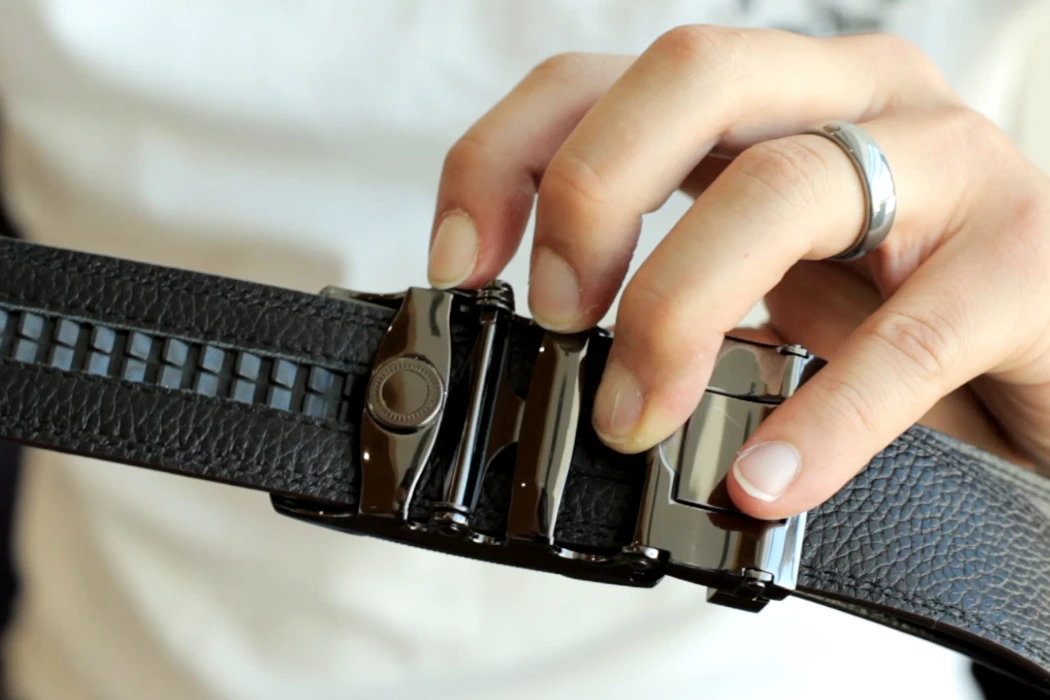
PU and PVC synthetic leather cannot be ranked for sustainability from the polymer name alone. Compare the complete coated fabric, its manufacturing route, chemical evidence, useful service and realistic disposal options. Waterborne PU can reduce reliance on processing solvents, but that does not automatically make a finished bag non-toxic, biodegradable or lower-impact in every category.
“Vegan leather” describes an animal-free positioning; it does not identify the coating, backing or adhesive. A bag advertised under that name may use PU, PVC or a plant-containing composite. Buyers need the composition and evidence behind the claim before choosing material or writing retail copy.
This guide compares the chemical, manufacturing, consumer-use and end-of-life questions that matter when sourcing synthetic materials for bags, belts and small accessories. It is a purchasing framework, not a product-specific life-cycle assessment.
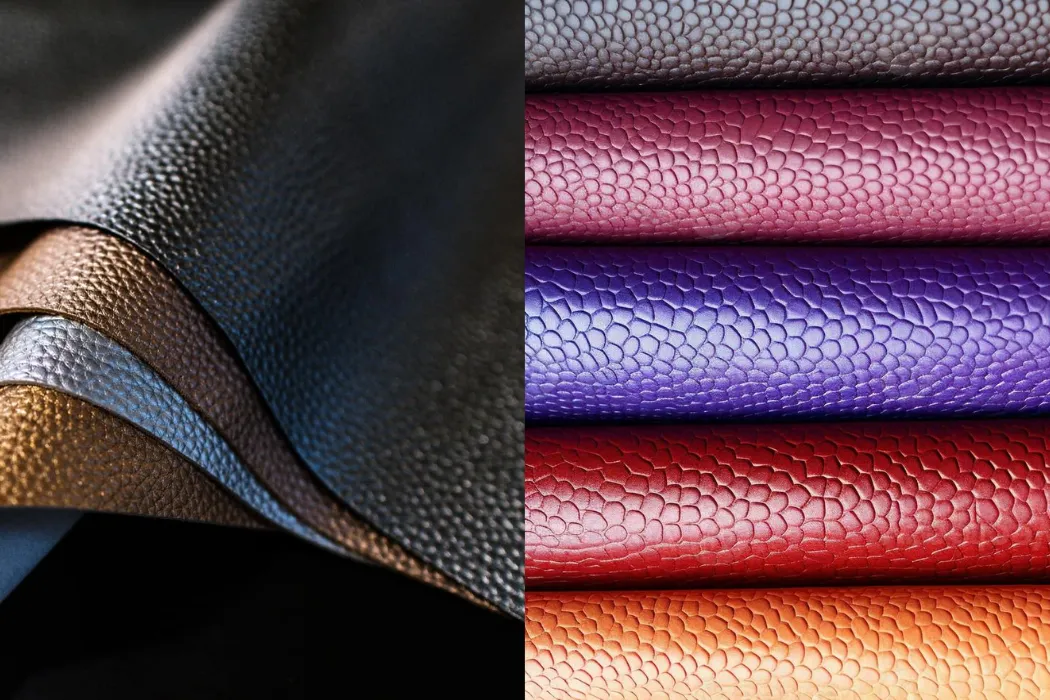
What Is the Chemical Difference Between PVC and PU?
PVC means polyvinyl chloride; PU means polyurethane. These identify different polymer families, not a complete finished-material recipe. Synthetic leather commonly combines a surface coating with a textile backing and may include foam, pigments, stabilisers, fillers and additional finishes. Ask which layers contain which polymers, especially when a material is marketed simply as “PU-coated.”
Chlorine Content and the PVC Life Cycle
Chlorine is part of PVC’s polymer structure. Its presence creates considerations for production and waste treatment, but the chlorine fraction of neat resin must not be presented as the composition of a finished coated textile. Nor does it establish a consumer exposure level.
- Production: Ask how the upstream producer manages chemical handling, process emissions and waste. An assembly-factory audit does not describe the resin producer’s operations.
- Disposal: Check the treatment route accepted locally for the complete product. Controlled treatment and uncontrolled burning are different situations; neither PVC nor PU should be described as safe to burn at home.
- Evidence: ECHA’s PVC investigation identifies concerns involving certain additives and microparticle releases. It does not establish that every PVC article has the same formulation or risk profile.
The Plasticiser Question: Making PVC Flexible
Flexible PVC formulations use plasticisers, but “plasticiser” does not mean that every formulation contains the same phthalates. Identify the actual substances and the restricted-substance requirements for the destination and product category.
- Migration: An additive’s presence, ability to migrate and resulting exposure are separate questions. Obtain testing suited to the substance and use instead of inferring exposure from the softness of the sheet.
- Substitution: A phthalate-free declaration should define what was excluded and how it was verified. It is not a blanket declaration that all other ingredients are harmless.
- PU comparison: PU flexibility can be designed through its polymer chemistry. That does not mean a PU-coated fabric contains no additives, solvent residues or other polymers.
Chemical Composition: What Buyers Should Request
Use the table to collect comparable evidence. A supplier’s answer should refer to the exact grade and colour offered, not an unrelated sample.
| Component | PVC material | PU material | Evidence to request |
|---|---|---|---|
| Polymer and backing | Identify PVC layers and substrate | Identify PU layers and any other coating polymers | Layer description and composition declaration |
| Plasticisers and additives | Identify the flexible formulation’s additives | Check additives, finishes and backing treatment | Relevant substance declarations and reports |
| Chlorine-related claims | Distinguish resin chemistry from finished sheet | Do not assume the whole composite is halogen-free | Defined claim covering the relevant components |
| Volatile emissions | Depend on formulation and process | Depend on formulation and process | Named emission method, conditions and results |
How Do Production Methods Impact the Environment?
The process matters alongside the polymer. Coating, drying, solvent recovery, energy supply, water use and scrap handling can change the production footprint. Compare the same functional material and assessment boundary; a resin-level improvement cannot be applied unchanged to a complete handbag.
Solvent-Based PU and DMF
Some PU processes use N,N-dimethylformamide, a solvent commonly abbreviated DMF. Its handling requires appropriate controls. The EU restriction on N,N-dimethylformamide addresses worker exposure under defined conditions. It should not be paraphrased as a universal finished-bag “zero DMF” rule.
- Identify the route: Ask which coating and coagulation steps use solvents and whether other layers or adhesives introduce them.
- Review controls: Recovery, ventilation, wastewater management and worker exposure records concern manufacturing; residual-solvent testing concerns the supplied material. Request the evidence appropriate to each question.
Waterborne and Bio-Based PU
Waterborne PU dispersions can replace solvent-based steps. Covestro’s textile-coating guidance describes such technologies and process-dependent resource savings. A particular supplier’s process result is not a universal reduction figure for all waterborne materials.
- Solvent claims: Establish whether “waterborne” applies only to the topcoat or to the full manufacturing route. Confirm the scope of any solvent-free declaration.
- Energy and water: Ask for the comparison baseline, production location, measurement period and assessment boundary behind savings claims.
- Bio-based content: Identify whether a percentage describes renewable carbon, mass of one component or the complete coated fabric. These are different measures and should not be interchanged.
For a material enquiry: Include the intended product, destination, coating and backing requirements, restricted-substance list and any environmental claim you plan to make. Confirm material availability and supporting records before approving a retail claim or bulk order.
Which Material Is Safer for the End Consumer?
Consumer safety depends on the actual article, exposure and applicable requirements. PVC is not automatically prohibited, and PU is not automatically compliant or hypoallergenic. Evaluate the coating, backing, lining, adhesives, dyes and hardware as relevant to the finished product.
Off-Gassing: What an Odour Can and Cannot Tell You
An unexpected odour is a reason to investigate a sample. It is not an analytical test that identifies a solvent or quantifies risk. A low-odour material also cannot establish the absence of restricted substances.
- Record the issue: Compare the sample with the approved reference under the same unpacking and storage conditions.
- Trace the components: Coating, adhesive, backing and packaging may all contribute; examine the product rather than guessing from the polymer name.
- Specify evidence: Where emissions or residues matter, agree a relevant laboratory method and limit. Do not use a sniff test as the release criterion.
Skin Contact and Hypoallergenic Claims
A PU surface used in one medical product does not prove that a fashion-material grade is suitable for skin contact. Likewise, breathability varies with coating structure, backing, thickness and assembly. Compare the proposed strap or lining under a relevant method when moisture comfort matters.
- Contact conditions: Consider where and how long the material touches skin or clothing, and whether wet use is expected.
- Whole-product review: Include colour transfer and relevant hardware chemistry. “Latex-free” or “hypoallergenic” needs its own evidence and defined scope.
Health and Safety Compliance Matrix
The following are different frameworks. None grants a general pass to one polymer family.
| Framework | PVC assessment | PU assessment | Buyer action |
|---|---|---|---|
| EU REACH | Assess applicable substances and article requirements | Assess applicable substances and article requirements | Match the current requirements to the actual formulation and use |
| California Proposition 65 | Review potential exposure to listed chemicals | Review potential exposure to listed chemicals | Determine any warning obligation from exposure, not polymer name |
| OEKO-TEX STANDARD 100 | Check any claimed certificate’s product scope | Check any claimed certificate’s product scope | Verify certificate validity and whether the supplied item is covered |
| US children’s-product rules | Assess age, use and applicable component rules | Assess age, use and applicable component rules | Agree the finished-product compliance and testing plan |
CPSC’s phthalates guidance concerns specified phthalates in accessible plasticised components of children’s toys and child-care articles. It is not a blanket PVC ban for every child’s fashion accessory. Other children’s-product requirements may apply separately. California’s official guidance explains that Proposition 65 warnings concern exposure to listed chemicals; they are not automatically required for PVC or automatically waived for PU.
What Happens at the End of the Product’s Life?
Neither a PU label nor a PVC label establishes that a finished accessory is biodegradable, compostable or accepted for recycling. A coated fabric may be bonded to foam, lining and reinforcement, with metal hardware attached. Plan for the complete article and the disposal infrastructure where it will be used.
The Incineration Question
Do not describe PU as burning cleanly or PVC as the only combustion concern. Waste treatment depends on the feedstock, facility and emission controls. Material selection should consider an authorised treatment route rather than assume informal burning is an acceptable disposal option.
- Keep claims specific: Ask the material provider what waste route it documents and for which material stream.
- Separate waste streams: Clean factory offcuts and mixed, worn consumer products can have different collection and treatment options.
Recyclability and Composite Construction
Recycling a polymer and recycling a finished handbag are different tasks. Coatings, backing textiles, adhesives, linings and hardware may need separation. Before stating “recyclable,” identify an actual collector or processor that accepts the material or product in the target market.
Ask whether a take-back route covers production scrap, used goods or both; what condition is accepted; and what happens to collected material. A laboratory recycling demonstration does not itself provide a consumer collection system. Avoid unsupported global recycling percentages for synthetic leather.
Hydrolysis Is a Durability Issue, Not Proof of Biodegradation
Some PU constructions can deteriorate through hydrolysis under warm, humid conditions. Resistance depends on the formulation and full construction. Peeling can also involve coating adhesion, wear or unsuitable care, so a failed sample needs investigation.
Fragmentation does not demonstrate complete biodegradation or make microplastic release an environmental benefit. Nor can a fixed laboratory exposure be translated directly into a number of years of use. Request relevant ageing and adhesion evidence and compare the material before and after exposure.
Why Is PVC Still Used?
PVC remains an option in coated materials because formulations can be selected for appearance, processing, cost and particular service conditions. That does not make all PVC cheaper or more durable than all PU. For fashion goods, compare grades that meet the same design and acceptance requirements.
The Cost Factor: Compare the Finished Specification
A quoted price per yard is incomplete without usable width, thickness, backing, finish, minimum quantity and quality requirements. Currency, colour development and order volume also affect a commercial comparison.
- Material cost: Compare the same unit and usable area. Check whether required testing or colour development is included.
- Conversion cost: Evaluate cutting, stitching, bonding and finishing on a sample. A lower sheet price can lose its advantage if the approved design requires additional processing or creates more rejected parts.
Durability in Demanding Conditions
Cleaning resistance, abrasion, flexing and ageing are grade-specific. A material intended for a specialised upholstery use is not evidence that every PVC or PU fashion material has the same performance.
- Cleaning: Ask for compatibility with the actual cleaning agent and method. Neither polymer name guarantees resistance to bleach or alcohol.
- Humidity and exposure: Evaluate the relevant finish, backing and bond after the agreed conditioning. Avoid predicting an outdoor lifespan from the polymer alone.
Performance and Environmental Trade-Offs
| Metric | PVC question | PU question | Decision evidence |
|---|---|---|---|
| Cost | What is included in the exact grade quote? | What is included in the exact grade quote? | Comparable finished-specification cost |
| Durability | How do coating and additives perform in use? | How do coating and bonds withstand relevant ageing? | Sample results against agreed methods and limits |
| Environmental impact | What are the process and additive records? | What are the process and formulation records? | Consistent assessment boundaries and supported claims |
| Hand-feel | Does the proposed grade meet the design? | Does the proposed grade meet the design? | Approved swatch and assembled sample |
What Are the Sustainable Alternatives for Brands?
Consider waterborne coatings, verified recycled content or plant-containing composites where they meet the product brief. These are attributes to evaluate, not automatic sustainability rankings. A change in material should preserve the performance needed for the product’s intended use.
Plant-Based Composites: Cactus, Apple and Pineapple
Plant-derived ingredients can be introduced in different ways: as fibres, fillers or feedstocks for part of a polymer. Those routes should not be described as chemically interchangeable. Different collections sold under one brand can also have different compositions.
- Composition: Request the exact collection’s coating, binder and backing details. Ananas Anam’s Piñatex information is an example of a producer-specific source; its statements should not be extended to all plant-containing materials.
- Claim basis: Explain what the plant or recycled percentage measures. Avoid converting a component percentage into a whole-product claim.
- End of life: Bio-based origin alone does not establish compostability or plastic-free construction. Check evidence for any separate claim.
Silicone-Coated Textiles
Silicone-coated textiles use another polymer family and still need a backing and a defined formulation. Describing them as “sand rather than plastic” obscures the processed composite the buyer actually receives.
- Process: Ask what a solvent-free or low-emission claim covers. Do not assume the coating, adhesive and backing all share the same processing route.
- Performance: Confirm flex, abrasion, adhesion and cleaning compatibility on the proposed grade. A broad temperature range from another application is not a finished-handbag specification.
Changing materials: Start with one approved product construction and compare candidate materials against it. Confirm availability, minimum quantities, processing changes, evidence and price before committing to a new collection or environmental claim.
Frequently Asked Questions
1. Is PU leather biodegradable?
Do not assume it is. A PU-coated textile’s peeling or fragmentation does not prove biodegradation. Bio-based content also does not establish compostability; any such claim needs evidence for the relevant material, conditions and disposal route.
2. Can you recycle PVC leather?
It depends on the construction and available collection and processing route. Ask whether a processor accepts the complete coated textile or article, including backing and additives. The recyclability of PVC resin does not establish that a local consumer recycling stream accepts a bag made from it.
3. Is vegan leather better for the environment than real leather?
There is no universal answer from the label. Compare actual materials using a consistent life-cycle boundary, allocation method and useful function. Include manufacturing, expected service, maintenance and disposal; do not assume either material always lasts a fixed number of years.
4. Does PU leather smell?
A PU product can have an odour from its coating, backing, adhesive or packaging. Smell cannot reliably identify DMF or establish compliance. Compare the sample with a reference and use appropriate testing if residues or emissions are a concern.
5. Is PVC safe for children?
The actual product and formulation must meet the requirements applying to its market, age group and use. Specified phthalates are restricted in US children’s toys and child-care articles; this does not mean every PVC accessory is banned or that every PU alternative automatically passes children’s-product requirements.
6. What is “DMF-free” leather?
In synthetic-material sourcing this usually concerns N,N-dimethylformamide. Define whether the claim means no intentional use or a measured residue below a stated limit, and identify the method and detection limit. Avoid confusion with dimethyl fumarate, a different substance that may also be abbreviated DMF.
Conclusion: Choose a Material You Can Substantiate
The practical choice is the material whose composition, process evidence and performance suit the product brief. Waterborne PU can be a useful option, but a sustainability claim must describe the actual grade and the evidence supporting it. PVC, PU and plant-containing composites all require that same discipline.
Keep a material file containing the approved swatch, layer description, relevant reports, claim wording and change-control requirements. If a supplier changes the backing, coating or additive package, review whether the approval still applies.
For a custom bag material and production enquiry, send Hoplok the design, destination, quantities and evidence requirements. PU bag minimums are 1,000 pieces, bag sampling takes 3–4 weeks and bulk production takes 60–90 days. Confirm the proposed material and schedule in the quotation before approving production.