Reversible belts are the ultimate accessory for efficiency, offering two distinct looks in a single strap. But for manufacturers, they represent a complex engineering challenge. Unlike standard belts, a reversible strap relies entirely on the structural integrity of its bonding agents and the mechanical precision of its hardware. If the adhesive fails, the layers delaminate. If the swivel mechanism fatigues, the belt becomes useless.
At its core, reversible engineering combines advanced lamination techniques with heavy-duty rotatable hardware. The process involves fusing two finished leather faces around a stabilizing core, ensuring that neither side wrinkles when bent. This requires precise control over material thickness, shrinkage rates, and stitch tension.
This guide explores the specific technical requirements for producing high-quality dual-sided belts. We will examine the critical differences in anatomy, the science of selecting compatible leathers, and the testing protocols necessary to guarantee longevity in a product designed to be twisted, pulled, and worn every day.
What Distinguishes the Anatomy of a Reversible Belt from Standard Belts?
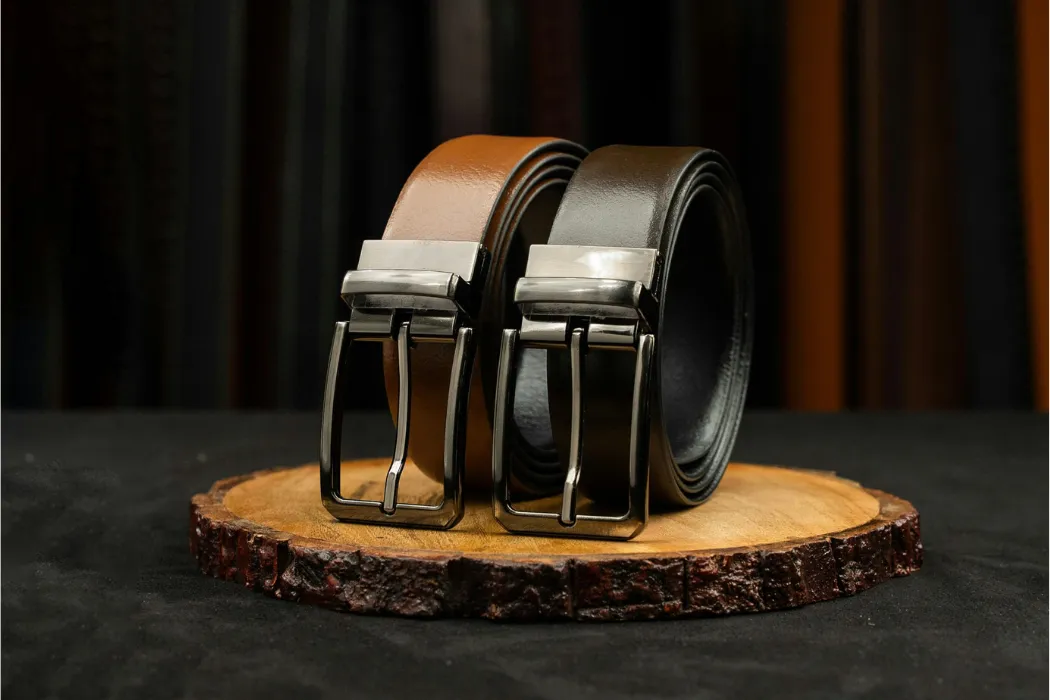
A standard belt typically consists of a top grain layer bonded to a raw or finished backing. A reversible belt, however, has no “backing.” Both sides are “faces.” This fundamental difference forces engineers to adopt a symmetric “sandwich” construction method to ensure durability and aesthetic balance.
The “Sandwich” Construction: Core Filler vs. Single-Ply
You cannot simply glue two pieces of leather together and expect them to perform well. Without a stabilizer, the belt will stretch unevenly. Reversible belts utilize a three-layer “sandwich” system:
- Side A (Face 1): The primary aesthetic layer (e.g., Black Smooth Leather).
- The Core (Filler): A non-woven or bonded leather stiffener (typically 0.8mm – 1.2mm) that prevents stretching and provides the “body” of the belt.
- Side B (Face 2): The secondary aesthetic layer (e.g., Brown Textured Leather).
This core layer is the skeleton of the belt. It absorbs the tension from the buckle, protecting the two outer leather layers from warping over time.
Feather Edge vs. Cut Edge: Structural Profiles for Reversibility
The edge profile dictates how the belt handles torsion (twisting). A Feather Edge involves skiving (thinning) the edges of the leather, folding them over the core, and stitching them down. This creates a domed, formal look that is highly resistant to delamination because the layers are mechanically locked by the fold. A Cut Edge involves bonding the layers flat, cutting them clean, and applying edge paint. While more modern, Cut Edge reversible belts require significantly stronger adhesives, as there is no folded leather to physically hold the sandwich together during the twisting action.
Flatness Engineering: Balancing Tension on Both Sides
One of the most common defects in reversible belts is “curling,” where the belt refuses to lay flat on a table. This happens when the tension on Side A does not match Side B. If one leather hide was stretched more during the cutting process than the other, it will attempt to retract (shrink) after bonding, pulling the belt into a “U” shape. Engineers must ensure that both leather faces are cut with the same grain direction and tension to maintain a perfectly flat profile.
How is Leather Selection Optimized for Dual-Sided Reversible Straps?
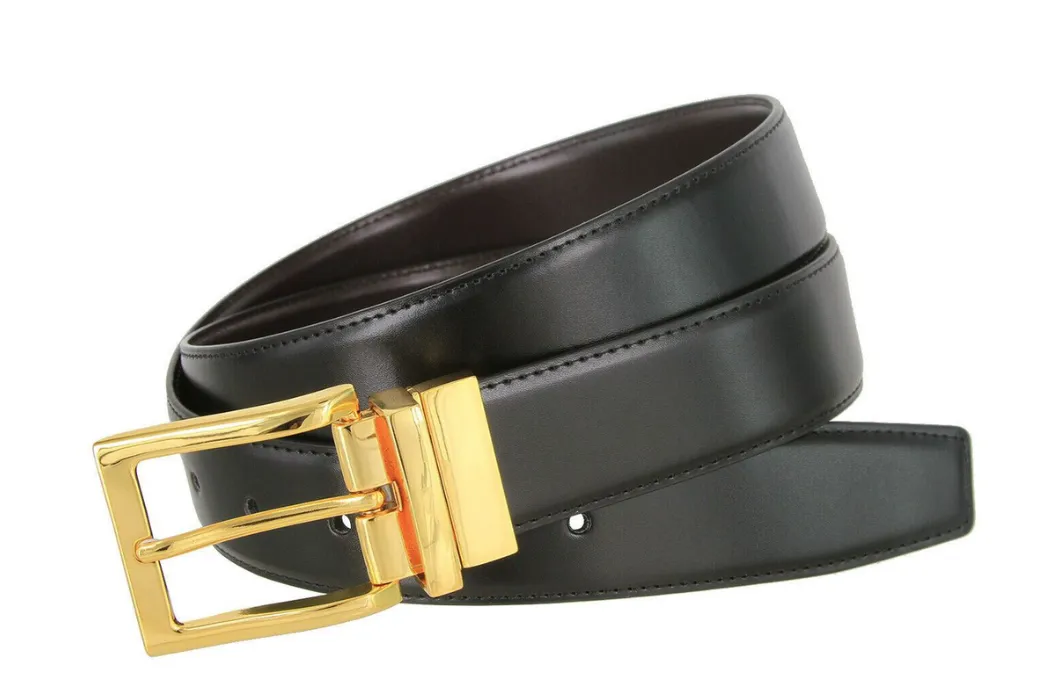
Selecting materials for a reversible belt is a matching game. You are not just picking one good leather; you are picking two leathers that must behave identically under stress, heat, and moisture. Mismatched materials are the leading cause of structural failure.
Matching Shrinkage Rates on Side A and Side B
Different tanning methods result in different shrinkage rates. For example, Vegetable Tanned leather shrinks and reacts to humidity differently than Chrome Tanned leather. If you bond a Veg-Tan strap to a Chrome-Tan strap, the belt will eventually bubble or ripple as they expand and contract at different rates. For high-durability reversible belts, it is best to use materials with similar chemical properties on both sides.
Split Leather vs. Full Grain: Material Compatibility for Bonding
The surface texture of the inner flesh side affects adhesion. Full Grain Leather generally has tight fibers on the back, offering a solid anchor for glue. Split Leather (the lower layer of the hide) is more porous. When bonding Full Grain to Split Leather, the adhesive viscosity must be adjusted. The porous Split Leather will soak up glue like a sponge, potentially starving the bond line. Engineers often apply a double-coat of adhesive to the Split side to ensure a secure link with the Full Grain side.
Precision Splitting: Achieving the 3.8mm Target Thickness
Reversible buckles have a fixed gap in the clamp or pin mechanism. If the belt is too thick, the hardware will jam or damage the leather surface during rotation. If it is too thin, the clamp will not bite securely, causing the buckle to detach. The industry standard target thickness for a finished reversible belt is typically between 3.5mm and 3.8mm. This means the individual leather layers must be split with extreme precision—often down to 1.2mm each—to allow room for the core filler and adhesive.
Material Combinations: Durability vs. Flexibility in Reversible Belts
| Material Combination | Flexibility Score | Durability Score | Engineering Notes |
|---|---|---|---|
| Full Grain + Full Grain | Medium | High | The premium standard. Very durable but requires “breaking in.” Heavy adhesion required. |
| Full Grain + PU (Synthetic) | High | Medium | PU is softer and more flexible, but delamination risk is higher due to different chemical bonding needs. |
| Split Leather + Split Leather | Low | Medium | Cost-effective. Often stiff due to the heavy PU coating on both faces needed to simulate grain. |
| Bonded Leather + Bonded Leather | Very Low | Low | Prone to cracking at the buckle hole and twist point. Not recommended for premium brands. |
Why Is Lamination the Most Critical Process in Reversible Belt Manufacturing?
In standard belt production, you often glue a raw fiber back to a finished top layer. The raw fibers grip the adhesive easily. In reversible belts, you are bonding a core to two finished leather skins, or sometimes bonding two finished skins directly. Finished leather is engineered to repel water and dirt, which means it also repels glue. This makes delamination (separation) the #1 failure mode for reversible belts.
Preventing “Bubbling”: Adhesive Selection for Two Finished Faces
Bubbles appear when the adhesive fails to bond evenly, creating pockets of air that expand with heat. Because reversible leather faces are often treated with oils or waxes, standard water-based latex glues often fail to penetrate. Engineers typically use solvent-based polyurethane (PU) adhesives or polychloroprene (CR) contact cements. These solvents slightly dissolve the surface finish, allowing the glue to bite into the fibers. For high-oil leathers (like Crazy Horse), a “primer” coat is mandatory to block the oils before applying the main adhesive.
Temperature Management During the Dual-Sided Pressing Phase
Once the adhesive is applied, the “sandwich” must be pressed. This is a delicate thermal balancing act. If the heat press is too hot (>80°C), the leather fibers will shrink, causing the belt to warp or stiffen permanently. If it is too cold, the adhesive will not fully activate (cross-link). The industry “sweet spot” is typically 50°C – 60°C under high pressure (4-6 bar) for a dwell time of 10-15 seconds. This ensures the bond sets without damaging the leather’s grain structure.
Bonding Strength vs. Reversible Bending Stress
A normal belt bends in one direction: around your waist. A reversible belt must bend in two directions. This constant flexing creates “shear stress” between the layers. If the adhesive dries too hard (like Super Glue), it will crack when bent. The adhesive used for reversible belts must be elastomeric—meaning it retains flexibility after curing. Engineers test this using a “Flexometer,” ensuring the bond holds even after 50,000 flex cycles.
How Does the Swivel Buckle Mechanism Function Under Stress?
The defining feature of a reversible belt is the buckle’s ability to rotate 180 degrees. This is not a simple screw; it is a mechanical assembly that endures significant torque. The engineering focus here is preventing the “wobbly head” syndrome, where the buckle becomes loose after a few months of use.
The Pivot Shaft: Spring and Ball Bearing Mechanics
Inside the neck of the buckle is a small detent mechanism. It typically consists of a steel spring pushing a ball bearing (or a shaped pin) into a groove on the shaft. When you twist the buckle, you are compressing that spring until it snaps into the next groove. This “click” locks the buckle in place. Cheap mechanisms use weak springs that lose tension, causing the buckle to spin freely. High-grade engineering requires tempered steel springs and deep-seated grooves to ensure a positive lock.
Zinc Alloy vs. Stainless Steel: Durability in Moving Parts
Most mass-market reversible buckles are made of Zinc Alloy (Zamak) via die-casting. While cost-effective, Zinc is a relatively soft metal. Over time, the steel pivot shaft can grind away the softer zinc housing, causing the buckle to rattle. For premium reversible belts, Stainless Steel or Solid Brass is preferred for the main housing because its hardness matches the steel shaft, significantly reducing wear and tear.
Clamp Reversible vs. Pin Reversible: Assembly Differences
There are two main ways to attach the strap to the buckle:
- Clamp Reversible (Clip-on): Metal teeth bite into the leather end. Pros: Easy for customers to open, cut the strap to size, and re-close (One Size Fits All). Cons: If the leather is too thin, the teeth slip.
- Pin Reversible (Screw-on): The buckle is screwed into a pre-punched hole. Pros: Extremely secure; almost impossible to pull off. Cons: Cannot be easily resized by the customer without tools.
What Stitching Techniques Are Required for Double-Sided Reversible Durability?
In a standard belt, the bottom stitch (bobbin thread) is hidden against the wearer’s pants, so cosmetic imperfections are acceptable. In a reversible belt, both sides are visible. This requires a higher level of stitching precision.
Balancing Thread Tension for Identical Appearance on Both Sides
Sewing machines rely on two threads: the top thread and the bobbin thread. If the tension is unbalanced, the knot where they interlock will be visible on one side, looking like small dots or loops. Engineers must precisely calibrate the machine tension so the interlock knot is buried exactly in the center of the belt’s core (the filler layer), making the stitch look identical on Side A and Side B.
Lock-Stitching to Prevent Layer Delamination
Reversible belts are often stitched with a “Lock-Stitch.” This is crucial because stitching is the secondary line of defense against delamination. If the adhesive fails, the stitching holds the sandwich together. We typically use a heavier weight synthetic thread (like Bonded Nylon 6.6) that resists rot and abrasion.
Stitch Density (SPI) Requirements for High-Motion Straps
Stitch density is measured in Stitches Per Inch (SPI). For reversible belts, we typically target 7 to 9 SPI.
Too Low (<6 SPI): The loops are long and prone to snagging on belt loops.
Too High (>10 SPI): The needle holes are too close together, essentially creating a “tear strip” (like a postage stamp) that weakens the leather, causing it to rip under tension.
How Are Textures and Colors Engineered for Reversible Compatibility?
Combining two different leathers creates physical challenges. If you pair a stiff Saffiano leather with a soft Nappa leather, the belt will feel unbalanced and may warp.
Pairing Smooth (Formal) with Embossed (Casual) Surfaces Effectively
Embossed leather (like Crocodile or Saffiano) is compressed under high heat, making it stiffer and thinner than natural grain leather. To balance the feel, engineers often adjust the thickness of the core filler. If Side A is a stiff embossed leather (1.2mm), we might use a slightly thicker, softer leather for Side B (1.4mm) or a softer core filler to restore the belt’s pliability.
Thickness Compensation for Heavy Grains
Heavy textures like alligator embossing add “vertical height” to the belt surface. When measuring the total thickness (e.g., 3.8mm), engineers must measure from the valleys of the texture, not the peaks. If you measure the peaks, the clamp buckle might not close properly because the effective thickness in the clamp zone is too thin.
Color Fastness: Preventing Dye Transfer Between Layers
A common issue in reversible belts is “dye migration.” If a white leather strap is bonded to a black oil-tanned strap, the black oil can slowly seep through the core and stain the white side over months of warm storage. To prevent this, a blocking barrier (usually a thin film or specialized adhesive) is placed between the layers to stop chemical migration.
Texture Compatibility Matrix for Reversible Designs
| Combination Type | Example | Engineering Challenge | Production Solution |
|---|---|---|---|
| Smooth + Smooth | Black Box Leather + Brown Box Leather | Showing imperfections | Requires highest grade leather (Grade A/B) as there is no texture to hide natural defects. |
| Smooth + Embossed | Black Smooth + Navy Saffiano | Stiffness Imbalance | The embossed side is usually stiff. The core filler must be softer to maintain flexibility. |
| Suede + Grain | Tan Suede + Black Pebble Grain | Cleaning & Crock (Rubbing) | Suede is hard to clean and prone to color transfer. Requires high-grade color fixation treatment. |
| Heavy Texture + Heavy Texture | Croc Print + Ostrich Print | Adhesion Surface Area | The deep valleys in the texture reduce bonding area. Requires heavier adhesive application or “buffing” the back more aggressively. |
Why Does Edge Finishing Require Special Treatment for Reversible Functionality?
The edges of a reversible belt are subjected to double the wear. When you twist the buckle, the belt edge rubs against the metal hardware. When you reverse the strap, the “inside” curve becomes the “outside” curve, stretching the edge paint to its limit.
Inking vs. Folding: Which Edge Type Survives Twisting Better?
From an engineering standpoint, a Folded Edge (where the leather is wrapped around the core) is mechanically superior for reversible functionality. The leather fibers themselves absorb the torsion stress. However, folded edges add bulk. For modern, slim reversible belts, manufacturers often use a Cut Edge with Edge Paint (Inking). This requires a specialized, rubberized paint formulation that can stretch up to 200% without cracking.
Solving Paint Cracking in High-Torsion Zones
The “twist zone” near the buckle is the failure point for most edge paint. Standard edge paint dries hard and brittle. For reversible belts, we use Italian-grade elastomeric polymers. These paints remain soft and rubbery even when cured. They move with the leather rather than fighting against it.
The Multi-Layer Painting Process for Flexible Adhesion
You cannot simply paint a reversible belt once. It requires a 5-step process to ensure the paint bonds to two different types of leather and the core filler simultaneously:
- Buffing: Sanding the raw edge to create a smooth, unified surface.
- Primer Coat: A deep-penetrating base that seals the absorbent leather fibers.
- Heat Ironing: Melting the primer into the pores for maximum adhesion.
- Color Coat (x2): Applying the aesthetic color layers.
- Top Coat: A matte or glossy finish that provides scratch resistance against the metal buckle.
What Specific Quality Control Tests Validate Reversible Belt Integrity?
Because reversible belts have moving parts and bonded layers, standard belt tests are insufficient. A specific battery of tests is required to simulate the unique stresses of dual-sided wear.
Rotation Cycle Testing (The 360° Torque Test)
This test focuses specifically on the buckle. The buckle is mounted on a jig and mechanically rotated 180 degrees back and forth. A standard reversible buckle should withstand 2,000 to 5,000 cycles without the spring losing tension or the pivot shaft developing excessive “play” (wobble).
Peel Strength Testing: Ensuring Layer Bond Stability
To verify the lamination quality, a dynamometer pulls the two leather layers apart at a fixed speed. For reversible belts, the minimum acceptable peel strength is typically 2.5 kg/cm. Anything less indicates that the belt will likely delaminate in humid conditions.
Hardware Fatigue: Testing the Spring Mechanism
The small spring inside the reversible mechanism is the heart of the operation. We perform a fatigue test where the spring is compressed and released 10,000 times. If the spring force drops by more than 15%, the batch is rejected. Weak springs are the primary cause of buckles that spin freely instead of locking.
QC Testing Standards: Reversible vs. Standard Belts
| Test Type | Standard Belt Requirement | Reversible Belt Requirement |
|---|---|---|
| Flex Test (Bally Flexometer) | 20,000 Cycles (One Direction) | 50,000 Cycles (Bi-Directional) |
| Buckle Torque Test | N/A (Fixed Buckle) | Must withstand 15kg of torque force without snapping the pivot shaft. |
| Adhesion (Peel Strength) | 2.0 kg/cm | 2.5 kg/cm (Due to opposing tension forces) |
| Salt Spray (Corrosion) | 24 Hours | 48 Hours (Moving parts trap moisture/sweat easily) |
Frequently Asked Questions
Why do reversible belt buckles break easily?
They break because of the pivot shaft. In cheaper belts, this shaft is made of soft Zinc Alloy which grinds down over time or snaps under torque. High-quality reversible buckles use a Stainless Steel shaft and a tempered steel spring to withstand the twisting force.
How do you fix a reversible belt that separated?
If the layers have delaminated (separated), you can repair it using a flexible contact cement like Barge or a leather-specific glue. Apply it to both inner surfaces, let it get tacky, and press firmly. Do not use Super Glue, as it will crack when the belt bends.
Can you cut a reversible belt to size?
Yes, but only if it uses a Clamp Reversible buckle. You can pry open the teeth on the back of the buckle, pull out the strap, cut the raw end with sharp scissors, and re-clamp it. If it is a Pin Reversible (screw-type), resizing is difficult without professional tools.
Are reversible belts less durable than regular belts?
Inherently, yes. A solid piece of leather (standard belt) has fewer points of failure than a bonded “sandwich” with a mechanical buckle (reversible belt). However, a well-engineered reversible belt using full-grain leather and stainless steel hardware can last for years.
Conclusion
Engineering a reversible belt is a masterclass in balance. It requires balancing the tension of two different hides, the chemical bond of adhesives against constant flexing, and the mechanical durability of a rotating metal assembly. It is not simply about gluing two strips of leather together; it is about creating a cohesive system that functions flawlessly in two directions.
For brands, the key to a successful reversible product line lies in the details: the elasticity of the edge paint, the temper of the buckle spring, and the precise calibration of the lamination press. Hoplok Leather Goods specializes in solving these exact engineering challenges. With our vertically integrated supply chain—from our own Pro Pelli tannery in Cambodia to our specialized metal sourcing—we ensure that every reversible belt meets the rigorous demands of global retail markets, delivering dual-sided performance without compromise.