Suspender Quality Assurance is a standardized physical testing protocol used to evaluate the mechanical integrity of a suspension system. Core test metrics include: Elastic Modulus Recovery (passing threshold >90% recovery after 10,000 cycles), Buttonhole Tear Strength (must exceed 300 Newtons), and Hardware Bite Force. Passing these stress tests is the only viable pathway to reducing RMA (Return Merchandise Authorization) rates.
Key Takeaways for Sourcing Managers
- Elastic Hysteresis: Cheap Elastane (Spandex) loses 20% tension within 3 months, leading to the “Bacon Edge” phenomenon—the #1 risk in B2B sourcing.
- The Anchor Failure: Bonded leather ends snap under 50 Newtons of force, whereas Full-Grain leather withstands over 500 Newtons.
- Hardware Creep: Adjusters must maintain Zero Slippage under a 5kg static load for 24 hours to ensure trousers stay up during active wear.
- Color Fastness: Elastic webbing must pass ISO 105-E04 perspiration resistance testing to prevent dye transfer onto white dress shirts.
Elastic Webbing Fatigue: The 10,000 Cycle Standard
The primary failure mode of a suspender is Elastic Hysteresis—the permanent loss of elasticity after repeated stretching. Sourcing managers often focus on the strap’s aesthetic pattern, ignoring the core material. However, if the elastic modulus fails, the suspenders become functionally useless within months. At Hoplok, we mandate a rigorous fatigue test to ensure tension retention.
Understanding Elastane vs. Rubber Cores
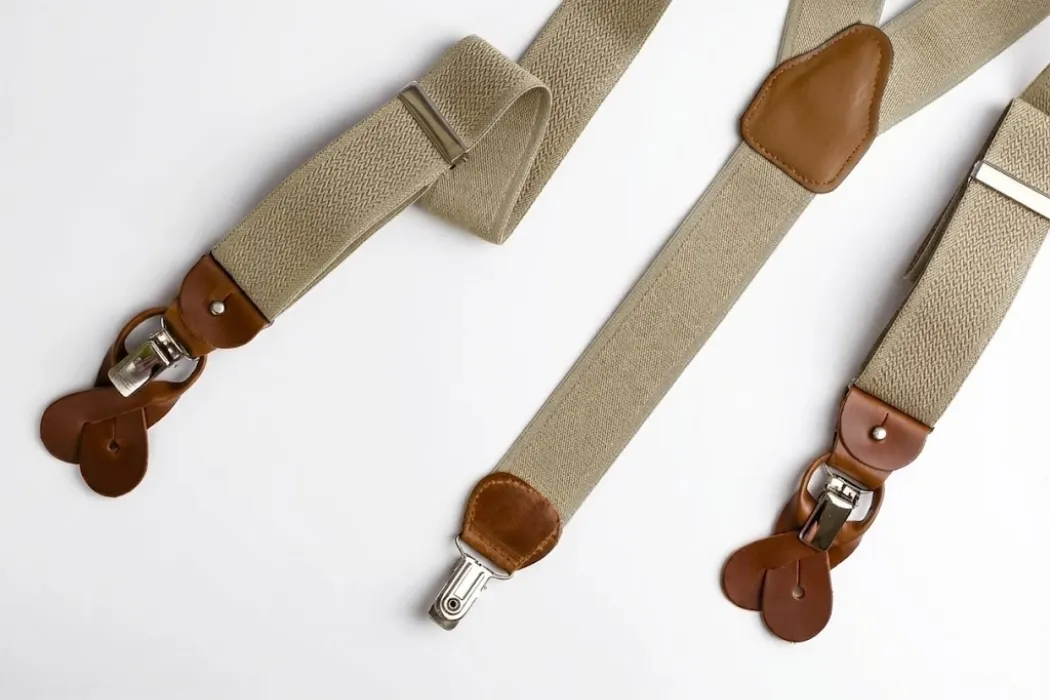
The “engine” of the strap is the elastic thread hidden inside the weave. The choice is binary: Natural Rubber (Latex) or Synthetic Elastane (Spandex/Lycra).
- Natural Rubber (The Cheap Option): Rubber is organic and highly susceptible to oxidation. Exposure to ozone and body oils causes it to dry rot and snap, creating the “crunchy” feeling inside old straps.
- Synthetic Elastane (The Premium Standard): Elastane is a polyurethane-polyurea copolymer. It is chemically stable, resisting oxidation and body oils. While it costs approximately $0.10–$0.15 more per yard, it extends the product lifespan by 300%.
The Cyclic Stretch Test (Hysteresis)
We do not rely on vendor promises; we rely on dynamic testing.
- Hoplok Lab Protocol: We subject webbing samples to a Cyclic Fatigue Tester. The strap is stretched to 150% of its resting length and released repeatedly for 10,000 cycles.
- Pass/Fail Criteria: A passing grade requires a Recovery Rate > 95%. If a strap returns to a length greater than 105% of its original size (meaning it has permanently stretched out by 5%), it fails. This strict tolerance prevents the “wavy edge” look associated with cheap fast-fashion suspenders.
UV Degradation Simulation
Suspenders are often worn without a jacket, exposing them to direct sunlight.
- The 100-Hour Test: We expose webbing to high-intensity UV lamps for 100 hours. Low-grade rubber cores will degrade and “chalk” (turn into white dust) under this stress, leading to a total loss of elasticity. Premium UV-stabilized Elastane remains flexible and retains its snap-back properties.
| Core Material | Recovery Rate (10k cycles) | UV Resistance | Cost Variance per Yard |
|---|---|---|---|
| Natural Rubber (Latex) | < 80% (Significant Sag) | Low (Rot/Chalking) | Baseline ($0.00) |
| Standard Elastane | 90% (Acceptable) | Medium | +$0.08 / yard |
| Hoplok High-Tenacity Elastane | > 95% (Excellent) | High (UV Stabilized) | +$0.12 / yard |
Leather End Structural Integrity: Preventing “Pull-Through”
The leather button tab (or “rabbit ear”) is the critical anchor point of the suspension system. A failure here is catastrophic—the suspenders snap off, potentially causing injury or wardrobe malfunction. “Pull-Through” failure occurs when the button acts like a wedge, tearing through the top of the buttonhole under load. Material density is the only defense.
Tensile Strength at the Buttonhole
We test leather ends by mounting them on a jagged steel fixture simulating a button and pulling until destruction.
- Bonded Leather Failure (<50 Newtons): Bonded leather is reconstituted dust held together by glue. Under tension, it exhibits a “brittle fracture” similar to a dry cookie snapping. It fails almost instantly at the buttonhole slit.
- Veg-Tan Full Grain (>500 Newtons): Full-grain vegetable-tanned leather relies on an interwoven collagen fiber network. Under stress, these fibers tighten and lock together (Self-Locking Effect), creating incredible resistance. It typically withstands over 500 Newtons of force before yielding.
Thickness vs. Flexibility Calibration
Engineering the leather end requires a precise balance between durability and usability.
- The Goldilocks Zone (2.4mm – 2.8mm): If the leather is thinner than 2.4mm, the risk of elongation and tearing increases significantly. If it is thicker than 3.5mm, it becomes too rigid to manipulate through a standard trouser button, frustrating the end-user. Hoplok calibrates all button tabs to a tolerance of 2.6mm +/- 0.2mm to ensure security without sacrificing ease of use.
The “Sandwich” Reinforcement Technique
For industrial workwear or heavy-duty applications (e.g., logging suspenders), leather alone may not suffice over 20 years of abuse.
- Nylon Mesh Core: Hoplok utilizes a proprietary reinforcement technique where a layer of high-tensile Nylon Mesh is glued between two thin layers of full-grain leather before stitching. This composite “sandwich” structure renders the buttonhole virtually tear-proof, increasing the tensile limit to over 800 Newtons while maintaining the classic look of leather.
Hardware Mechanics: Grip, Slip, and Corrosion
The metal components of a suspender are active mechanical devices. They must grip without destroying and hold without slipping. Sourcing managers often specify the look of the hardware (e.g., “Antique Brass finish”) but fail to specify the performance, leading to high returns due to “slipping adjusters” or “rusting clips.”
Clip Bite Force Testing
The “bite” of a suspender clip is a function of spring tension and tooth geometry. It must be calibrated to a precise window.
- The Safety Zone (15N – 25N): We measure the clamping force using a digital force gauge.
- < 15 Newtons: The clip is too weak. It will slide off the waistband when the user sits or bends (The “Snap-Off” failure).
- > 25 Newtons: The clip is too aggressive. The teeth will puncture delicate fabrics like Super 120s wool or silk, causing permanent garment damage.
- Plastic Inserts: To safely achieve higher grip on formalwear, Hoplok mandates injection-molded plastic inserts inside the jaws. This increases friction coefficient while preventing metal-to-fabric contact.
Adjuster Slippage (Creep Test)
Adjusters that slide down during the day are a functional failure. We test for “Hardware Creep.”
- Static Load Protocol: A suspender strap is threaded through the adjuster, and a 5kg weight is hung from the bottom for 24 hours.
- Pass/Fail Criteria: The total vertical slippage must be less than 2mm. Cheap, polished adjusters often fail this test because the internal teeth lack the necessary bite angle to lock the webbing in place.
Salt Spray Test (ASTM B117)
Corrosion is not just an aesthetic issue; rust stains can ruin expensive shirts. Plating quality is verified in our corrosion chamber.
- 24 vs. 48 Hours: Standard Zinc Alloy hardware with cheap barrel plating often shows “Red Rust” or pitting after just 12 hours of salt spray exposure. Hoplok specifies Solid Brass or high-grade Rack Plating that must withstand a minimum of 24 hours (Standard) or 48 hours (Premium) of continuous salt fog without visible oxidation.
| Component | Test Standard | Typical Failure Mode | Hoplok QC Requirement |
|---|---|---|---|
| Suspender Clip | Clamping Force Gauge | Slipping off (<15N) or Tears Fabric (>25N) | 20N (+/- 2N) |
| Length Adjuster | Static Load (5kg/24h) | Creep / Sliding down | < 2mm slip (5kg / 24h) |
| Plating Finish | ASTM B117 Salt Spray | Oxidation / Rust Stains | Pass 48 Hours |
| Plastic Insert | Impact Test | Cracks inside the clip | High-Impact Nylon (No PVC) |
Joinery Stress: Stitching and Back Patch Engineering
The “Joinery”—where the elastic straps meet the leather back patch—is the structural keystone of the suspender. In X-Back designs, this crossover point endures multi-directional shear forces every time the wearer twists or bends. A failure here results in the entire assembly falling apart. We engineer this junction using heavy-duty saddlery techniques.
The X-Back Crossover Stress
On an X-Back suspender, the two straps pull against each other at the crossing point. Simple straight stitching cannot handle this torque.
- Shear Force Dynamics: As the shoulders move, the straps act like scissors, creating shear force on the thread. A single line of stitching will snap under this friction.
- The Box-X Stitch Requirement: Hoplok mandates a Reinforced Box-X Stitch (a square with an X inside) at all high-stress anchor points. This pattern distributes the load across 40+ independent thread locks, ensuring that even if one stitch breaks, the structure remains intact.
Thread Tensile Strength
The thread is often the cheapest component, yet it determines the product’s lifespan. Cotton thread rots; standard polyester stretches.
- Bonded Nylon 6.6: We utilize Bonded Nylon 6.6 Thread (Tex 70 or higher) for all leather-to-elastic connections. This industrial-grade filament has a tensile strength 3x higher than cotton and is coated with a bonding agent to prevent fraying under constant abrasion against the leather patch.
Glue vs. Sew Construction
A common cost-cutting tactic in “Fast Fashion” suspenders is to use adhesive instead of stitching to attach the back patch.
- The “Clean Look” Trap: Brands often market glue-only construction as a “sleek, stitch-free” design. In reality, it is a manufacturing shortcut to save labor costs.
- Delamination Risk: Sweat and body heat dissolve industrial glues over time. Once the glue fails, the straps detach instantly. Hoplok always sews through the patch, treating adhesive only as a temporary placement aid, never a structural bond.
Chemical Compliance: Color Fastness and Safety
Mechanical failure causes returns; chemical failure causes lawsuits. Because suspenders are worn in high-friction, high-sweat zones directly against expensive shirting, chemical stability is paramount. A single batch of bleeding dye can destroy a retailer’s reputation and result in costly claims.
Crocking Test (Dry & Wet Rubbing)
The “Crocking” test measures the amount of color transfer from the suspender strap to another surface via rubbing.
- The White Shirt Risk: We use a Crockmeter to rub a white cotton cloth against the dyed webbing for 10 cycles (dry) and 10 cycles (wet).
- Grade 4.0 Standard: The color transfer is rated on a Grey Scale from 1 (severe transfer) to 5 (no transfer). Hoplok mandates a minimum of Grade 4.0. Anything lower means the dye isn’t fixed properly and will ruin the end-customer’s $200 dress shirt after a long day of wear.
Perspiration Resistance (Acid Test)
Human sweat is a complex chemical cocktail that varies in pH. It attacks both dyes and metals, accelerating degradation.
- ISO 105-E04 Protocol: We submerge material samples in simulated acid and alkali perspiration solutions, then subject them to pressure and heat. This verifies that the elastic dyes will not bleed when wet and that the metal hardware plating will not react with skin acidity to cause irritation or tarnishing.
REACH and Prop 65 Compliance
For global distribution, materials must meet strict toxicity standards to clear customs.
- Chrome VI Free: Our vegetable-tanned leather ends are rigorously tested to ensure they are free from Hexavalent Chromium (Chrome VI), a known allergen and carcinogen restricted in the EU (REACH).
- Phthalate Free: The synthetic components (elastic core and plastic inserts) are certified free of regulated Phthalates and Lead, ensuring full compliance with California Proposition 65 for the US market.
| Test Type | Equipment Used | Standard (ISO/ASTM) | Pass/Fail Criteria |
|---|---|---|---|
| Color Fastness (Rubbing) | Electronic Crockmeter | ISO 105-X12 / AATCC 8 | Grade 4.0 (Min) |
| Perspiration Resistance | Perspiration Tester | ISO 105-E04 | No Color Change |
| Nickel Release | Atomic Absorption Spectrometer | EN 1811 | < 0.5 µg/cm²/week |
| pH Value | pH Meter | ISO 3071 | pH 4.0 – 7.5 |
Manufacturing Tolerances and QC Protocols
Specifications on a tech pack mean nothing without rigorous enforcement on the production line. Manufacturing elastic goods presents unique challenges because the material is “live”—it wants to shrink and move. Achieving consistency requires strict dimensional protocols that exceed standard industry allowances.
Length Tolerance Standards
Cutting elastic webbing is difficult because it stretches under the tension of the cutting machine feed. If not managed, a “42-inch” strap can shrink to 40 inches overnight.
- The Industry Norm (+/- 2.0cm): Most factories accept a wide variance of +/- 2.0cm because it is faster to cut webbing under high tension.
- Hoplok Precision (+/- 1.0cm): We utilize a “Relaxed State” cutting protocol. Webbing is unrolled and allowed to rest for 24 hours to neutralize tension before cutting. This allows us to hold a tighter tolerance of +/- 1.0cm, ensuring that a Size L is actually a Size L, reducing customer fit returns.
Visual Inspection (AQL 2.5)
We enforce a strict Acceptable Quality Limit (AQL) 2.5 for major defects during final inspection. Our QC inspectors are trained to reject specific flaws that mass-market factories often overlook.
- Weaving Defects: Any “Skipped Yarn” (a missing thread in the weave), oil stains from the loom, or “Slubs” (lumps of thread) are immediate grounds for rejection.
- Leather Grading: For the leather ends, we reject pieces with open scars, loose grain (wrinkling), or vein marks that affect structural integrity. We only cut from the Grade A/B sections of the hide, discarding the belly and neck areas.
Frequently Asked Questions
What is the lifespan of elastic webbing?
It depends on the core material. Premium High-Tenacity Elastane yarns are engineered to retain their elasticity and shape for 3–5 years of regular use. In contrast, cheaper rubber latex cores suffer from rapid oxidation and typically lose tension within 6–12 months, resulting in permanent sagging.
Why do suspender clips damage trousers?
Fabric damage is caused by aggressive metal serrations. Cheap stamped metal clips rely on sharp teeth to bite into the fabric for grip, which cuts the fibers of fine wool. Hoplok prevents this by using clips with injection-molded plastic inserts. These inserts rely on friction rather than puncture force, securing the waistband without abrasion.
How do I test leather quality on suspenders?
Perform a “Cross-Section Check” and a “Tensile Pull Test.” Cut a sample leather end. Full-grain leather will reveal a dense, fibrous structure that is difficult to tear. Bonded leather will look like pressed cardboard or layered paper and will snap brittlely under tension, revealing its lack of structural integrity.
The Verdict: Reducing Risk Through Rigorous Testing
In the global supply chain, “Quality” is often a subjective term used to justify price. At Hoplok, we believe quality must be an objective, quantifiable metric. A suspender is a mechanical system designed to fight gravity and motion. If the elastic hysteresis fails or the leather tab tears, the product has failed its engineering purpose, leading to brand damage and costly returns.
Hoplok’s Lab Promise
We operate by a simple engineering principle: We don’t guess quality; we test quality. Every batch of material entering our facility undergoes the torture tests described in this guide before a single unit is cut or sewn. We believe that the cost of testing is infinitely lower than the cost of a recall.
Eliminate the “loose elastic” Headache
If you are a sourcing manager tired of fielding customer complaints about “saggy straps” or “snapped leather ends,” it is time to upgrade your specifications. Contact Hoplok to discuss our Industrial-Grade Suspender Solutions, certified to withstand 10,000 fatigue cycles. Let us build a product that outlasts the trousers it holds up.