For a wallet prototype, 2–4 oz (approximately 0.8–1.6 mm) leather is a useful range to explore. A 3–4 oz exterior with 2–3 oz pockets is one possible starting point, not a manufacturing standard. Choose the final thickness from the actual leather, pocket pattern, lining and loaded sample; a compact multi-pocket design may need thinner components.
Why do some leather wallets feel bulky while others feel slim? Thickness matters, but so do leather temper, overlapping layers, pocket dimensions, edge construction and lining. A full-grain description alone does not predict how a wallet will close or how securely it will hold cards. Buyers need a component specification and a working sample, rather than a single leather weight for the whole product.
This guide explains the trade conversion from ounces to millimeters, compares component choices for bifolds and cardholders, and shows where splitting or skiving can reduce bulk. Use those details to prepare and evaluate a working sample.
What Do “Leather Weight” and “Ounces” Actually Mean?
In leather buying, ounce weight commonly describes a nominal thickness range rather than the finished wallet’s mass. The trade conversion is 1 oz ≈ 1/64 inch ≈ 0.4 mm. Tandy’s thickness chart explains this convention. Use millimeters and an agreed measurement method in the production specification, particularly when several layers overlap.
The “Ounce” vs. Millimeter Conversion (A Simple Chart)
The conversions below are rounded. Applications are illustrative: construction, temper and reinforcement can make a different thickness suitable for the same product.
| Ounces (oz) | Millimeters (mm) | Inches (approx.) | Common Manufacturing Use |
|---|---|---|---|
| 1-2 oz | 0.4 – 0.8 mm | 1/64″ – 1/32″ | Wallet Interiors, Thin Linings, Small Goods |
| 2-3 oz | 0.8 – 1.2 mm | 1/32″ – 3/64″ | Wallet Pockets, Slim Cardholders, Linings |
| 3-4 oz | 1.2 – 1.6 mm | 3/64″ – 1/16″ | Wallet Exteriors, Bifolds, Journal Covers |
| 4-5 oz | 1.6 – 2.0 mm | 1/16″ – 5/64″ | Durable Bags, Totes, Laptop Cases |
| 8-9 oz | 3.2 – 3.6 mm | 1/8″ – 9/64″ | Thicker leather goods; suitability depends on construction |
Using Ounces and Millimeters in a Purchase Specification
An ounce description helps when comparing suppliers that use the leather trade convention. It should not replace a measurable millimeter specification. Record whether a quoted range describes supplied leather, a locally skived edge or the complete assembled wallet. These are different measurements, and confusing them can lead to a sample that looks correct but feels much bulkier in production.
How Thickness is Measured (Using a Gauge)
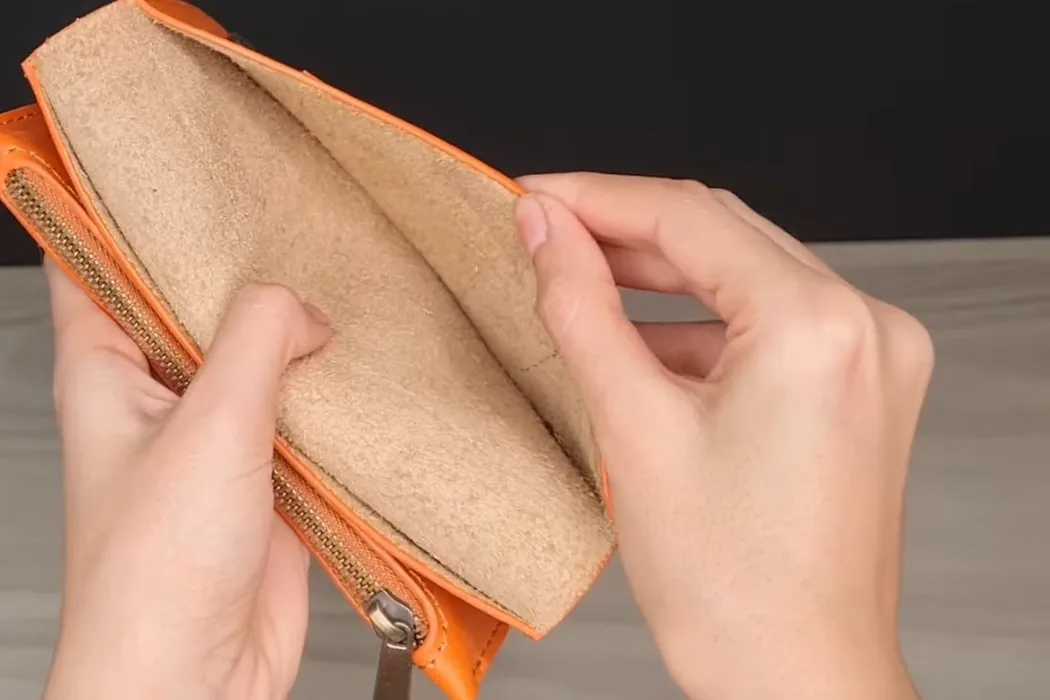
Thickness can vary across a hide and between hides. Measure representative cutting areas rather than assuming the same value everywhere. The measurement pressure and procedure also matter when comparing soft materials.
- In a craft setting: A hobbyist uses a handheld leather thickness gauge. They will measure multiple spots on their hide to find a consistent area to cut from.
- In a factory setting: Splitting can reduce leather thickness over a larger area; local skiving removes material where the pattern needs thinner edges or folds. Agree a feasible target and tolerance with the supplier, then verify the supplied lot. A splitting machine does not itself guarantee a universal ±0.1 mm tolerance.
ISO 2589 specifies a leather thickness measurement method. It does not prescribe the best wallet thickness or a pass tolerance. Put the agreed method, inspection locations and acceptance range into the specification so the production sample can be compared with the approved reference.
Why Is Choosing the Right Weight an Important Design Decision?
Thickness affects bulk and bending behavior, but strength and wear also depend on the leather, finish and construction. Evaluate these properties separately. A heavier leather is not automatically better, and a thin leather is not automatically unsuitable for a durable wallet.
The “Pocket Brick” Problem: What Happens When Leather is Too Thick
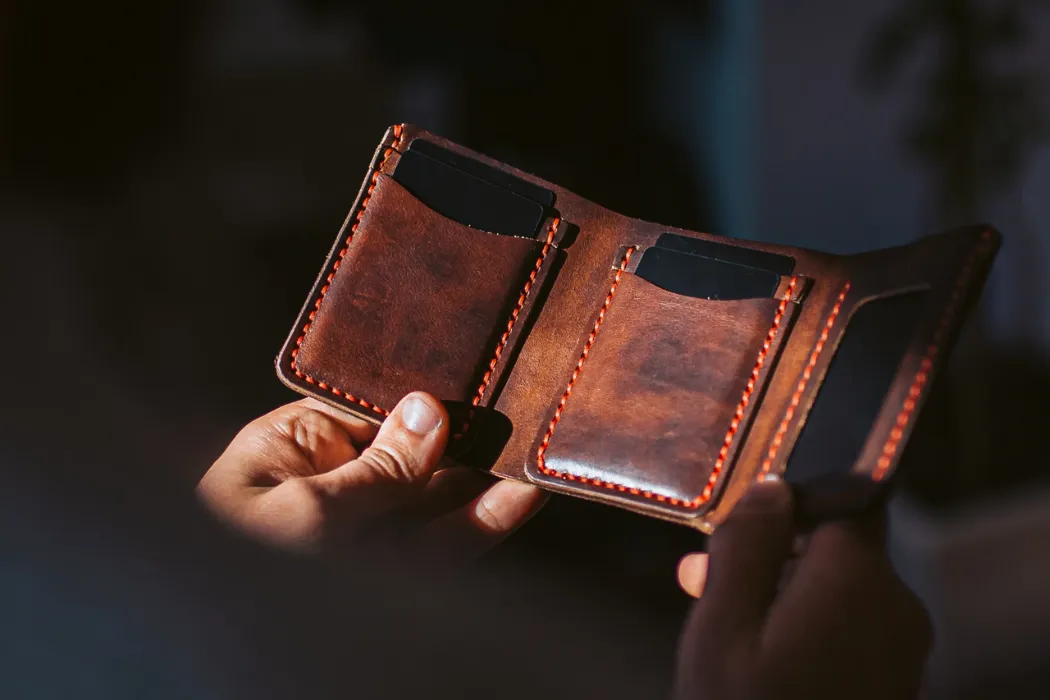
This is a common mistake for beginner designers who associate “thick” with “quality.” They might build a bifold wallet where every single piece—the exterior shell and all interior pockets—is made from a durable 4 oz (1.6 mm) leather.
The risk is unnecessary bulk, particularly where pockets and turned edges overlap.
- Layer thickness: Two 1.6 mm pieces add up to 3.2 mm before adhesive, lining and other layers. Folding the complete wallet creates a different stack that should be measured on the assembled sample.
- Card access: Thick or firm pocket leather can make insertion difficult if the opening, seam allowance and capacity are too tight.
- Finished size: You cannot calculate the empty wallet’s overall thickness from one component alone. Measure it closed and loaded with the agreed number of cards and notes.
The “Flimsy” Problem: What Happens When Leather is Too Thin
A thinner construction also needs validation. For example, using 2 oz (approximately 0.8 mm) leather throughout may work in one pattern and lack support in another.
Check the sample for the following issues instead of rejecting thin leather by weight alone:
- Structure: Does the chosen leather hold the intended shape, or does the exterior need a lining or reinforcement?
- Card retention: Test the specified card capacity, repeated insertion and removal, and retention after use. Thickness alone does not predict when a pocket will stretch.
- Wear points: Inspect corners, folded areas, seams and coating performance on the complete construction. Do not infer a service life from the ounce number.
The Stacking Effect: Map Every Overlapping Layer
At a given location, material thicknesses accumulate. The closed wallet also includes folds, air gaps and its contents, so adding layer measurements is a planning aid rather than a substitute for a finished-sample measurement.
For a turned-edge card pocket, map the construction before choosing the leather:
- Identify the pocket face and any backing or lining.
- Mark where the next pocket overlaps it.
- Include turned edges, seam allowances and reinforcements where they actually overlap.
As a simple arithmetic example, eight overlapping 1.0 mm layers total 8 mm before other materials. This does not mean that every four-pocket wallet has eight layers at its fold. T-shaped pocket patterns and staggered overlaps can reduce material behind the visible pocket face. Review a cross-section or an opened sample to identify the real stack.
Specifying Hand-Feel in a Prototype Review
Try a component combination such as a 3–4 oz exterior and 2–3 oz pockets, then compare it with a thinner alternative if the pattern has many overlaps. Use the same leather article and pocket dimensions when isolating the effect of thickness.
Buyer’s sample review: Record the empty and loaded profile, card insertion effort, fold behavior and the feel of the edges. Ask the supplier to identify what changed between sample revisions. An approved reference sample and written component measurements are more useful than an unsupported claim about a factory’s monthly prototype output.
What is the Best Leather Weight for a Bifold or Trifold Wallet?
For a first bifold trial, a 3–3.5 oz (1.2–1.4 mm) exterior and 2–2.5 oz (0.8–1.0 mm) pockets are possible starting specifications. They are not universal optima. A trifold introduces another fold and can require thinner parts, fewer overlaps or a different lining. Approve the loaded sample before fixing the production values.
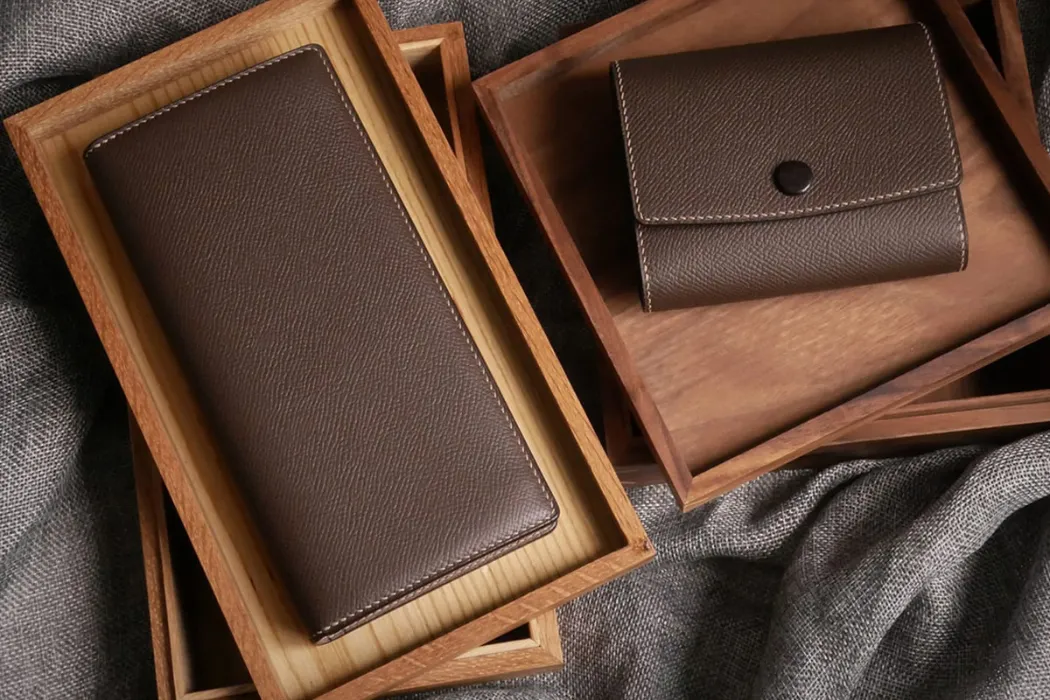
Standard Bifold: Balancing Durability and Bulk
A bifold allows you to compare the exterior and pocket materials separately. For example, a prototype specification might use:
- Exterior shell: 3–3.5 oz (approximately 1.2–1.4 mm) leather, with its temper, finish and grain description specified separately.
- Interior pockets: 2–2.5 oz (approximately 0.8–1.0 mm) leather, subject to card retention, seam and fold checks on the actual pattern.
The combination must still be tested. A firm exterior, undersized pockets or overlapping linings can make a wallet stiff even when its component thicknesses look reasonable.
The Trifold Challenge: How to Manage Extreme Layering
A trifold has two folds and three main sections. When closed, these sections and their pockets overlap differently from a bifold. Map the closed stack and confirm the fold allowance with the planned card and note load.
A trial specification can start with:
- Exterior shell: Around 3 oz (1.2 mm), adjusted to the material and pattern rather than treated as an absolute maximum.
- Interior pockets: Around 2 oz (0.8 mm), with reinforcement or another thickness where the sample requires it.
Specify local thinning only where it is needed. Over-skiving can leave inadequate material at a stitch line or fold, so check the remaining thickness and seam construction as well as the finished profile.
The “Hidden” Component: Linings and Reinforcements
Linings and reinforcements are part of the thickness specification. A textile-lined compartment can be appropriate for a slim design; an all-leather interior can also work when the pattern manages overlap. Neither construction is automatically more luxurious.
- Nylon or polyester fabric: Ask for the actual textile thickness, backing and finish. Check friction against cards, seam behavior and the contribution of adhesive to the assembled stack.
- Pigskin lining: Specify the actual leather article and thickness. Assess its surface, tear behavior and compatibility with the outer leather rather than assuming all pigskin is exceptionally strong.
- Reinforcements: A thin reinforcement can help control stretch or shape in selected areas. Its thickness, bonding and effect on folding should be part of sample approval.
What About a Trifold with a Zipper Compartment?
A zipper compartment, often requested for coin storage, adds another layer of complexity. The zipper tape itself has thickness, and the leather used for the compartment must be flexible enough to move with the zipper.
Test the compartment with its intended contents and operate the zipper through the full opening. A thinner, more flexible leather may help, but there is no mandatory 2 oz chrome-tanned specification. Pattern allowance, zipper tape, lining and nearby seams also affect operation.
What is the Right Weight for Minimalist, Slim & Cardholder Wallets?
For a minimalist cardholder, 1.5–2.5 oz (approximately 0.6–1.0 mm) components are possible trial choices. A less layered front-pocket design may use 3 oz (1.2 mm) leather. These examples need adjustment for card capacity, leather temper and edge construction.
The Single-Pocket Card Sleeve (Ultra-Minimalist)
A simple card sleeve can use two main panels with little overlap. Trial a thin leather and check whether the mouth stays open, the seam holds and the specified number of cards remains secure. More thickness may be appropriate for a firmer unlined design; animal species alone does not settle the choice.
The Front Pocket Bifold (Slim & Functional)
A front-pocket bifold may use a single nominal thickness, such as 3 oz (1.2 mm), if its pattern limits overlap. Compare this with thinner pockets before approval. A single-weight construction is a design choice, not evidence of lower manufacturing skill.
The Money Clip Wallet (Durable & Rigid)
Separate the metal clip’s clamping performance from the leather body’s stiffness. The attachment area needs suitable support, while the rest of the wallet may remain flexible.
For a deliberately rigid body, a 4–5 oz (1.6–2.0 mm) leather can be a trial option. Reinforcement or a laminated construction offers another route. Check the clip mounting, closed profile and card access rather than treating belt-weight leather as necessary.
Wallet Style vs. Prototype Thickness Examples
These are starting points for sample comparisons, not industry standards or guaranteed performance ranges. Specify the final values after the loaded sample review.
| Wallet Style | Trial exterior (oz/mm) | Trial interior (oz/mm) | Key Consideration |
|---|---|---|---|
| Bifold (Classic) | 3.0 – 3.5 oz (1.2-1.4 mm) | 2.0 – 2.5 oz (0.8-1.0 mm) | Balance durability with bulk. |
| Trifold | 3.0 oz (1.2 mm) | 2.0 oz (0.8 mm) | Map three-panel overlaps and test the loaded fold. |
| Minimalist Cardholder | 1.5 – 2.5 oz (0.6-1.0 mm) | 1.5 – 2.5 oz (0.6-1.0 mm) | Thinness is the primary goal. |
| Front Pocket Wallet | 3.0 oz (1.2 mm) | 3.0 oz (1.2 mm) | Single-weight construction; check pocket access. |
| Money Clip (Rigid) | 4.0–5.0 oz (1.6–2.0 mm) trial | 2.0 oz (0.8 mm) | Support the clip attachment; verify hardware performance. |
How Do Manufacturers Manage Thickness? (The Skiving Technique)
Skiving removes thickness locally where an edge, fold or overlap needs it. Splitting addresses a larger area. Both can help control bulk, but the pattern and remaining material at seams still determine whether the construction works.
What is Skiving? (The Secret to Thin Edges)
A turned edge may need local thinning so the folded material does not create a bulky seam. A cut-and-finished edge uses a different construction and may need less skiving. Neither method alone defines a luxury wallet. Avoid a blanket “skive to zero” instruction: the edge must retain enough material for its intended seam and use.
Hand Skiving (Craft) vs. Machine Skiving (Manufacturing)
Both hand and machine methods require setup and process control:
- Hand skiving: A maker removes material with a suitable skiving knife. Time and consistency depend on the leather, geometry and operator; there is no fixed minutes-per-wallet rule.
- Machine skiving: Dedicated equipment can thin selected areas for repeat production. FORTUNA describes skiving and splitting for leather goods. Agree the required profile on the actual material rather than assuming a machine guarantees a specific residual thickness or tolerance.
Where to Skive: The T-Slot and the Fold
Review the fold and pocket openings first, then mark any other overlaps that need thinning:
- Main fold: Adjust the pattern allowance and, if needed, the local thickness so the loaded wallet closes without excessive resistance.
- Pocket openings: A turned opening may need skiving; a cut edge may not. Specify the remaining thickness and fold width according to the material and seam, rather than imposing a universal 0.3–0.5 mm value.
Tight pockets can result from insufficient opening width, seam placement, lining friction or a firm leather as well as excess thickness. Diagnose the assembled sample before attributing the problem to skipped skiving.
Production control: Record skiving locations and agreed residual thicknesses in the technical pack. Compare the seam profile, fold operation and card retention with the approved sample. A social audit does not certify skiving precision, and no fixed percentage reduction applies to every wallet.
Which Leather Types Are Best for Different Weights?
Compare actual leather articles at the thicknesses needed by the pattern. Species, tannage, finish and temper all matter; there is no universal strength ranking that selects the right wallet leather from its name alone.
Firmer Exteriors: Cowhide and Bridle Leather
For a firmer exterior, request samples with the intended stiffness and finish, then assess how they bend at the wallet’s fold.
- Cowhide: Available in varied thicknesses and finishes. A 4 oz example can provide a substantial feel, but its performance still needs validation in the chosen construction.
- Bridle leather: Consider the supplier’s actual article, oil/wax finish and temper. Check transfer onto cards or linings and the behavior of the finish at folds. The name does not guarantee weather resistance.
Thin Interiors: Compare the Article, Not a Species Ranking
Thin leather is not necessarily a flesh split. A grain layer can be reduced from the flesh side while retaining its surface. Request the substrate and grain description along with thickness, then test the material at the pocket’s seam and opening.
- Kangaroo: Where a brand considers this material, first confirm lawful sourcing and destination-market eligibility, then request article-specific performance data. Do not use the unsupported claim that it is ten times stronger than cowhide to justify a thinner specification.
- Goatskin: A possible interior material when its thickness, finish and handling suit the design. Check abrasion, color transfer and seam performance on the supplied article; a species label does not guarantee these properties.
Soft Exteriors: Calfskin and Other Grain Leathers
A soft hand-feel should be balanced with fold, seam and surface-wear requirements. Luxury positioning does not remove the need to validate performance.
- Calfskin: Compare the available finish and temper at the required thickness. Fine surface appearance can suit a dress wallet, but it does not establish a universal 2.5–3.5 oz specification.
- Other grain leathers: Specify tannage, surface correction and finish separately. “Top-grain” does not mean that a leather must be chrome-tanned, sanded or supplied at 3 oz. The Leather Research Laboratory explains grain terminology.
Leather Type vs. Sample Evaluation
Use the following as a comparison worksheet. Thicknesses are illustrative trial ranges; the material name is not a test result.
| Leather Type | Property to evaluate | Illustrative trial thickness | Best For (Wallet Type) |
|---|---|---|---|
| Cowhide (Veg-Tan) | Temper and fold behavior | 3.0 – 5.0 oz (1.2-2.0 mm) | Durable Bifold Exterior, Money Clip |
| Cowhide (Chrome-Tan) | Temper and finish performance | 2.5 – 3.5 oz (1.0-1.4 mm) | Soft Bifold Exterior, Zipper Wallet |
| Calfskin | Surface and seam performance | 2.5 – 3.0 oz (1.0-1.2 mm) | Luxury & Dress Bifolds |
| Goatskin | Seam, abrasion and transfer | 2.0 – 3.0 oz (0.8-1.2 mm) | Durable Interiors, Linings, Cardholders |
| Kangaroo | Article data and sourcing eligibility | 1.5 – 2.5 oz (0.6-1.0 mm) | Specialist option; confirm availability separately |
| Embossed cowhide | Substrate and coating performance | 2.0 – 3.0 oz (0.8-1.2 mm) | Textured exterior; check lining requirement |
FAQ Section (People Also Ask)
1. What’s the difference between 3 oz and 4 oz leather?
Using the trade conversion, the difference is about 0.4 mm (1/64 inch). A nominal 4 oz piece is one-third thicker than a 3 oz piece. That difference accumulates where layers overlap, but the complete wallet profile also depends on folds, linings and contents.
2. Can I use a single weight for the whole wallet?
Yes, if the pattern and leather support it. A minimalist design can make this easier because it has fewer overlaps, but a single-weight bifold is not automatically wrong. Compare the loaded sample with an alternative using thinner pockets.
3. Is thicker leather always more durable?
No. Thickness alone does not predict service life. Leather structure, finish, seams, fold geometry and use all matter. Tensile strength is a measured material property, and increasing thickness does not automatically increase that strength value or guarantee longer wear.
4. What weight leather do luxury brands use?
There is no single thickness used by all luxury brands. Designs can use leather pockets, textile linings or mixed constructions. Specify the profile, material and performance your collection needs instead of relying on an assumed Gucci or Prada recipe.
5. What does “skiving” mean in wallet making?
Skiving is local thinning before assembly. It can reduce bulk at selected edges and folds. The required remaining thickness depends on the leather and construction; thinning too far can weaken the area, so the finished seam should be checked as well as its appearance.
6. Why are my card slots so tight?
Possible causes include an undersized opening, seam allowance, lining friction, insufficient room for the card load, firm leather or excessive thickness at overlaps. Compare dimensions and the complete stack before changing the leather weight.
7. What is the best leather weight for a trifold wallet?
There is no absolute maximum. A 3 oz exterior and 2 oz interior are possible trial values, but a different material or pattern may need another combination. Check all three panels together with the intended contents, and adjust the lining, overlaps or local skiving as needed.
Conclusion: Approve the Complete Wallet, Not Just Its Ounce Weight
Leather weight is one part of a wallet specification. Start with a plausible component range, map the overlapping layers, and compare the actual material in a loaded prototype. Set final thicknesses and skiving details from that evidence rather than treating one recipe as a universal rule.
Keep an approved reference for profile, card access and fold behavior, with measurable component details in the technical pack. This makes production checks more useful than subjective descriptions such as “thin” or “premium.”
For a custom wallet enquiry, send Hoplok the pattern or reference, card capacity, preferred material, quantity and destination. The confirmed MOQ is 300 for leather wallets and 1,000 for PU wallets; bulk production is normally 60–90 days, with the project schedule confirmed separately. Contact Hoplok to discuss a sample and production specification.