For manufacturers and brand buyers, designing women’s leather belts that can excel across markets requires more than aesthetic intuition—it demands measurable precision. From achieving tensile strengths of 2,000–6,000 psi to aligning with a global market projected to reach $46.1 billion by 2032, every design decision affects durability, supply scheduling, and brand positioning in a rapidly evolving fashion ecosystem.
This guide unpacks the full production strategy behind versatile women’s belts—from forecasting leather accessory trends using AI data models and runway insights to engineering belt gauges ranging 0.05–0.15 inch for optimal flexibility. Buyers and designers will discover how structure, color accuracy, and jewelry-grade hardware can work together to deliver products that are both style-forward and globally competitive.
How to forecast upcoming trends in women’s leather accessories?
Trend forecasting in women’s leather accessories combines data on search volumes, runway influences, and market projections. Rising demand for sustainable, tan-toned, and functional pieces guides production timing, material procurement, and design direction to align with evolving consumer behavior.
Core principles of forecasting women’s leather accessory trends
Forecasting fashion directions in women’s leather accessories is an art rooted in both analytics and aesthetic intuition. Designers and brands decode digital sentiment, correlate it with the runway ecosystem, and mirror these insights in production schedules and design calendars.
- Monitor keyword surges such as “sustainable leather bag” (+65%) or “brown leather handbag” (+40%) to detect emerging preferences.
- Use runway show impacts—Fall 2025 collections caused 30–50% search spikes—as early indicators of color and silhouette popularity.
- Account for seasonal slowdowns in June–July and March–April when planning inventory to avoid overstocking.
- Evaluate global market expansion, projected at $46.1 billion by 2032 with a 4.9% CAGR, to gauge long-term category health.
These pillars ensure that brands act proactively—anticipating what consumers will desire next rather than reacting to trends once they’ve peaked.
Data-driven tools and technologies guiding leather trend forecasting
The digitization of the fashion supply chain has transformed how trend forecasting is conducted. Brands now rely on integrated technologies and sustainability standards to predict what materials, textures, and features will dominate upcoming seasons.
- Apply AI systems for pattern and waste-optimization analysis to predict cost-effective and eco-conscious trends.
- Incorporate 3D printing to prototype personalized patterns that resonate with rising customization demand.
- Track RFID and smart-leather innovations to anticipate functional accessory trends such as temperature-regulating materials.
- Leverage insights from LWG-certified sourcing, REACH, and ISO 9001 manufacturing compliance to align with sustainable market growth.
Together, these data-driven tools enable not only accurate forecasting but also a more sustainable, responsive design loop that aligns craftsmanship with the evolving expectations of conscious consumers.
Research insights and market overview
Recent data paints a detailed picture of the sector’s trajectory. The global leather handbag market stood at $30.3 billion in 2023 and is forecasted to reach $46.1 billion by 2032, signaling ongoing demand growth. Analysts note strong search performance for “sustainable” and “brown/tan” leather products—up 65% and 40% respectively—as the preference for natural and durable tones continues to replace fast-fashion cycles.
- Runway events, notably Fall 2025 shows, generate 30–50% post-event search spikes, offering key timing cues for design drops.
- Seasonal dips in June–July and March–April emphasize the need for forecast-driven inventory management.
- Functional designs—such as phone pockets, RFID sleeves, and thermoregulating finishes—indicate a clear move toward practicality and conscious luxury.
Technology maintains the predictive edge: 3D printing offers customizable prototypes, while AI systems reduce material waste and accurately forecast consumer sentiment shifts. Rising interest in pre-owned and responsibly sourced handbags also redefines “trend longevity,” grounding style in durability and ethics over disposability.
What are the manufacturing challenges for high-waist vs. hip belts?
High-waist belts require greater longitudinal stability to prevent shifting, while hip belts demand more flexibility and curvature conformity. Manufacturers must adjust leather gauge, modulus, and cutting precision to balance strength, comfort, and appearance.
Structural and Design Differences Between High-Waist and Hip Belts
The vertical positioning of a belt on the body changes not just its style but also the engineering demands it places on the material. High-waist and hip belts differ in contour, mechanical response, and the type of stresses applied when worn and fastened.
- High-waist belts sit higher on the torso, requiring longer, more stable sections to resist slipping and maintain contour.
- Hip belts rest lower and must flex across broader curvature, emphasizing lateral flexibility and prong alignment.
- Each type demands distinctive silhouette shaping and curvature trimming to match expected wear position and garment layering.
Material Specifications and Production Adjustments
Leather belts rely on precise mechanical balance between tensile strength, elongation, and hardness. These metrics determine how well a belt holds shape under tension while maintaining comfort against curved body areas. Manufacturing technique and batch control become critical when styles differ in curvature and thickness profiles.
- Leather gauge ranges from 0.05–0.15 inch (1.27–3.81 mm) to manage flex and tensile balance between waist and hip models.
- Tensile strength of 2,000–6,000 psi and Graves tear resistance of 200–500 lbs/in prevent hole deformation, while Shore A hardness of 80–99 ensures body conformity.
- Techniques like edge skiving, precision hole punching, and use of release sheets for 10–20 strap batches maintain accuracy across varied curve patterns.
- ISO 9001 and LWG-certified manufacturing ensures consistent modulus and elongation control (150–450%) for durable fit response.
These figures are derived from standardized industrial tests (ASTM D-624, Shore hardness, tensile and modulus measurements) applied to belt leather. In both high-waist and hip variants, precision cutting and consistent modulus ensure structural fidelity — but the final shaping differs: high-waist belts prioritize anti-shift rigidity, while hip belts emphasize side flexion and hardware alignment to the natural curve of the hips.
How can brands utilize jewelry-grade hardware as a selling point?
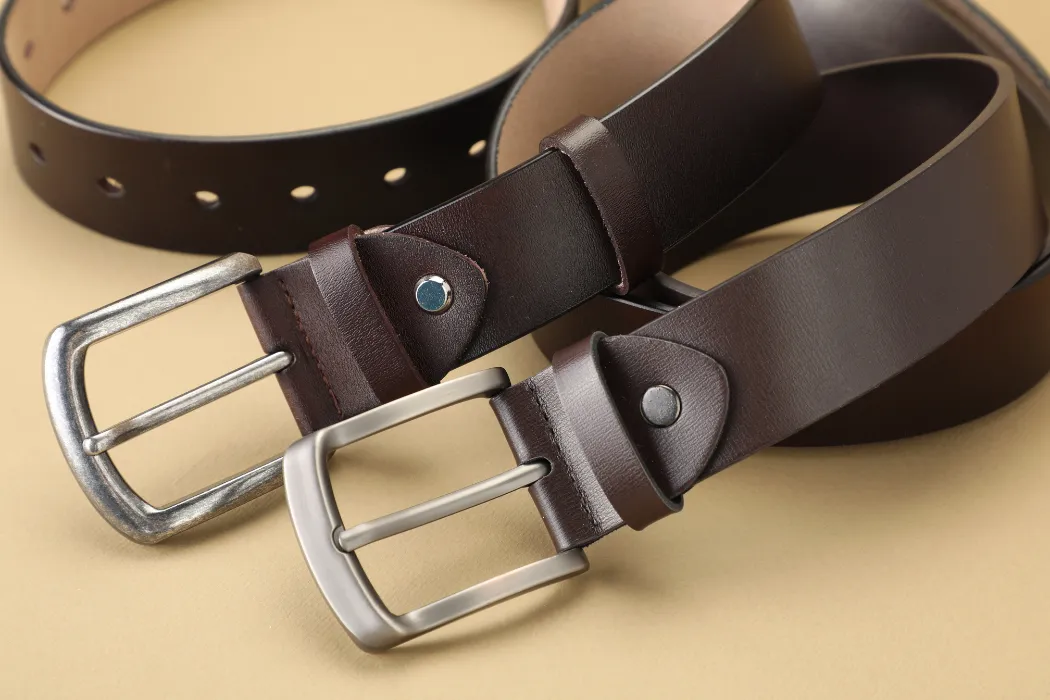
Brands can utilize jewelry-grade hardware by emphasizing its corrosion resistance, premium aesthetic, and durability. Using polished brass, stainless steel, or Italian metal finishes signals craftsmanship and helps position products as timeless, high-value accessories.
| Material / Component | Key Advantage | Application Insight |
|---|---|---|
| High-Grade Stainless Steel | Corrosion resistance in humid or wet environments | Used in hammer loops, belt clips, and “long D” rings to maintain alignment under stress |
| Polished Brass / Nickel-Plated Steel | Premium shine, tarnish resistance, and classic elegance | Ideal for belt rings and buckles that emphasize luxury finish |
| Italian Metals | Aesthetic versatility and strong mechanical integrity | Common in high-end bag or belt hardware with brass, silver, or gunmetal tones |
The Appeal of Jewelry-Grade Hardware in Leather Accessories
When consumers handle a leather belt or handbag with jewelry-grade hardware, the tactile and visual experience communicates refinement. Polished finishes like brass, nickel-plated steel, or Italian metal alloy amplify perceived luxury by mimicking the luster of fine jewelry. The smooth, reflective surface suggests precision and care in craftsmanship—qualities that set premium brands apart from mass-market accessories.
Beyond aesthetics, these materials deliver functional excellence. Their resistance to oxidation and tarnish preserves their brilliance even with prolonged use, reinforcing the notion of longevity and reliability. For a buyer, this durability justifies higher price points and aligns the product with luxury expectations.
Material Specifications and Brand Integration Strategies
From a technical perspective, each metal’s performance characteristics can support strategic storytelling in product marketing. When brands describe the specific grade, finish, or engineering design of the hardware, it transforms a small component into a tangible emblem of quality.
- High-grade stainless steel offers exceptional rust and corrosion resistance, maintaining integrity in humid or coastal markets.
- Industrial rivets and Chicago screws at stress points ensure mechanical strength and facilitate easy replacement or adjustment, reducing lifetime maintenance cost.
- Custom finishes—such as gunmetal, brushed silver, or warm brass—can be color-matched to 8–9 oz. top-grain cowhide for cohesive aesthetic design.
- Aligning these hardware systems with ISO 9001 production standards supports claims of precision manufacturing and repeatable quality control.
Through this integration, brands can elevate their narrative around durability and elegance. For example, highlighting “jewelry-grade Italian brass buckles” or “ISO-standard stainless steel fasteners” gives consumers concrete proof of quality—bridging the emotional appeal of luxury with the measurable performance of engineered hardware.
Custom Leather Belts, Perfected for Your Brand
What are the technical hurdles of color-matching vibrant fashion shades?
Color-matching vibrant fashion shades is complex due to factors like illuminant metamerism, fabric surface variation, and dye interactions. Achieving tolerances within ΔE 00 or DE CMC 2:1 requires multi-illuminant spectral profiling, precise measurement tools, and time-consuming calibration workflows.
Understanding Metamerism and Material Variability
At the core of vivid color reproduction lies the challenge of metamerism — the phenomenon where two materials that appear to match under a specific illumination, such as D65 daylight, can look drastically different under others like D50 or incandescent light. This optical behavior is intensified in vibrant shades because their spectral reflectance curves are steep and sensitive to wavelength shifts.
- Illuminant metamerism causes colors to match under one light (D65) but differ under others like D50 or incandescent.
- Surface texture, optical brightening agents, and batch variation influence light reflection, altering color appearance across materials like leather and PU.
Substrate variability further complicates the goal. Optical brightening agents (OBAs) shift reflected wavelengths, while textures change how light scatters between fibers or grains. As a result, two samples dyed with the same formula can yield distinct appearances depending on surface gloss or fiber density, pushing match tolerances outside acceptable ΔE thresholds.
Measurement Standards and Tolerance Control in Production
To standardize what “match” means across global production sites, manufacturers rely on strict numerical models rooted in color science. ΔE tolerances—whether DE00 or DE CMC 2:1—quantify the three-dimensional color difference between a target and a sample within the CIE Lab space. Even a ΔE of 1.0 can be visually noticeable for bright hues.
- ΔE tolerances (DE00 or DE CMC 2:1) define acceptable color deviation in 3D color space, refined using QTX spectral data from Pantone or Archroma libraries.
- Spectrophotometers and ICC spectral profiles are used for lab dips and digital printing calibration—each profile cycle taking about 3 hours to complete consistent results.
Each calibration loop—often 2–3 hours from paper print to measurement—fine-tunes the ICC profiles that govern printer output or dyeing recipes. The process is iterative and data-heavy, balancing the spectral properties of inks, dyes, and substrates. Brands seeking cross-material consistency, such as pairing tinted hardware finishes with dyed leathers, must integrate multi-illuminant spectral profiling to anticipate metameric shifts before production scaling.
Research Insights
Recent research consolidates several key technical parameters shaping the color-matching pipeline:
- Illuminant metamerism significantly affects perceived matches across D65, D50, daylight, and incandescent lighting; multi-illuminant methods are vital.
- ΔE tolerances (DE00 / DE CMC 2:1) precisely define allowable deviations, where smaller values indicate tighter visual alignment.
- Spectral data formats such as QTX ensure consistent interpretation across Pantone, CSI, Archroma, and Coloro libraries.
- Profile creation and measurement cycles average about three hours per test iteration, involving multiple substrate and light source checks.
- Textile-specific factors—OBAs, weaving density, batch variability—undermine universal ΔE criteria across material types.
- Spectrophotometers and ICC spectral models remain core instrumentation for maintaining consistency from lab dips to mass production.
In essence, achieving vibrant color precision is a layered mix of physics, data calibration, and material science. Every fabric, dye, and lighting condition adds another variable to the puzzle—making color management a continual process rather than a one-time calibration task.
How to design thin “skinny” belts without sacrificing tensile strength?
Designing thin belts without losing strength requires choosing high-tensile full-grain leathers tested to ISO 3376 and ASTM D2208, maintaining optimal thickness (8.5–9.5 oz or 3.2–3.8 mm), and reinforcing fiber alignment and grain direction through precise engineering and calibration.
Balancing Skinny Aesthetics with Structural Integrity
Creating a visually slim belt that still endures everyday tension hinges on material integrity. Designers must use leathers that naturally combine flexibility with high tensile resistance. This is achieved by selecting strong hides with continuous fiber alignment along the belt’s length, ensuring each pull distributes tension evenly.
- Ideal balance achieved using full-grain leather with naturally aligned fibers parallel to the belt’s tension line.
- Kangaroo leather provides the highest tensile strength per mm, but often requires reinforcement layers for belt applications.
- Avoid bonded or split leathers since they lose structural cohesion under repeated flexion or tension.
- Target belt thickness of 8.5–9.5 oz (~3.2–3.8 mm) enables a sleek profile while meeting wear durability expectations.
Full-grain selections maintain natural fiber directionality, enabling the belt to maintain resilience under tension. The thin yet strong cross-section makes it possible to design visually minimal belts suitable for formal wear without compromising on performance.
Testing Standards and Engineering Reinforcements
Precision testing defines whether a thin belt can withstand mechanical loads consistent with daily use. Here, international standards guide both laboratory verification and production consistency.
- Use ISO 3376:2020 for tensile strength and elongation testing with a grip distance of 50 ± 1 mm or 100 ± 2 mm depending on sample size.
- Apply ASTM D2208 “grab method” for measuring breaking strength of light, narrow belt leathers up to 2200 N limit.
- Control thickness per ISO 2589 using ±0.02 mm accuracy gauges to prevent stretch or deformation in thin cuts.
- Reinforce with stitched lining or fiber inserts when using thinner hides and verify tear load per ISO 3377-2 standards.
- Calibrate machines per ISO 7500-1 to ensure dependable rupture data and consistent tension results across production batches.
This technical process ensures that every slim belt, whether casual or formal, meets durability thresholds without losing the visual minimalism that defines “skinny” belt aesthetics.
In essence, when tensile tests, calibrated gauges, and proper reinforcement converge, designers can confidently achieve thin leather belts that are both elegant and mechanically dependable—embodying precision engineering within a refined silhouette.
Which textures (Haircalf, Metallic) are most popular for women’s brands?
Current market research shows no concrete data ranking Haircalf or Metallic textures in women’s belts, suggesting they remain niche options. Most brands emphasize full-grain leathers, but such textures are emerging in limited-edition or fashion-forward collections due to their unique aesthetics.
Understanding Haircalf and Metallic Leather Textures in Women’s Fashion
In women’s accessories, texture often drives the sense of luxury and individuality. Haircalf, also known as hair-on leather, offers a tactile, natural surface where the hair fibers remain intact. This lends a soft, plush feel, often used to introduce a rich, organic visual contrast in accent belts and handbags.
Metallic textures, on the other hand, take the opposite approach. Achieved through foil coatings or metallic pigment embossing, such finishes deliver a striking reflective quality that feels modern, dynamic, and slightly edgy. These textures typically appear in limited-edition releases or seasonal high-fashion capsules, where visual impact is essential to brand differentiation.
Technical Production and Absence of Quantitative Popularity Data
From a production perspective, both Haircalf and Metallic leathers require specialized processing steps that are distinct from standard full-grain or top-grain belt materials. Haircalf relies on retaining the hair-side integrity during finishing, while Metallic leathers depend on uniform surface preparation prior to coating application. Despite their visual appeal, these finishes fall outside most standardized testing frameworks used for leather goods.
- No ASTM or ISO standards define mechanical performance parameters for Haircalf or Metallic leathers. Manufacturers therefore resort to in-house testing protocols, such as ISO 105 for color fastness or ASTM D2209 for crocking resistance.
- Between 2023 and 2030, women’s leather belts are projected to grow at a 7.4% CAGR, yet market studies omit all texture-level analysis. This indicates that Haircalf and Metallic remain niche variants, unlikely to have measurable global market share or verified volume data.
In summary, both finishes provide aesthetic diversity but exist more as artistic expressions than standardized product segments. Their value lies in tactile novelty and design character, not in broad commercial adoption.
Research Context and Market Observations
Current research confirms a significant gap in texture-specific data for women’s leather belts. Reports consistently center on broader economic indicators and brand-level dominance rather than finish categories. Luxury houses such as LVMH, Kering, Hermès, and Prada sustain roughly 60% market share at the high end, prioritizing proven materials like full-grain and top-grain leather for quality assurance and brand identity.
- No sources report production volume, market share, or distribution data for Haircalf or Metallic textures in women’s belts.
- Leather maintains a 72.4% share in the belts and wallets category overall, with formal belts accounting for around 42.3% by 2025—both metrics unrelated to surface texture.
- Technical documentation lacks any ASTM or ISO references for these finishes, highlighting a need for custom validation workflows when using them in production.
Given these absences, manufacturers such as Hoplok can best approach Haircalf and Metallic validation through internal material testing aligned to color fastness, surface adhesion, and wear resistance standards. Market visibility remains stylistically driven rather than quantitatively benchmarked, allowing these textures to serve as creative differentiators within small-batch, trend-conscious collections.
How to ensure color fastness in brightly dyed leather goods?
Color fastness for brightly dyed leather goods is maintained by applying proper dye fixation techniques and verifying results through standardized tests such as ISO 7906, BS EN ISO 11640, and ASTM D2096, which measure resistance to rubbing, washing, and exposure under grey scale ratings.
| Standard | Scope & Method | Key Rating |
|---|---|---|
| ISO 7906:2022 | General principles for evaluating resistance of leather to washing, rubbing, and light. | Grey scale 1–5 (5=best) |
| BS EN ISO 11640:2019 | Measures color fastness to dry/wet rubbing using standardized cotton under defined strokes. | Grey scale ≥4 for belts |
| ISO 15703:1998 | Evaluates leather’s resistance to mild washing using PTFE rods and liquor agitation. | Grey scale 1–5 |
| ASTM D2096-11(2019)e1 | Tests color transfer of coated/uncoated leathers under laundering conditions. | Grey scale 1–5 |
Principles and Importance of Color Fastness in Brightly Dyed Leather
Color fastness in leather refers to the material’s ability to resist fading or dye transfer when subjected to friction, light, moisture, or cleaning processes. For brightly dyed leathers—such as those used in belts, handbags, or decorative accessories—this property is central to both visual appeal and performance durability.
Because bright colors (like red, orange, and yellow) contain higher dye concentrations and saturations, they are particularly susceptible to degradation from rubbing or exposure. Failure to maintain high fastness levels can lead to staining of clothing, patchy surface color, and diminished product reputation. Therefore, standardized testing provides an objective benchmark for manufacturers to ensure consistent, market-ready quality.
Testing Standards and Performance Targets for Bright Leather Colors
Evaluating color fastness for brightly dyed leather involves applying internationally recognized standards that simulate the conditions of real-world use—rubbing, washing, and exposure. The protocols below outline the primary methods and performance benchmarks adopted by manufacturers and testing laboratories.
- ISO 7906:2022 defines general evaluation principles, covering resistance to washing, rubbing, and light exposure. It applies to various dyed leather types, including retanned or crust leathers.
- BS EN ISO 11640:2019 measures color fastness to rubbing under dry and wet conditions. Standardized cotton is rubbed across the leather surface under defined pressure and stroke count.
- ISO 15703:1998 simulates mild washing exposure using PTFE rods in a controlled liquor bath, assessing both leather and adjacent fabric staining on the grey scale.
- ASTM D2096-11(2019)e1 extends evaluation to strenuous laundering and dye transfer conditions, particularly for washable leather applications.
Grey scale ratings, ranging from 1 (poor) to 5 (excellent), are universally used across ISO, BS EN, and ASTM tests to interpret the level of color change and staining. For brightly dyed belt-grade leather, values of 4 or higher are generally targeted to ensure minimal visual alteration and prevent dye transfer onto adjacent fabrics or metal fittings. During assessment, test specimens of approximately 100mm × 40mm are exposed to rubbing cycles under a light intensity of ≥600 lx (D65 source) to confirm that visible transfer remains negligible.
In practice, physical and chemical stresses are tested independently—friction producing abrasion and light impact, washing causing solubilization or migration of dyestuff. Proper dye fixation during manufacturing is therefore crucial before such tests, forming the foundation for durable, color-stable bright leathers in commercial goods.
What are the standard ladies’ belt sizes from XS to 3XL?
Standard ladies’ belt sizes range roughly from 26 inches for XS to about 48.5 inches for 3XL, designed to fit waist measurements between 24 and 51 inches. Belts are sized by total length excluding the buckle and typically increase in 4–6 inch increments per size.
Understanding Women’s Belt Size Conventions
Women’s belt sizing follows apparel conventions that measure the belt end-to-end, excluding the buckle. This ensures sizing consistency with waist measurements rather than arbitrary dress sizes. When a belt size increases, the additional length—typically 4 to 6 inches—accounts for both comfort and buckle-hole adjustments, allowing for layered outfits and seasonal changes in waist fit.
- Belt sizes for women follow clothing conventions, measured end-to-end excluding the buckle.
- Each size increment corresponds to approximately 4–6 inches increase in length to cover waist range adjustments.
- Sizing variations exist between brands, but measurements typically relate to waist circumference rather than dress size.
Detailed Size Ranges from XS to 3XL
Below are the standard belt length and waist fit ranges commonly seen across women’s leather accessories. These measurements are based on representative manufacturer charts, though exact numbers may vary slightly between brands.
- XS: 26 in (67 cm) belt length, fits 24–26 in waists.
- S: 30 in (77 cm) belt length, fits 27–30 in waists.
- M: 34 in (87 cm) belt length, fits 31–34 in waists.
- L: 38 in (97 cm) belt length, fits 35–38 in waists.
- XL: 42 in (107 cm) belt length, fits 39–42 in waists.
- 2XL: 44–46 in (112–117 cm) belt length, fits 43–46 in waists.
- 3XL: 46–48.5 in (117–123 cm) belt length, fits 47–51 in waists.
Currently, there is no formal ASTM or ISO standard governing women’s belt sizing. Manufacturers typically rely on proprietary fit charts that undergo in-house verification. Despite these differences, consistency is maintained across most retailers, allowing consumers to compare sizes confidently when purchasing new belts or replacements.
How can international design teams help brands compete globally?
International design teams enable brands to compete globally by harmonizing creative innovation with standardized benchmarks like WSOS, integrating cross-border expertise, and accelerating product readiness through shared best practices and compliance with global judging systems.
Global Standardization and Collaborative Design Practices
Standardization across design disciplines is one of the strongest levers for global competitiveness. By converging creative workflows with international frameworks, teams in different countries can ensure coherence in both output and evaluation metrics while maintaining regional adaptability.
- WorldSkills Occupational Standards (WSOS) ensure consistency in design output, with up to 5% variation allowed to reflect international practice.
- Frameworks from global awards like A’ Design and IDEA encourage multi-country participation, enabling knowledge transfer and innovation benchmarking.
This global alignment enables brands to build harmonized design systems that translate efficiently across borders—resulting in faster product validation cycles, more equitable collaboration, and shared creative vocabulary across teams.
Technical Evaluation, Compliance, and Competitive Benchmarking
Beyond aesthetic excellence, design teams must meet international evaluation standards that cover economic efficiency, safety regulations, and sustainability performance. Competitions and certifications provide an objective structure for assessing readiness for global markets.
- Andreu World International Design Contest emphasizes sustainability metrics like carbon footprint and recyclability for scalable production.
- Global awards such as BDA 2025 and ICSC use evaluation data including 25,000 sq. ft. GLA requirements and financial efficiency to gauge success.
- SkillsUSA and OSHA guidelines ensure safety and engineering rigor in material testing for international product compliance.
Such benchmarking allows brands to identify technical gaps early, shrink compliance timelines, and validate design integrity against global judging systems—bridging the gap between creative ideation and industrial realization.
Research Insights
Data from global competitions illustrates how shared standards and evaluation frameworks accelerate cross-border competitiveness. WSOS weightings allocate 100% of marks across defined sections, with a 5% variance that reflects international best practices. Similarly, ICSC Global Design Awards examine real-estate efficiency through benchmarks like a minimum 25,000 sq. ft. GLA, while Andreu World integrates carbon footprint and recyclability data for mass-production scalability.
These technical lenses merge with human-centered evaluation through BDA 2025 categories and A’ Design Award’s global jury structure—each validating how design decisions translate into financial, environmental, and ethical impact. By adhering to OSHA and SkillsUSA standards, international design teams ensure that the products emerging from their collaborations embody both safety and sustainability.
Ultimately, distributed teams using WSOS frameworks and global award feedback loops gain access to a living system of best practices. They can rapidly adapt design strategies for new markets and deliver consistent quality across multiple production ecosystems—reshaping how brands compete on a truly global scale.
Final Thoughts
The women’s leather belt market highlights how craftsmanship, technology, and data converge to define success. From tensile integrity and color precision to hardware aesthetics and sizing logic, every factor reinforces the commitment to quality that underpins a premium brand identity. By understanding and addressing material behavior, production tolerances, and trend dynamics, manufacturers can stay adaptable within a rapidly changing consumer environment.
Ultimately, designing for versatility means merging artistry with measurable performance. Brands that integrate global standards, sustainable sourcing, and innovative technologies not only future-proof their operations but also elevate customer trust. As fashion cycles accelerate and expectations for durability rise, transparency in craft, testing, and global collaboration becomes the foundation of long-term competitiveness in women’s leather accessories.
Frequently Asked Questions
What belt styles trend for women?
In 2025, trending women’s leather belt styles include minimalist designs (½”–1″ width), waist-cinching belts (1.5″–2.5″ width), braided or woven models with adjustable fits, statement belts with oversized buckles over 2″ wide, and wrap or obi-style belts designed for tying.
How to measure for a high-waist belt?
Wrap a flexible measuring tape around the spot where the belt will sit on your high waist, keeping it snug but not tight. Use the middle hole rule for sizing accuracy; belts are measured from the buckle to the middle hole. Size up if between measurements for comfort and adjustability.
What is the standard women’s belt width?
The typical width range for women’s belts is 20–35 mm. Everyday and fashion belts fall around 20–32 mm, skinny belts are 10–20 mm wide, and statement styles extend to 35–40 mm.
Can you use recycled leather for belts?
Yes, recycled leather is suitable for women’s belts. Common examples include braided belts about 30 mm wide made from recycled leather blended with rayon and finished with durable brass buckles.
How to choose the right buckle for a dress belt?
Select buckles fitting a 1–1.5 inch belt width. Thinner 1 inch options look more formal. Preferred materials include solid brass or AISI 4130/4140 alloy steel heat-treated to 35–42 Rc and zinc plated per ASTM B633‑98 standards for at least 4000 lbs (17.8 kN) tensile strength.
What colors trend for women’s belts?
Trending 2025 colors include Martian Green (Pantone Color of the Year), terracotta, metallic silver, black, beige, tan, taupe, burgundy, forest green, cognac, and chocolate brown. Demand for eco-driven shades like Martian Green is rising among 68% of Gen Alpha shoppers prioritizing sustainability.