X-back and Y-back describe the arrangement of suspender straps behind the wearer. X-back designs generally continue into two rear strap runs; Y-back designs join into one rear run. That difference affects the layout of the garment attachments and the appearance of the back, but it does not establish a universal comfort or strength winner.
For a brand developing fashion suspenders, choose the back layout together with the webbing, adjusters, joining piece and intended trousers. The following comparison covers garment accessories, not tool support, industrial harnesses or protective equipment.
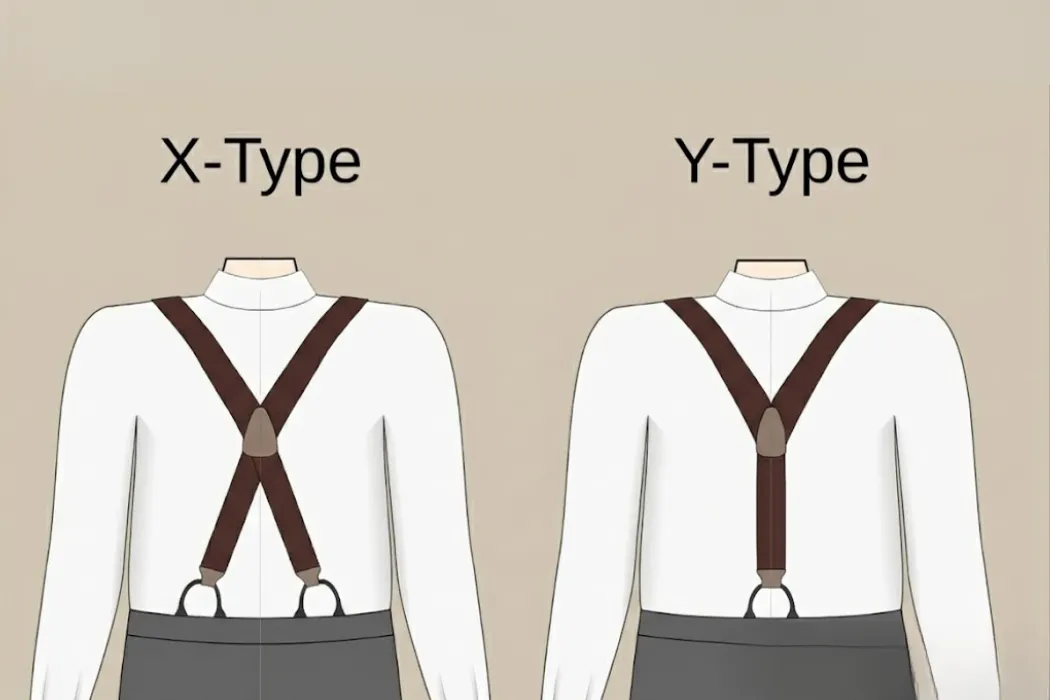
An X-back creates a crossing arrangement, while a Y-back brings the upper straps into a single lower section. Button tabs can divide into several ends, and clips may use different attachment arrangements. Therefore, “four-point versus three-point” is only a shorthand for some constructions; it is not a complete count of buttons or attachment components.
| Design detail | X-back | Y-back |
|---|---|---|
| Rear layout | Usually two rear runs after the crossing | Usually one rear run below the junction |
| Garment interface | Specify the positions of both rear attachments | Specify the rear attachment and any split button tab |
| Joining piece | Controls the crossing or retains the straps | Connects the upper runs to the lower run |
| Sample comparison | Check rear spacing, crossover position and adjustment | Check junction position, lower length and adjustment |
Ask for a drawing showing the complete attachment layout. The same shape name can conceal different elastic sections, hardware and joining constructions.
Test fit across the intended size range
Strap length, shoulder path, trouser rise and adjuster position affect fit. A taller wearer does not necessarily need the same change as a wearer with a longer torso or a different waistband position. Record the measurement path and the minimum and maximum usable adjustment, including the attachment ends.
During a fit review, check standing, sitting, bending and reaching in the intended garments. Observe whether a strap migrates outward, an adjuster moves, the waistband is pulled unevenly or the joining piece presses against the wearer. Compare both back layouts with similar materials so the result is not merely a comparison between different elastic tensions.
A back shape alone should not be marketed as correcting posture, spinal asymmetry or pain. Nor does it prove better performance for every shoulder shape. Record the fit observations and the sample configuration rather than turning them into broad physiological claims.
Choose the material and joining piece as a system
Elastic webbing, woven cloth and leather components can contribute different appearance and movement. Some constructions place elasticity in only part of the assembly. Confirm the full bill of materials, including the joining piece, backing and stitched or riveted attachments.
A leather junction should be specified by material, thickness, shape, edge treatment and attachment pattern. Full-grain leather is not automatically required for every joining piece, and a fixed thickness cannot suit every design. Check whether the sample bends appropriately, whether holes or stitches distort, and whether a thick junction creates visible bulk under clothing.
Retain an assembled sample. A flat leather patch or a loose length of elastic cannot demonstrate the complete connection’s behavior.
Clip-on ends attach to a suitable waistband without dedicated buttons, but grip and potential marking depend on the clip and fabric. Test them on the actual garment construction, including any reinforcement or lining. Check opening and closing, unwanted release and damage after the agreed use assessment.
Button ends need an appropriate button layout and secure garment attachment. Define button dimensions, spacing and tab geometry together. Do not infer that every button attachment is stronger than every clip or that one can be substituted without changing the garment specification.
Formality is a design brief, not a back-shape rule
Y-back designs can provide a clean visual arrangement, while X-back designs can form part of traditional or casual styling. Neither shape alone determines whether the accessory belongs in a formal collection. For example, Albert Thurston describes an X-back boxcloth design, illustrating why fabric, finish and attachment style should be considered together.
For a jacketed look, review the actual layers on a dressed sample. A bulky joiner, adjuster or clip can show through regardless of the letter-shaped layout. Agree on hardware color, strap width, shirt contrast and whether the accessory is intended to be visible.
Prepare an approval sheet for both versions
- Back layout drawing and garment attachment positions.
- Strap composition, width, thickness and any elastic sections.
- Finished length range and measurement convention.
- Joining piece specification and attachment details.
- Adjuster and clip or button-tab references.
- Fit observations, appearance limits and appropriate component and assembly checks.
- Care instructions verified for the complete combination of materials.
If comparing X-back and Y-back samples, keep a record of every other construction difference. This allows the team to identify which change produced the preferred fit instead of attributing the result to the back shape alone.
For a proposed leather-component or fashion-accessory project, send Hoplok the drawing and intended use. Confirm the requested supply scope, minimum quantity and sampling schedule separately; the published belt minimums should not be applied automatically to a suspender assembly.
For the full component brief, see the guide to suspender components and sizing.