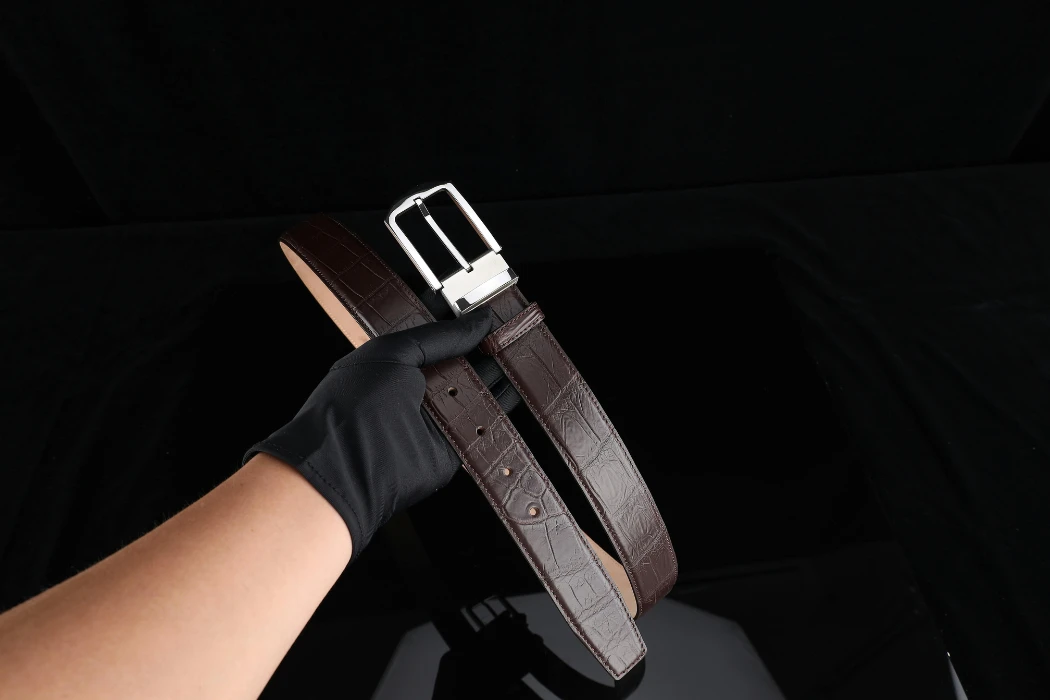
In the hierarchy of luxury accessories, nothing signals status quite like a genuine crocodile or alligator belt. The distinct scale pattern is nature’s own fingerprint, impossible to replicate perfectly. However, this is also a market fraught with expensive traps. It is all too common to spend $500 thinking you are buying premium alligator, only to receive a stiff, cracking belt made from cheap Caiman or, worse, embossed cowhide.
In this guide, we have ranked the 15 best crocodile and alligator belt brands for 2025. We evaluated these brands based on three critical manufacturing pillars: Skin Grade (absence of scars), Cut Selection (Belly vs. Hornback), and Finishing Details. From the bespoke masters of Paris to the heritage bootmakers of Texas, this list represents the absolute apex of exotic leather craftsmanship.
As manufacturing experts with decades of experience in sourcing exotic skins, we look beyond the price tag. We will reveal why CITES Certification is your only guarantee of legality and sustainability, and explain the crucial biological differences between American Alligator and Nile Crocodile that dictate a belt’s longevity.

Species Matter: Alligator vs. Crocodile vs. Caiman
To the untrained eye, all reptilian scales look similar. To a manufacturer, they are vastly different materials with distinct structural properties. The price gap between a $400 belt and a $2,000 belt often comes down to the species of the animal. Understanding these biological differences is the first step in avoiding overpaying for inferior skins.
American Alligator (The Gold Standard)
American Alligator (Alligator mississippiensis) is widely considered the premier material for dress belts. Native to the southeastern United States, its skin is prized for having an “umbilical scar” (a long, webbed pattern) and, crucially, a complete lack of sensory pores on the scales. This results in the cleanest, smoothest finish possible.
- The Look: The belly scales are distinctively square and symmetrical near the center, transitioning to rounder scales on the sides.
- The Feel: It is softer and more pliable than crocodile, meaning the belt will mold to your waist comfortably without the risk of cracking at the stress points.
Nile / Porosus Crocodile (The Exotic Alternative)
While often grouped with Alligator, Crocodiles are biologically distinct. The luxury market primarily uses Nile Crocodile (Crocodylus niloticus) and the ultra-rare Saltwater Crocodile (Crocodylus porosus). The key identifier is a tiny, visible dot—a sensory pore—located near the edge of every single scale.
- Porosus: This is the “Hermès standard.” It features a small, tight, and incredibly symmetrical scale pattern. It takes glazing (high-shine finishing) exceptionally well.
- Texture: Crocodile skin is naturally slightly more rigid than alligator, providing a structured, armored look that holds up well for decades.
The Caiman Trap (The Budget Imitation)
If you see a “Genuine Crocodile” belt for under $300, it is almost certainly Caiman (Caiman crocodilus). Native to South and Central America, these smaller reptiles have skins containing “osteoderms”—hard calcium deposits or bony plates beneath the scales.
- The Pitting: Because of the bony plates, the leather cannot be dyed evenly, often showing a “pitted” or crinkled appearance in the center of the scales.
- The Stiffness: Caiman is brittle. When bent into a belt loop, the finish often develops “spider-web” cracks (crazing) between the scales. It is durable but lacks the refined elegance of true alligator.
The Cut & Construction: Belly vs. Hornback
Once the species is chosen, the “Cut”—the specific section of the hide used—determines the belt’s formality and price. Furthermore, how the manufacturer cuts that strip (in one piece or multiple pieces) acts as a litmus test for true luxury.
Belly Cut (The Formal Standard)
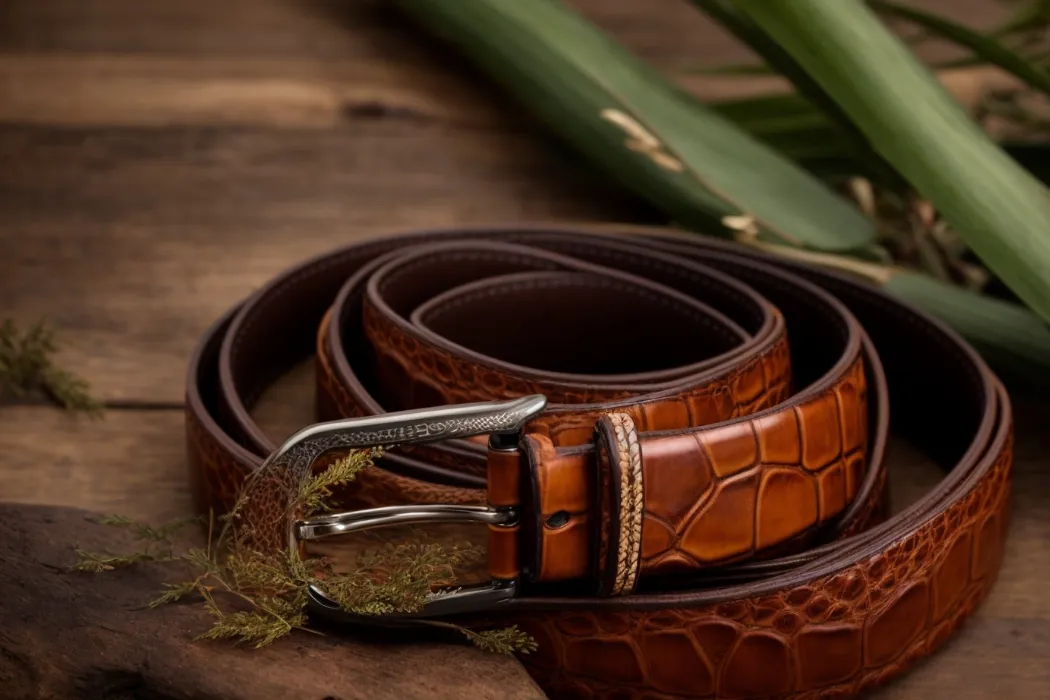
The Belly Cut is the most coveted and expensive section of the hide. It features the classic “tile” pattern: flat, smooth, rectangular scales that lie flush against the fabric of a suit. Because the belly is the softest part of the animal, these belts are flexible and comfortable from day one.
- Aesthetic: Understated and elegant. The scales are symmetrical, making it the only appropriate choice for business or formal wear.
- Finish: Usually offered in a high-gloss “Glazed” finish to highlight the perfection of the scales.
- Cost: High. It requires a pristine underbelly free from scratches caused by the animal sliding on riverbeds.
Hornback (The Rugged Statement)
The Hornback Cut is taken from the top of the animal. It retains the osteoderms—the raised, bony ridges that act as the animal’s armor. This creates a dramatic, three-dimensional profile that stands out physically from the waist. It is visually aggressive and incredibly tough.
- Aesthetic: Wild and prehistoric. It pairs perfectly with denim, cowboy boots, or casual chinos, but is considered a faux pas with a suit.
- Tactility: The ridges are hard like stone. While durable, the belt will be stiffer and thicker than a belly cut belt.
- Uniqueness: Each ridge pattern is entirely unique, like a fingerprint.
One-Piece vs. Spliced (The Value Factor)
This is the secret that separates a $500 belt from a $1,500 one. A One-Piece belt is cut from a single, continuous strip of skin from a large, mature alligator (typically 10-12 feet long). A Spliced belt is made by stitching together 3 or 4 shorter scraps of leftover skin.
- Visual Continuity: A one-piece belt has a seamless scale pattern from buckle to tip. A spliced belt has visible vertical seams where the pattern breaks abruptly.
- Durability: Spliced seams are weak points that can separate over time. A solid strap has complete structural integrity.
- Scarcity: Large, flawless skins are rare. Spliced belts use the “waste” from handbag production, hence the lower price.
Finishing Techniques: Glazed vs. Matte
The final step in manufacturing is the “Finish.” This is not just a color choice; it changes the molecular structure of the skin’s surface. The finish dictates how the belt reflects light, how it feels against the hand, and, most importantly, how it handles water and scratches.
The Agate Glazing (Traditional Luxury)
The iconic, glass-like shine of a formal alligator belt is not achieved through plastic varnish. It is created through Agate Glazing (Lissage). A stone made of agate is rubbed over the skin under immense pressure, compressing the fibers until they naturally shine. This creates a brilliant, jewel-like surface perfect for tuxedos.
- Pros: Unmatched elegance and color depth. The classic “million dollar” look.
- Cons: Extremely sensitive to water. A single drop of rain can cause “blistering” where the fibers swell and lose their gloss permanently.
Matte & Nubuck (Modern Stealth)
Matte finishes are achieved by skipping the glazing stone and instead tumbling the skins with natural oils. This leaves the scales with a soft, rubbery tactility that feels warm to the touch. Nubuck alligator takes this a step further by lightly buffing the surface to create a velvet-like nap.
- Pros: Much more durable and water-resistant than glazed. It resists cracking and hides scratches effectively.
- Evolution: Matte alligator is not static; it will naturally buff up and become glossier (patina) where it rubs against your pant loops.
Hand-Patina (The Artistic Touch)
Popularized by brands like Berluti, Hand-Patina involves using un-dyed “Crust” leather as a canvas. Artisans apply dyes, essential oils, and pigments by hand with brushes and cloths to create a multi-tone effect. This highlights the space between the scales (the veins) in a contrasting color.
- Uniqueness: No two belts are identical. The color has a 3D depth that factory drum-dyeing cannot replicate.
- Maintenance: Requires specialized creams to maintain the color intensity, as the surface is often more porous than heavily sealed skins.
The 15 Best Crocodile & Alligator Belt Brands (Summary List)
Here is our definitive ranking for 2025. We have organized the brands by their specific expertise—whether you need a bespoke masterpiece, a high-fashion icon, or a rugged western accessory.
| Rank | Brand | Origin | Species Specialty | Price Range (USD) |
|---|---|---|---|---|
| 1 | House of Fleming | USA | Bespoke American Alligator | $450 – $700+ |
| 2 | Hermès | France | Porosus Crocodile (Apex) | $2,000 – $4,000+ |
| 3 | John Allen Woodward | USA | Hand-Made Masterpiece | $1,200 – $3,500 |
| 4 | Stefano Ricci | Italy | Milled Crocodile | $2,500 – $4,500 |
| 5 | ABP Concept | France | Parisian Custom (Strap) | $350 – $600 |
| 6 | w.kleinberg | USA | Matte & Glazed Alligator | $295 – $595 |
| 7 | Zilli | France | Ultra-Glazed Crocodile | $2,000 – $3,800 |
| 8 | Kiton | Italy | Neapolitan Soft-Construction | $1,800 – $3,200 |
| 9 | Brioni | Italy | Matte Formal Alligator | $1,200 – $2,500 |
| 10 | Ralph Lauren Purple Label | Italy | Stirrup Buckle Alligator | $900 – $1,500 |
| 11 | Equus Leather | UK | Hand-Stitched Bridle/Exotic | $400 – $800 |
| 12 | Crockett & Jones | UK | Shoe-Matching Crocodile | $350 – $550 |
| 13 | Lucchese | USA/Italy | Western Belly & Hornback | $300 – $800 |
| 14 | Tony Lama | USA/Global | Value Caiman / Alligator | $150 – $450 |
| 15 | BRUCEGAO | Hong Kong | Exotic Focus | $200 – $400 |
1. House of Fleming
Origin: USA (Atlanta) | Price: $450 – $700+
If you watch professional golf, you have seen a House of Fleming belt. They are the “secret” bespoke maker for the world’s elite athletes and CEOs. They do not mass-produce; every belt is cut to order from a massive inventory of skins.
- The Experience: You select the exact skin color, the stitch color, and the width. It is a fully bespoke experience.
- Material: They specialize in American Alligator with a distinctively soft, matte finish that is flexible enough for the golf swing but rigid enough for dress trousers.
2. Hermès
Origin: France | Price: $2,000 – $4,000+
Hermès sets the global standard for grading exotic skins. They famously control the supply chain so tightly that they get “first pick” of the world’s flawless hides. The Porosus Crocodile belt (identified by the `^` symbol) is the holy grail of accessories.
- Glazing: Their “Lissage” (agate stone glazing) technique creates a mirror-like shine that is deeper and more durable than any competitor.
- Construction: The edges are heat-sealed and hand-painted with a precision that makes the belt look like a single fused piece of art.
3. John Allen Woodward
Origin: USA (Boulder, CO) | Price: $1,200 – $3,500
John Allen Woodward is not a factory; he is a master craftsman. He personally cuts, sews, and signs every single belt. His work is considered “Heirloom Grade,” often featuring intricate hand-patina finishes that highlight the individual scales.
- Signature: He is famous for the “Hornback” cut, treating the bony ridges like sculptural elements.
- Guarantee: Because he stitches every millimeter himself, he offers a lifetime guarantee on construction—a rarity in the luxury world.
4. Stefano Ricci
Origin: Italy | Price: $2,500 – $4,500
Stefano Ricci defines unapologetic Italian opulence. The brand is famous for the Eagle Head buckle, often cast in gold or platinum. Their crocodile skin is treated to be impossibly soft, often featuring a unique “milled” texture that feels like fabric.
- The Look: Maximalist. The scales are often large, center-cut belly sections chosen for maximum visual impact.
- Hardware: The buckles are jewelry, often encrusted with diamonds or semi-precious stones, designed for the ultra-wealthy.
5. ABP Concept
Origin: France (Paris) | Price: $350 – $600
Atelier du Bracelet Parisien (ABP) is a cult favorite among watch collectors for their straps, and they apply the same micro-precision to belts. They offer an online “configurator” that allows you to customize every detail, from the lining leather to the thickness.
- Specialty: They excel at unique finishes like “Nubuck Alligator” or “Special Tanning” (e.g., denim-blue dye effects).
- Value: For a fully bespoke, handmade Parisian product, their pricing is surprisingly accessible compared to big fashion houses.
6. w.kleinberg
Origin: USA (Atlanta) | Price: $295 – $595
w.kleinberg has been the premier supplier of exotic belts to America’s finest haberdasheries (like Neiman Marcus) since 1984. They are the benchmark for the classic American dress belt.
- Selection: They maintain one of the largest stocks of legally sourced American Alligator in the country.
- Style: Known for the “Engine Turned” sterling silver buckle sets paired with glazed alligator tabs—the definitive “Wall Street” look.
7. Zilli
Origin: France (Lyon) | Price: $2,000 – $3,800
Zilli invented the luxury leather jacket, and their belts follow suit. They use a proprietary “Ultra-Glazed” finish that makes the crocodile skin shine like black patent leather, but with the depth of natural scales.
- Flexibility: Their “Ingot” zip belts are engineered with a unique flexible core, allowing the belt to move with the body without creasing the high-gloss finish.
- Prestige: A Zilli belt is a status symbol in Eastern Europe and the Middle East, signaling membership in an exclusive club.
8. Kiton
Origin: Italy (Naples) | Price: $1,800 – $3,200
Kiton’s philosophy is “The Best of the Best +1.” Their belts are handmade in Naples with the same soft construction as their famous suits. They use crocodile skin that has been tumbled to remove all stiffness.
- Hand-Feel: This is likely the softest crocodile belt you will ever touch. It drapes like silk.
- Buckle: Usually features a subtle, palladium-plated roller buckle that doesn’t distract from the exquisite quality of the skin.
9. Brioni
Origin: Italy (Rome) | Price: $1,200 – $2,500
Brioni brings Roman tailoring elegance to leather goods. Unlike the flashy finishes of other brands, Brioni excels at Matte Alligator. Their belts are understated, designed to seamlessly blend with a Super 150s wool suit rather than draw attention to the waist.
- Aesthetic: The definition of “Quiet Luxury.” The matte finish absorbs light, looking rich and sophisticated without being shiny.
- Construction: Often features a “tubular” construction with hidden stitching, creating a sleek, seamless profile ideal for formalwear.
10. Ralph Lauren Purple Label
Origin: Italy | Price: $900 – $1,500
Purple Label is Ralph Lauren’s top-tier line, manufactured in Italy. The icon here is the Stirrup Buckle alligator belt. It perfectly captures the “American Old Money” aesthetic, blending equestrian heritage with the finest Italian exotic skins.
- Design: The stirrup-shaped buckle is unique and instantly recognizable without being a logo. It sits flat against the waist.
- Leather: They use high-gloss, glazed alligator in rich, traditional colors like mahogany, black, and saddle tan.
11. Equus Leather
Origin: UK | Price: $400 – $800
Equus Leather preserves the dying art of traditional English saddlery. Every belt is hand-stitched using two needles and linen thread (saddle stitch), which is significantly stronger than machine stitching. While famous for bridle leather, their bespoke alligator options are structurally bombproof.
- Durability: This is likely the strongest construction on the list. The combination of exotic skin with English Bridle lining creates a belt that will never stretch.
- Customization: You choose the buckle, thread color, width, and exact length.
12. Crockett & Jones
Origin: UK (Northampton) | Price: $350 – $550
If you own a pair of high-end English shoes, you know the struggle of matching the leather. Crockett & Jones solves this by producing belts from the exact same skins as their footwear. Their crocodile belts are classic, conservative, and perfectly matched in color and shine.
- The Match: The only way to guarantee your “Dark Brown Antique” belt matches your “Dark Brown Antique” loafers perfectly.
- Value: For genuine crocodile (often Caiman or Nile Croc at this price point) made in England, the value proposition is excellent.
13. Lucchese
Origin: USA/Italy | Price: $300 – $800
Lucchese is to western boots what Rolls Royce is to cars. Their exotic belts are designed to complement their legendary boots. They offer a wide range of cuts, from elegant Ultra-Belly for dress wear to rugged Hornback for a statement western look.
- Variety: One of the few brands offering “Giant Gator” cuts and distinctive hand-stained finishes like “Black Cherry.”
- Construction: Built tough. These belts are thicker than European dress belts, designed to fill the loops of denim jeans.
14. Tony Lama
Origin: USA/Global | Price: $150 – $450
Tony Lama makes exotic skin accessible. They primarily use Caiman alligator, which allows them to offer the genuine reptile look at a fraction of the price of American Alligator. While Caiman is stiffer, Tony Lama’s construction ensures it remains durable for daily wear.
- Entry Level: The best option for your first exotic belt if you are on a budget but refuse to buy fake embossed leather.
- Style: Classic western tapers with removable buckles, allowing for personalization.
15. BRUCEGAO
Origin: Hong Kong | Price: $200 – $400
BRUCEGAO is a specialized manufacturer focusing entirely on exotic skins. By sourcing directly from Southeast Asian farms and selling direct-to-consumer, they cut out the middleman markup. They offer genuine crocodile and alligator belts in a massive array of colors and finishes.
- Variety: If you want a blue, green, or red crocodile belt, they likely have it.
- Transparency: They are clear about the species used (often Siamensis or Porosus) and provide CITES documentation for international shipping.
How to Spot Fake vs. Real Exotic Leather
As manufacturing technology advances, “Croc-Embossed” cowhide has become surprisingly realistic. Some brands even use “Genuine Leather” stamps to mislead buyers into thinking embossed prints are the real deal. To protect your investment, you need to look for specific biological markers that machines cannot replicate.
The Pattern Test (Nature vs. Machine)
Nature hates perfect symmetry. On a genuine alligator or crocodile belt, the scale pattern will be slightly irregular. You might see a scar, a wrinkle, or a transition where square scales gradually become rounder. This irregularity is the hallmark of authenticity.
- The Repeater: If you look closely at embossed leather, you will often spot a repeating pattern every 10-12 inches where the steel press mold stamped the hide.
- The Depth: Real scales have deep, distinct crevices. Embossed valleys are often shallow and uniform in depth.
The ISO Pore Check (The Magnifying Glass Test)
This biological feature is impossible to fake convincingly. As mentioned earlier, all Crocodile species have a tiny sensory pore (a hair follicle) near the edge of every scale. Alligator skin is completely smooth with no pores.
- The Fake: Embossed leather will either have no pores (mimicking alligator) or, in cheap attempts, have printed dots that look like ink spots rather than physical indentations.
- The Test: Use your phone’s macro camera. If you see a tiny, physical pit on a “Crocodile” belt, it is real. If you see it on an “Alligator” belt, it is actually Crocodile (or Caiman).
The Flexibility Factor (The Hinge Test)
Real reptile skin is composed of rigid plates (scales) connected by soft, flexible living tissue (the hinge). When you bend a genuine belt, it should flex effortlessly between the scales, like the links of a watch bracelet.
- The Bend: When you bend embossed cowhide, the entire surface curves stiffly because it is one solid piece of leather. The “scales” will often wrinkle or stretch unnaturally.
- The Feel: Real alligator feels fluid and drapes over your hand. Fake embossed leather feels stiff, springy, and wants to return to a straight shape immediately.
Choosing the Right Finish for the Occasion
An exotic belt is a statement, but the wrong finish can send the wrong message. A high-gloss, bony belt worn with a tuxedo looks confused, not sophisticated. To maximize the versatility of your investment, you must match the skin’s texture and shine to the formality of the event.
Formal / Black Tie (The Glazed Belly)
For weddings, boardrooms, or black-tie galas, the rule is strict: Understated Elegance. You must select a Glazed Belly cut. The flat, symmetrical scales lie flush against the loops of fine wool trousers without ruining the silhouette.
- Color: Strictly Black or Dark Chocolate Brown.
- Width: Keep it narrow, between 30mm (1.18″) and 32mm (1.25″). Anything wider looks too casual for a suit.
- Buckle: A simple, polished silver or gold frame buckle. No plaques, no oversized logos. Ideally, the belt should be “invisible” until noticed upon closer inspection.
Business Casual (The Matte Diplomat)
In a modern office or smart-casual setting (chinos and a blazer), a high-gloss belt can look too “flashy” or “new money.” The sophisticated choice here is Matte Alligator. The soft, rubbery sheen whispers luxury rather than shouting it.
- Color: Navy, Burgundy, or Tobacco. These colors show off the natural beauty of the scales better than black.
- Texture: A matte finish pairs beautifully with the textures of flannel, tweed, or heavy cotton.
- Width: You can go slightly wider, up to 35mm (1.38″), to fill the larger belt loops of chinos.
Weekend / Western (The Hornback Statement)
When wearing denim, boots, or heavy canvas, you need a belt with physical presence to match the rugged fabrics. This is the domain of the Hornback (Osteoderm) cut or high-contrast finishes.
- Texture: The bony ridges of a Hornback belt provide a 3D texture that stands up to the visual weight of denim.
- Color: Cognac, Peanut, or “Black Cherry” with hand-painted patina effects look incredible as they age and scuff.
- Width: Standard 38mm (1.5″) or 40mm to ensure the belt doesn’t slide around in jean loops.
| Occasion | Recommended Cut & Finish | Ideal Width | Best Colors |
|---|---|---|---|
| Black Tie / Formal | Glazed Belly (Flat) | 30mm – 32mm | Black, Dark Brown |
| Business Casual | Matte / Nubuck Belly | 32mm – 35mm | Navy, Cordovan, Tan |
| Weekend / Denim | Hornback / High-Contrast | 38mm – 40mm | Cognac, Natural, Grey |
Essential Care for Exotic Skins
There is a dangerous misconception that because crocodiles live in water, their leather is waterproof. The opposite is true. The tanning process removes the natural protective mucus, leaving the skin highly reactive. An alligator belt requires a completely different maintenance protocol than a cowhide one to prevent the scales from cracking or the finish from clouding.
Water Danger (The Blister Risk)
Water is the arch-nemesis of a Glazed Alligator belt. Because the high-gloss finish is achieved through pressure (glazing) rather than a chemical sealant, water droplets can penetrate the surface instantly. This causes the collagen fibers to swell, creating permanent, raised bumps known as “blistering” that destroy the glass-like shine.
- The Rule: Never wear a glazed belt if rain is in the forecast. Matte and Nubuck finishes are more forgiving but should still be kept dry.
- The Fix: If water splashes on the belt, blot it gently with a dry white cloth immediately. Never rub, and never use a hairdryer, which will cause the scales to curl and crack.
Specialized Conditioning (No Cowhide Oil)
Never use standard leather conditioners (like Neatsfoot oil or beeswax) on exotic skins. These heavy oils will clog the pores and darken the membranes between the scales, ruining the contrast. You must use a product specifically formulated for reptiles, such as Saphir Reptan.
- Why Reptan? It is a lighter, non-greasy milk that penetrates the dense scales without leaving a sticky residue that attracts dust.
- Application: Apply sparingly once every 6 months. Focus on the “hinges” between the scales, as this is where cracking typically starts. Always buff with a clean microfiber cloth afterward.
Storage Protocols (The Roll Method)
Unlike cowhide belts which are best hung, alligator belts should ideally be stored rolled loosely in a coil. Hanging a heavy alligator belt by the buckle for months can stretch the membrane between the scales, causing them to separate or “lift” over time.
- Protection: Place the coiled belt inside a breathable Cotton Dust Bag. Never use plastic, which can trap humidity and cause mildew—a death sentence for exotic skins.
- Placement: Store in a dark drawer. UV light from the sun will fade dyed alligator skin (especially Cognac and Navy shades) much faster than bovine leather.
Conclusion: The Graduation of a Wardrobe
Owning a genuine alligator or crocodile belt is often seen as the “graduation” of a gentleman’s wardrobe. It is the final step in a sartorial journey, representing the highest form of respect for natural materials. Unlike mass-produced accessories, a reptile skin belt is unique by definition—no two animals have the exact same scale pattern. Whether you choose the bespoke artistry of John Allen Woodward or the iconic status of Hermès, you are investing in a piece of nature that has been preserved through master craftsmanship.
Manufacture Your Exotic Leather Collection with Hoplok
For brands, entering the exotic leather market is a high-stakes game. Unlike cowhide, where a mistake costs pennies, a single cutting error on an alligator skin can result in hundreds of dollars of lost material. To navigate this complex niche successfully, you need a manufacturing partner with specialized expertise. At Hoplokleather, we provide the technical mastery required to produce high-end exotic goods.
We mitigate the risks of exotic manufacturing through our dedicated specialty division:
- CITES Compliance: We manage the full chain of custody for protected species. Every product we manufacture comes with the necessary CITES documentation, ensuring your inventory is 100% legal for global export and retail.
- Sourcing Mastery: We have established direct relationships with top-tier farms in Louisiana (for Alligator) and Southeast Asia (for Crocodile). We source Grade 1 skins free from scars, ensuring your belts have the pristine finish luxury clients demand.
- Zero-Waste Cutting: Our master cutters use advanced manual layout techniques to ensure perfect scale symmetry on the belt strap while maximizing the yield of every inch of these precious skins.
Whether you are looking to create a limited run of bespoke alligator belts or a full collection of exotic small leather goods, we offer the precision and compliance you need.
Elevate your brand with exotics. Contact our team today to discuss your project requirements.