The best materials for personalized passport covers are typically Full-Grain Leather, premium PU (Polyurethane), or Ballistic Nylon. Full-Grain Leather is the superior choice because it offers the highest durability (20+ years) and holds deep hot debossing without rebounding. PU Faux Leather serves as a budget-friendly alternative ideal for colorful UV printing, though it degrades faster (3-5 years). Nylon suits practical travelers seeking lightweight waterproofing, usually personalized via woven labels.
Your passport is likely the most valuable document you own. It holds your identity, your biometric data, and your freedom to move across borders. So, why would you slip it into a cheap, brittle PVC sleeve that might crack and trap melted ink against your visa pages in the heat? A passport cover does two jobs: it acts as armor against travel hazards like humidity and bending, and it serves as a canvas for your personal style.
But here is the manufacturing reality: not all materials “accept” customization equally. A material that looks good on the shelf might reject gold foil after a week in your pocket, or a stamped logo might fade because the fiber density is too low. In this guide, we are analyzing materials not just by how they feel, but by how they perform under the heat and pressure of manufacturing. We will help you choose the substrate that ensures your monogram—and your passport—survives the journey.
Why Is Genuine Leather Considered the Gold Standard for Personalization?
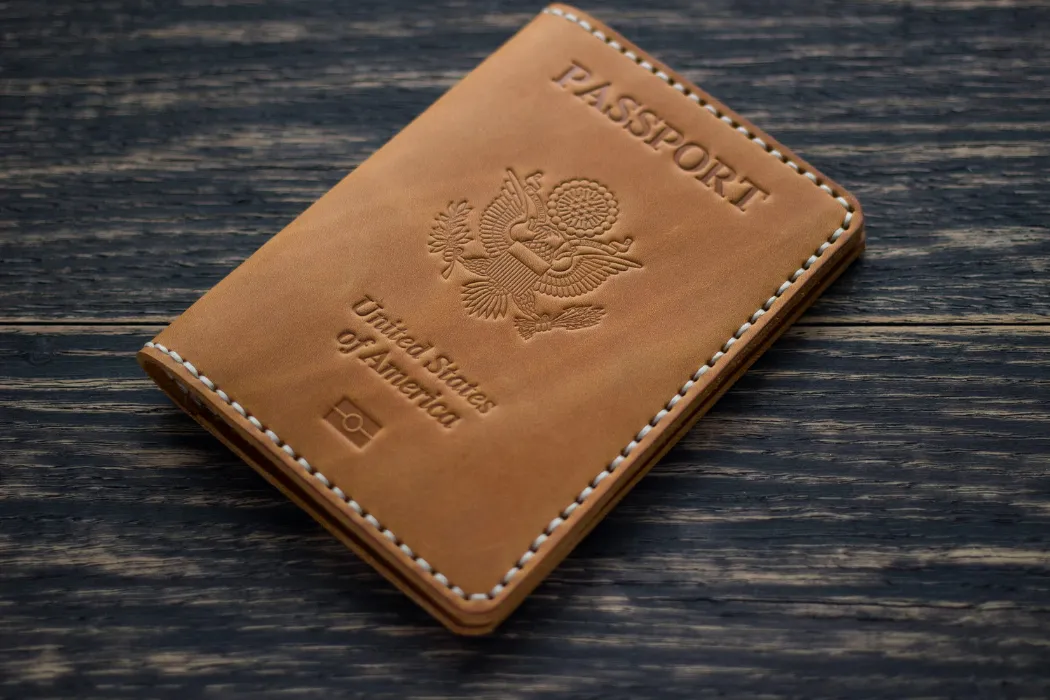
Genuine leather, particularly vegetable-tanned full-grain, is regarded as the gold standard because it possesses “fiber memory.” When subjected to specific heat and pressure, the dense collagen fibers compress and permanently lock into that shape, rendering hot stamping or foil stamping incredibly crisp with zero rebound. Unlike plastics that melt or synthetic fibers that bounce back, real leather develops a unique patina as you travel, visually recording your miles while maintaining structural integrity.
The Mechanics of Debossing: Why Fiber Density Matters
Think of leather customization like sculpting clay versus pressing a sponge. The quality of the impression depends entirely on the density of the hide’s corium layer.
- Full-Grain Integrity: Full-grain leather has the highest fiber density. When we apply pressure, the fibers compact tightly and stay there. This allows for deep, sharp edges on letters that remain legible for decades.
- The “Rebound” Effect: Lower grade “genuine” or bonded leathers are often filled with glues. Over time, these materials tend to “rebound” or swell back to their original flat state, causing your personalized initials to fade or blur after just a few months of humidity changes.
Saffiano Leather: The Scratch-Resistant Champion
If you love the idea of leather but hate the idea of scratches, Saffiano is the engineered solution. Invented by Prada, this is real leather treated with a heated cross-hatch wax finish.
- Armor Plating: The wax coating creates a surface hardness that deflects keys, coins, and rough airport handling. A Saffiano cover looks exactly the same on Day 1000 as it did on Day 1.
- Water Repellency: Unlike naked leather which drinks up water (and stains), Saffiano beads water off immediately, protecting your passport from accidental spills in the lounge.
Hoplok Injection: Customizing High-End Leather
We treat customization as a science, not just decoration. Precision temperature control is the difference between a burn mark and a perfect stamp.
- The 130°C Rule: At Hoplok, we heat our high-precision brass molds to exactly 130°C. This is the “glass transition” sweet spot for vegetable-tanned leather where the collagen yields without burning.
- Depth Precision: We calibrate our pneumatic presses to achieve a deboss depth of exactly 0.5mm. This depth is critical—it is deep enough to protect the gold foil from surface friction, but shallow enough to maintain the structural strength of the cover’s pocket.
Does Faux Leather Offer a Durable Alternative for Budget Travelers?
High-quality PU (Polyurethane) is a viable alternative, provided you choose the right grade. Unlike brittle PVC, water-based PU is softer, more eco-friendly, and resists cracking. For personalization, PU is exceptionally suited for UV digital printing, enabling vibrant full-color designs that leather cannot achieve. However, you cannot achieve a deep “Blind Emboss” on PU, as the high heat required to set the impression often melts the synthetic surface coating.
PU vs. PVC: Why You Should Avoid Vinyl
Not all “fake leathers” are created equal. In the manufacturing world, there is a massive difference between Polyurethane (PU) and Polyvinyl Chloride (PVC).
- The PVC Trap: PVC is the cheapest option ($2-3 per yard) but contains phthalates, which are rigid plasticizers. These evaporate over time, causing the cover to become brittle and crack at the spine, especially in cold weather.
- The PU Advantage: High-grade PU does not rely on plasticizers for flexibility. It mimics the pore structure of leather, allowing it to flex thousands of times without cracking. If you are buying vegan, always check the label for “PVC-Free.”
The Advantage of Color: UV Printing Potential
While leather struggles with complex graphics, PU excels as a blank canvas for modern digital art.
- Ink Adhesion: Because PU has a uniform surface tension, UV-cured inks bond instantly to it. This allows for photo-realistic prints or intricate multi-colored patterns that would bleed on natural leather.
- Consistency: If you are ordering 50 covers for a corporate retreat, PU guarantees that every single one looks identical in color, whereas leather dye lots can vary significantly.
Leather vs. Faux Leather Personalization Matrix
| Technique | Real Leather Effect | Faux Leather (PU) Effect | Recommendation |
|---|---|---|---|
| Hot Stamping (Foil) | Excellent (Permanent bond) | Fair (Surface bond, may peel) | Real Leather |
| Blind Debossing | Deep & Crisp (Fiber memory) | Poor (Rebounds/Melts) | Real Leather |
| UV Printing | Fair (Texture interferes) | Excellent (Vibrant & Sharp) | Faux Leather |
| Laser Engraving | High Contrast (Burns dark) | Dangerous (Toxic fumes for PVC) | Real Leather Only |
When Should You Choose Canvas or Nylon Instead of Leather?
If your priority is ultra-lightweight carry or extreme water resistance, then Ballistic Nylon or Coated Canvas are the undisputed best choices. While they lack the luxury patina of leather, they are immune to water damage and typically weigh only 1/3 as much as leather. Personalization for these functional materials is usually achieved through durable Screen Printing or sewn-on Woven Labels rather than traditional heat embossing.
The Weight Factor for Minimalists
For the “One-Bag” traveler or the ultralight backpacker, every gram in your pack matters. The density difference is stark.
- The Leather Drag: A standard full-grain leather passport wallet with card slots weighs approximately 100g (3.5 oz). In a lightweight summer shirt pocket, this feels substantial and causes sagging.
- The Nylon Float: In contrast, a cover made from 500D Cordura or Ripstop Nylon weighs just 30g (1 oz). This 70g difference makes the cover feel almost invisible until you need it.
Water Resistance: Protecting the Pages
Functionality often beats aesthetics when you are trekking through Southeast Asia or caught in a downpour.
- Hydrophobic Barrier: Unlike leather which is porous and absorbs moisture, synthetic fabrics like X-Pac or DWR-coated nylon provide a physical barrier. Water beads off the surface.
- Page Protection: This is crucial for your passport’s longevity. High humidity can warp paper visa pages and corrode the RFID chip. A waterproof nylon shell ensures the interior stays bone dry.
Customization Limits of Fabric
The trade-off for this durability is a limit on how “fancy” the personalization can look. You cannot treat fabric like skin.
- No Debossing: You generally cannot deboss nylon. The synthetic fibers have high tensile strength and elasticity; if you press a heated die into them, they simply bounce back to their original shape.
- Tactical Branding: Personalization is done via Screen Printing (which gives a sporty look but can crack) or Woven Labels (stitched on tags), which offers a rugged, industrial aesthetic suited for field gear.
How Does the Material Affect the RFID Blocking Capability?
Modern passports utilize RFID chips for data storage, necessitating physical shielding to prevent contactless skimming. Because materials like Leather and PU provide zero inherent blocking, manufacturers must insert a conductive metal mesh between the layers. Full-grain leather excels in this application because its natural thickness hides the mesh texture perfectly, whereas thin nylon covers often emit a “crinkling” noise when the metallic liner flexes.
The “Sandwich” Construction
You cannot judge a cover’s security just by looking at the outside. The protection relies on an internal assembly method known as a Faraday Cage.
- The Hidden Layer: We sew a layer of nickel-copper coated fabric between the outer shell and the inner lining. This mesh disperses radio waves (specifically 13.56 MHz) before they can reach the chip.
- Material Integration: With leather, we skive (thin down) the edges to fold over the mesh, making the shield invisible. With thin nylon, the mesh often “floats” between layers, leading to that tell-tale “potato chip bag” sound when you bend the wallet.
Testing Security
Many cheap covers slap a “Protected” sticker on the box without verified testing. You can verify the effectiveness of your material choice at home.
- The Access Card Test: Place your work ID badge (most use the same 13.56 MHz frequency as passports) inside the cover. If the door reader fails to beep when you tap the wallet against it, the shield is working.
- The Smartphone Test: Use an NFC reader app on your phone. Scan your passport naked to confirm it reads, then place it inside the cover and scan again. A good leather or nylon shield should render the chip completely invisible to the phone.
What Are the Maintenance Needs for Different Passport Cover Materials?
Different materials require specific care strategies to keep personalized designs intact. Real leather generally needs a high-quality conditioner every 6 months, but you must strictly avoid foil-stamped areas because oils will dissolve the adhesive holding the gold. PU leather requires only a damp cloth; you must never use alcohol, as it dissolves printed patterns. Ballistic Nylon is the easiest to maintain and can often be scrubbed with mild soapy water.
Protecting the Foil Stamp on Leather
Hot foil stamping is the most classic personalization method, but it is also the most fragile part of a leather cover. It is a physical layer of metal, not a dye.
- The “No-Oil” Zone: When you apply mink oil or leather balm to keep the cover supple, work carefully around your initials. If oil seeps under the foil, it breaks the bond, causing the letters to peel off.
- Friction Damage: Gold foil is soft. If you keep your passport in the same pocket as your keys or loose change, the metal edges will act like a scraper and remove the foil within weeks.
Cleaning Printed PU Surfaces
The UV-printed designs on PU covers are vibrant but chemically sensitive. In the post-pandemic era, this is a common failure point.
- The Alcohol Ban: Never use hand sanitizer or alcohol wipes to clean a PU cover. The solvent attacks the polymer coating and the ink immediately, turning the surface sticky and blurring the image.
- Safe Cleaning: Use only a clean microfiber cloth dampened with plain water. If a stain is stubborn, a tiny drop of dish soap is the maximum chemical strength you should use.
Material Durability & Care Comparison
| Material | Abrasion Resistance | Water Resistance | Maintenance Difficulty | Expected Lifespan |
|---|---|---|---|---|
| Full-Grain Leather | High (Scratches heal) | Low (Absorbs water) | High (Needs oil) | 10+ Years |
| Saffiano Leather | Very High (Hard coat) | Medium (Repels splashes) | Low (Wipe only) | 5-8 Years |
| PU / Vegan Leather | Low (Edges peel) | High (Plastic surface) | Low (No solvents) | 1-3 Years |
| Ballistic Nylon | Very High (Tough fabric) | High (DWR coated) | Very Low (Washable) | Lifetime |
How Do Brands Choose Between Materials for Their Collections?
Brand selection ultimately relies on the intersection of Target Audience and Price Point. For Corporate Gifting or high-end collections, Saffiano Leather is the top choice because it offers durability, uniformity, and a perceived high value. Conversely, for Fast Fashion or tourism merchandise, PU provides the necessary low cost (BOM as low as $2-$3) and infinite design flexibility. Hoplok suggests brands explicitly specify “Phthalate-Free” PU in their BOM to ensure compliance with EU and US regulations.
The Cost vs. Value Equation
When you are building a Bill of Materials (BOM), the raw material cost dictates your retail strategy. The gap is significant.
- The Premium Premium: Full-grain leather raw material costs are typically 5x to 10x higher than high-grade PU. This forces a higher retail price point ($50+) but builds long-term brand equity.
- Volume Economics: For promotional items or giveaways, PU allows you to hit a sub-$15 retail price while maintaining healthy margins.
The “Unboxing” Experience
Material choice extends beyond durability; it defines the sensory experience of the customer receiving the product.
- The Scent of Luxury: Real leather offers a rich, organic smell that immediately signals value when the box is opened. This is a critical psychological trigger for luxury buyers.
- The Plastic Risk: Lower-grade PU often off-gasses a chemical smell. If you choose PU, you must ensure it is aired out properly during manufacturing to avoid a negative first impression.
Material Selection Guide
| Target Market | Recommended Material | Best Customization |
|---|---|---|
| Corporate Gifting | Saffiano Leather | Gold/Silver Foil Stamping |
| Luxury Travel | Full-Grain Leather | Deep Blind Debossing |
| Gen Z / Trend | PU / Faux Leather | Full Color UV Printing |
| Eco-Conscious | Recycled Nylon / Cactus | Woven Label / Patch |
Frequently Asked Questions
Is Saffiano leather actually real leather?
Yes. It is genuine cowhide that has been treated with a heated wax finish and pressed with a cross-hatch pattern. This processing makes it significantly more scratch-resistant and water-repellent than “naked” leathers, though it feels more rigid.
Can you wash a leather passport holder?
Absolutely not. Submerging leather in water strips away its natural oils, causing the fibers to shrink and crack as they dry. If your cover gets dirty, wipe it gently with a damp microfiber cloth and allow it to air dry away from direct heat.
Does foil stamping last on PU leather?
It typically does not last as long as on real leather. Because PU lacks the deep fibrous structure of natural hide, the foil sits on top of the smooth synthetic coating. Without that mechanical “grip,” the foil is more prone to peeling off due to pocket friction.
What is the best material for a vegan passport cover?
We recommend Cactus Leather or high-grade Microfiber PU. Unlike cheap PVC, these modern eco-materials offer better structural integrity and breathable qualities that mimic real leather without the animal product.
Do plastic covers damage passports?
Yes, they can. Over long periods, especially in hot climates, the plasticizers in cheap PVC sleeves can migrate. This chemical reaction can cause the plastic cover to fuse with your passport or lift the gold foil/ink from the official document.
Why is my “leather” passport cover peeling?
If your cover is peeling, it is likely Bonded Leather (leather dust glued together) or low-quality PU. True Full-Grain Leather never peels; it simply wears down, softens, and develops a rich patina over time.
Conclusion: The Final Stamp of Quality
Choosing a material is effectively choosing a travel companion. Full-grain leather is the heirloom that ages gracefully alongside your journey; PU is a versatile, colorful fashion statement for the season; and Nylon is the tactical tool for the rugged explorer who demands function over form.
For brands and retailers, personalized passport covers represent a perfect high-margin SKU with historically low return rates—but only if the base material withstands the manufacturing process. A beautiful logo is worthless if it fades before the customer returns home. The integrity of the substrate is the foundation of your brand’s reputation.
Ready to build a collection that lasts? At Hoplok Leather, we offer end-to-end customization services, from sourcing premium ProPelli hides to executing high-precision Logo Hot Stamping and secure RFID shielding assembly. Contact Hoplok Leather today to create a travel accessory line that carries your brand’s legacy across every border.