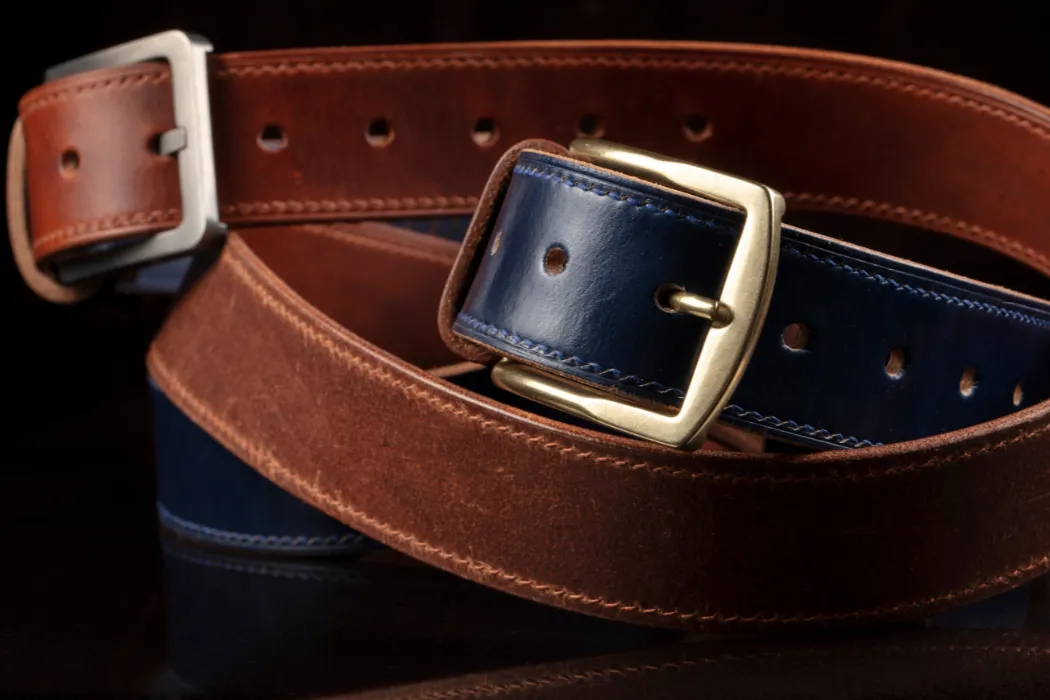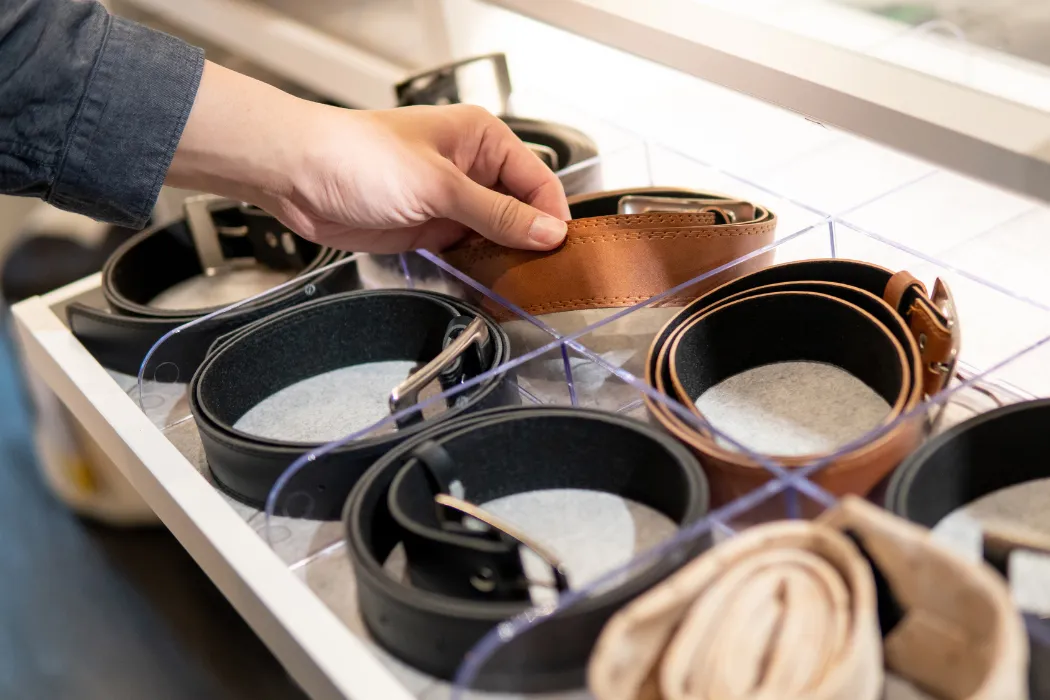
For manufacturers and sourcing managers, braided leather belts represent far more than a fashion detail—they’re a complex balance of craftsmanship, production efficiency, and material engineering. Whether each belt takes up to eight hours of manual braiding by skilled artisans or is produced in multiple units per hour through precision‑calibrated machines, understanding these distinctions is key to quality assurance and brand positioning.
This article explores the complete technical landscape behind braided leather belts—from the structural differences between hand‑braided and machine‑woven belts to material selection (such as PU versus suede), anti‑stretch engineering methods, and finishing techniques that extend product life. You’ll discover how design choices like 7 mm–11 mm braid slot widths, ISO‑verified tension controls, and edge treatments influence both performance and aesthetic value—data essential for informed sourcing and scalable product development.

What is the difference between hand-braided and machine-woven belts?
Hand-braided belts are crafted manually with tighter tension and artisanal variability, often taking up to 8 hours each; machine-woven belts are produced with uniform, looser tension for scalability and consistent output quality.
| Attribute | Hand-Braided Belt | Machine-Woven Belt |
|---|---|---|
| Tension & Feel | Denser, tighter weave with higher stretch resistance | Looser, more regular tension across the belt surface |
| Production Time | Up to 8 hours per belt by skilled artisans | Multiple belts per hour on calibrated machines |
| Consistency & Output | Unique artisan variability; no two belts identical | Highly uniform patterns for scalable mass production |
Core Differences in Craftsmanship and Structure
- Hand-braided belts exhibit tighter tension and denser weave, which makes the prong insertion harder but reduces early stretch.
- Machine-woven belts maintain consistent, looser tension that enables uniformity and speed in production with scalable output.
- Handcrafted belts incorporate artisan techniques like plaited or mystery braids, while machine types rely on programmed patterns for precision.
Technical and Production Data Comparison
- Hand-braiding requires up to 8 hours per belt by skilled artisans, while machines can produce multiple belts in the same timeframe.
- Full-grain leather strips are interwoven using tools with 7 mm to 11 mm slot widths; tighter manual interlacing increases resistance to stretch.
- Machine processes achieve tension regularity through calibrated looms, whereas hand methods depend on the artisan’s manual control.
Key Data Points
- Hand-braided belts feature tighter tension compared to machine-woven belts, making the prong harder to insert.
- Machine-braided belts produced on specialized machinery maintain consistent but looser tension, while hand-braiding unavoidably achieves higher tightness.
- Hand-braided leather belts take around 8 hours each to produce by artisans.
- Both belt types often use full-grain leather strips — examples include double loops laced with cord or triple layer loops interlocked with double rope strands for strength.
- Weaving slot punch tools for leather belts typically range between 7 mm and 11 mm widths.
- Leather braid constructions include plaited weave (flat ribbons of 3+ strands), twined technique (pairs around a core cord), coiling method, rib weave, and basket weave (2×2 over-under pattern).
Research Summary
Hand-braided belts differ from machine-woven mainly in tension and craftsmanship consistency. Hand-braiding naturally produces tighter braids through manual control, resulting in a denser structure that resists stretching better, though it takes several hours of artisanal labor per belt. Machine weaving, conversely, enforces even but looser tension for predictable, scalable production. The denser braids in handwoven designs make prong insertion firmer but help minimize early stretch during use.
From an engineering perspective, full-grain leather is typically used for both methods. Hand-braided belts leverage the flexibility of plaited or twined patterns for improved shock absorption, while machine looms rely on programmed interlacing for consistency. There are no ASTM or ISO standards providing stretch or failure benchmarks, though qualitative data suggest synthetic fibers outperform natural ones in abrasion resistance, while natural hides offer a richer tactile and visual patina.
Durability follows construction logic: tighter, manually reinforced loops and dense braids enhance longevity — in some cases promising decades of use — despite inevitable stretch over long years. While machine processes dominate large-scale outputs, hand-braiding remains favored for its authenticity, tactile variance, and craftsmanship aesthetics characteristic of high-end, ethically sourced full-grain leathers.
How to select the most durable materials (Suede vs. PU) for braiding?
PU (polyurethane) synthetic leather typically offers higher abrasion resistance, water resistance, and consistency compared to natural suede, making it the more durable and cost-effective option for braiding belts that demand endurance and uniformity.
Understanding Material Composition and Durability Differences
When choosing materials for braided belts, understanding the core structural differences between natural suede and polyurethane (PU) is critical. These differences directly influence durability, flexibility, and maintenance needs under repeated mechanical stress.
- Natural suede is derived from the flesh side of the hide, lacking the grain layer that protects full-grain leather, which makes it more susceptible to wear, stains, and moisture damage.
- PU leather is polymer-based, engineered with isocyanates and polyols to provide consistent flexibility and superior abrasion resistance—lasting over 70,000 cycles compared to suede’s qualitative durability.
- Pigskin suede offers added thickness and resilience but still underperforms against polyurethane synthetics in quantified endurance testing.
These compositional characteristics explain why PU can better withstand the tight weaving involved in braided belt production, while suede’s soft nap and porous nature make it more prone to deformation and surface wear.
Performance Metrics and Selection Guidelines for Braided Belt Applications
For manufacturers balancing endurance, cost, and environmental performance, comparative metrics offer a clear decision path:
- PU synthetic leather achieves over 70,000 abrasion cycles and resists water for up to 1 hour, while genuine leather reaches 150,000 cycles and 3 hours of water resistance.
- Suede’s lack of grain structure leads to poor tensile strength and flattening of nap under repeated stress—issues critical for tightly woven braids.
- Price comparison: PU leather averages $5–$10 per sq ft, versus suede or genuine leather’s $15–$30 per sq ft.
- For mass production, PU offers superior uniformity and lower maintenance needs, aligning with ISO 9001 and LWG-certified production environments like Hoplok’s integrated facilities.
In summary, while suede retains an artisanal aesthetic, PU provides measurable reliability and cost efficiency for large-scale braided goods. Its uniform structure supports consistent braid tension and wear life, making it the logical choice for performance-oriented belt manufacturing.
Research Highlights
Key Data Points:
- Suede Synthetic Leather: 70,000+ cycles durability (abrasion resistance), water-resistant up to 1 hour, priced $5–$10 per sq ft.
- Genuine Leather: 150,000 cycles durability, water-resistant up to 3 hours, priced $15–$30 per sq ft.
- PU Synthetic Leather: excellent abrasion and cut resistance, flexible polymer matrix from isocyanates/polyols, potential peeling or cracking over time.
- Natural Suede: less durable than full-grain leather, highly vulnerable to moisture and surface wear due to lack of protective grain layer.
- Pigskin Suede Variant: thicker and more resilient than standard suede, though without quantified endurance data.
Overall, polyurethane-based synthetics consistently outperform suede in controlled abrasion and water tests. Although no ASTM or ISO braiding-specific tests exist, the available industrial data confirm PU’s advantage in wear life and production scalability.
What engineering techniques prevent braided belts from over-stretching?
Braided belts resist over‑stretching through a combination of controlled tensioning, heat‑set stabilization, reinforced interlacing patterns, and strategic material selection with low elongation factors, all verified by ISO and ASTM test protocols.
| Core Technique | Purpose | Measurement / Verification |
|---|---|---|
| Controlled Tensioning | Maintains uniform strand load during braiding to avoid uneven elongation zones. | Monitored through strand-tension gauges and digital feedback loops. |
| Heat-Set Stabilization | Locks the fiber geometry at high temperature to reduce future elastic recovery. | Calibrated using thermal conditioning profiles around 130 °C under constant load. |
| Reinforced Interlacing Patterns | Distributes mechanical load evenly through cross-locking geometry. | Verified by micro-tensile mapping and dimensional stability inspection. |
| Low-Elongation Material Selection | Ensures inherent resistance to permanent stretch through fiber modulus design. | Measured using ISO 17238 and ASTM D6775 elongation protocols. |
Fundamental Principles of Stretch Control in Braided Belts
The resistance of a braided belt to permanent stretch begins with its mechanical geometry. Each strand in the braid shares the applied load through an interlaced structure, transforming tension into balanced lateral compression. This equilibrium prevents any one fiber from bearing excessive load and thereby limits elongation.
- Interlaced structures distribute load evenly, limiting local fiber extension under tension.
- Low‑elongation leathers or polyester cords (with ≤2% elastic stretch) are preferred for dimensional stability.
- Tighter braid density and consistent pattern symmetry reduce permanent deformation and curling.
In practice, the braid’s cross‑section and symmetry are optimized through careful control of strand angle and tension at the point of convergence. When done correctly, the geometry itself becomes a mechanical safeguard against over‑extension.
Technical Processes and Testing Standards for Tension Stability
Engineering teams apply a series of tension‑control and shaping processes that give the braided belt its enduring elastic stability. Each process is validated against recognized material test standards.
- Controlled heat‑setting at around 130 °C under tension locks fibers and minimizes future elastic recovery.
- Mechanical pre‑tensioning and post‑braid calibration align strand tension to prevent weak zones and uneven stress fields.
- Quality verification uses ISO 17238 and ASTM D6775 tensile‑elongation tests, typically maintaining elongation rates below 3%.
- Compliance with ISO 9001 and BSCI‑verified manufacturing protocols ensures repeatable tension stability across production batches.
Through this combination of mechanical design, controlled thermal treatment, and international testing conformity, braided belts maintain both structural integrity and dimensional consistency even under repeated stress cycles.
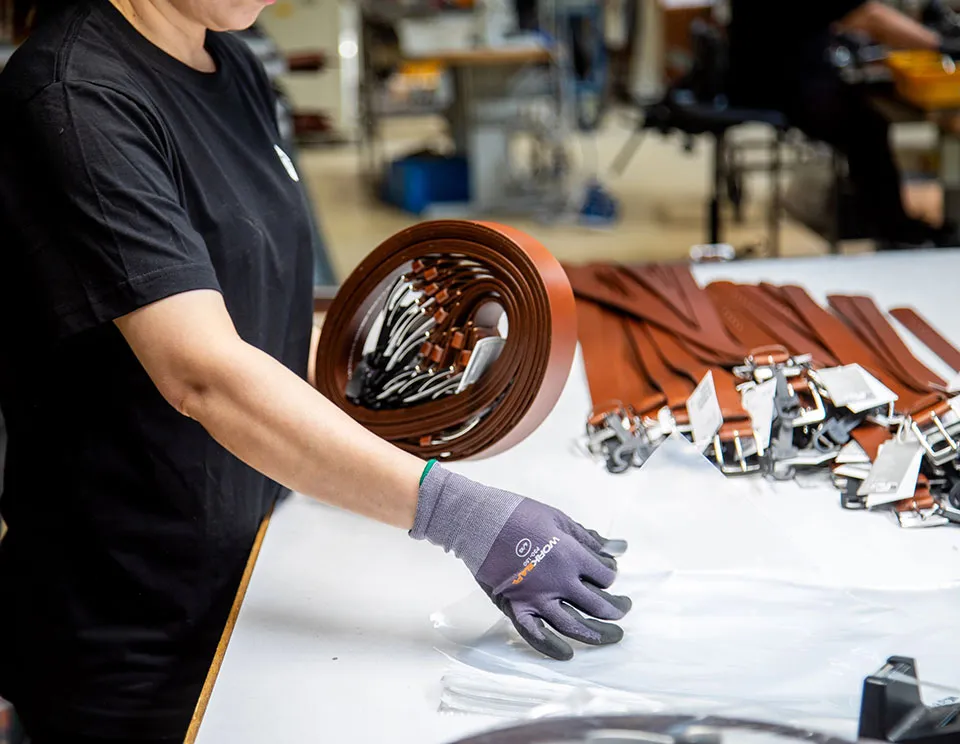
Custom Leather Belts Crafted for Modern Brands
How to ensure consistent hole placement in a woven belt structure?
Consistent hole placement in woven belts depends on aligning holes relative to belt width using standardized 3/4–1 inch spacing, centering the middle hole at the belt’s measured size, and using calibrated templates or punches to maintain uniformity across production.
Principles of Centered Hole Alignment in Braided or Woven Belts
To maintain a balanced and comfortable fit in a woven or braided belt, the alignment of the holes must follow the belt’s central measurement point. This ensures visual symmetry and consistent buckle positioning regardless of the belt’s flexibility or weave pattern.
- The middle hole must align with the wearer’s waist measurement (e.g., 44 inches from the buckle end).
- Maintain an odd number of holes (5 or 7) for symmetrical buckle positioning.
- Hole spacing typically equals belt width, around 3/4 inch to 1 inch apart for standard belts.
- Central alignment prevents uneven wear and supports aesthetic balance.
Technical Tools and Measurement Standards for Precision Punching
Precision in hole punching is achieved through a combination of mechanical accuracy and adherence to common spacing conventions. Artisans use standardized punches and templates to ensure uniform results across multiple belts or production batches.
- Use a #5 rotary or 3/16” round drive punch to create clean, round holes perpendicular to the weave.
- Templates such as Ivan Leathercraft’s multi-width acrylic ensure uniform spacing for 25–38mm belts.
- Apply spacing increments of 3/4–1 inch with ±4 holes from the central hole for 8–9 inches of adjustment range.
- No formal ASTM/ISO standards exist, but workshops follow established leathercraft conventions for even distribution.
Research Insights and Practical Summary
Research shows that reliable hole placement in woven or braided belts is primarily determined by matching the hole spacing to the belt width. For example, a 1-inch-wide belt typically uses 1-inch hole spacing, ensuring the design maintains equilibrium when wrapped around the waist.
Hole alignment begins with marking the middle hole at the true belt size, usually 44 inches from the buckle end for a 44-size waist, followed by ±4 holes spaced at 3/4–1 inch outward on both sides. This creates an adjustment range of 8–9 inches for normal comfort and flexibility. Clean holes made perpendicular to the weave with a #5 punch prevent frayed edges, and coating the interior with clear sealant or nail polish can enhance durability in intricate weaves.
For artisans, using multi-width templates designed for 25–38 mm straps guarantees repeatable production consistency. While there are no formal ASTM or ISO standards specific to belt hole spacing, traditional craftsmanship consistently emphasizes an odd number of evenly spaced holes centered on the belt’s midpoint—balancing both aesthetics and wear integrity.
What edge treatments are available for complex braided leather straps?
Edge treatments for complex braided leather straps include core techniques such as beveling, sanding, and burnishing to smooth and strengthen edges, alongside advanced methods like edge dyeing, painting, creasing, binding, and wax sealing to enhance water resistance, color coordination, and longevity.
Fundamental Edge Preparation: Beveling and Burnishing
Preparing the edges of complex braided leather straps begins with essential treatments designed to refine the contour and prevent early wear. Beveling and burnishing are the foundational steps in achieving a professional, durable edge finish.
- Beveling removes hard corners using a 45° angle cut or rounded sanding, helping thick braided straps resist wear and cracking.
- Burnishing compresses and smooths fiber edges through heat and friction, forming a sealed, glossy finish that strengthens durability.
These steps not only improve handling comfort but also create a seamless visual flow across the strap, which is especially important in complex braided constructions where edge uniformity contributes to both function and design appeal.
Advanced Finishing and Protective Treatments
After the foundational preparation, additional treatments can be applied to elevate both the aesthetic and functional performance of the straps. These methods are often selected based on desired color effects, usage conditions, and overall style direction.
- Techniques include edge dyeing or painting for color consistency, creasing for definition, and binding for reinforcement in high-wear areas.
- Applying beeswax or similar agents adds water resistance, and burnishing the flesh side with compounds such as Tokonole refines underside texture for premium quality.
Together, these advanced finishing processes help ensure that complex braided straps retain their color harmony, edge strength, and supple flexibility through prolonged use and varied environmental exposure.
How to integrate hardware without compromising the braid’s integrity?
Hardware integration in braided belts demands reinforcement techniques, proper positioning, and compatible materials. Designers use structural anchoring, reinforced tabs, and compliant adhesives to prevent stress concentration and maintain both strength and aesthetic integrity.
Before delving into specific engineering methods, it’s worth acknowledging a practical boundary: public data on mechanical integration standards for braided leather hardware remains scarce. Existing references focus on material finishes and aesthetics rather than measurable performance data. For accurate design validation, consult technical whitepapers from industry bodies such as the Leather Working Group or ISO standards on attachment tension and durability.
Understanding Stress Distribution in Braided Constructions
A braided leather structure operates on the principle of shared tension. Each strand interlaces with others, balancing longitudinal and lateral loads as the belt flexes. When metal components like buckles or rings are added, the uniformity of this tension field can be disrupted.
- Braided leather distributes tensile forces through interlaced strands; improper hardware anchoring can distort this equilibrium.
- Load concentration near metal fasteners can lead to micro‑tearing or stretching unless pressure is absorbed through woven padding or synthetic interlayers.
To mitigate such issues, reinforcement zones are introduced where tension changes abruptly—typically near buckle tabs or strap terminations. These areas may incorporate bonding layers, secondary stitching, or flexible films to diffuse force without interfering with the braid’s natural elasticity.
Reinforcement Techniques for Secure Hardware Attachment
Achieving a reliable connection between hardware and braid requires both structural foresight and controlled manufacturing methods. Designers employ composite materials and standardized testing to ensure that durability isn’t achieved at the cost of suppleness.
- Use of bonded leather tabs or folded ends lined with reinforcement fabric rated above 50 psi tensile strength to stabilize loops for buckles.
- Application of manufacturer‑compliant adhesives and secured stitches tested under ISO 9001 quality controls within Hoplok’s production, ensuring defect rates under 1%.
Ultimately, the goal is equilibrium: the connection must resist separation and stretching without creating stiffness where flexibility is required. Prototypes are validated through cycle testing that mimics repetitive movement, confirming that the reinforcement distributes stress effectively across adjacent strands. By integrating these engineering principles early in the design phase, manufacturers preserve the braid’s natural appeal while meeting mechanical performance standards.
What are the current global fashion trends for braided leather accessories?
Global trends for 2025 emphasize eco-conscious materials, hand-woven craftsmanship, and multifunctional use across belts, totes, and bracelets. Vegan leather, metallic finishes, and embossed textures define a fusion of sustainability and luxury appeal, favored by designers like Dior, Loewe, and Stella McCartney.
Eco-conscious and artisanal influence shaping braided leather aesthetics
The 2025 fashion landscape highlights a clear shift toward responsible material selection and craftsmanship. Braided leather accessories now reflect environmental mindfulness, combining style with sustainability. Designers increasingly opt for minimal material consumption and renewable sources such as vegan leather substitutes that mimic traditional aesthetics while reducing ecological impact.
- Braided belts and bags emphasize minimal material use with eco-friendly vegan leather alternatives, aligning with sustainability goals.
- Hand-woven, artisanal braiding techniques gain popularity for conveying luxury and individuality in fashion-forward markets.
This revival of manual weaving techniques associates braided leather pieces with craftsmanship and exclusivity. The outcome is a distinctly human aesthetic—small variations in texture and weave density become emblems of authenticity.
Emerging materials, finishes, and accessory formats in 2025
Advancements in imitation leather technology and surface treatment have redefined the tactile expression of braided accessories. Modern processes allow bold finishes while maintaining softness and flexibility expected of wearable items.
- Vegan leather dominates the 2025 season, with metallic finishes in gold, silver, and bronze adding a modern edge to belts and totes.
- Croc-embossed and snakeskin textured braids are adopted in leather bracelets and woven bags by brands such as Dior, Loewe, and Bottega for added depth and versatility.
Color palettes favor neutrals enhanced with subdued metallics, suitable for both daytime and evening wear. With braided totes transitioning effortlessly from casual to formal contexts, 2025 accessories encapsulate the broader trend toward hybrid functionality.
Research insights shaping the 2025 fashion context
Recent observations emphasize sustainable design philosophies and artisanal detailing as key differentiators. According to aggregated fashion trend analyses, braided leather belts and totes align with eco-conscious fashion movements and minimalist material use. Textural finishes—especially croc-embossed and snakeskin varieties—elevate surface complexity without resorting to animal-based sources.
- Braided leather totes emerge as a defining accessory for summer 2025, designed to adapt from casual denim ensembles to sophisticated eveningwear.
- Leather bracelets from luxury houses like Dior, Loewe, and Bottega continue to bridge jewelry and fashion accessory categories.
While current trend documentation highlights aesthetics, no available data provides quantitative metrics such as tensile strength or standardized weave densities. The discussion remains rooted in visual and material narratives rather than technical specifications. Nonetheless, braided patterns persist as a tactile statement of care, sustainability, and individuality—values resonating across modern global fashion ecosystems.
How does the hand-burnishing process improve the look of braided belts?
Hand-burnishing refines leather edges and braid surfaces by polishing fibers with frictional heat, sealing pores, and highlighting the grain’s natural patina. The result is a smoother, glossier, and more professional appearance with enhanced durability and texture consistency.
Understanding the aesthetics of hand-burnished braided belts
When craftsmen hand-burnish braided belts, they apply a combination of heat, friction, and controlled pressure to the leather surface, producing visible depth and a graceful tactile finish. This technique transforms natural grain textures into something richer and more visually engaging—an effect impossible to replicate through industrial polishing.
- Burnishing brings out natural grain depth, creating a soft sheen that amplifies color richness.
- Frictional heat compresses fibers, forming a sealed, glossy patina that gives an heirloom-quality finish.
- Edges appear uniform and rounded, eliminating raw or uneven surfaces found in unburnished braids.
The blend of mechanical action and aesthetic control makes each burnished braid one-of-a-kind, subtly reflecting the artisan’s motion and the inherent grain of the leather.
Technical method and performance outcomes of hand-burnishing
Beneath its artistry lies a systematic process that balances preparation, tool handling, and tactile awareness. Each step contributes to the performance and appearance of the final belt.
- Preparation sequence includes gluing with Seiwa Leathercraft Glue, beveling, and progressive sanding using 150, 600, then 800 grit.
- Edge dye application ensures color continuity, followed by wetting with gum tragacanth for smooth fiber compression.
- A wood slicker or bone folder generates heat through rapid motion—completion signaled by a distinct “tacky sound.”
- This process migrates natural oils to the surface, increases gloss, and seals the braid edges for enhanced durability.
- Relies on tactile and auditory cues instead of numeric metrics—no ASTM or ISO gloss measurements are standard.
The result is a finish that reinforces the leather’s structural integrity while accentuating its artisan quality—a synthesis of precision craftsmanship and sensory intuition. Each pass of the burnisher deepens both the polish and the character of the belt, producing a subtle gloss and an enduring surface uniformity that distinguishes handmade work from machine output.
What are the specific QC checkpoints for braided leather products?
Quality control for braided leather products involves thorough inspections across pre-production, in-process, and final stages to ensure material consistency, dimensional accuracy, durability, and aesthetic appeal. Each stage includes specific tests for material integrity, stitching strength, hardware performance, and compliance with chemical safety standards.
Core QC Stages and Objectives in Braided Leather Production
The quality assurance process for braided leather products is divided into multiple checkpoints designed to maintain consistency, performance, and visual appeal. These inspections are structured to track the product from raw material through final packaging, enabling early detection and correction of issues.
- Pre-Production Inspection (PPI) checks natural leather imperfections, tanning quality, and dye uniformity before use.
- During Production Inspection (DUPRO) focuses on stitching strength, seam durability, and dimensional consistency.
- Pre-Shipment Inspection (PSI) ensures hardware functionality and verifies the belt’s final appearance and performance.
- Finishing and Aesthetic Reviews cover edge polishing, coatings, surface textures, and color consistency.
Each stage plays a distinct role: Pre-Production eliminates base material flaws, In-Process Inspection ensures uniform craftsmanship across batches, and Pre-Shipment confirms readiness for retail display and long-term wear.
Technical and Compliance Parameters in QC Testing
Beyond visual checks, braided leather products undergo rigorous technical and compliance tests to guarantee performance reliability and meet international production standards.
- Functionality tests include buckle engagement cycles, hole alignment, and overall wear simulation to confirm lasting performance.
- Chemical and odor standards require all belts to be free of REACH-restricted substances and unpleasant smells.
- Internal tracking systems record inspection results and corrective actions to maintain defect rates below 1%.
- Facilities follow ISO 9001, BSCI, and SMETA verified procedures to ensure process standardization and traceability.
These checkpoints combine empirical testing and documentation. The continuous monitoring of leather stability, tensile properties, and odor neutrality helps guarantee that every braided item adheres to both brand-specific and global compliance frameworks.
Final Thoughts
The craftsmanship behind braided leather belts reflects a rare balance between traditional artistry and modern engineering. From the precisely controlled tension of hand-braiding to the calculated scalability of machine production, each technique defines unique qualities in texture, strength, and individuality. Material choices such as full-grain leather, PU, and suede influence both performance and aesthetics, while finishing processes—like burnishing, beveling, and edge sealing—determine the final refinement of the piece. Every layer of construction, from material selection to hole alignment and hardware integration, carries the trace of thoughtful design and mechanical precision.
Ultimately, braided leather belts are not only functional accessories but also enduring expressions of timeless craftsmanship and innovation. As sustainability and quality assurance become guiding principles in modern production, the fusion of artisanal detail with regulated industrial standards ensures these belts will continue to represent both durability and elegance. The study of their materials, techniques, and trends underscores a simple truth—meticulous engineering and human creativity remain inseparable in creating accessories that last through style cycles and generations alike.
Frequently Asked Questions
Do braided leather belts stretch?
Braided leather belts are designed to stretch slightly through the use of elastic cores, bonded rubber, or stretch materials within the braid. This gives them flexibility and comfort without permanent deformation. Typical compositions may use about 5% rubber mixed with leather and viscose for balance.
How to clean braided leather belts?
Use a soft cloth to wipe dust, then gently clean with a mildly damp cloth and mild soap. Avoid oversaturating. Stubborn stains can be treated with a leather cleaner tested on a hidden area. Condition every 3–6 months, air dry away from sunlight, and store rolled to avoid creases.
Are braided belts casual or formal?
Braided belts are mostly casual to business‑casual. Smooth leather styles are the most formal, suede and fabric types are more casual. They pair well with chinos, jeans, and sport coats but are unsuitable for full suits or black‑tie occasions.
How to tell real leather braiding?
Real braided leather shows natural texture, inconsistent grain, and firm flexibility, unlike PU leather which feels plastic or perfectly smooth. For technical verification, check supplier documentation or test reports following standards such as ASTM D2813 or ISO 3376 for genuine leather properties.
What is the best width for braided belts?
An optimal width is around 3.5 cm (1.4 in), providing versatility and comfort for casual or smart‑casual wear. General ranges between 2.5–3.5 cm suit jeans and chinos, balancing durability and visual proportion.
Can you resize a braided belt?
Yes. To shorten one, secure the section to cut with adhesive tape, remove the buckle, cut to the desired length, re‑punch a new rivet hole, and reattach the buckle. This prevents the braid from unraveling. Always cut conservatively, because a belt can be shortened but not lengthened.