In a global leather goods market valued at over $400 billion, the barrier to entry has lowered, but the barrier to distinction has risen. For fashion brands and retailers, the initial strategy for launching a belt collection dictates the company’s financial health and brand perception for years. In an industry where consumer loyalty is directly tied to tangible quality, the fundamental decision lies between leveraging existing infrastructure for speed or engineering a unique product for long-term equity.
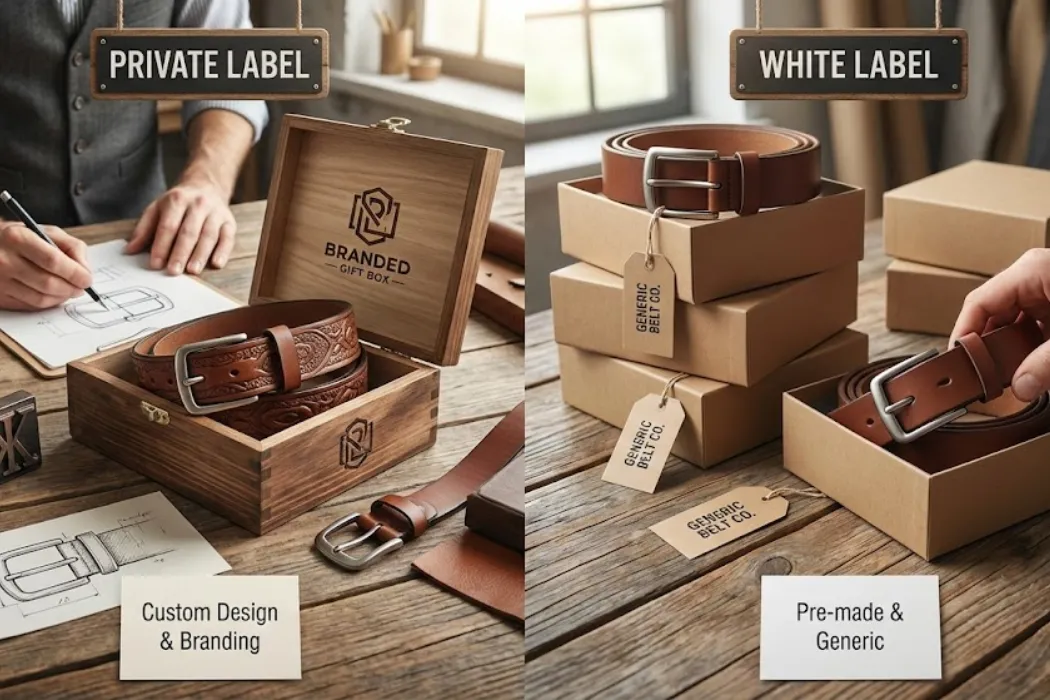
White Label manufacturing utilizes pre-engineered, factory-owned designs, allowing businesses to place their branding on finished stock for immediate market validation. This model prioritizes rapid deployment and minimal upfront investment. Conversely, Private Label manufacturing demands total control over the production cycle, requiring the brand to own the specifications for everything from the buckle’s zinc alloy composition to the leather’s specific oil content and edge finishing techniques.
This distinction goes beyond simple branding. It fundamentally alters the cost structure, requiring a rigorous analysis of tooling amortization versus inventory turnover. It impacts technical performance, determining whether a product meets generic safety standards or specific ISO durability ratings. The following analysis dissects these two models through the lens of manufacturing engineering and financial scalability, providing the data needed to secure a supply chain that matches your growth ambitions.
The Engineering Distinction: Defining the Workflows
The primary error emerging brands make is viewing the difference between White Label and Private Label as merely a branding exercise. From an engineering perspective, these are two entirely distinct manufacturing workflows. White label is a logistical process of finishing existing inventory, while private label is a developmental process of creating new intellectual property.
White Label Production: The “Off-the-Shelf” Reality
White label manufacturing operates on a stock-utilization model, where the manufacturer acts as the product owner and you simply select from existing inventory.
- Pre-Approved SKUs: Selection is limited to factory catalog specs (e.g., standard 3.5mm vegetable-tanned straps).
- Lead Time: Production utilizes pre-cut or semi-finished stock, compressing delivery to 2-4 weeks.
- Engineering Input: Your involvement is restricted solely to cosmetic branding, such as heat stamping or laser engraving.
This rigidity allows for rapid deployment but strictly eliminates your ability to alter structural specifications like stitch count, edge paint viscosity, or the leather’s temper.
Private Label Production: The “Design-to-Dustbag” Process
Private label manufacturing functions on a specification-ownership model, beginning with a detailed Tech Pack rather than a catalog selection.
- Tooling Creation: Requires CNC-machining new steel molds for custom buckles, taking 14-21 days.
- Material Control: Dictates specific leather sources, such as LWG-certified crusts from Italy or custom finishes.
- Technical Specs: Defines performance metrics like peel strength (aiming for >2.5 kg/cm) and anti-corrosion thickness.
While this workflow extends the time-to-market to 60-90 days, it results in a product that is engineered specifically for your target demographic’s usage patterns and aesthetic preferences.
Intellectual Property and Design Ownership
The most critical, yet often overlooked, engineering distinction lies in who holds the rights to the molds and design files.
- White Label IP: The factory retains ownership of the design and molds; you only own your trademarked logo.
- Private Label IP: You pay NRE (Non-Recurring Engineering) costs, typically securing exclusive rights to the design.
- Defensibility: Competitors cannot purchase or replicate your unique buckle geometry or patented mechanisms.
This “defensible moat” is essential for brands looking to build equity that can be valued and sold in the future, as it prevents your supplier from selling your best-seller to your competitor.
| Feature | White Label (Stock) | Private Label (Custom) |
|---|---|---|
| Lead Time | 2 – 4 Weeks (Rapid Launch) | 8 – 12 Weeks (Development Required) |
| Design Ownership (IP) | Factory Owned (Non-Exclusive) | Brand Owned (Exclusive) |
| Minimum Order (MOQ) | Low (Often 50-100 pcs) | Mid-High (Typically 300+ pcs) |
| Tooling Costs | $0 (Uses Existing Molds) | $500 – $2,000+ (Custom Molds) |
| Customization Depth | Logo & Packaging Only | Full Specs (Leather, Hardware, Stitching) |
White Label Belts: Speed and Market Validation
For brands prioritizing cash flow velocity over brand equity, White Label manufacturing offers a distinct strategic advantage. This model functions less as a manufacturing partnership and more as a procurement strategy.
Speed to Market Metrics
White label manufacturing circumvents the traditional bottlenecks of tooling and tanning to maximize cash flow velocity.
- Tooling Avoidance: Bypasses the 14-21 day cycle required for CNC machining custom hardware molds.
- Material Readiness: Utilizes stock leather hides, completely eliminating 30+ day tanning lead times.
- Agility: Enables brands to chase micro-trends (e.g., 35mm woven belts) and launch instantly.
Consequently, the total time-to-market is compressed to just 2-4 weeks, allowing products to reach retail shelves before a fleeting trend dissipates.
Lowering the Barrier to Entry
This model shifts the financial risk profile from asset investment (tooling/inventory) to marketing execution.
- Capital Efficiency: Eliminates upfront NRE costs, restricting expense strictly to Cost of Goods Sold (COGS).
- Minimums: Offers accessible MOQs of 50–100 units compared to the industry standard of 300-500 units.
- Validation: Allows for testing consumer preference across multiple styles without significant inventory commitment.
New entrants can effectively test market viability across five different belt styles for the price of developing a single private label SKU.
The “Me-Too” Product Risk
The engineering efficiency of white label comes at the significant cost of market distinctiveness and long-term value.
- Shared Geometry: Competitors use the exact same open molds, buckle shapes, and strap construction.
- Standard Materials: Often relies on Second Layer (Split) leather rather than premium Full Grain options.
- Price Competition: Forces brands to compete solely on margin rather than unique feature sets.
Without unique specifications, these products lack the patina potential and tensile durability required to command premium pricing or build long-term customer loyalty.
Private Label Belts: Building Defensible Brand Equity
For brands that view their product lines as long-term assets rather than temporary cash flows, Private Label manufacturing is the only viable path. This model shifts the focus from convenience to curation, allowing you to engineer a product that is physically impossible for competitors to clone off the shelf.
Custom Hardware and Mold Development
Hardware is the visual signature of a belt; moving from a catalog buckle to a custom mold transforms a generic accessory into branded jewelry.
- Mold Investment: Requires an NRE (Non-Recurring Engineering) fee, typically $500 – $2,000, to cut steel molds for zinc alloy or solid brass casting.
- Integrated Branding: Allows for logos to be 3D-debossed directly into the metal during the casting process, rather than superficially laser-etched later.
- Exclusivity Contracts: Ensures legal ownership of the geometry, preventing the factory from offering your distinct buckle design to other clients.
By owning the mold, you secure a visual identity that persists even if you change manufacturers, effectively turning a functional component into a trademarkable asset.
Material Control and LWG Sourcing
Private label frees you from the “mystery meat” of generic bonded leather, granting access to traceable, premium supply chains.
- Provenance: Enables sourcing from specific Leather Working Group (LWG) Gold or Silver rated tanneries in Italy, Brazil, or Argentina.
- Custom Finishes: Allows for proprietary developments, such as specific oil-tanned or “Crazy Horse” finishes created in specialized facilities like Pro Pelli.
- Chemical Safety: Ensures strict compliance with REACH (EU) or Prop 65 (US) standards by controlling the exact tanning recipe.
This level of control not only elevates the tactile quality of the product but also protects your brand from liability regarding chemical restrictions and sustainability claims.
Specification Dominance
True luxury is defined by the invisible engineering details that generic tech packs ignore, but which private label allows you to dictate.
- Stitch Density: You can specify a high-end 8-9 SPI (Stitches Per Inch) for a refined aesthetic, versus the standard 4-5 SPI found in white label goods.
- Edge Architecture: Mandating 3+ layers of edge paint with intermediate sanding for a perfectly smooth, convex edge profile.
- Internal Reinforcement: Controlling the choice of filler (e.g., specifying bonded leather “Salpa” over cardboard) to prevent the belt from losing shape.
Dominating these specifications ensures that your belt doesn’t just look better on the shelf—it ages better over years of wear, directly driving customer retention and reducing return rates.
Financial Forensics: Cost Structures and Margins
The choice between White Label and Private Label is fundamentally a calculus of cash flow versus margin capture. White Label minimizes upfront risk but caps profitability; Private Label requires capital injection but unlocks economies of scale.
Analyzing Minimum Order Quantities (MOQs)
MOQ is the gatekeeper of the manufacturing world, determining which model your current capital can support.
- White Label Thresholds: Factories can release as few as 50–100 units per style because the raw materials are already paid for and sitting in inventory.
- Private Label Thresholds: Requires an industry standard of 300–500 units per colorway to justify the setup time for leather cutting and edge-painting machines.
- Cash Flow Impact: White label allows for a broad assortment (10 styles x 50 units) for the same cash outlay as a single deep private label run.
For startups, the lower MOQs of white label preserve vital liquidity for marketing, while private label demands a commitment to volume sales to clear the higher inventory hurdles.
The Impact of Tooling Fees
Tooling costs (NRE) are the primary differentiator in the upfront balance sheet, acting as a “buy-in” fee for exclusivity.
- Amortization Logic: A $1,500 mold fee adds $15.00 per unit to a 100-piece run, but only $0.50 per unit to a 3,000-piece run.
- White Label Savings: Eliminates this line item entirely, using “public domain” hardware that costs $0 in development.
- Barrier to Scale: Avoiding tooling fees saves money initially but ties you to generic hardware that cannot be trademarked or defended.
Smart brands view tooling not as an expense, but as a capital asset—once paid, the mold belongs to you, and the unit cost drops significantly on all re-orders.
Unit Cost vs. Total Landed Cost
While Private Label has higher startup costs, it offers a significantly lower per-unit cost (FOB price) at scale.
- The Markup Gap: White label products often carry a 20-30% premium on the unit price because the factory assumes the inventory risk.
- Material Efficiency: Private label pricing is calculated on “cost-plus” (material + labor + margin), removing the “convenience premium” of in-stock goods.
- Break-Even Point: Typically, once a brand surpasses 1,000 units annually, the savings in unit cost outweigh the initial mold fees.
Transitioning to private label is the single most effective lever for increasing gross margin, often improving profitability by 15-25% purely by removing the middleman’s inventory surcharge.
| Cost Driver | White Label (500 Units) | Private Label (500 Units) |
|---|---|---|
| Tooling / NRE Fees | $0 | $1,200 (One-time) |
| Unit Price (FOB) | $9.50 (Stock Premium) | $6.80 (Direct Cost) |
| Custom Packaging | $0.50 (Generic) | $1.20 (Custom Box) |
| Total Investment | $5,000 | $5,200 |
| Effective Cost Per Unit | $10.00 | $10.40 (First Run) / $8.00 (Re-order) |
Quality Assurance and Physical Performance
While marketing sells the first belt, quality sells the second. Private Label allows you to define the failure point of your product through rigorous testing standards, whereas White Label forces you to accept the factory’s default risk tolerance.
Tensile Strength and Load Testing
A belt is a structural device, not just an accessory; it must withstand significant torque and tension without elongation or deformation.
- Generic White Label: Often untested or rated only for “cosmetic hold,” frequently failing at loads as low as 20-30 kg.
- Private Label Standard: Can be engineered to meet ISO 3377 tear strength standards, supporting loads exceeding 100 kg without snapping.
- Hardware Integrity: Custom molds allow for strict ASTM D2208 grab tests to ensure the buckle prong does not shear off under daily stress.
By specifying load ratings in your tech pack, you eliminate the catastrophic failure modes—like a snapped buckle—that lead to viral negative reviews and returns.
Chemical Compliance and Safety
Global market access depends on strict adherence to chemical safety regulations, which are invisible to the eye but critical for legality.
- Regulatory Risks: White label stocks may contain undisclosed substances, risking violation of EU REACH (Cadmium/AZO dyes) or California Prop 65 (Lead/Phthalates).
- Control Points: Private label allows you to mandate Lead-Free (<90ppm) zinc alloy hardware and chrome-free vegetable tanning agents.
- Verification: You can demand third-party lab reports (e.g., SGS or Intertek) for every production batch before shipment.
Ignorance is not a legal defense; private label ensures you are the master of your supply chain’s chemical composition, not a victim of it.
Color Fastness and Wear Resistance
The “crocking” phenomenon—where dye rubs off onto a customer’s khaki pants—is a common brand-killer in low-end manufacturing.
- White Label Risk: Often uses surface-sprayed pigments that score low (Grade 2-3) on the ISO 11640 rub test.
- Private Label Solution: Enables the specification of “drum-dyed” leathers that penetrate the fiber, achieving Grade 4-5 wet/dry rub resistance.
- Edge Durability: Specifying heat-set edge paint prevents peeling after exposure to sweat and humidity.
Investing in superior dyeing processes protects your customers’ clothing and preserves your brand’s reputation for premium quality.
| Test Standard | Purpose | Private Label Target Value |
|---|---|---|
| ASTM D2208 / ISO 3377 | Tear Strength & Load | >100N (Newtons) |
| ISO 11640 | Color Fastness (Crocking) | Grade 4/5 (Wet & Dry) |
| ASTM D6182 | Flex Resistance (Cracking) | >50,000 Cycles |
| CPSC / REACH | Lead Content (Hardware) | <90 ppm (Total Lead) |
Strategic Scaling: Choosing the Right Path
The decision between White Label and Private Label is rarely binary. Successful brands often employ a dynamic strategy that evolves with their revenue milestones, leveraging the speed of one and the equity of the other to maximize growth.
The Hybrid Approach
The most sophisticated retailers utilize a “Core vs. Trend” portfolio strategy to balance inventory risk with brand identity.
- The “Signature” Core (Private Label): Invest your NRE budget here. Develop 2-3 evergreen belts (e.g., a classic 35mm dress belt with custom hardware) that define your brand and generate 70% of revenue.
- The “Seasonal” Chase (White Label): Use stock production for high-risk, short-lifecycle trends (e.g., neon colors or studded wide belts) to capture immediate market demand without tooling commitments.
- Market Testing: Launch a new concept as White Label first; if sales exceed 500 units, transition it to Private Label with custom upgrades for the next re-order.
This hybrid model protects your cash flow from “fashion misses” while ensuring your flagship products remain proprietary and defensible assets.
Indicators It Is Time to Switch
Transitioning from White Label to Private Label should be a mathematically driven decision, triggered by specific volume and margin thresholds.
- Volume Threshold: When a single SKU sells over 1,000 units annually, the savings in unit cost (FOB) will mathematically outweigh the initial mold amortization within 6 months.
- Margin Compression: If you need to enter wholesale distribution, the 20-30% premium attached to white label goods will make your margins too thin to support retailer commissions.
- Quality Control limit: When return rates for “generic defects” (e.g., edge peeling) exceed 3-4%, it signals that off-the-shelf quality is damaging your brand equity.
Switching too early drains liquidity on unnecessary molds; switching too late bleeds potential profit margin to the middleman.
Vetting Manufacturing Partners
Whether you choose speed or customization, the integrity of your manufacturing partner determines your supply chain’s resilience.
- Social Compliance Audits: Demand current SMETA (Sedex) or BSCI audit reports to ensure your products are not made in sweatshops, protecting you from PR disasters.
- Vertical Capability: Prioritize factories with in-house finishing (like a dedicated tannery or finishing plant) to control leather consistency rather than those who rely solely on market stock.
- Dual-Country Options: Look for partners with facilities in both China (for complex R&D) and Southeast Asia (like Cambodia) to hedge against tariffs and leverage lower labor costs for volume runs.
A true manufacturing partner doesn’t just take orders; they provide the compliance documentation and scalable infrastructure required to sell into major global retailers.
Frequently Asked Questions
What is the main difference between white label and private label belts?
White label refers to buying pre-made, stock products and applying your logo to them. Private label involves creating a unique product from scratch, where you control the design, materials, and specifications.
Is private label manufacturing more expensive than white label?
Upfront, yes. Private label requires investment in molds (NRE) and sample development. However, at scale (usually over 1,000 units), private label offers a significantly lower per-unit cost than white label.
What is a typical MOQ for private label leather belts?
The industry standard is 300–500 units per style/color to justify material preparation. White label MOQs can be as low as 50 units.
Can I trademark a white label product?
You can trademark your brand name and logo, but you generally cannot trademark the physical design of a white label belt because the factory retains the IP rights to the mold and structure.
How long does it take to develop a private label belt collection?
Expect a timeline of 60–90 days: 2-3 weeks for design/tooling, 2-3 weeks for sampling, and 4-6 weeks for bulk production.
Do I need a tech pack for white label products?
No. For white label, you typically only need to provide your logo file (AI/PDF vector format) and select your desired colorways from the factory catalog.
Conclusion: The Best of Both Worlds
The choice between White Label and Private Label is ultimately a trade-off between speed and equity. White Label is the tactical choice for testing waters and generating immediate cash flow. Private Label is the strategic choice for building a defensible brand asset that commands loyalty and higher valuations.
However, the ideal growth trajectory often requires a partner who can navigate both worlds. This is where Hoplok Leather Goods stands apart. With over 22 years of experience and a unique dual-country infrastructure (China & Cambodia), Hoplok bridges the gap between agile startups and global retailers.
Unlike rigid manufacturers, Hoplok offers:
- Flexible Scalability: Support for lower MOQs to help emerging brands launch, with the capacity to scale to 800,000 units/month for global expansion.
- Vertical Material Control: Through our self-owned Pro Pelli leather finishing facility, we offer private label clients exclusive access to LWG-standard finishes that competitors cannot replicate.
- Turnkey Engineering: From rapid 2-7 day sampling to full tech pack development, our engineering team ensures your transition from white label to private label is seamless.
Whether you need to capture a trend next month or build a legacy for the next decade, your supply chain should be an accelerator, not a bottleneck.
Ready to engineer your next bestseller? Contact Hoplok today for a consultation on your specific project needs.