Choosing between private-label and white-label belts affects development work, differentiation, inventory commitments and the documents you need from a supplier. The best route depends on your product brief and commercial position, rather than a universal rule that one model is faster, cheaper or higher quality.
Terminology varies. White label commonly means an existing supplier design offered to multiple brands. Private label broadly means goods sold under a retailer’s or brand’s own label and can include either adapted existing designs or more extensive custom development. Ask what the supplier actually offers instead of relying only on these labels.
This guide compares a shared-design route with a specification-led custom route. It covers the practical decisions around hardware, materials, tooling, quality and repeat orders so that buyers can compare quotations on a consistent basis.
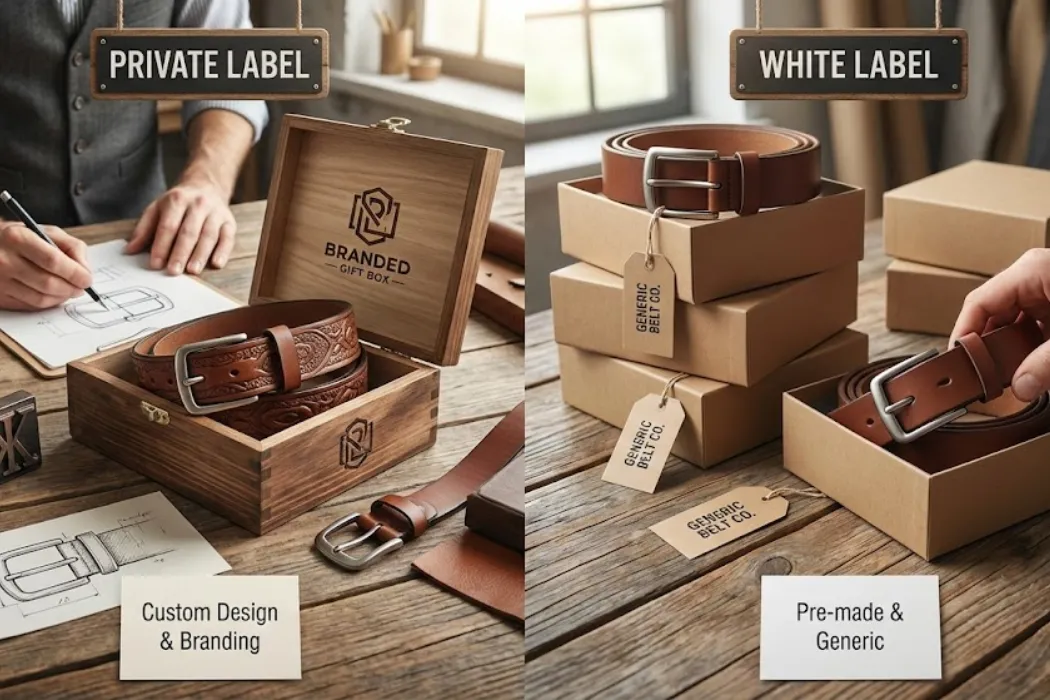
The illustration contrasts common shared-design and custom-development arrangements. Actual supplier programmes can overlap, and an existing design may be produced to order rather than held as finished stock.
The Manufacturing Distinction: Defining the Workflows
The meaningful difference is the work required before production: choosing an approved existing construction, modifying it, or developing a new one. A branding-only order can still require approval and manufacturing; a private-label order does not always require a new mould.
White Label Production: The Existing-Design Route
Start with the supplier’s available belt designs and establish what can change. Options might include a logo, packaging, colour or selected components, but each change needs confirmation. An existing catalogue is not evidence of ready-to-ship stock.
Ask for the exact material, dimensions, buckle and finish, plus stock or production availability. Check whether the same design is offered to other buyers and whether repeat orders will use the same materials. Those details determine both launch planning and future consistency.
Private Label Production: The Custom-Development Route
A more extensively customised belt begins with a technical brief covering leather, layers, dimensions, hardware, edges, branding and packaging. Development may use existing components where they meet the brief, reserving new tooling for features that actually require it.
Agree on drawings, samples and approval milestones before bulk production. Custom hardware can add development work, but mould duration and cost depend on the part and supplier. A material test requirement should likewise match the actual construction, not a generic premium target.
Intellectual Property and Design Ownership
Tool ownership, design-file ownership, permitted use and exclusivity are separate matters. Paying a development fee does not automatically transfer every right or create patent protection. Record what the contract grants and what remains the supplier’s existing intellectual property.
For example, the USPTO design-patent guide describes protection for qualifying ornamental designs through an application process. A manufacturing invoice is not a patent. Obtain advice on the protection relevant to your markets and design.
For custom tooling, specify storage, maintenance, use by others, release or transfer arrangements and what happens when the relationship ends. Do not assume that owning a physical mould makes a component impossible to copy.
| Decision | Existing shared design | Custom specification |
|---|---|---|
| Development | Confirm available options and approvals | Define changes, samples and any new tooling |
| Availability | Verify stock or production schedule | Confirm material and component readiness |
| Rights | Check permitted branding and design use | Agree ownership, licensing and exclusivity in writing |
| Minimum order | Supplier- and programme-specific | Material- and project-specific |
| Quality | Inspect and test the selected construction | Inspect and test the developed construction |
White Label Belts: Speed and Market Validation
An established design can reduce development decisions and may suit a buyer testing an assortment. The benefit depends on the actual availability and suitability of the product. It does not remove the need to inspect samples or assess the commercial commitment.
Speed to Market
Using an existing buckle and material can avoid some tooling or material-development stages. However, branding, packaging, production allocation and shipping still take time. Confirm each milestone rather than assuming a fixed two-to-four-week launch.
Ask which parts are genuinely in stock, how long they can be reserved and what substitutions might be proposed later. If a seasonal deadline matters, make it part of the quotation and approval plan.
Lowering the Barrier to Entry
An existing-design programme may need less development spending, but it does not necessarily have a lower minimum quantity. Compare the complete first-order commitment, including samples, branding setup, packaging and unsold inventory exposure.
For a small assortment, avoid ordering many variants merely because each appears inexpensive. Use your demand evidence and available cash to decide which combinations are worth testing. Request the actual supplier minimums before building the launch budget.
If other brands can buy the same design, differentiation may come from assortment, fit, service, presentation or distribution. That is a commercial consideration, not proof that the leather must be split, bonded or low quality.
Ask for the material and performance evidence just as you would for a custom belt. An established design can be well made; a unique design can still be poorly executed. Neither business model determines patina or durability.
Private Label Belts: Developing a Distinctive Range
Custom development can help a brand meet a particular fit, appearance or construction brief. Its value should be clear enough to justify the additional decisions and commitments. Exclusivity, quality and commercial success each require their own evidence.
Custom Hardware and Mould Development
Define the intended geometry, base metal, finish and branding before requesting a tooling quote. Compare whether the feature needs a new mould or can be achieved through an existing part and another decoration process.
The quote should distinguish tooling, samples and unit production. Record approval criteria and the rights associated with the design and tool. If portability matters, discuss whether the tool can actually be used by another manufacturer and under what conditions.
Material Control and LWG Sourcing
A custom brief can identify the required grain treatment, tannage, temper, finish and source documentation. The same information can also be requested for an existing design. Material transparency is a purchasing requirement rather than an exclusive feature of custom manufacturing.
Hoplok’s ProPelli facility finishes incoming crust leather and holds a current LWG Gold rating. It is not a raw-hide tannery. LWG certification concerns the assessed operation and does not guarantee that every finished product passes all restricted-substance requirements.
Agree any custom colour or surface effect through a physical reference and specification. A facility rating does not establish ownership or exclusivity of that finish.
Controlling the Construction Specification
Specify stitch type and spacing, edge finish, layer construction, buckle attachment and dimensions. Set these to suit the product rather than assuming a particular SPI, paint-layer count or filler material is always premium.
Review the complete sample and its relevant test results. An attractive edge or denser seam does not alone prove longer life. Keep the approved sample and technical pack aligned so production has one clear reference.
Cost Structures and Margins
Compare first-order cash requirements and likely repeat-order costs separately. Development charges, minimum quantities, stock risk and delivered costs can change the result. Neither sourcing label guarantees a margin improvement.
Analysing Minimum Order Quantities
Ask how the minimum applies and whether component or material minimums create additional commitments. Do not generalise one supplier’s quantity to an entire industry or assume catalogue goods are available in fifty-piece runs.
Hoplok’s belt MOQ is 300 leather pieces or 1,000 PU pieces. Confirm the proposed assortment and order allocation in the quotation. These are Hoplok’s stated belt minimums, not universal definitions of private or white label.
The Impact of Tooling Fees
For a simple comparison, allocate a confirmed tooling fee across the number of units you realistically expect to purchase. The arithmetic is tooling cost divided by allocated units. Keep that calculation separate from the supplier’s unit price and any accounting treatment.
Include maintenance, modification and replacement arrangements where applicable. Reorders may avoid the initial tool-development charge, but material, labour and other prices can still change. The fee is not automatically a purchase of all design rights.
Unit Cost vs. Total Landed Cost
Compare quotations using the same product specification, quantity, packaging and delivery terms. Add applicable freight, insurance, duties, taxes and destination charges when estimating landed cost. A lower factory price can be offset elsewhere.
Use your own quotations and sales assumptions to calculate a break-even point. There is no universal annual volume at which custom production becomes cheaper, and no standard percentage premium attached to white-label goods.
| Cost item | Existing-design quote | Custom-development quote |
|---|---|---|
| Development and tooling | Confirm branding, sample and setup charges | Separate design, sample and tool charges |
| Unit production | Price the exact selected construction | Price the approved custom specification |
| Packaging | Confirm included items and changes | Confirm custom materials and minimums |
| Delivered cost | Add charges under agreed delivery terms | Add charges under the same comparison basis |
| Repeat orders | Check availability and substitution policy | Check retained tooling and current material prices |
Quality Assurance and Physical Performance
Both sourcing routes need suitable specifications and verification. Quality is not an automatic consequence of customization. Define the relevant material and finished-belt checks before approving a production order.
Material Strength and Attachment Testing
Distinguish a leather specimen test from a buckle or complete-belt attachment test. ISO 3377-1 describes a leather single-edge tear method; it is not a universal finished-belt load rating. Specify the actual test and acceptance criteria for the question being asked.
For the buckle fold, evaluate the representative leather stack and fastening. Record the setup and where damage occurs. An ordinary apparel belt should not be marketed as load-bearing safety equipment based on an unrelated strength figure.
Chemical Requirements and Verification
Identify requirements from the target market, product category and materials. Neither white label nor private label is automatically compliant. Ask for representative evidence and a process for assessing material or finish changes.
California Proposition 65 concerns exposure and warning duties, not one universal lead-content threshold for all hardware. For relevant US children’s products, CPSC paint requirements must be distinguished from accessible-substrate requirements. Agree the appropriate test scope with a competent laboratory.
Colour Fastness and Wear Resistance
Colour transfer can occur when a belt rubs against clothing. Assess the selected face, lining and edge finish under the agreed dry, wet or other relevant conditions. A dyeing label does not guarantee a rubbing grade, and surface pigmentation is not automatically inferior.
Review edge adhesion and flex behaviour on the complete construction. A fixed number of paint layers or a “heat-set” description cannot substitute for process compatibility and performance evidence.
| Quality question | What to assess | Acceptance basis |
|---|---|---|
| Material consistency | Identity, thickness, temper and finish | Approved material reference and specification |
| Colour transfer | Relevant rubbing behaviour | Agreed method, conditions and grade |
| Construction | Attachment, seams, edges and flexing | Representative finished-belt test plan |
| Chemical requirements | Relevant materials and exposure | Applicable market requirements and valid evidence |
Strategic Scaling: Choosing the Right Path
A range can combine existing and custom elements. Make that choice style by style, using demand evidence, differentiation needs and available resources. A staged approach should still maintain clear material and quality requirements.
The Hybrid Approach
A brand might develop distinctive hardware for a core style while using an existing component for a seasonal design. Another may begin with an established construction and later change its fit or materials. Neither sequence requires a fixed revenue split.
Keep the specification and approval history for each version. If customer feedback leads to a change, record what changed and evaluate its effect rather than treating the next order as automatically equivalent.
Indicators It Is Time to Switch
Consider custom development when a repeated fit, design or material need cannot be met by the current offer, and when expected demand supports the commitment. Compare realistic forecasts and supplier quotes rather than a universal sales threshold.
If quality is the problem, first investigate the cause and supplier response. A change in manufacturing label alone will not fix poor edge preparation or an unsuitable buckle. Evaluate corrective action alongside alternative sourcing options.
Vetting Manufacturing Partners
Verify the actual production site, material sourcing, relevant capability and capacity available to your order. Ask which operations are in-house and which are subcontracted. A finishing facility and a tannery have different roles.
Review relevant social-audit evidence, scope and follow-up rather than collecting logos. Sedex describes SMETA as an audit methodology used to assess conditions and support improvement; it is not a blanket ethical-product certificate.
For a multi-country proposal, confirm the actual production route and landed cost. Location alone does not guarantee a tariff saving or shorter lead time.
Frequently Asked Questions
What is the main difference between white label and private label belts?
White label commonly refers to an existing shared design. Private label means goods sold under the buyer’s brand and may involve limited adaptation or extensive customization. Confirm the actual design, production and rights arrangement with the supplier.
Is private label manufacturing more expensive than white label?
Custom development can add upfront work and tooling, but the total comparison depends on the specification, quantity and supplier. Calculate first-order and repeat-order costs from real quotations.
What is a typical MOQ for private label leather belts?
Minimums vary by manufacturer and programme. Hoplok’s stated belt MOQ is 300 leather pieces or 1,000 PU pieces. Confirm the proposed order details in the quotation.
Can I trademark a white-label product?
Brand marks and product-design rights are different matters. A sourcing label does not decide trademark eligibility or transfer design rights. Check your rights to use the design and obtain appropriate advice before making protection claims.
How long does it take to develop a private-label belt collection?
For Hoplok, belt sampling typically takes 2–3 weeks and bulk production 60–90 days. Confirm tooling, material readiness, approvals and shipping separately. The bulk-production period is not the complete development-to-delivery timeline.
Do I need a tech pack for white-label products?
You still need a clear order specification: selected design, materials, dimensions, branding, packaging and acceptance criteria. An approved catalogue reference may cover some details, but changes should be documented.
Conclusion: Choose the Scope That Fits the Range
Compare the actual work, rights, costs and evidence behind each offer. An existing design can support a suitable launch, and custom development can meet a distinct product need. A written specification and realistic approval plan matter in both cases.
Hoplok manufactures leather goods in China and Cambodia and offers custom leather belt development and production. Belt MOQ is 300 leather pieces or 1,000 PU pieces. ProPelli handles incoming-crust finishing and holds a current facility-level LWG Gold rating.
Hoplok’s stated monthly capacity is 200,000–300,000 leather belts and 600,000–800,000 PU belts. Confirm the available production allocation for the proposed order.
Share your belt brief, material preference, quantities and required launch date. The quotation can identify development work, component requirements and the schedule, with belt samples typically taking 2–3 weeks and bulk production 60–90 days.