“Woven” describes a construction, while “leather” describes a material. A bag can be both woven and leather. A fair durability comparison therefore separates solid leather panels, leather strips, natural plant-fibre weaves and synthetic woven materials, then examines the complete bag.
There is no universal rule that all leather bags last decades while all woven bags last only a summer. Compare the materials, lining, attachments and intended use rather than assigning lifespan from the category name.
Define the construction being compared
| Construction | What to identify | Potential inspection focus |
|---|---|---|
| Solid leather panels | Leather reference, finish, thickness and support | Corners, folds, edges and attachment areas |
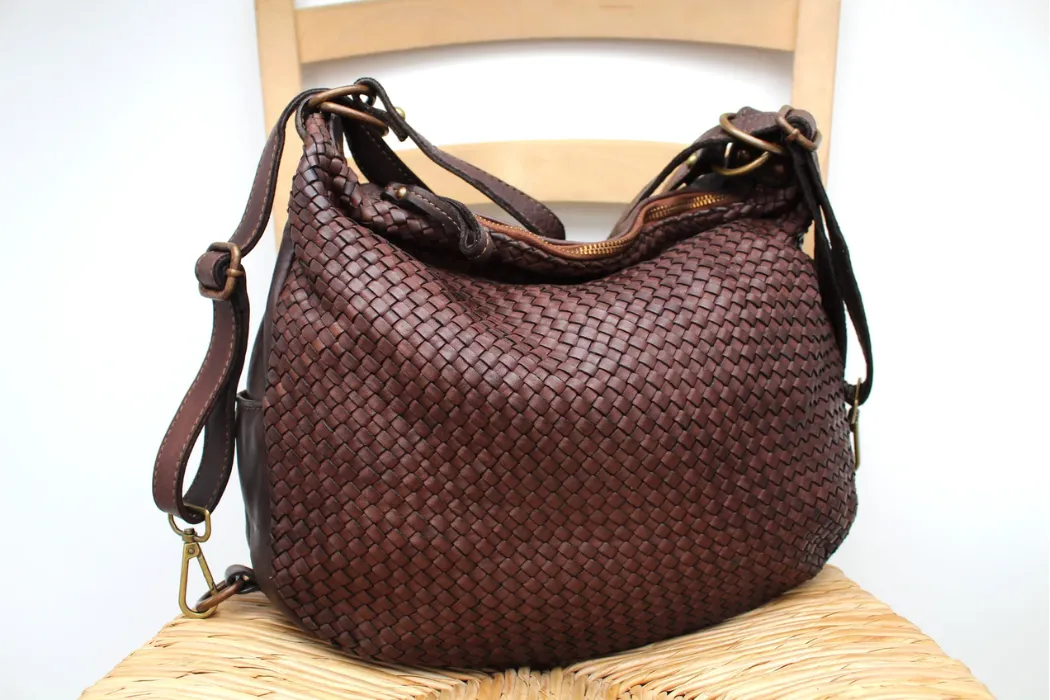
| Woven leather strips | Strip material, width, joins, backing and finish | Strip movement, exposed edges and termination points |
| Natural-fibre weave | Actual fibre and weave structure, lining and reinforcement | Snagging, local damage, distortion and handle attachment |
| Synthetic woven material | Fibre or strip composition, coating and construction | Abrasion, seam performance, coating and dimensional change |
| Embossed woven effect | Base material with a surface pattern | Surface finish and base construction; it is not an interlaced weave |
“Raffia-look” may describe an appearance rather than the actual fibre. Likewise, a woven pattern in PU does not prove that leather strips were used. Ask for the composition and construction details before comparing quotations or writing the label.
How will the bag be used?
A daily tote carrying a device needs different checks from a light occasion pouch. Record the contents and carrying positions, then examine the base, lining and handle path together. Neither a leather panel nor an attractive weave automatically makes the assembly suitable for the intended contents.
Use the same contents and assessment conditions when comparing prototypes. Check opening access, deformation, attachment movement and the appearance after unloading. Do not substitute an informal demonstration for a specified performance test or label the result with an unsupported maximum load.
Inspect the weave at the points where it ends
Look at the top edge, side joins, base corners and places where handles connect. Confirm how strips or fibres are secured and whether a lining or reinforcement carries part of the load. Check the inner surface for exposed ends that can catch contents.
On woven leather, inspect strip edges and intersections as well as the overall pattern. A dense weave may hide minor marks visually, but this does not prove higher abrasion resistance. A woven surface can also add thickness, weight or snag points that need assessment.
Water exposure and care are separate questions
Openings in a weave can allow water to pass even when individual strands resist wetting. A leather face can bead water while seams and edges remain vulnerable. Check the finished bag against the actual exposure requirement before using “waterproof.”
Care depends on the specific material combination. Do not assume natural fibres should be oiled like leather or that all synthetic weaves can be washed. Publish the approved method for shell, lining and trim. For leather moisture questions, see the water-resistance guide.
Suspected mould needs assessment rather than a universal vinegar wipe. Storage conditions and packaging should keep articles dry and appropriately supported, with instructions suited to the finished product.
Compare repair access and appearance expectations
A broken strand, damaged panel or failed handle may be repairable depending on access, remaining material and available replacement parts. Invisible repair is not guaranteed for either construction. Ask how likely repairs would be performed before claiming repairability on the product page.
Define acceptable variation in natural fibres or leather through approved samples. A brand can value an irregular texture without accepting loose joins or failed attachments. Keep appearance acceptance separate from functional acceptance.
What to send with a sourcing enquiry
Provide the intended contents, outer dimensions, material composition, weave or surface reference, lining, handle design and desired care instructions. Identify which features are open to adjustment. Ask the supplier to confirm feasibility and sample assessment requirements for the chosen construction.
For Hoplok bag development, discuss the specific leather or PU design through the contact page. A style reference does not establish that every natural-fibre or technical woven construction is part of the offered range; confirm the project details first.
Frequently asked questions
Can a woven bag also be a leather bag?
Yes. Woven describes how elements are interlaced; leather can be the material used for those elements.
Is woven leather always stronger than solid leather?
No. Compare the particular materials, backing, joins and complete bag under the same intended-use assessment.
Are natural-fibre bags impossible to repair?
No universal rule applies. Feasibility depends on the damage, construction, access and available repair skills or materials.