The best material for a personalised passport cover depends on the decoration, construction and target use. Leather can suit a tactile debossed design; a suitable PU grade can support a uniform printed collection; canvas or nylon can suit a textile-based design. None of these names guarantees a fixed lifespan, waterproofing or successful logo application.
A useful cover should fit the intended passport, allow easy removal and avoid transferring colour, coating or adhesive to the document. Before comparing decorative finishes, check pocket dimensions, edge construction and how the loaded cover folds.
This guide compares materials through the practical questions that determine a good sample: how the logo is applied, how the surface wears, what care it needs and what evidence supports any protective claim.
Why Choose Leather for Personalisation?
Leather offers a range of textures, handles and finishes for small accessories. A firm vegetable-tanned grade may suit a pronounced impression, while a softer or heavily finished leather may need a different decoration approach. “Genuine leather” alone does not specify the grain, tannage or finish.
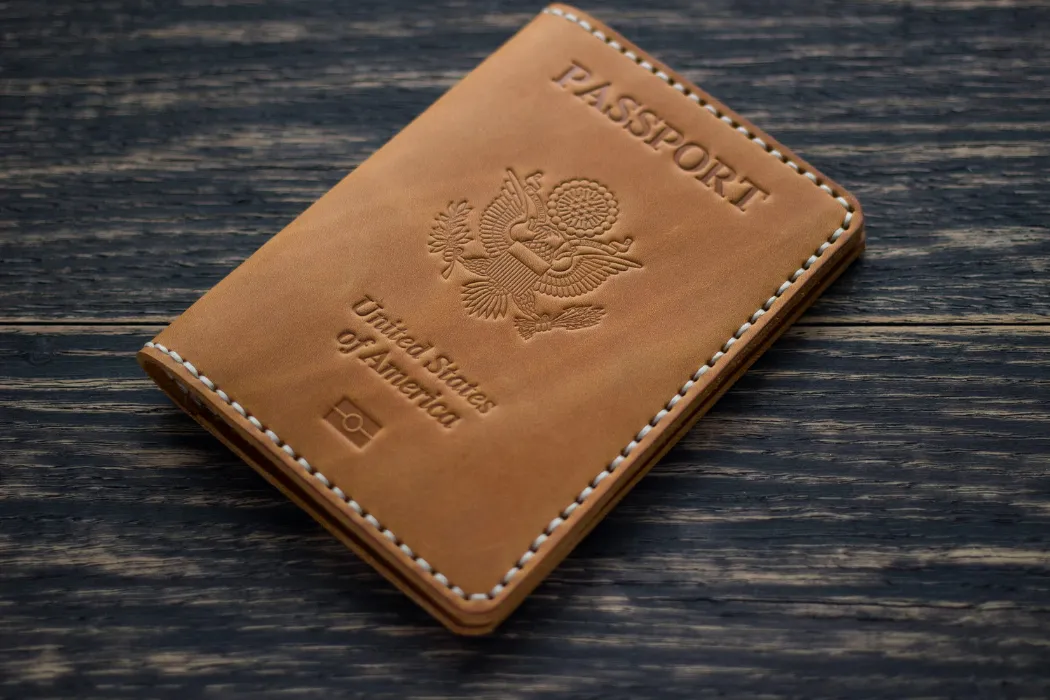
The Mechanics of Debossing: Material and Tooling
Debossing presses an impression into the surface. The outcome depends on the substrate, finish, thickness, tool detail and process settings together; it is not controlled by fibre density alone.
- Material selection: Compare the actual leather grades with the same artwork. Check sharpness, unwanted gloss, distortion and recovery after the sample has rested.
- Artwork: Fine lettering, deep impressions and placement near seams need sample approval. A large flat logo trial does not necessarily predict a small monogram on a folded pocket.
Full-grain describes the retained grain surface, not a guarantee that an impression will remain unchanged for decades. Leather and Hide Council terminology helps distinguish grain descriptions from performance claims.
Saffiano Leather: Texture and Finish
Prada describes its Saffiano as calfskin with a heat-embossed texture and characteristic waxed finish. In general sourcing, a Saffiano-style crosshatch can also be reproduced on other substrates, so request the actual composition.
- Appearance: A crosshatch texture can make small marks less conspicuous, but it is not scratch-proof. Check corners and folds as well as flat surfaces.
- Decoration: The texture may interrupt fine foil detail. Approve the logo size, foil coverage and placement on the exact finish.
A water-repellent surface is not a waterproof passport cover. Open edges, seams and pockets remain relevant to protection of the document inside.
Specifying Materials for Personalised Passport Covers
Put the material reference, thickness, finish, artwork, placement and acceptable impression in the sample brief. Record production settings through the approved process rather than treating one temperature or depth as a universal leather rule.
- Heat and pressure: Follow the substrate and decoration-system requirements, then trial the actual assembly. A fixed 130°C setting is not a general collagen “glass-transition” specification.
- Depth and support: Check the impression against remaining thickness, pocket function and visible marks on the reverse. There is no mandatory 0.5 mm deboss depth for every cover.
Does Faux Leather Offer a Durable Alternative?
A suitable PU-coated textile can work well for a passport-cover design, but the coating, backing and finish must be specified. Evaluate bending, adhesion and decoration on the actual grade. Waterborne processing is an attribute to investigate, not proof that a material cannot crack or that it is automatically more sustainable.
PU and PVC: Compare the Full Construction
PU and PVC identify different polymer families. Neither tells the buyer the complete additive package or the performance of the finished accessory. A material may also combine different layers.
- PVC: Flexible formulations use plasticisers, which are not all the same substances. Assess applicable chemical requirements rather than assuming every grade contains the same restricted phthalates.
- PU: Identify the coating, backing and any foam or adhesive. Request relevant ageing, flex and adhesion evidence instead of relying on “PVC-free” as a complete quality specification.
For a fuller purchasing comparison, see the PVC and PU material-evidence guide. Chemical compliance and environmental claims need their own defined support.
The Colour and UV-Printing Options
Both natural leather and suitable synthetic grades can be UV printed. Roland’s leather-printing guidance demonstrates that printing is not exclusive to PU. Ink adhesion still depends on the actual surface and printing system.
- Adhesion: Follow the equipment and ink supplier’s guidance. Roland’s primer instructions address materials on which UV ink does not adhere readily; instant bonding is not a universal assumption.
- Consistency: Approve colour and artwork on the production material, then define the allowable range. A uniform coating can simplify matching but does not guarantee identical colour in every batch.
Leather and Faux-Leather Personalisation Matrix
| Technique | Leather considerations | PU considerations | Approval check |
|---|---|---|---|
| Foil application | Texture and finish affect coverage | Requires a compatible foil and process | Detail, adhesion and resistance to rubbing |
| Blind debossing | Grade and thickness affect impression | Only where the substrate supports the process | Sharpness, recovery and reverse-side damage |
| UV printing | Suitable systems can print leather | Adhesion is surface-specific | Colour, adhesion and flex after printing |
| Laser marking | Confirm exact material compatibility | Use only a specifically verified compatible grade | Supplier approval, safe processing and sample result |
Laser suitability cannot be decided by “real versus faux.” Trotec identifies PVC as unsuitable, while its dedicated material range includes a laser-compatible PU product. That particular grade does not establish that all PU sheets are suitable. Confirm the actual composition and equipment requirements before processing.
When Should You Choose Canvas or Nylon Instead of Leather?
Canvas and nylon can suit a lightweight, textile-led design with printing, a patch or a woven label. Their suitability depends on fabric weight, weave, coating and assembly. “Ballistic nylon” is a textile description here, not a promise of protective or tactical performance.
The Weight Factor
Weigh complete samples with the same pocket layout rather than comparing the density of outer materials alone. Lining, reinforcement, closure and additional shielding can materially affect total weight and bulk.
- Leather version: Specify the thickness and whether pockets require reinforcement. More card slots and folded edges add bulk independently of the leather name.
- Textile version: Include backing and lining in the comparison. A lightweight face fabric may still require support for pocket shape or decoration.
A claim that every nylon cover weighs one-third as much as every leather cover is not a useful purchasing basis. Record the weight of the approved finished sample.
Water Resistance: Protecting the Pages
A coated fabric may resist surface wetting, but the finished cover’s seams and openings can admit water. Do not call an ordinary open passport sleeve waterproof because the shell fabric has a water-resistance claim.
- Material evidence: Identify the coating and any relevant test report. Water beading alone does not measure protection under sustained exposure.
- Product use: Check the closure and document access. Keep the passport away from water and follow its issuer’s care instructions; an accessory should not encourage more hazardous storage.
Customisation Limits of Fabric
A woven textile does not generally accept the same deep impression as a leather surface. A separate patch, suitable print or label may provide clearer decoration, depending on the design.
- Heat application: Evaluate distortion, coating damage and appearance before approving a heat-transfer process.
- Labels and printing: Check stitch placement, reverse-side bulk, ink adhesion and any contact with the document. A woven label can also carry clear material and care information.
How Does Material Affect RFID-Blocking Capability?
A leather, PU or nylon outer shell is not evidence of RFID shielding. If shielding is a product requirement, specify the intended function and assess the assembled cover. Avoid implying that an accessory is mandatory to make every passport secure: ICAO Doc 9303 Part 11 describes chip-access security mechanisms as well as possible physical shielding.
The Layered Construction
A shielding layer may be integrated between the outer and inner materials. Its performance depends on the conductive material, coverage, openings and construction, not on the luxury status of the outer leather.
- Specification: Identify the layer and the intended frequency or reader system in the technical brief. Confirm whether the claim applies with the cover open or closed.
- Integration: Check folds, joins, pocket fit and any change after repeated use. Sound or thickness alone cannot establish shielding quality.
Confirm the proposed shielding design and evidence during development. Do not assume a particular metal-mesh recipe is present in every cover or available in every quotation.
Testing the Shielding Claim
A failed phone scan is not a certification of protection. A reader may fail because of compatibility, orientation, access controls or the test setup. An office badge can also use a different system from the document the cover is intended for.
- Development check: Define the reader, compatible test document or test device, distance, orientation and cover position, with an uncovered control.
- Claim evidence: Obtain a documented assessment against the intended claim, including the finished construction and relevant ageing. Do not turn a single home experiment into a broad anti-theft guarantee.
What Maintenance Do Different Passport Covers Need?
Care should follow the exact material, finish and decoration. Remove the passport before cleaning, keep the cover away from excessive heat and avoid saturating it. A product-specific care instruction is more useful than an automatic oiling or washing schedule.
Protecting Foil Decoration on Leather
Foil decoration can wear through friction or incompatible cleaning products. Its durability depends on the foil system and surface preparation as well as use. Metallic appearance does not mean a thick layer of solid gold is present.
- Cleaning products: Use only those recommended for the complete finish and decoration. Test an inconspicuous area before broader use; do not automatically apply mink oil or leather balm.
- Friction: Keep keys and abrasive objects away from the decorated face. Describe likely care needs without claiming a fixed number of weeks before wear.
Cleaning Printed PU Surfaces
Start with the manufacturer’s instructions for the printed coating. Avoid aggressive rubbing and unapproved solvents; the compatibility of water, detergents or disinfectants depends on the specific material and ink.
- Routine care: A soft cloth may be sufficient for dust. Use a lightly damp cloth only where the supplier recommends it.
- Stains: Do not escalate to stronger chemicals by trial and error. Ask for a method appropriate to the stain and finish.
Material Durability and Care Comparison
| Material | Wear question | Moisture question | Care approach | Approval evidence |
|---|---|---|---|---|
| Full-grain leather | Surface, corner and fold wear | Finish-specific absorption and marking | Supplier-approved care for the finish | Decorated sample and relevant checks |
| Saffiano-style leather | Texture and coating wear | Finished cover is not automatically waterproof | Protect coating and foil from abrasion | Composition and finish reference |
| PU-coated textile | Coating adhesion, flex and ageing | Backing, edges and seams also matter | Care compatible with coating and print | Exact material and assembled-product evidence |
| Nylon or canvas | Fabric, coating and seam wear | Assess coating and openings | No washing assumption for a multilayer product | Finished weight, construction and care trial |
How Do Brands Choose Materials for a Collection?
Start with the target customer, decoration and intended retail position, then compare quotes for complete constructions. A material name alone does not establish the bill of materials, selling price, margin or return rate.
The Cost and Value Equation
Separate outer material, lining, reinforcement, decoration, labour and packaging in the quote discussion. Compare the same quantity, layout and quality requirements so a cheaper offer does not conceal a different construction.
- Leather option: Ask how finish, thickness and cutting requirements affect the price. There is no universal five-to-ten-times multiplier over PU.
- Promotional option: Check whether artwork setup, personalisation data and packaging are included. A low material cost does not guarantee a profitable retail price.
The Unboxing Experience
Assess handle, odour, colour and presentation on a packed sample. Strong odour should prompt investigation of material, adhesive and packaging rather than simply airing the goods until an odour is less noticeable.
- Presentation: Check decoration alignment, clean edges and accurate material labels.
- Claims: Avoid using “vegan,” “recycled” or “plant-based” as a shortcut for every environmental attribute. Request evidence for the wording used.
Material Selection Guide
| Collection brief | Candidate | Decoration to evaluate | Main approval question |
|---|---|---|---|
| Corporate gift | Leather or suitable PU | Foil or printed logo | Legibility, consistency and packed presentation |
| Tactile leather accessory | Leather matched to the desired handle | Blind deboss or foil | Impression and finish wear |
| Colour-led collection | Print-compatible leather or synthetic | Digital print | Colour and ink adhesion through flexing |
| Verified material-content story | Documented recycled or plant-containing grade | Label, patch or suitable print | Claim scope and finished-product suitability |
Frequently Asked Questions
Is Saffiano leather actually real leather?
Prada’s Saffiano is calfskin, but the crosshatch look can be reproduced on other materials. Ask for the composition of the offered grade; the pattern alone does not authenticate leather or establish waterproofing.
Can you wash a leather passport holder?
Do not immerse or machine-wash it unless the maker explicitly permits that for the complete product. Remove the passport and follow finish-specific care instructions. Avoid heat and vigorous rubbing.
Does foil stamping last on PU leather?
A compatible foil and PU surface can give a useful result. Durability depends on the complete system and use, not simply whether the substrate is natural. Approve adhesion and rubbing performance on the actual decorated sample.
What is the best material for a vegan passport cover?
Compare a suitable synthetic or plant-containing composite against the brief and verify the animal-free claim across relevant components. “Cactus” or “microfiber” does not guarantee performance, biodegradability or a particular chemical-compliance result.
Do plastic covers damage passports?
Assess the actual material in contact with the document for transfer, sticking and suitability under intended storage conditions. Follow the passport issuer’s guidance. Neither “plastic” nor “leather” alone guarantees compatibility, and an accessory should be removable without damaging the booklet.
Why is my leather passport cover peeling?
Peeling can involve a synthetic coating, a bonded layer or a finish on real leather. Inspect the failure and verify the material declaration; peeling alone does not prove that the article is PU or bonded leather. Full-grain leather may also carry a finish that can fail.
Conclusion: Approve the Material and the Decoration Together
A successful passport cover combines fit, suitable material, compatible decoration and clear care instructions. Compare finished samples and documented requirements rather than promised lifetimes, arbitrary stamping settings or guaranteed margins.
For personalised leather accessory development, send Hoplok the cover layout, material preference, artwork, quantities and destination. Accessory minimums and pricing are quoted by design; confirm any shielding requirement, decoration process and project schedule in the quotation.