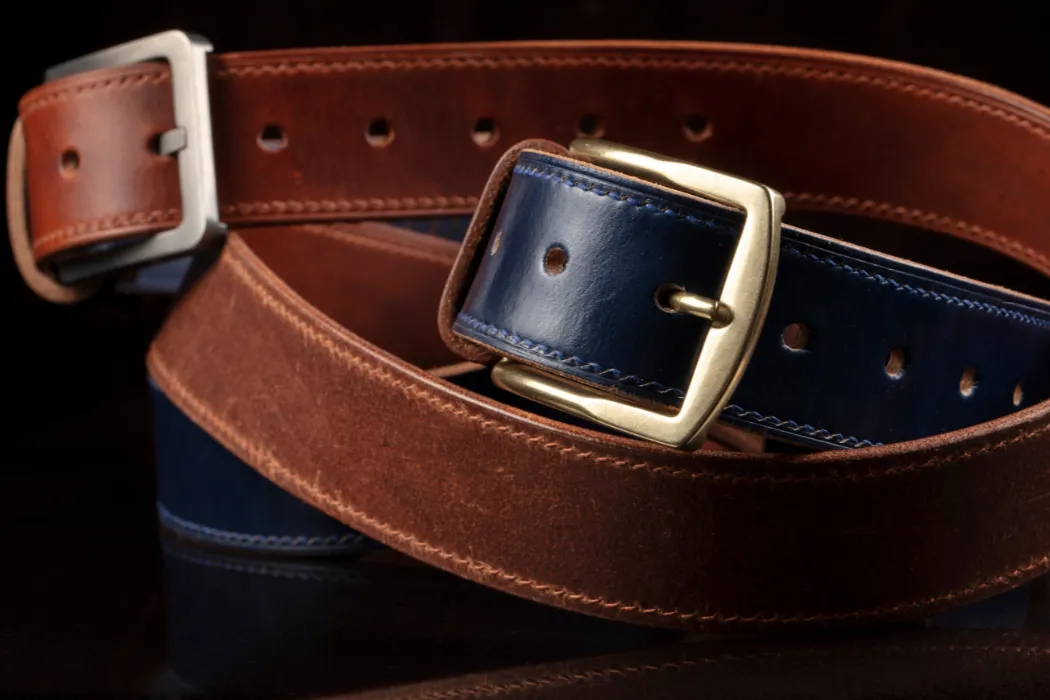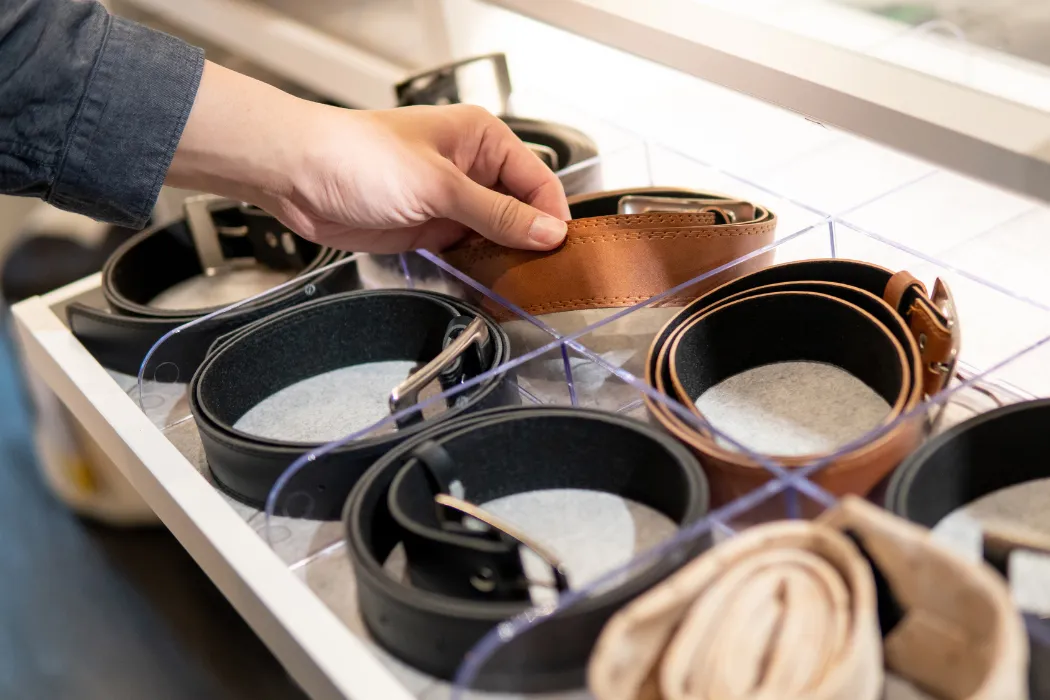
Choosing the right custom leather belt manufacturer in 2026 demands more than a price comparison—it’s about vetting technical precision, capacity, and compliance. As B2B buyers navigate OEM and ODM sourcing options, the difference between consistent global output and costly rework often lies in the details: tensile strength ≥ 20 N/mm² under ISO 3376 : 2020, breaking strength ≥ 400 N per DEAS 7.8, and certified defect rates below 1%. For brands scaling globally, these factors define both performance and reliability in the finished belt.
This comprehensive OEM/ODM Sourcing Guide explains how to evaluate manufacturing partners, interpret ISO and LWG certifications, understand minimum order quantities (as low as 50 units), and apply the China Plus One strategy through certified Cambodian factories. You’ll also learn how to safeguard your IP, manage tech packs through golden samples, and implement AQL 2.5 inspection standards—ensuring every production run meets the durability and aesthetic consistency your brand demands.
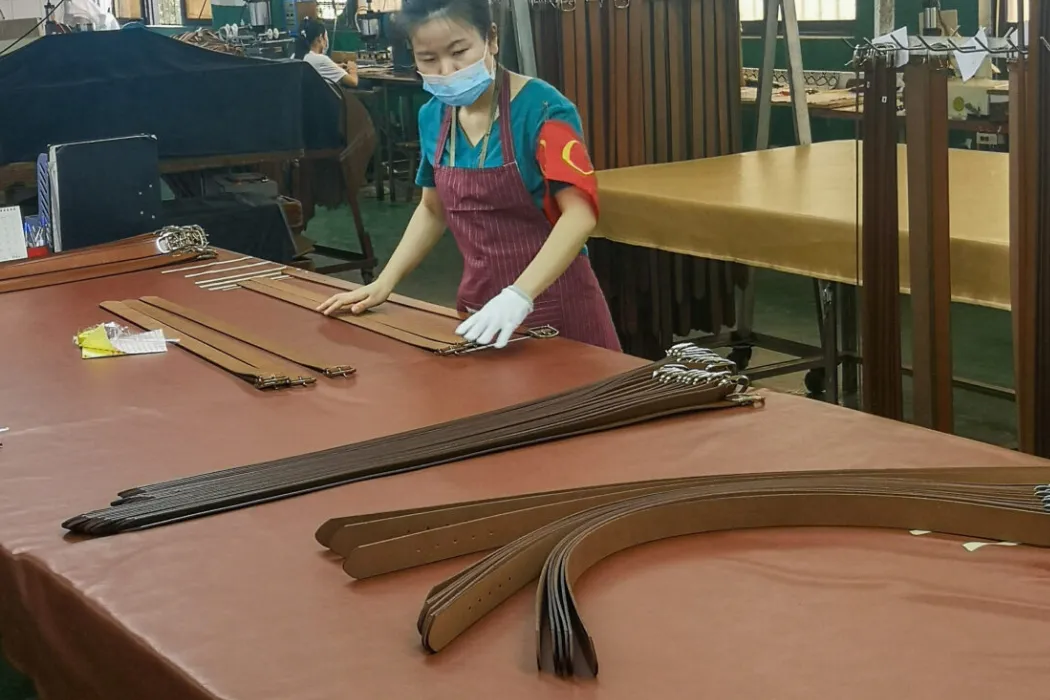
How to Choose the Right Belt Manufacturer?
Selecting the right belt manufacturer involves assessing their material sourcing, manufacturing expertise, certifications, production capacity, and testing conformity to ISO and industry standards. Reliable factories ensure consistent strength, durability, and design flexibility aligned with brand needs.
| Key Data Point | Specification | Standard / Reference |
|---|---|---|
| Leather tensile strength | ≥ 20 N/mm²; elongation 30–80% | ISO 3376 : 2020 |
| Breaking strength | ≥ 400 N | DEAS spec 7.8 |
| pH determination | Chemical stability testing | ISO 4045 : 2018 |
| Colour fastness | Resistance to rubbing | ISO 11640 : 2018 |
| Finish adhesion | 3.5 N dry / 2.0 N wet | ISO 11644 |
| Metal components | Corrosion‑resistant and secure rivets | Design clause — DEAS & ISO references |
Key Criteria When Selecting a Belt Manufacturer
Finding a dependable belt manufacturer means looking beyond price and focusing on operational reliability, supply chain ethics, and product engineering competence. The following considerations help identify vendors capable of consistent global output at scale.
- Evaluate manufacturer’s experience with custom leather belts for global fashion or industrial brands.
- Check sourcing transparency for full‑grain or vegetable‑tanned leather and supplier compliance with LWG or REACH standards.
- Assess sample lead time (e.g., 2–7 days) and production scalability (e.g., over 1 million belts monthly).
- Confirm that quality assurance processes include defect rates below 1% and certified facility audits (e.g., BSCI, SMETA).
When these parameters align with your brand’s design goals and compliance needs, you can confidently onboard a manufacturer that balances artistry with technical precision.
Technical and Quality Standards to Verify
Quality verification is a critical due diligence step. Each manufacturer should demonstrate adherence to mechanical strength and chemical stability benchmarks under recognized ISO or DEAS frameworks.
- Leather tensile strength ≥ 20 N/mm² and elongation 30 – 80% following ISO 3376 : 2020.
- Minimum breaking strength of 400 N as per DEAS specification testing procedure 7.8.
- pH determination (ISO 4045 : 2018), colour fastness (ISO 11640 : 2018), and finish adhesion 3.5 N dry / 2.0 N wet (ISO 11644).
- Metal components must be corrosion‑resistant, adequately strong, and securely clinched rivets.
- Factories should hold ISO 9001 and LWG certifications to ensure process consistency and sustainable leather finishing.
These standards, when upheld, guarantee leather belts that maintain tensile integrity, color stability, and long‑term endurance across diverse environmental conditions. The DEAS framework further strengthens confidence by aligning artful production with measurable engineering performance.
What is the Difference Between OEM and ODM?
OEM (Original Equipment Manufacturer) builds products based on the buyer’s exact design and specifications, giving the buyer full IP ownership. ODM (Original Design Manufacturer) provides pre-designed products for branding and minor customization, offering speed and lower development cost but less design control.
Core Differences in Design, IP, and Customization
The distinction between OEM and ODM starts with who controls the product design and intellectual property, which defines the level of customization available to buyers in sectors like leather belt manufacturing.
- In OEM, the buyer provides full design packs — including CAD files, BOM, stitching specs, and testing requirements — while maintaining IP ownership of patterns and hardware designs.
- In ODM, the factory owns the design and tooling; the buyer customizes logos, colors, and minor details, but the base design remains the supplier’s property.
- OEM supports full customization across materials, dimensions, and finishes; ODM allows mostly aesthetic modifications such as branding, buckle color, or packaging style.
In short, OEM is a design‑ownership model, while ODM is a customization‑within‑constraints model. This difference impacts not just creativity, but how brands manage production rights and future sourcing freedom.
Technical and Commercial Implications for Belt Manufacturing
Beyond conceptual differences, OEM and ODM models drive distinct technical and commercial consequences in how a custom leather belt project is executed — from tooling cost to quality control strategy.
- OEM programs require higher upfront cost and time for tooling and prototyping — molds and embossing dies can take a month or more — but deliver full supply chain control and design exclusivity.
- ODM shortens time‑to‑market using pre‑engineered belt designs, absorbing tooling costs across multiple clients for lower development cost per product.
- OEM buyers can replicate their design across factories in China or Cambodia to maximize trade advantages and resilience; ODM users are tied to the supplier’s platform, reducing sourcing flexibility.
- In OEM, QA and testing standards (like ISO 9001, BSCI, and LWG) are typically buyer‑driven, while in ODM, the factory oversees regulatory compliance and reliability validation.
Put simply, OEM suits brands prioritizing differentiation, IP retention, and supply chain control; ODM appeals to those aiming for speed and lower risk in development cost. For custom belt production, the choice affects not just cost but how a brand shapes its long‑term product identity and sourcing strategy.
Why Source Belts from Cambodia (China Plus One)?
Cambodia offers a high-capacity, certified, and compliant leather belt manufacturing ecosystem that complements China by reducing geopolitical risk, lowering costs, and enabling faster delivery. Factories like Hoplok leverage 1M-belt monthly outputs, ISO/BSCI certifications, and 15–20 day lead times for global brands.
| Capacity | Lead Time | Certifications / Compliance |
|---|---|---|
| Up to 1 million belts per month; facilities span 50,000 sq. meters with 4,500 artisans | Design-to-production in 15–20 days; bulk runs 45–90 days | ISO 9001, BSCI, SMETA, LWG, OEKO-TEX; Better Factories Cambodia compliance (250+ checkpoints) |
Cambodia’s Advantage in the China Plus One Strategy
Cambodia’s integration into global supply chains makes it a powerful ally for brands implementing a China Plus One manufacturing model. By positioning itself alongside Chinese production rather than competing against it, Cambodia offers a reduced-risk model for sourcing leather belts while ensuring quality and compliance.
- Cambodia offers tariff-free trade access via preferential agreements for exports to EU and USA markets.
- Factories employ over 4,500 skilled artisans across 50,000 square meters of advanced production facilities, supporting strong supply chain resilience.
- Geopolitical diversification allows brands to reduce dependency on China while maintaining a consistent quality output.
- Compliance with Cambodia’s 2007 Law on Standards reinforces reliability and export compliance for leather goods.
By leveraging these benefits, global fashion and accessories brands integrate Cambodian factories into their sourcing mix, using them as a stability anchor to offset logistics disruptions or trade policy fluctuations tied to China.
Production Capacity, Lead Time, and Quality Standards
Cambodian leather belt production is characterized by both scale and precision, shaped by consistent application of global certifications and modern lean manufacturing principles. The integration of ISO, BSCI, and SMETA frameworks ensures efficiency while maintaining ethical production standards.
- Up to 1 million belts are produced monthly, with bulk manufacturing cycles completing in 45–90 days.
- Rapid design-to-production cycles, ranging from 15–20 days, support faster market responsiveness for global fashion brands.
- Defect rates are consistently below 1%, maintained through ISO 9001, BSCI, SMETA, LWG, and OEKO-TEX-certified processes with third-party audits.
- Better Factories Cambodia enforces more than 250 compliance checkpoints focused on ethical labor practices and worker safety.
This meticulous approach—supported by standardized inspections, audited environmental controls, and mandatory safety regulations—positions Cambodian facilities like Hoplok as key players for brands demanding both quality and social responsibility in belt production.
Custom Leather Belts Tailored for Your Brand
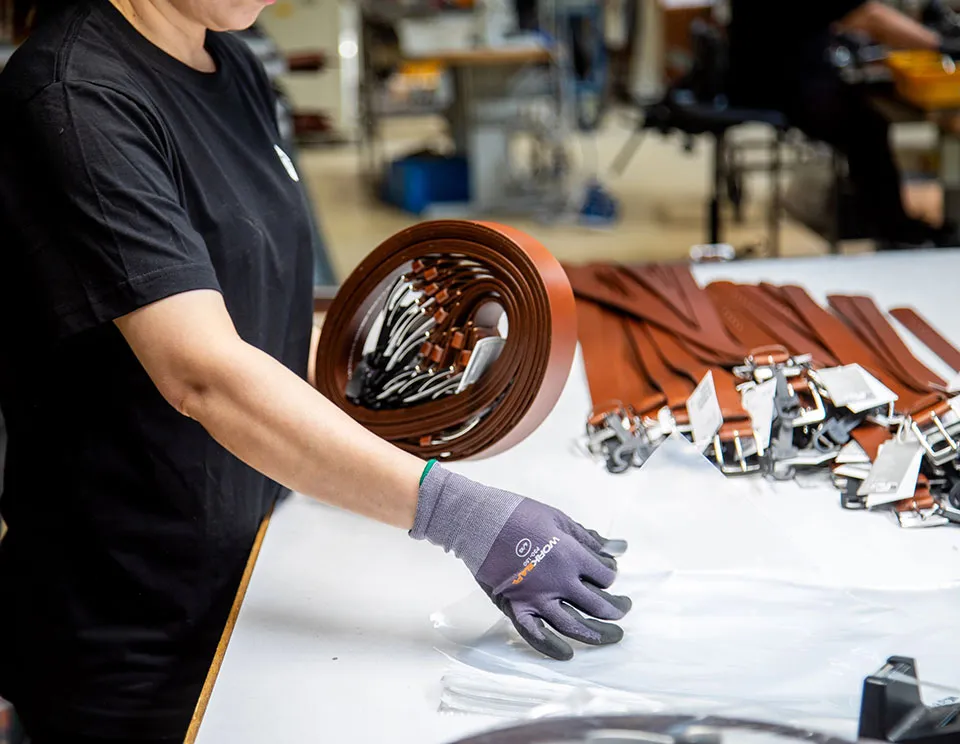
What Factory Certifications Do You Need?
A professional leather belt manufacturer should hold ISO 9001, ISO 14001, and ISO 45001 certifications for process control, environment, and safety, along with leather‑specific audits such as LWG, OEKO‑TEX, or SLF to ensure traceability, chemical compliance, and sustainability credibility.
Core ISO Management Systems for Leather Manufacturing
In leather belt manufacturing, ISO certifications form the foundation of a verifiable management system. They govern everything from quality consistency to workplace safety. These standards are not optional extras but internationally recognized frameworks that translate day‑to‑day processes into traceable, auditable evidence of reliability.
- ISO 9001:2015 ensures a documented quality management system for consistent belt dimensions, finish, and performance.
- ISO 14001:2015 governs environmental management, controlling waste, emissions, and chemical usage in leather finishing.
- ISO 45001:2018 focuses on occupational health and safety, reducing accidents in labor‑intensive stitching and cutting processes.
Factories openly displaying their ISO certificates and welcoming client audits signal credible manufacturing discipline and a commitment to continuous improvement across all operational levels.
Leather‑Specific and Chemical Compliance Certifications
Beyond management systems, a trustworthy leather belt manufacturer must also meet certification programs that relate directly to the source material—ensuring the leather itself is processed and finished under responsible conditions. These certifications guarantee both environmental accountability and product safety for end users.
- Leather Working Group (LWG) audit standard rates tanneries Bronze (65%), Silver (75%), or Gold (85%) based on environmental and social performance.
- LWG certificates remain valid for 24 months for leather manufacturers and 12 months for traders, validating recent audits of effluent, energy, and traceability metrics.
- OEKO‑TEX LEATHER STANDARD covers chemical safety in finished belts; OEKO‑TEX STeP audits factory sustainability and worker protection.
- Additional programs like I.C.E.C. (Italy), C.S.C.B. (Brazil), and Sustainable Leather Foundation (SLF) reinforce ethical sourcing and sustainable manufacturing credentials.
Collectively, these certifications create a full‑spectrum picture of compliance — one that tracks each belt’s leather back to its origin, monitors environmental performance at the tannery level, ensures legal chemical usage, and documents worker welfare conditions. When selecting a manufacturing partner, these credentials serve as tangible proof that sustainability claims are backed by verifiable international standards rather than marketing promises.
How to Go from Tech Pack to Golden Sample?
The journey from tech pack to golden sample involves three iterative prototype rounds guided by precise specifications, testing criteria, and version control, ensuring every design element—materials, dimensions, stitching, and hardware—matches the intended final product.
Understanding the Tech Pack as a Production Blueprint
A tech pack functions as the engineering foundation for product manufacturing. It defines not only the creative direction but also the measurable technical specifications that guide sampling and production. Each component—from the main leather to the smallest hardware screw—is documented for traceability and accuracy.
- Includes technical flats, BOM (leather, lining, trims, thread), and stitching notes with type and spacing.
- Specifies tolerances, Pantone color codes, and AQL plan for pass/fail criteria before bulk sign-off.
These details ensure that every measurement and quality benchmark aligns with brand standards. During sampling, factories refer to these parameters to produce prototypes, minimizing ambiguity and costly revisions.
Sampling Rounds and Achieving the Golden Sample
The path from the first prototype to the final golden sample is a controlled, iterative process. Each round tightens precision through both visual and functional testing. The objective is to reduce variation and confirm that all physical and performance attributes align with the approved specifications.
- Three sampling rounds: 1st—structure/size test; 2nd—material and color refinements; 3rd—final golden sample.
- Testing includes shrinkage, colorfastness, and hardware durability; golden sample approval triggers 4–6 week production timeline.
Version control plays a critical role across these stages—each round is linked back to earlier versions of the tech pack for comparison and documentation. This transparency eliminates confusion during production handoffs and guarantees repeatability for subsequent manufacturing runs.
Once the golden sample is approved, it serves as the physical reference for mass production. Suppliers initiate material orders, finalize tooling, and generate packaging assets. With clear alignment on specifications, the factory transitions smoothly into a 4–6 week bulk production phase, maintaining the material and color consistency validated during sampling.
What is the MOQ for Custom Belts?
Most flexible OEM leather belt manufacturers set a minimum order quantity (MOQ) around 50 units per design to balance production efficiency and accessibility for smaller brands. Hoplok Leather typically sets a flexible MOQ around 100 units for production with sample options starting from one piece.
Understanding MOQ in Custom Belt Manufacturing
MOQ, or Minimum Order Quantity, represents the smallest production quantity a manufacturer will accept for a custom belt order. It defines the threshold that allows factories to maintain efficiency while balancing costs per production run.
The concept exists primarily to offset the fixed setup, tooling, and labor costs required to start each production batch. Cutting dies, stitching setups, and finishing stations all introduce measurable preparation overhead. Having an MOQ ensures that these costs are distributed over a reasonable quantity of belts, keeping the per‑unit price competitive.
For small or emerging brands, MOQs can act as both an investment test and a gateway. Factories that maintain flexible terms — typically between 50 to 100 units per SKU — often attract startups and designer collaborations eager to validate their designs without committing to full‑scale runs.
Industry Benchmarks and Hoplok’s MOQ Policy
Across the leather goods sector, MOQ expectations vary widely depending on production scale, material source, and target market. Benchmark data shows how leading manufacturers position their entry thresholds:
- LECAS and Customcy both publish a 50‑unit MOQ for custom leather goods, including belts — a low barrier intended to help new brands engage with bespoke manufacturing.
- ColsenKeane uses minimum order values instead of unit counts: US$1,500 initial and US$500 for reorders, reflecting their artisanal focus and premium material sourcing.
- Hoplok Leather sets a general production MOQ of 100 units per design, but allows prototype sampling from a single unit — a hybrid approach balancing industrial efficiency with custom flexibility.
- Large‑volume runs can scale up to 10,000 units per style, with lead times spanning 45–90 days depending on batch size and finishing requirements.
This tiered approach — single‑unit sampling, moderate production MOQ, and flexible volume scaling — helps Hoplok Leather support both niche designers and established private‑label partners without compromising manufacturing consistency or material integrity.
Across the broader OEM landscape, the working baseline for MOQ on custom leather belts typically rests around 50 units per design for flexible factories. Some premium or private‑label houses set higher order-value thresholds to preserve artisanal production quality, while on‑demand B2C services may allow single‑piece runs at a premium cost structure. This diversity of MOQ models reflects the adaptability of modern leather production — from boutique experimentation to global-scale manufacturing.
How is Quality Controlled (AQL 2.5)?
AQL 2.5 means that during pre‑shipment inspection, only up to 2.5% of units may show major defects in a sampled lot based on ISO 2859‑1. Inspectors classify defects as critical, major, or minor, sampling belts statistically rather than inspecting 100% of them.
Understanding the AQL 2.5 Quality Standard
AQL 2.5, defined by ISO 2859‑1:1999, represents a 2.5% maximum acceptable rate of major defects in a production lot. This threshold, widely applied across apparel and leather goods industries, helps manufacturers balance inspection intensity and statistical assurance.
- Critical defects are not tolerated (AQL 0.0), major defects align with AQL 2.5, and minor defects often use AQL 4.0 under garment industry practice.
- This system balances inspection efficiency and statistical assurance, ensuring Hoplok’s defect rate remains below 1%, well within required standards.
By setting distinct quality thresholds for each defect type, AQL 2.5 provides both a clear quality benchmark and a scalable control mechanism for large batch production where full inspection is impractical.
Applying AQL 2.5 at Hoplok Leather’s Belt Factories
In Hoplok Leather’s manufacturing workflow, quality control is executed according to ISO 2859‑1 sampling procedures. Instead of checking every single belt, inspectors use international standard tables to determine how many units to inspect and how many defects are permissible before a batch is rejected.
- Inspectors use ISO 2859‑1 tables to link lot size (e.g., 5,000 belts) to a sample size and acceptance numbers; for a 200‑belt sample at AQL 2.5, 10 or fewer majors pass, while 11 triggers rejection.
- Defects are recorded by type—critical (e.g., burrs), major (e.g., misaligned buckle holes), and minor (e.g., light shade variance)—before shipment.
- Hoplok’s integrated QA workflow combines in‑house inspections with third‑party checks from firms like QIMA, HQTS, and AQI Service to uphold ISO 9001 compliance and consistent global standards.
This hybrid inspection approach allows Hoplok to maintain strong quality consistency across international orders while reducing unnecessary rework. Defect data is reviewed after each batch to refine processes and strengthen the defect‑prevention strategy for subsequent production runs.
Supporting Research Context
Under AQL 2.5 quality management, every belt batch undergoes statistically driven sampling inspections. For example, a 5,000‑unit lot might require a 200‑unit sample. If 10 or fewer belts display major defects, the lot is approved; 11 or more lead to rejection or rework. This keeps overall quality aligned with a long‑term defect rate below or equal to 2.5% for major defects—the industry’s “worst tolerable” limit.
Defect categories are precisely defined to standardize inspection judgment:
- Critical defects (AQL 0.0): Safety or compliance issues such as burrs, sharp metal edges, or incorrect labeling—none tolerated.
- Major defects (AQL 2.5): Workmanship or aesthetic faults that impact usability or saleability, like uneven stitching or misaligned holes.
- Minor defects (AQL 4.0): Cosmetic imperfections such as slight paint specks or natural leather grain deviation.
These guidelines ensure that Hoplok’s pre‑shipment inspections are globally accepted and compatible with third‑party verification frameworks used by QIMA, HQTS, and AQI Service, enabling consistent quality metrics across all production partners.
How to Protect Your Intellectual Property (IP)?
Intellectual property protection for custom leather goods covers trademarks, design registrations, patents, and copyrights. Brands can register logos via USPTO or WIPO Madrid System, and secure belt shapes under the Hague System to avoid imitation and safeguard supply chain authenticity.
Understanding the Layers of IP Protection for Leather Goods
Protecting leather goods such as belts, wallets, and handbags involves several overlapping forms of intellectual property (IP). Each targets a different aspect of brand or product identity—from names to visual features to functional innovations.
- Trademarks protect brand names and logos via USPTO or WIPO Madrid System filings (e.g., Nike Swoosh).
- Industrial designs secure 3D belt or buckle shapes under WIPO Hague System or the Design Act of 2000 (India).
- Patents under the PCT system cover functional innovations like clasp mechanisms or leather treatments.
- Copyrights protect original graphic or pattern designs and strengthen enforcement rights upon registration.
Applying International IP Systems and Enforcement Examples
Expanding IP protection across international markets requires understanding and applying global filing systems. These frameworks simplify multi-country protection and ensure consistent rights enforcement in trade-sensitive sectors like leather goods manufacturing.
- Use WIPO Madrid System for multi-country trademark protection and Hague System for industrial designs.
- File functional patents through the WIPO Patent Cooperation Treaty (PCT) for expanded coverage.
- Reference enforcement precedents such as Christian Louboutin v. Pawan Kumar with INR 10.7 lakhs damages for trademark infringement.
- Use Class 18 under Nice Classification for belts, bags, and other leather goods to ensure correct trademark filing.
Key Data Points
- WIPO Madrid System: International trademark filing system for multi-country protection of brand logos/names (e.g., Louis Vuitton monogram).
- WIPO Hague System: International industrial design registration for 3D shapes/patterns (e.g., handbag forms by Hermès, Chanel).
- WIPO PCT System: Patent Cooperation Treaty for filing patents on functional components (e.g., Louis Vuitton tumbler lock patented 1890; Keepall OLED screen 2020).
- USPTO Trademark Registration: Protects logos (e.g., Nike Swoosh, Lacoste crocodile) in key markets; country-specific filing required.
- U.S. Copyright Office Registration: Enables statutory damages for unique fabric patterns/graphics; inherent upon creation but registration strengthens enforcement.
- Design Act of 2000 (India): Protects registered industrial models (3D designs) for 10 years + 5-year extension; penalties up to INR 25,000 for piracy.
- Christian Louboutin v. Pawan Kumar (India): Awarded INR 10.7 lakhs damages for red sole trademark infringement.
- Class 18 (Nice Classification): International trademark class for leather goods (e.g., belts, bags).
Research Summary
For a custom leather belt manufacturer, IP protection layers trademarks on brand identifiers (logos, names) via USPTO or WIPO Madrid System filings to prevent confusion or dilution, as in Louis Vuitton v. Dooney & Bourke where courts assessed street-level recognizability. Industrial designs under WIPO Hague System or U.S. design patents secure unique belt shapes, buckles, or patterns, favored by brands like Victoria Beckham for bypassing the “distinctiveness” proof required in trademarks. Patents via PCT target functional innovations, such as proprietary leather treatments for durability or colorfastness and novel clasp mechanisms, exemplified by Louis Vuitton’s 1890 tumbler lock still in use.
Combining protections addresses supply chain risks: copyrights for original leather patterns or graphics (U.S. separability test limits to separable elements), trade dress for overall belt appearance, and unfair competition claims proving customer confusion or reputation harm. Enforcement examples include Hermès dilution wins and INR 10.7 lakhs damages in India, supporting duty-free origins by verifying authentic supply chains against counterfeits in Class 18 leather goods. Novices avoid middleman markups via registered IP verifying direct manufacturer authenticity, while experienced brands build resilience through multi-jurisdictional filings reflecting regional legal nuances such as U.S. versus EU separability standards.
Case Study: Private Label Scaling?
Private‑label scaling in leather belts hinges on repeatable industrial processes, certified materials, and flexible MOQs that enable brands to expand SKUs efficiently while maintaining consistent quality and cost control.
OEM Partnership and Brand Scalability
Turnkey OEM partnerships form the foundation of scalable private‑label belt programs. These manufacturers manage the entire lifecycle—from design to mass production—so that brands can grow SKUs without internal factory investments.
- Turnkey OEMs handle complete processes from pattern‑making and prototyping to mass production, allowing rapid brand scaling.
- Hybrid sourcing strategies use both domestic (U.S./EU) and overseas lines to balance IP security with cost and duty advantages.
- Established partners like Softline Brand Partners and Eric Scott Leathers exemplify holistic private‑label programs that expand product portfolios.
These strategic relationships enable differentiation through brand identity elements—such as hardware finishes, embosses, and packaging—while maintaining predictable production timelines and cost structures.
Technical Framework for Scalable Production
Scalable private‑label production relies on repeatable processes, specified materials, and quality certifications that ensure consistency across global supply bases. The following technical attributes shape that repeatability:
- A defined industrial sequence: strap cutting → edge skiving/polishing → hole punching (25–30 mm spacing) → stitching/riveting → finishing → 100 % QC ensures every batch meets tensile and aesthetic standards.
- Material standards use full‑grain and top‑grain bovine leather (3.0–4.0 mm for men, 2.0–3.0 mm for women) in line with ISO/ASTM classifications for reliable performance.
- Flexible MOQs of 100–300 units per style allow both pilot runs and scalable commercial production once color and finish samples are approved.
- Certifications such as ISO 9001, BSCI, and LWG guarantee consistent production standards and traceable sourcing, allowing manufacturers like HoploK Leather and Lider Kemer to sustain repeatable global supply chains.
Together, these parameters create a mechanical and procedural foundation that lets private‑label brands expand styles and collections without losing uniformity or increasing defect risk.
Research Insights and Industry Examples
Field research shows that market scalability depends as much on sourcing architecture as on process integrity. OEMs often operate multiple production origins to balance margins, lead times, and tariff qualification, while maintaining identical quality systems across factories.
- Typical MOQs range from 100–300 units per style/color overseas and 50–100 units in smaller U.S./EU workshops.
- Turkey‑based exporters such as Lider Kemer market ROI‑driven corporate/private‑label belt programs, offering case studies for wholesale buyers seeking volume justification.
- Softline Brand Partners and Eric Scott Leathers exemplify OEM models that integrate design, prototyping, and multi‑origin scaling for brand clients.
- Guides from HoploK Leather emphasize certification, batch color management, and pre‑production sampling as prerequisites to dependable scaling.
These examples demonstrate that the most successful private‑label scaling strategies prioritize stable engineering, verified materials, and transparent OEM partnerships over opportunistic sourcing. The result is sustainable growth in both SKU diversity and brand credibility.
Final Thoughts
The 2026 OEM/ODM landscape for custom leather belts underscores how craftsmanship, certification, and scalability intertwine to determine success. Choosing the right partner isn’t solely about who can produce at the lowest cost—it’s about selecting a factory that demonstrates engineering rigor, ethical sourcing, and consistent compliance with ISO, LWG, and BSCI frameworks. Manufacturers like Hoplok in Cambodia exemplify how global brands can combine artistry and precision through lean, certified production systems supported by transparent quality control benchmarks such as AQL 2.5.
As brands navigate a more complex supply chain environment defined by tariff shifts, environmental mandates, and rapid product cycles, the ideal strategy blends OEM design control with ODM agility across diversified sourcing geographies. A future‑ready partnership balances IP protection, flexible MOQs, and detailed tech‑pack governance to ensure that every belt leaving the factory meets both creative and technical expectations. In this way, the 2026 sourcing model becomes not just a procurement decision but a strategic investment in brand identity, sustainability, and enduring market competitiveness.
Frequently Asked Questions
What is the standard MOQ for custom leather belts?
A typical minimum order quantity for custom leather belts ranges from 50 to 200 pieces per design. Many OEM factories set around 50 units as their standard MOQ for personalized leather goods, balancing flexibility for new brands and efficiency in production.
How long is the lead time from sampling to delivery?
The average lead time is approximately 5 to 9 weeks from the initial sample phase to delivery. This includes about 7–14 days for sampling or prototyping and 30–45 days for bulk manufacturing, plus freight transit time depending on region.
What is the difference between OEM and ODM manufacturing?
OEM manufacturing means the buyer provides complete designs and owns all IP, while the manufacturer handles production. ODM means the manufacturer provides existing designs that the client can customize and rebrand — enabling faster market entry but less control over the base design.
Do I need a tech pack to start belt production?
Most manufacturers prefer a complete tech pack that details materials, dimensions, stitching density (typically 6–8 SPI), hardware specs, and logo placement. While production can begin with sketches or samples, a tech pack ensures accurate specifications and quality consistency.
What are the import duties for leather belts from China?
For 2025, the total U.S. import duty for leather belts from China averages about 94–104% of customs value. This figure combines a base MFN rate of 2–10% with the China-specific surcharge of roughly 84–94% under the current tariff regime.
How are AQL standards used to check belt quality?
AQL (Acceptable Quality Limit) inspections sample production lots according to ISO 2859. For belts, typical thresholds are 0% for critical defects, about 1.5–2.5% for major defects like stitching errors, and up to 4.0% for minor cosmetic imperfections.