Why does a belt fail? Usually, it is not because the leather looks bad. It fails because the buckle snaps under pressure, the strap cracks after a few months of bending, or the dye ruins a customer’s expensive white shirt. These are not simple design errors. They are critical engineering failures that damage brand reputation.
Real quality control is not just about inspecting a finished product with a magnifying glass. It requires rigorous physical destruction inside a testing lab. Engineers must mechanically pull straps until they snap, bend materials thousands of times until they crack, and aggressively rub surfaces until the color bleeds. If a belt cannot survive this calculated torture, it is not ready for the customer.
We will break down the “Big Three” standard physical tests: Tensile Strength (pulling power), Flex Testing (resistance to cracking), and Color Fastness (anti-staining). Understanding these specific lab metrics helps global buyers distinguish between high-quality manufacturing and cheap alternatives that look identical but fall apart in the real world.
Why Is Tensile Strength the Most Critical Safety Test?
Tensile strength is the measurement of the maximum stress a material can withstand while being stretched or pulled before breaking. For a belt, this is the ultimate safety check. It ensures that when a user tightens their belt or lifts a heavy object, the strap does not snap, and the buckle does not rip away from the leather.
Understanding the “Break Point” of Leather vs. PU
Not all materials handle stress the same way. The internal structure of the material dictates how much force it can take.
- Full Grain Leather: Contains dense, interwoven natural fibers. It typically withstands over 100kg of force because the fibers tighten under pressure.
- Synthetic PU: Relies on chemical bonds and backing fabric. If the backing is cheap, the PU layer stretches and snaps at much lower forces, often around 40kg-60kg.
Laboratories use a machine called a Dynamometer to pull the strap from both ends until catastrophic failure occurs.
The Role of Stitching and Buckle Attachment
A belt rarely breaks in the middle of the strap; it fails at the connection points. The area where the buckle is stitched or screwed into the strap is the weakest link.
- Stitch Count: Too many stitches per inch perforate the leather like a stamp, making it tear easily. Ideally, 4-5 stitches per cm provides balance.
- Rivets vs. Screws: Rivets distribute pressure permanently, while screws can loosen over time, lowering the overall tensile reliability.
Engineers specifically test the “buckle pull-out strength” to ensure the hardware doesn’t detach under load.
How Humidity and Thickness Affect Strength
Environmental factors play a massive role in testing results. A belt tested in a dry lab performs differently than one in a humid container.
- Moisture Content: Leather is hygroscopic. High humidity can soften the fibers, reducing tensile strength by up to 15-20%.
- Thickness Consistency: A belt marked as 3.5mm must be consistent. If one spot skived down to 2.8mm exists, the tensile test will fail exactly at that thinner point.
Testing standards require samples to be conditioned in a controlled environment for 24 hours before pulling.
| Material Type | Typical Thickness | Tensile Strength Expectation | Common Failure Mode |
|---|---|---|---|
| Full Grain Leather | 3.5mm – 4.0mm | > 120kg Force | Buckle prong tears hole |
| Bonded Leather | 3.0mm – 3.5mm | 60kg – 80kg Force | Material snaps/separates |
| PU / Synthetic | Var. (with filler) | 40kg – 60kg Force | Backing fabric tears |
How Does Flex Testing Simulate Daily Wear and Tear?
A belt is not a static object. Every time a user sits down, stands up, or walks, the belt flexes around their waist. Over one year, a belt may bend and straighten thousands of times. Flex testing compresses this timeline into a few hours of rapid laboratory movement to predict how the material will age.
The Mechanics of the “Wiggle” Test (Bally Flex)
The industry standard for this is the Bally Flexometer test. It works by aggressively folding the leather back and forth to simulate extreme wear.
- The Setup: A sample of the belt is clamped into the machine and folded over itself.
- The Cycle: The machine flexes the sample at high speed (often 100 cycles per minute).
- The Duration: A high-quality belt must withstand 50,000 cycles without showing signs of damage. This equates to years of daily use.
If a material is too stiff or dry, it will snap during this test just as a dry twig snaps when bent.
Detecting Micro-Cracks in the Finish
Often, the leather itself is strong enough, but the aesthetic finish fails first. This is common in belts with heavy surface coatings or thick edge paint.
- Surface Cracking: Under the microscope, engineers look for the “orange peel” effect. This happens when the coating is not elastic enough to stretch with the leather.
- Edge Paint Failure: If the rubberized paint on the edge of the belt is cheap, it will crack and peel off after only a few thousand flexes.
Good quality finishing agents must be flexible. They need to move like skin, not like a hard shell.
Why Laminated Layers Separate (Delamination Risks)
Many belts are made like a sandwich: a top layer, a filler material inside, and a bottom lining. Flex testing reveals if the glue holding this sandwich together is strong enough.
- The “Bubble” Effect: As the belt bends, the inner layers rub against each other. If the adhesive bond is weak, the layers separate, creating unsightly air bubbles on the surface.
- Bonded Leather Risks: Since bonded leather is made of scraps glued together, it has poor internal cohesion. Intense flexing often causes it to crumble internally.
To prevent this, manufacturers must use industrial-strength, heat-activated adhesives that penetrate deep into the fibers.
Will Your Belt Stain Your Clothes? Understanding Color Fastness
There is no faster way to lose a customer than ruining their expensive clothing. Color fastness refers to a material’s resistance to fading or transferring dye onto other surfaces. In the leather industry, this transfer of color is technically called “crocking.” It often happens when a dark belt rubs against a light-colored pair of trousers or a white shirt.
The Wet Rub vs. Dry Rub Test Methods
To test this, laboratories use a device called a Veslic Rub Tester. A white wool felt pad is loaded with a specific weight and rubbed back and forth across the surface of the leather.
- Dry Rub Test: Simulates normal friction against clothing. A standard passing grade usually requires the material to withstand 500 cycles without significant color transfer.
- Wet Rub Test: Simulates high-risk scenarios like sweat or rain. The felt pad is soaked in water. Because water acts as a mild solvent, it breaks down dye easier. The standard is lower here, often requiring 250 cycles.
How Oil and Wax Finishes React to Heat and Sweat
Not all leathers are equal. Leathers that rely on heavy oil or wax finishes—like Crazy Horse or Pull-Up leather—are notorious for color migration.
- Heat Sensitivity: On a hot day, the oils inside the leather become fluid and rise to the surface, carrying pigment with them.
- Sweat Acidity: Human sweat is slightly acidic. This acidity can chemically react with certain dyes, causing them to bleed more than plain water would.
For these “oily” styles, engineers must apply a final fixing agent (a clear topcoat) to lock the pigment in without ruining the natural hand-feel.
Interpreting the Grey Scale (Grades 1-5)
Lab results are not pass/fail; they are graded on the ISO Grey Scale. This compares the stain on the white wool pad to a standardized chart.
- Grade 5: Perfect. No color transfer visible.
- Grade 4: Good. Slight shadow, acceptable for most retail standards.
- Grade 3: Borderline. Noticeable staining. Often rejected for luxury goods.
- Grade 1: Failure. Heavy dye transfer.
Most global brands demand a minimum of Grade 4 for Dry Rub and Grade 3/4 for Wet Rub.
| Test Condition | Standard Cycles | Minimum Accepted Grade | High Risk Materials |
|---|---|---|---|
| Dry Rubbing | 500 – 1000 Cycles | Grade 4-5 | Suede, Nubuck |
| Wet Rubbing | 150 – 250 Cycles | Grade 3-4 | Oil Tanned, Crazy Horse |
| Sweat / pH Test | 50 – 100 Cycles | Grade 3 | Vegetable Tanned Leather |
What Defines Hardware Durability and Corrosion Resistance?
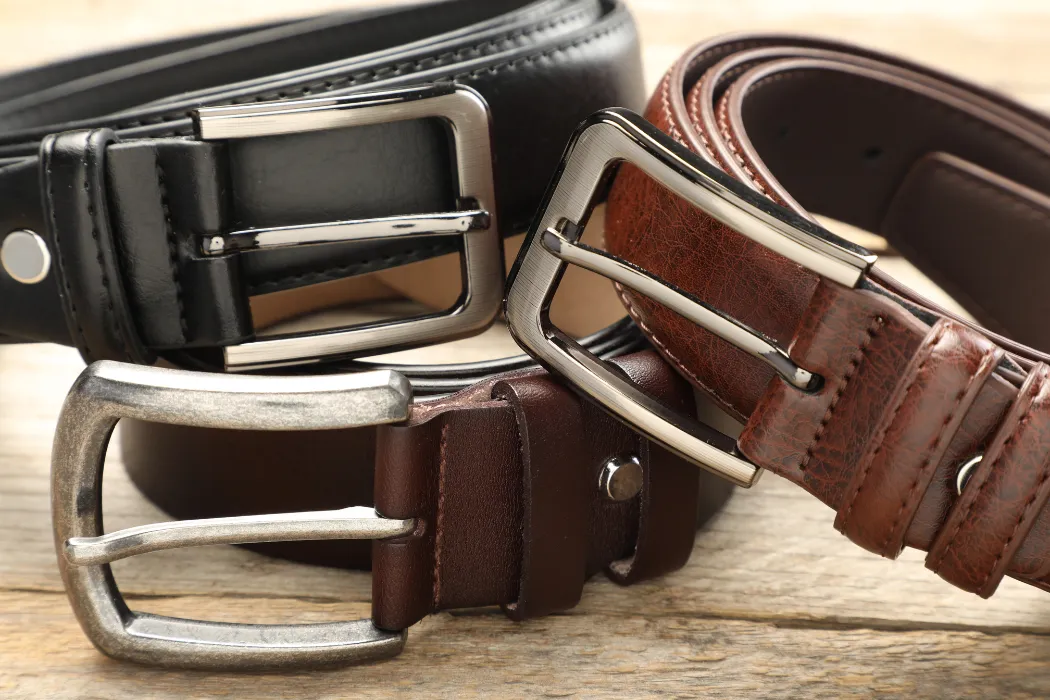
A belt buckle is more than just a fastener; it is the “jewelry” of the product. However, because it is made of metal, it faces two unique enemies: oxidation (rust) and mechanical fatigue. A beautiful brass buckle is useless if it turns green after a week of sea freight or if the prong snaps off when tightened.
Testing the Plating Thickness on Buckles
Most belt buckles are made of Zinc Alloy or Steel and then coated with layers of expensive metals like nickel, chrome, or gold. The durability depends entirely on the thickness of these layers, measured in microns.
- Rack Plating vs. Barrel Plating: High-quality buckles are hung individually (rack) to get an even coat. Cheap buckles are tumbled in a barrel, resulting in thin, uneven coverage that scratches easily.
- The Sealing Layer: A final clear lacquer (electrophoretic coating) acts as a shield. Without this, even thick plating will tarnish rapidly when exposed to air.
Salt Spray Testing for Ocean Freight & Humid Climates
To predict how hardware survives shipping across the ocean or use in humid cities like Miami or Singapore, engineers use the Salt Spray Test (ISO 9227).
- The Chamber: Buckles are placed in a warm cabinet and blasted with a saline mist (5% NaCl solution) continuously.
- The Standard:
- 24 Hours: Minimum standard for fast fashion. No red rust allowed.
- 48 Hours: Standard for mid-range brands.
- 72+ Hours: Required for premium brands and marine-grade leather goods.
If a buckle shows “pitting” (tiny black spots) or “blistering” after 24 hours, it will likely corrode while sitting in a warehouse.
Mechanical Functionality: The Click and Release
For reversible belts or ratchet belts, moving parts introduce failure points. Mechanical testing involves repeating the action until the spring gives out.
- Rotary Testing: Reversible buckles are twisted back and forth 2,000 to 5,000 times to ensure the internal spring doesn’t lose tension.
- Prong Strength: The prong is the most stressed part of a classic buckle. It is subjected to a static load test to ensure it doesn’t bend backward under normal waist tension.
How Do You Establish a Reliable Quality Control Standard?
Consistency is the difference between a one-time order and a long-term partnership. A reliable factory does not just hope the belts turn out well; they enforce standards using a structured Quality Control (QC) system. This shifts the focus from “it looks okay” to “it meets the data specification.”
Moving from “It Looks Good” to “It Passed Lab Data”
Visual inspection is necessary but insufficient. A belt can look flawless on the surface but have weak internal bonding that will fail in a week. Modern QC relies on data points.
- The AQL Standard: Most factories use the Acceptance Quality Limit (AQL) system (typically AQL 2.5 or 4.0). This statistically determines how many units must be randomly tested from a batch.
- Destructive Testing: A small percentage of every production run must be destroyed in the lab to prove that the batch meets the tensile and flex requirements.
The Importance of Raw Material Inspection Before Cutting
The best time to catch a defect is before the leather is cut. Once production starts, mistakes become expensive.
- Incoming Material Check: Raw hides must be inspected for insect bites, scars, and thickness variation. If the leather is too thin in the center, it must be rejected immediately.
- Hardware Verification: Buckles should be tested for weight and plating thickness upon arrival. Installing a rusting buckle onto premium leather is a waste of good material.
Documentation and Third-Party Verification (LWG, ISO)
Trust is good, but documentation is better. Professional manufacturers maintain a paper trail for every batch.
- LWG (Leather Working Group): This certification ensures the tannery follows strict environmental protocols, meaning the leather is free from banned chemicals like Chromium VI.
- ISO Standards: A factory should be able to provide test reports referencing specific ISO standards (e.g., ISO 11640 for color fastness), proving their methods are globally recognized.
| Production Stage | Inspection Action | Critical Acceptance Standard |
|---|---|---|
| Incoming Materials | Measure Thickness & Visual Check | No deep scars; Thickness tolerance +/- 0.1mm |
| Hardware Check | Salt Spray & Weight Check | No rust after 24h; Plating thickness > 3 microns |
| In-Line Assembly | Stitch & Edge Paint Inspection | 4-5 stitches/cm; No bubbling or peeling paint |
| Final QC | Aesthetic & Pull Test | Clean finishing; Random sample passes 60kg pull |
Frequently Asked Questions About Belt Durability
What is the standard tensile strength for a good leather belt?A high-quality full-grain leather belt should withstand at least 100kg to 120kg of force. Bonded leather often fails between 60kg and 80kg.
How do you test leather for color transfer?Color transfer is tested using a Veslic Rub Tester. It rubs a white wool pad against the leather for 500 cycles (dry) or 250 cycles (wet) to see if the dye bleeds.
Why does my leather belt crack when I bend it?Cracking usually occurs because the leather fibers have dried out or the surface coating (finish) is too thick and brittle. This is detected early via Bally Flex Testing.
What is the difference between wet and dry crocking?Dry crocking happens from normal friction against clothes. Wet crocking happens when the belt is exposed to sweat or rain, which acts as a solvent and causes dye to transfer more easily.
Does PU leather require different testing than genuine leather?Yes. While PU is also tested for tensile strength and flexing, engineers focus more on Hydrolysis Testing (resistance to humidity/peeling) rather than fiber breakage.
How often should factory quality control be performed?QC should be continuous. Raw materials must be inspected upon arrival, and finished goods should undergo AQL random sampling (Acceptance Quality Limit) before every shipment.
Conclusion: Engineering Trust, Not Just Leather
Durability is not an accident. It is the result of precise engineering, rigorous testing, and an uncompromising commitment to data. For global brands, the cost of a product recall or a ruined reputation far outweighs the savings of skipping these critical tests.
At Hoplok Leather Goods, we don’t just manufacture belts; we engineer longevity. With over 22 years of experience and a unique dual-factory system in China and Cambodia, we offer a scalable, tariff-friendly manufacturing solution without sacrificing quality.
Our self-owned Pro Pelli leather finishing facility allows us to control the quality chain from the raw crust to the final buckle click. We strictly adhere to ISO, BSCI, and SMETA standards, ensuring every belt we ship has passed the “Big Three” tests for Tensile, Flex, and Color Fastness.
If you are looking for a manufacturing partner who speaks the language of technical quality and delivers compliant, data-backed leather goods, contact Hoplok today. Let’s build a product that stands the test of time.