For two decades, the global supply chain was obsessed with “Just-in-Time” efficiency. Buyers consolidated production into single mega-hubs to maximize leverage and minimize inventory costs. However, recent trade tariffs, port congestions, and regional lockdowns have ruthlessly exposed the fragility of this single-basket approach. Relying on one region for 100% of your inventory is no longer an asset; it is a critical liability.
Today, forward-thinking procurement teams are pivoting to a “Just-in-Case” strategy. This requires diversifying manufacturing footprints without sacrificing product consistency. By splitting production between a mature hub like China and an emerging duty-free zone like Cambodia, brands create a strategic firewall. If one location faces a geopolitical freeze or logistical bottleneck, the other keeps supply lines open.
This dual-country model is not merely a cost-saving tactic; it is an operational insurance policy. It allows brands to navigate the volatile landscape of international trade duties while maintaining the high technical standards required for premium leather goods. The following analysis details how this structural split protects your bottom line.
How does a dual-country footprint bypass international trade barriers?
A dual-country strategy allows brands to actively arbitrage international trade policies rather than being passive victims of them. While China offers mature infrastructure, it often carries a heavy tariff burden—specifically the punitive Section 301 tariffs in the US. Cambodia, conversely, serves as a strategic “tariff shield,” benefiting from preferential trade statuses like the EBA (Everything But Arms) for Europe or GSP (Generalized System of Preferences) history for the US, significantly lowering the final “landed cost.”
The “Real Cost” of a Leather Bag
Many buyers make the mistake of comparing only the FOB (Free On Board) price. However, the profitability of a SKU is determined by its Landed Cost (FOB + Freight + Duty). A bag manufactured in Dongguan might have a slightly lower FOB price due to mature supply chains, but once it hits the Port of Long Beach or Rotterdam, trade duties can obliterate that margin.
- Section 301 Impact: For US buyers, leather goods from China are often subject to an additional 25% punitive tariff on top of standard MFN rates. This means a $100 bag effectively costs $125 before it even leaves the port.
- The Cambodia Alternative: By shifting volume production to Cambodia, brands bypass these punitive tariffs entirely. Even when standard duties apply, avoiding the extra 25% creates a massive competitive advantage.
- European EBA Status: For EU brands, Cambodia often enjoys 0% duty under the Everything But Arms agreement, whereas Chinese imports face standard third-country duty rates.
This creates a clear bifurcation of strategy: use China for complex, low-volume “speed-to-market” styles where margin can absorb the tariff, and use Cambodia for high-volume “replenishment” styles where every percentage point of duty savings scales directly to the bottom line.
Duty Rate Comparison: China vs. Cambodia
The table below illustrates the estimated duty impact for standard leather goods entering major Western markets. Note how the “Origin Effect” changes the financial equation.
| Product Category | Import Market | Sourcing from CHINA (Est. Duty) | Sourcing from CAMBODIA (Est. Duty) |
|---|---|---|---|
| Leather Handbags | USA | Standard + 25% (Sec 301) | Standard Rate Only (No 301) |
| Leather Handbags | Europe (EU) | Standard (~3% – 9%) | 0% (EBA Status) |
| Leather Belts | USA | Standard + 25% (Sec 301) | Standard Rate Only (No 301) |
| Leather Belts | Canada | Standard Rate | 0% (GPT/LDC Status) |
By maintaining active production lines in both countries, a brand ensures that no matter how trade winds blow, they have a compliant, cost-effective pathway to their warehouse.
Can a multi-factory model protect against regional lockdowns and port strikes?
When a single port shuts down, it acts as a tourniquet on the global supply chain, cutting off the flow of goods instantly. This was painfully evident during the Yantian Port disruptions and the strict regional lockdowns of 2020-2022. Brands relying solely on one manufacturing hub found their entire inventory trapped. A dual-country model introduces critical geographic separation—approximately 1,500 km (930 miles) between Dongguan and Phnom Penh—ensuring that a localized crisis in one country does not paralyze your entire season.
Geographic Diversification: The 900-Mile Buffer
Physical distance is your first line of defense. Climate events, power rationing, or labor strikes are often localized. By splitting production, you decouple your risk exposure.
- Decoupled Power Grids: Manufacturing hubs in Guangdong rely on the Southern China Power Grid, while Cambodian factories operate on a completely separate infrastructure. If one region faces summer power rationing, the other continues running at full capacity.
- Labor Market Independence: Public holidays and labor movements rarely overlap perfectly. For instance, Chinese New Year shuts down Dongguan for 3-4 weeks, but Cambodian factories have a shorter break, allowing for continuity in sampling and material preparation during Q1 critical periods.
- Port Redundancy: Relying solely on the Port of Shenzhen creates a single point of failure. A dual-country setup opens access to the Sihanoukville Autonomous Port, providing an entirely different shipping route to Western markets.
This separation transforms a potential “force majeure” disaster into a manageable logistical headache. You are not asking “Will we ship?” but rather “Which hub will we ship from?”
Case Study: Resilience During the “Zero-COVID” Era
The operational value of this redundancy was stress-tested during the strict lockdowns of 2022. While many factories in East China were forced into dormancy for weeks, manufacturers with mirrored capabilities in Southeast Asia simply shifted their order allocation.
- Scenario: A major regional lockdown freezes raw material movement in Dongguan for 14 days.
- Response: The brand activates its contingency plan. The Cambodian facility, already holding approved “Gold Standard” samples and core materials, ramps up production of the high-volume SKUs.
- Result: While competitors faced stockouts of their core items, the dual-source brand maintained 85-90% fulfillment rates by leveraging the operational hub that remained open.
Resilience is not accidental; it is engineered. It requires a partner who treats their two factories not as separate entities, but as two engines powering the same vehicle. If one engine stalls, the other keeps the brand moving forward.
Why is vertical integration the secret to material consistency across borders?
The greatest fear for any buyer sourcing from two different countries is the “Two-Kitchen Problem”: asking two different chefs to cook the same soup using local ingredients usually results in two different tastes. In leather manufacturing, if you source “Whiskey Brown” leather from a local tannery in China and a local tannery in Cambodia, variances in water pH, humidity, and chemical supply will inevitably lead to mismatched products. The solution is Vertical Integration—specifically, the “Crust-to-Finish” model.
The “Crust-to-Finish” Solution
To guarantee that a belt made in Phnom Penh looks and feels identical to a belt made in Dongguan, you cannot rely on local finished leather sourcing. Instead, leading manufacturers control the finishing process in-house. They purchase “Crust” (semi-processed, vegetable-tanned, or chrome-tanned hides) from a single, consistent global source—such as top-tier tanneries in Italy, Brazil, or Argentina—and then apply the final finish in their own facility.
- Unified Raw Material: By using the same batch of crusts from the same herd/region (e.g., Brazilian steers), the base grain structure and thickness are identical regardless of where the final stitching happens.
- Centralized Finishing Recipes: When the manufacturer owns the finishing plant (e.g., an in-house tannery), they use the exact same chemical formulas, heat-pressing times, and polishing techniques. This ensures the Pantone color match is within a tight Delta E < 1.0 tolerance.
- Specialized Effects: In-house finishing allows for consistent execution of complex techniques like Crazy Horse, Oil-Tanned, or Vintage Washes, which are notoriously difficult to replicate across different external suppliers.
This vertical control means the buyer approves one material master sample, and the factory replicates it mechanically, rather than relying on the “artistic interpretation” of third-party local tanneries.
Chemical Control and Global Compliance
Owning the finishing process is also the only way to strictly guarantee chemical compliance across borders. When outsourcing to small local tanneries in emerging markets, traceability can get murky.
An integrated facility controls its own Chemical Warehouse, ensuring that every dye, oil, and wax meets rigorous international standards:
- REACH Compliance (EU): Ensuring no restricted substances like Azo dyes or Chromium VI are present.
- Prop 65 (USA): Strictly monitoring lead and phthalate levels in surface coatings.
- LWG Certification: Working exclusively with crusts from Leather Working Group (LWG) Gold or Silver rated tanneries ensures the entire supply chain adheres to environmental best practices.
In this model, the factory is not just sewing leather; they are engineering the leather. This creates a closed-loop system where quality is dictated by internal SOPs, not external variables.
How do manufacturers maintain identical quality standards in different labor markets?
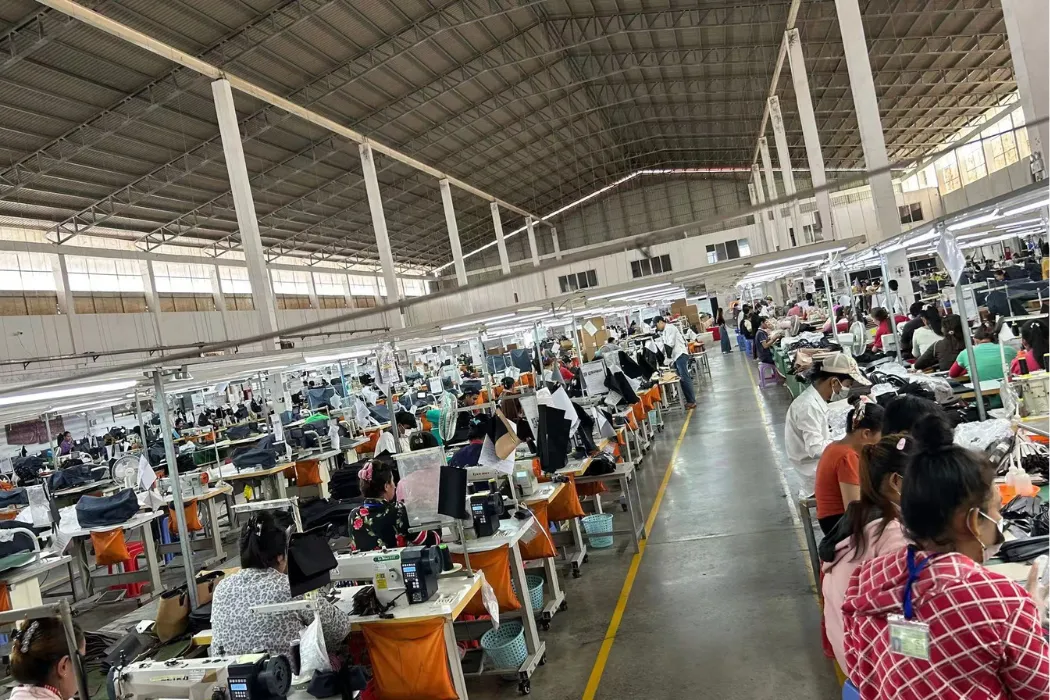
A common misconception among buyers is that “Made in China” automatically implies higher quality than “Made in Cambodia” due to a more mature workforce. While China has a 30-year head start in manufacturing heritage, quality is not a function of geography; it is a function of process. Leading manufacturers bridge the skill gap by treating their Chinese facility as the “Brain” (R&D and Training Center) and their Cambodian facility as the “Muscle” (Volume Execution), linked by a rigorous transfer of Standard Operating Procedures (SOPs).
The “Golden Sample” Protocol
Consistency starts with the Golden Sample. In a dual-hub model, the complex development work—pattern making, hardware engineering, and initial prototyping—happens in the mature hub (China). This is where the “Technical Bible” (Tech Pack) is written.
Once a sample is perfected and approved by the brand, it is sealed as the Golden Sample. This physical standard, along with the digital patterns and tooling, is then shipped to the Cambodian facility. The role of the satellite factory is not to interpret the design, but to replicate it mechanically. Workers are not guessing stitch counts; they are following a pre-validated roadmap created by 20-year veterans.
Cross-Pollination of Technical Talent
Machinery is easy to move; expertise is harder. The most successful dual-country manufacturers do not just open a factory in Southeast Asia and hire locals to run it. They deploy a “Seed Team”—senior production managers, machine technicians, and QC directors from their headquarters—to station permanently in the new facility.
- On-Site Training: Senior technicians teach complex skills like edge inking and hand-braiding directly on the line, ensuring the “hand-feel” remains consistent with the brand’s legacy products.
- Unified QC Standards: By using the same Quality Assurance managers to oversee audits in both countries, the interpretation of “defects” remains identical. A scratch defined as a defect in Dongguan is also a defect in Phnom Penh.
Quality Control Framework: Development Hub vs. Volume Hub
Understanding the distinct roles of each hub helps brands allocate orders effectively while maintaining a singular quality standard.
| Operational Metric | China Hub (The “Brain”) | Cambodia Hub (The “Muscle”) |
|---|---|---|
| Primary Function | R&D, Prototyping, Complex Small Batches | High-Volume Scaling, Replenishment |
| Quality Standard | Sets the Standard (Creates Golden Sample) | Matches the Standard (Executes Golden Sample) |
| Workforce Seniority | High (10-20+ years avg. experience) | Mixed (Managed by Senior Expats) |
| Inspection Protocol | 100% Full Check (Development Phase) | AQL 2.5 / 4.0 or 100% (Based on Client SOP) |
| Ideal Order Type | Flash Trends, intricate construction, < 1,000 units | Core Styles, straightforward assembly, > 5,000 units |
This structure allows brands to enjoy the cost benefits of a developing labor market without suffering the “tuition costs” of unskilled errors.
Is the dual-country model more sustainable for long-term brand growth?
Sustainability is often viewed purely through an environmental lens, but for a business, it also means economic sustainability. A single-country model forces a brand to constantly switch suppliers as they grow: starting with a small workshop in Italy, moving to a boutique factory in China, and finally hunting for a low-cost giant in Southeast Asia. A dual-country partner eliminates this churn, supporting a brand’s lifecycle from the first 500 units to the first 500,000.
Scalability: From Prototype to Container
The “Growth Trap” kills many fashion brands. They find a great factory for small orders, but when they finally land a massive contract with a retailer like Target or Walmart, their boutique factory cannot scale, and the price point is too high. Conversely, big factories won’t touch their small experimental lines.
The dual-country model solves this by offering a graduated ecosystem:
- Incubation: New collections are born in the China facility, where low MOQs and high technical support allow for experimentation.
- Acceleration: As a specific SKU gains traction, production is migrated to the Cambodia facility to optimize margin without changing the supplier relationship or the contract.
Unified Compliance Architecture
Managing the ethical compliance of a supply chain is expensive. Vetting five different factories for BSCI (Business Social Compliance Initiative) or SMETA standards consumes massive internal resources.
Partnering with one manufacturer who holds valid ISO 9001, ISO 14001, and social audits across both their China and Cambodia campuses simplifies the compliance burden. You audit one partner, review one set of corrective action plans (CAPs), and maintain one line of communication for your entire ESG (Environmental, Social, and Governance) strategy.
Frequently Asked Questions
Q: Is leather quality lower in Cambodia compared to China?
A: No. If the factory operates a “Crust-to-Finish” model, the raw material is identical. The sewing quality is maintained by transferring strict SOPs and senior technicians from the China hub.
Q: What are the lead time differences between the two regions?
A: China is generally faster for raw material sourcing (local markets). Cambodia requires an additional 7-10 days for materials to be shipped in, so planning needs to be slightly more predictive.
Q: Do I need to manage two separate contracts for a dual-country setup?
A: Typically, no. A mature dual-country manufacturer acts as a single entity. You sign one contract, place one PO, and they allocate production internally based on your volume and margin targets.
Q: How does the Leather Working Group (LWG) certify facilities in emerging markets?
A: LWG audits are global. A tannery in Cambodia is subject to the exact same environmental protocols as one in Italy. Look for manufacturers who explicitly state they source from LWG-rated partners.
Conclusion
In a volatile global economy, redundancy is royalty. The “Just-in-Time” era of putting all your eggs in the cheapest basket is over. Today, the winning strategy is diversification: leveraging China’s technical brain for development and Cambodia’s brawn for duty-free scaling. This approach secures your margin against tariffs and your inventory against lockdowns.
For brands seeking this exact level of engineered resilience, Hoplok Leather Goods has spent over 22 years building this dual-country infrastructure. With integrated factories in Dongguan and Cambodia, and our own Pro Pelli finishing facility, we provide the turnkey solution that allows you to sleep soundly while your supply chain works around the clock. Don’t just buy a product; buy a safety net.