Handbag manufacturing turns a design into a repeatable product through specification, sampling, material preparation, assembly, inspection and packing. For a brand, the key is to carry the approved material and construction decisions through each stage without uncontrolled substitutions.
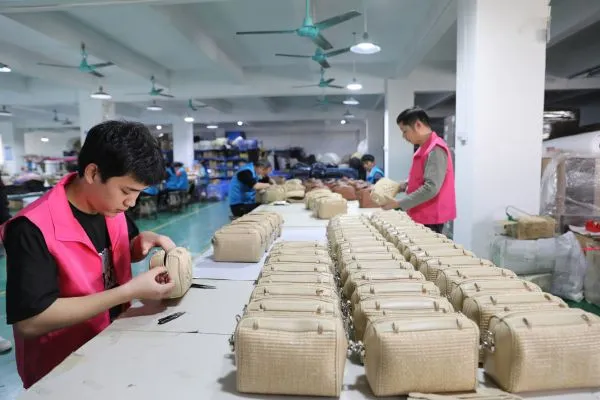
Selecting a handbag manufacturer involves reviewing how the factory develops patterns, confirms materials, records approvals and handles production checks. Equipment and audit logos alone do not prove that a particular bag meets your requirements.
This guide follows the production process from concept to shipment, identifies what buyers should approve, and distinguishes general industry options from confirmed Hoplok capabilities. Production timing and commercial details should be agreed for the actual project.
Design and Prototyping
Quick answer: Define the design and technical pack, create a physical sample, evaluate function and appearance, and record the approved revision before bulk production. A sample exposes construction issues that drawings alone may miss.
Conceptual Design
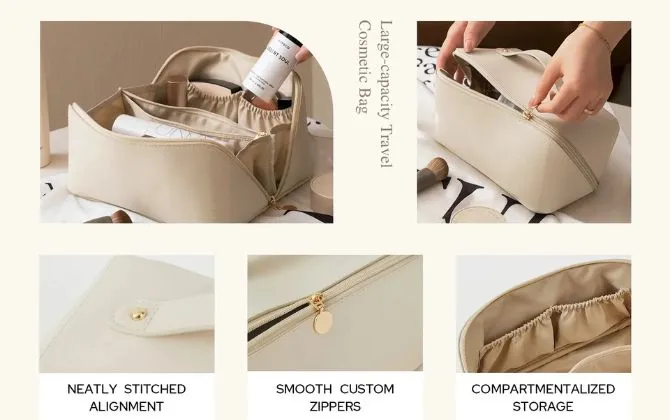
Conceptual design sets the creative foundation for every handbag. Designers immerse themselves in current trends, consumer insights, and brand DNA to sketch silhouettes that resonate. This phase transforms abstract ideas into tangible visuals that guide the entire production process.
- Trend Research: Analyze runway shows, social media (Instagram, TikTok), and street style.
- Mood Boards: Combine color palettes, textures, and hardware inspirations.
- Sketch Iterations: Rapid hand or digital sketches to refine silhouettes.
- Consumer Input: Incorporate feedback from target demographics and focus groups.
Creating a Technical Specification (Tech Pack)
A tech pack is the production blueprint that bridges design and manufacturing. It converts sketches into precise instructions for cutting, stitching, and assembly, reducing costly errors. Clear tech packs help teams identify missing decisions during sampling and provide a controlled reference for production.
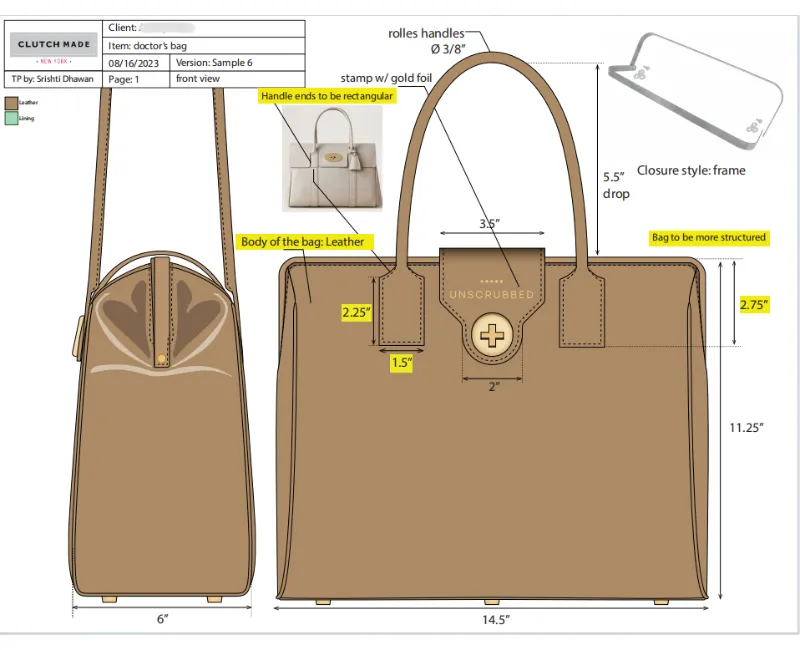
Illustrative technical-pack layout. Dimensions and branding shown belong to the pictured example, not a standard specification for every bag.
- Detailed Dimensions: Exact height, width, depth, and strap lengths.
- Material Call‑Outs: Specify hide thickness, grain direction, fabric weights.
- Stitch & Seam Instructions: Define stitch type, spacing, and reinforcement points.
- Hardware Placement: Pinpoint zipper types, buckle sizes, and logo positions.
Prototype Development
Prototyping turns tech packs into physical samples, revealing design strengths and weaknesses. Skilled pattern makers draft precise templates, then artisans cut and assemble test materials. Each prototype undergoes evaluation to fine‑tune fit, function, and finishing details.

- Pattern Making: Draft paper or CAD patterns for each panel.
- Sample Cuts: Use stock materials (leather or mock‑up fabrics) for initial builds.
- Fit & Function Tests: Evaluate strap comfort, pocket access, and closure ease.
- Iteration Rounds: Refine based on sample evaluation and designer feedback; agree the scope and timing of each revision.
Customization & Collaboration with Designers
Successful prototypes lead to close collaboration between brands and manufacturers. At this stage, bespoke elements—hardware, materials, branding—are finalized. Clear sample comments and recorded approvals help both teams resolve aesthetic and technical requirements.
- Bespoke Hardware: Custom metal finishes, engraved clasps, unique zipper pulls.
- Material Swaps: Documented leather specifications, recycled-content fabrics and animal-free alternatives, subject to material feasibility.
- Brand Details: Embossed logos, signature linings, personalized hangtags.
- Rapid Feedback Loops: Annotated drawings and physical samples to confirm design choices; agree any additional visualisation service for the project.
Types of Materials: Leather, Textiles and Composites
Material names need a complete specification. Leather grain condition, textile construction, coating, backing, thickness and handle all affect assembly. Environmental or animal-free claims require evidence for the complete composition and relevant supply chain.
Full‑Grain Leather

Full-grain leather retains the original grain surface. It can suit products that accept natural character, but the name does not establish the highest tensile strength, a particular patina or a lifetime of use. The Leather Research Laboratory defines the term by the retained grain.
- Specify thickness, temper, finish and acceptable natural markings.
- Review usable cutting areas and matching of adjacent panels.
- Check folds, colour transfer and attachment areas on the actual bag.
Top‑Grain Leather

Top-grain terminology varies between suppliers and is not a fixed second-highest quality grade. Confirm whether the grain surface is intact or corrected and how it has been finished. A selected soft leather may suit hobo bag construction, while a firmer specification may support a different silhouette.
- Ask about buffing, pigmentation, embossing and backing.
- Approve physical colour and grain standards.
- Compare material and construction rather than assuming a lower price than full grain.
PU & PVC Synthetics
PU- or PVC-based leather alternatives commonly combine a coating with a textile backing. A PU coating can also appear on animal leather, so composition must be confirmed before a vegan claim. These materials offer different colours and textures, with performance determined by the exact formulation and construction.
- Specify coating, backing and layer thickness.
- Evaluate adhesion, folding and edge behaviour on crossbody-style samples or the relevant design.
- Compare material cost factors within equivalent quotations rather than assuming a fixed fraction of leather cost.
Nylon
Nylon fibres can be made into bag fabrics with different yarn sizes, weaves and coatings. A selected lightweight fabric may suit a travel or everyday shell, but the fibre name alone does not establish tear strength, abrasion resistance or water protection.
- Specify composition, weave, weight and coating.
- Check seam slippage, rubbing and colour transfer.
- Validate care on the complete bag, including hardware, lining and adhesives.
Canvas
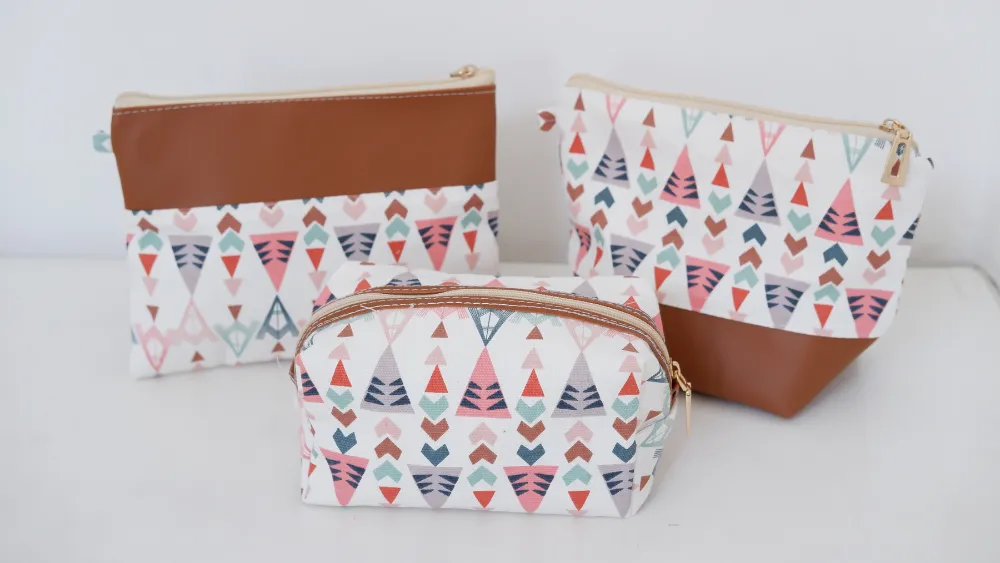
Canvas is a woven construction commonly using cotton or a blend. Different weights and finishes provide different handles and appearance. Prints, embroidery and leather trim can be developed on a suitable fabric without assuming every canvas is sustainable or machine washable.
- Confirm fibre content, weight and dimensional stability.
- Review edge fraying and reinforcement at handles.
- Test the intended print, lining and care combination.
Neoprene
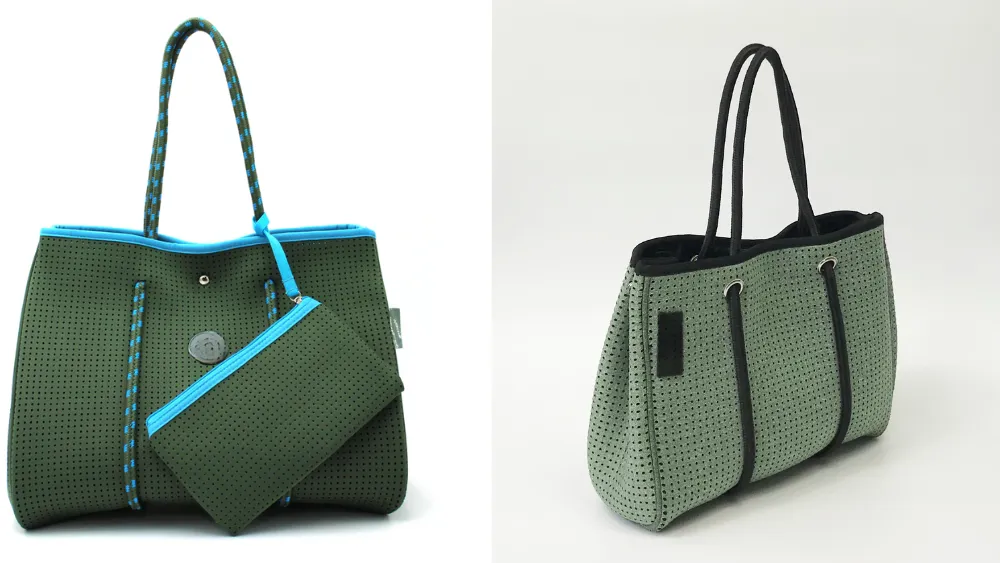
Neoprene is polychloroprene rubber; materials sold for bags can be foam laminates with textile facings, and some similar-looking foams use other polymers. Confirm the actual composition. A padded appearance does not establish certified impact protection.
- Specify foam and facing thickness, density and bonding.
- Check seam bulk, compression recovery and closure areas.
- Confirm source availability and manufacturing feasibility for the particular design.
Recycled PET
Recycled PET can be made into polyester textiles. The feedstock and content must be documented, and coatings or trim may use other materials. Recycled origin does not by itself establish water resistance or identical performance to a virgin material.
- Obtain appropriate recycled-content and supply-chain evidence.
- Keep composition claims separate from physical testing.
- Check the scope of any standard instead of treating OEKO-TEX and recycled-content programmes as interchangeable.
Plant‑Based Leather
Plant-based leather alternatives are supplier-specific composites using inputs such as pineapple leaf fibre, cactus-derived material or apple-derived material. They are not animal hides and may contain polymers, binders and backing fabrics.
- Request full composition and the basis of any content percentage.
- Do not infer biodegradability, plastic-free content or lower impact from the plant name.
- Check current source availability, folding, adhesion and care for the exact grade.
Cork
A cork-faced material for bags generally includes supporting layers and bonding components. Its visible mottled surface can suit a particular design, but the complete laminate determines flexibility, seam behaviour and care.
- Specify cork face, backing, adhesive and any coating.
- Review bending, cutting and edge appearance.
- Avoid transferring raw-cork environmental or allergy claims to the finished bag without evidence.
Mass Production & Scaling
Bulk production should follow a controlled sample and specification. Confirm materials, order quantity, manufacturing steps, quality checks and packing before scheduling the run.
Transition from Prototypes to Production Runs
Once prototypes are approved, manufacturers shift to full production by refining processes and securing raw materials at scale. This phase involves setting target batch sizes, establishing cost analyses, and scheduling pilot runs. Clear communication between design and production teams ensures that any last-minute adjustments are captured. By aligning technical specs with manufacturing capabilities, brands can identify likely rework or scheduling risks before committing the order.
- Define batch volumes and pricing tiers
- Conduct pilot runs to validate production workflows
- Finalize material procurement schedules
- Coordinate design changes with factory engineers
- Set up initial quality checkpoints
Production Line Setup & Workflow Optimization
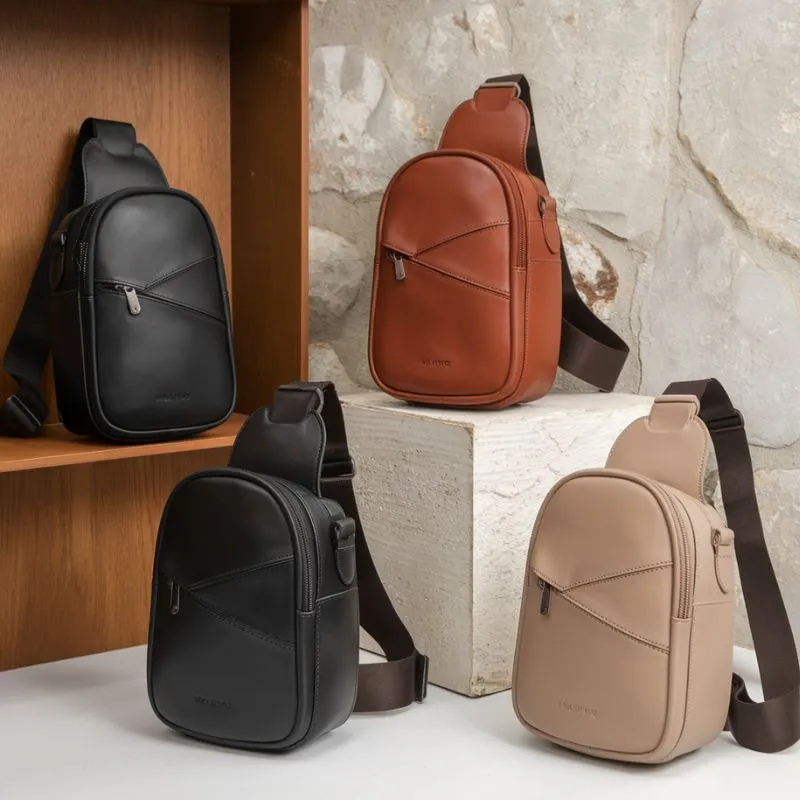
Organise the work sequence around the product: cutting, preparing components, stitching, hardware installation, finishing and inspection. A process map helps identify where pieces wait, where defects recur and which operations need an approved reference.
The appropriate layout and work allocation depend on the bag. Agree the relevant work instructions, progress reports and inspection records for the order.
- Map material and work-in-progress movement.
- Assign checks before defects become hidden inside the assembly.
- Keep job instructions and approved revisions available at relevant stations.
- Track completed quantities, rework and material shortages through the agreed reporting process.
Material Preparation
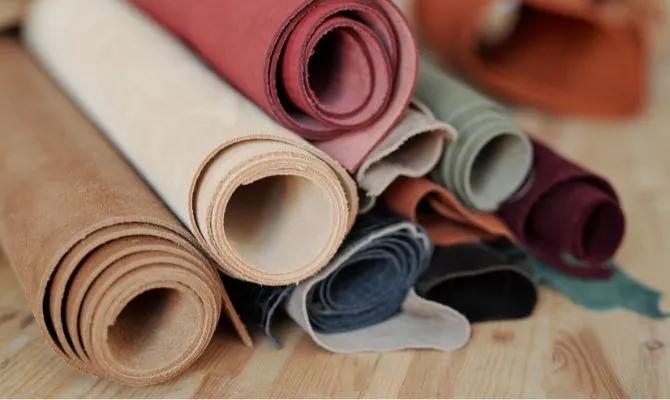
Prepare the selected materials for the approved handbag style. Cutting methods may include knives, dies or digital cutting, depending on material, pattern and production needs. A small order does not automatically require manual cutting, and a large order does not automatically require CNC.
Any softening, coating or other treatment must be part of the approved material specification. Do not assume every hide or fabric receives waterproof or UV-resistant treatment.
- Check material identity, colour and usable areas before cutting.
- Control pattern direction, matching and allowances.
- Prepare lining, interfacing and hardware by the correct revision.
- Label bundles with style, colour and lot references where required.
Assembly Process
Assembly joins the panels, gussets, linings, straps and closures into the specified form. The seam and machine choice depend on the material and joint; straight stitching, edge binding and other techniques should be selected for the actual construction rather than assigned by price tier.
Hardware may be installed with suitable presses or other tools. Verify placement and support before closing the surrounding assembly, especially where later access will be difficult.
- Check seam allowance, stitch formation and tension.
- Reinforce attachment areas according to the sample.
- Confirm zipper travel, pocket access and closure alignment.
- Control bonding and edge preparation where multiple layers meet.
- Inspect the assembled shape before final finishing.
Quality Control
Quality control compares the actual materials and bags with the approved specification. Agree which checks are visual, dimensional, functional or laboratory tests, and define the acceptance criteria before production. A generic standard name is not a complete test plan.
Management-system certification, facility audits and product testing have different purposes. ISO 9001 concerns quality management; it does not certify a bag as safe. SMETA is a social-audit methodology, not a product certification.
- Incoming: verify specified material, colour, thickness and documentation.
- In-process: check seams, dimensions, hardware and alignment before assembly hides them.
- Final: inspect appearance, dimensions, closures, attachment function and packing.
- Testing: agree relevant methods for rubbing, flexing, colour transfer and attachment loads, without implying every batch receives every laboratory test.
- Compliance: obtain market-specific product and chemical requirements separately from facility audit records.
Finishing Touches
Finishing brings the assembled bag to the approved appearance. Some operations, such as logo placement or edge treatment, may occur earlier when components remain accessible. The actual sequence belongs to the construction plan.
Cleaning must suit the surface and all adjacent materials. Avoid generic solvent, polish or conditioner instructions that could change the finish or transfer colour.
- Remove loose threads, dust and approved-process residue.
- Review edge finish, logo position and hardware appearance.
- Attach approved labels, hangtags and accessories.
- Check any shape support or protective wrap against the packing sample.
Packaging & Shipping
Packing protects the approved product and identifies what is shipped. Confirm unit protection, carton configuration, labels, handling and shipment responsibilities before dispatch.
Packing

Select packaging for the bag surface, storage conditions and transport route. Tissue, dust bags, protective film or other materials can be evaluated for compatibility. Do not assume a plastic-looking liner is compostable or suitable for home composting.
A packing sample should show how the bag is supported, which parts are separated, and whether wrap or adhesives can mark the finish. Confirm any environmental claim against the actual packaging material and disposal conditions.
- Define units per carton and packing orientation.
- Check colour, style and size quantities against the packing list.
- Confirm barcode, carton marks and destination labels.
- Use the agreed carton specification and avoid damaging compression.
- Keep packing inspection records with the order.
Shipping

Choose freight using packed weight, volume, destination and required arrival date. Obtain current route quotations and transit estimates from the forwarder. Production, freight, customs clearance and final delivery are separate schedule components.
Hoplok bulk production is typically 60–90 days, with project details confirmed in the quotation. It is not a door-to-door delivery promise.
- Agree shipping terms and the handover point.
- Confirm freight, customs, insurance and destination-delivery responsibilities.
- Prepare the appropriate invoice, packing list and transport documents.
- Verify any route-specific or product-specific documentation.
- Agree warehousing or staged delivery only when explicitly included in the order.
Technology in Handbag Manufacturing
Technology can assist particular tasks, but a machine or software name is not evidence of output quality. Ask how the proposed method supports your material and pattern, and inspect the result.
Automation & Machinery
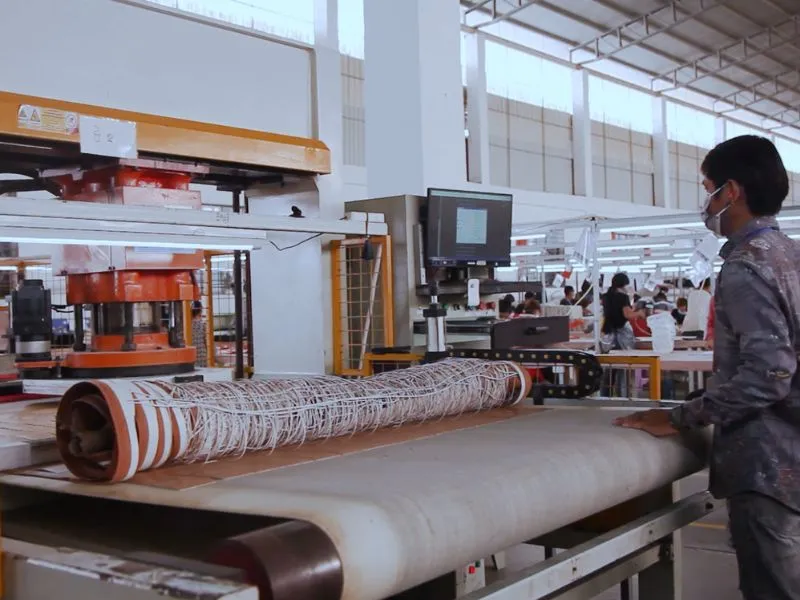
Factories may use digital cutting, sewing equipment, presses and edge-finishing tools according to the product. Precision and output depend on material, pattern, tooling, settings and operators. No universal micrometre tolerance, stitch speed or waste-saving percentage applies to all handbag production.
The presence of equipment in a factory photograph does not establish which process will be used for an order. Confirm the relevant workflow during development.
- Review cut shape and edge condition on representative material.
- Check stitch formation and seam consistency in the selected assembly.
- Confirm hardware installation without crushing or marking panels.
- Validate edge-finishing and drying requirements on the actual leather or laminate.
Design & Production Planning Software
Digital patterns and controlled technical documents can help teams manage dimensions, materials and revisions. The important outcome is a clear current specification that the sampling and production teams both follow.
A PLM or ERP platform is an industry option, not a confirmed Hoplok integration service. No EDI, VMI or ERP/API connection is offered through this guide.
- Keep the current pattern and bill of materials identifiable.
- Record approved sample changes and who confirmed them.
- Track material readiness, sample decisions and production milestones through an agreed process.
- Compare the actual development schedule and revision turnaround against the project needs.
Innovative Technologies
Some projects use additional development tools, such as a physical hardware mock-up or digital pattern comparison. Their value depends on the design question being resolved. Confirm availability before including them in a project schedule.
Electronic features, shielding claims or traceability platforms require their own technical and commercial scope. They are not standard manufacturing capabilities implied by a materials or process overview.
- Define the problem a proposed tool should solve.
- Validate any mock-up against production tooling and material.
- Require testing for a specific functional claim rather than assuming a special lining guarantees protection.
- Use verifiable supplier records for provenance; a digital ledger alone cannot establish the truth of its inputs.
Sustainability in Handbag Production
Support sourcing and environmental claims with evidence tied to the actual material, facility and order. Keep product performance, recycled or organic content, facility certification and social audits separate in the purchasing file.
Material Claims and Supporting Records
Recycled textiles and plant-derived composites may support defined sourcing objectives, but their full composition and performance still need review. Coatings, adhesives, lining and hardware affect the finished product.
LWG certification relates to its specified supply-chain activity and facility scope. It is not a blanket certification of every hide or handbag. LWG explains its certification programmes; Textile Exchange provides distinct content and supply-chain standards.
- Identify the precise claim and supporting record.
- Check current certificates and material transaction evidence where applicable.
- Confirm any water-based or low-emission process claim for the actual product used.
- Avoid assuming plant input, recycled content or a packaging label proves a lower total impact.
Reducing Waste & Energy Consumption
Review cutting layouts and defect allowances for the selected pattern. Reuse of suitable offcuts may be possible, but it must respect material identity, size, appearance and quality requirements. There is no fixed waste reduction for all nesting software or all bag designs.
Energy, water and waste claims should use facility-specific records and a stated boundary. Do not assume every manufacturer uses solar panels, water recycling or closed-loop material recovery.
- Measure usable yield for representative materials.
- Separate unavoidable defects from avoidable cutting or assembly waste.
- Track rework and scrap causes to identify practical changes.
- Request evidence for any resource-use or waste-reduction statement.
Ethical Labor Practices
Buyers should request current social-audit information for the manufacturing facility and review its scope, findings and follow-up actions. An audit is evidence to assess, not a guarantee that every labour condition is satisfactory at all times.
Sedex explains that SMETA is an audit methodology and uses no certification pass/fail model. Review the applicable social-audit record separately from management-system and product requirements.
- Confirm the facility name and audit date.
- Review relevant findings and corrective actions.
- Discuss workforce safety, grievance channels and working conditions through appropriate records.
- Keep purchasing requirements distinct from unsupported claims of universal compliance.
Challenges and Future Trends in Handbag Manufacturing
Material availability, order changes and evolving customer preferences can affect production. Manage these as project variables rather than relying on unsupported market-growth figures or guaranteed technology savings.
Common Manufacturing Challenges
Material and hardware quotations can change, and long-lead components can constrain the schedule. Agree price validity, approved substitutions and decision deadlines before the order is placed. A category-wide annual price-change percentage is not a reliable budget for a particular bag.
- Resolve material substitutions before production.
- Protect pattern, logo and brand permissions in the project documentation.
- Allow for source-material and custom-hardware lead times.
- Plan for inspection, rework and shipment handover in the schedule.
Emerging Trends in Design & Production
Personalisation and material-content stories can influence a collection, but each adds specification decisions. A custom logo, lining or colour must be translated into an approved production reference.
Electronic or smart-bag features should be scoped separately with suitable technical expertise. They are not a default Hoplok offer or a reason to promise a shorter sample schedule.
- Define branding methods and placement.
- Confirm the feasibility of custom hardware and colours.
- Review modular or convertible details in the full prototype.
- Keep trend-led variations within the confirmed material, quantity and timing constraints.
Impact of Technology & Consumer Preferences
Customer feedback can guide material, pocket and closure choices. Digital documents can help manage revisions, while evidence-based sourcing records support accurate claims. These tools work best when the decisions and acceptance criteria are clear.
A viral trend does not remove the time required for materials, sampling, approvals or production. Build the launch date around the confirmed schedule rather than an assumed accelerated process.
- Collect feedback by product feature rather than broad material stereotypes.
- Record changes in a controlled revision.
- Verify organic, recycled or animal-free claims before marketing.
- Allow adequate approval time before the production slot.
Hoplok Can Help You Develop Your Own Handbag Product Line
Hoplok supports custom leather-goods development through an agreed design, material and production brief. Use the facility and scheduling details below when preparing your enquiry.
Partnering with a Trusted Manufacturer

Hoplok operates four facilities totalling 19,000 m²: HongDing belts in Dongguan (5,000 m²), Hoplok bags in Cambodia (4,000 m²), Hongcen Max belts in Cambodia (5,000 m²), and ProPelli leather finishing in Cambodia (5,000 m²).
ProPelli performs finishing on incoming crust leather rather than raw-hide tanning. Its valid LWG Gold status is facility-specific; it is not a blanket rating for all four factories or every finished product.
- Confirm which facility and workflow apply to the order.
- Review the actual sample and technical specification.
- Request documents relevant to the buyer’s market and claim scope instead of assuming ISO or product certification.
Customization & Scalability
Confirmed bag minimums are 200 pieces for leather bags or 1,000 for PU bags. Bag sampling is typically 3–4 weeks and bulk production 60–90 days. Style and colour allocation, source materials, revisions and custom-hardware timing are confirmed in the quotation.
The design should identify shell material, lining, reinforcement, dimensions, closure, straps, branding and packaging. Specialty materials require feasibility review rather than an assumed in-stock offer.
- Send drawings and physical or photographic references.
- State quantity and target market.
- Confirm the sample scope and approval stages.
- Base cost and schedule decisions on the actual quotation.
Streamlined Production Process
Keep the development brief, sample comments and final approvals connected. The factory and buyer should work from the same material and construction revision when preparing production.
Set a reporting arrangement that supports material decisions and approvals. Agree which updates, inspection records and shipment documents the project requires.
- Confirm the technical pack and bill of materials.
- Approve the physical sample and any permitted variation.
- Document changes before bulk production.
- Review agreed quality and packing checks before shipment.
Why Choose Hoplok as Your Handbag Manufacturing Partner?
Assess Hoplok against your actual product requirements: the sample result, material choices, facility scope, quantity, schedule and communication process. Use the development and quality records to compare the offer against your acceptance criteria.
- Review custom leather bag options for a relevant product brief.
- Use confirmed minimums and timing for launch planning.
- Compare equivalent quotations and the agreed quality checks.
- Request evidence for any certification, content or environmental claim you intend to publish.
Conclusion
Handbag production becomes easier to control when each stage has a clear input and approval: design, technical pack, materials, sample, production instructions, inspection and packing. The buyer’s role is to keep those decisions consistent and resolve changes before they affect the bulk order.
To develop a collection with Hoplok, start with the custom leather bag manufacturing brief and share dimensions, materials, quantity and target market. Contact the team to confirm feasibility and quotation details.
FAQ
What materials are commonly used in handbag manufacturing?
Options include animal leather, coated textile composites and woven fabrics such as canvas, nylon or polyester. Specify actual composition, finish, thickness and construction. Natural, synthetic or recycled labels alone do not establish performance or environmental impact.
How long does it take to manufacture a handbag?
For Hoplok bags, sampling is typically 3–4 weeks and bulk production 60–90 days, with the project schedule confirmed in the quotation. Source materials, custom hardware, revisions and approvals affect planning; transport time is additional.
What is the difference between handcrafted and machine‑made handbags?
Many bags combine machine operations with manual preparation, assembly and finishing. Quality depends on the material, construction and process control, not a simple handmade-versus-machine ranking. Ask how the proposed workflow achieves the approved sample.
How do manufacturers ensure handbag quality?
Use agreed material, in-process and final checks against the specification, with relevant testing where required. Quality-management certification, social audits and LWG facility certification have distinct scopes; none automatically certifies every handbag’s performance or safety.
What role does sustainability play in handbag production?
It informs sourcing, resource use, waste management and the evidence behind product claims. Evaluate the actual materials and facility records. Recycled or plant-derived content does not by itself prove a lower total impact, and audit or certificate scope must be verified.
How can I start my own handbag product line?
Define the target customer and design, prepare dimensions and material references, and work with a custom handbag manufacturer on a sample. For Hoplok, plan around minimums of 200 leather bags or 1,000 PU bags and confirm the development schedule before committing a launch date.