The logo on a leather belt is often the first detail a customer touches. It tells them if the product is luxury or mass-market before they even look at the price tag. Choosing the wrong application method can make premium full-grain leather look cheap, while the right technique adds perceived value instantly.
Manufacturers rely on three primary methods to apply branding: Hot Stamping (using heat to transfer metallic foil), Deep Embossing (using high pressure and heavy molds to reshape the fiber), and Laser Engraving (using focused light beams to etch the surface). Each method changes the leather’s character differently. Stamping adds color and shine, embossing adds structural depth, and laser adds contrast through burning.
But picking a method is not just an artistic choice. It is a technical decision that affects your tooling budget, production speed, and the durability of the brand mark after months of daily wear. Let’s break down the mechanics, costs, and best use cases for each technology.
What is Hot Stamping and When Should You Use It?
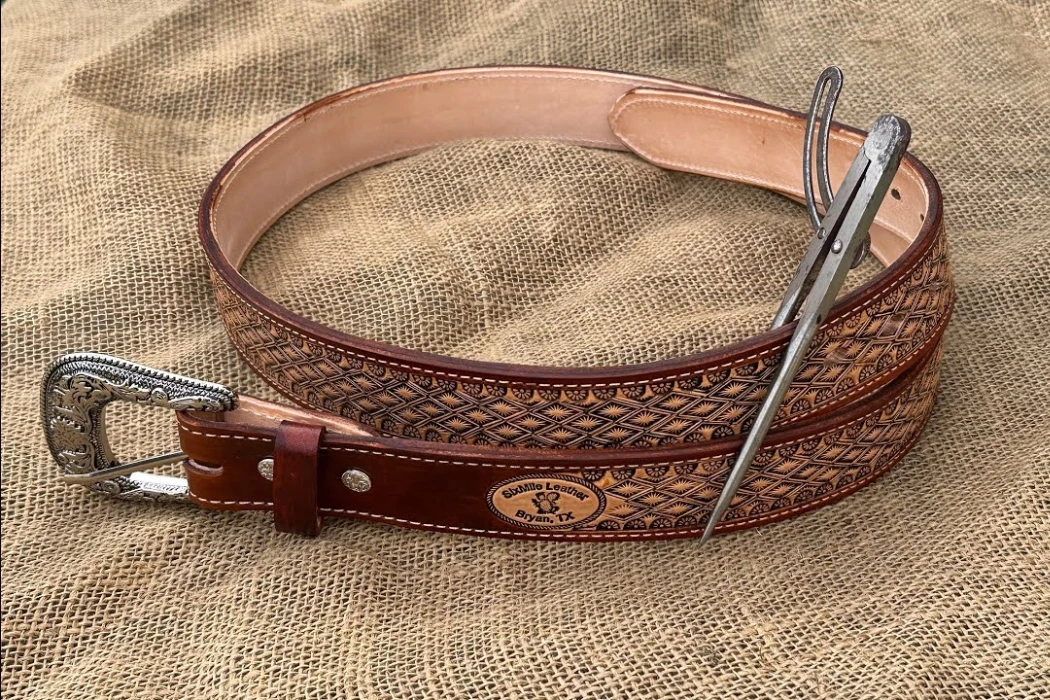
Hot stamping (or foil stamping) is a dry printing process that uses a heated metal die to transfer a thin layer of metallic or pigmented foil onto the leather surface. Unlike ink, which absorbs into the fiber, foil sits on top, creating a high-contrast, reflective finish that catches the light.
The Foil Transfer Process
The magic happens through a combination of three variables: Heat, Pressure, and Dwell Time.
- A magnesium or brass die is heated to approximately 110°C to 130°C depending on the foil type.
- The machine presses the die against a roll of foil and the leather strip.
- The heat activates a heat-sensitive adhesive layer on the back of the foil.
- The foil releases from its carrier film and permanently bonds to the leather fiber.
This process is exceptionally fast, often taking less than 1.5 seconds per unit once the machine is set up.
Durability Considerations
While visually striking, hot stamping has a specific vulnerability: Abrasion. Belts endure constant friction against pant loops and buckles.
- Surface Risk: If the foil is applied to a flat surface without significant pressure, the edges can flake off after 6-12 months of heavy wear.
- The Fix: To maximize longevity, engineers use a technique called “Foil Embossing.” This simultaneously pushes the logo deeper into the leather while applying the foil. The surrounding leather walls protect the metallic finish from direct friction.
For high-traffic areas like the belt tip, a deep blind emboss is often safer than foil.
Best Leather Candidates
Foil is finicky. It requires a consistent surface area to adhere correctly.
- Ideal: Smooth Top Grain, Corrected Grain, or Smooth PU. The flat surface ensures 100% foil transfer.
- Risky: Heavy Pebbled Grain or Tumbled Leather. The uneven texture creates gaps where the foil cannot stick, leading to a “speckled” or broken look.
If your design requires a textured leather, we recommend smoothing out the specific logo area (a “plate mark”) before stamping.
How Does Deep Embossing Create a Permanent 3D Effect?
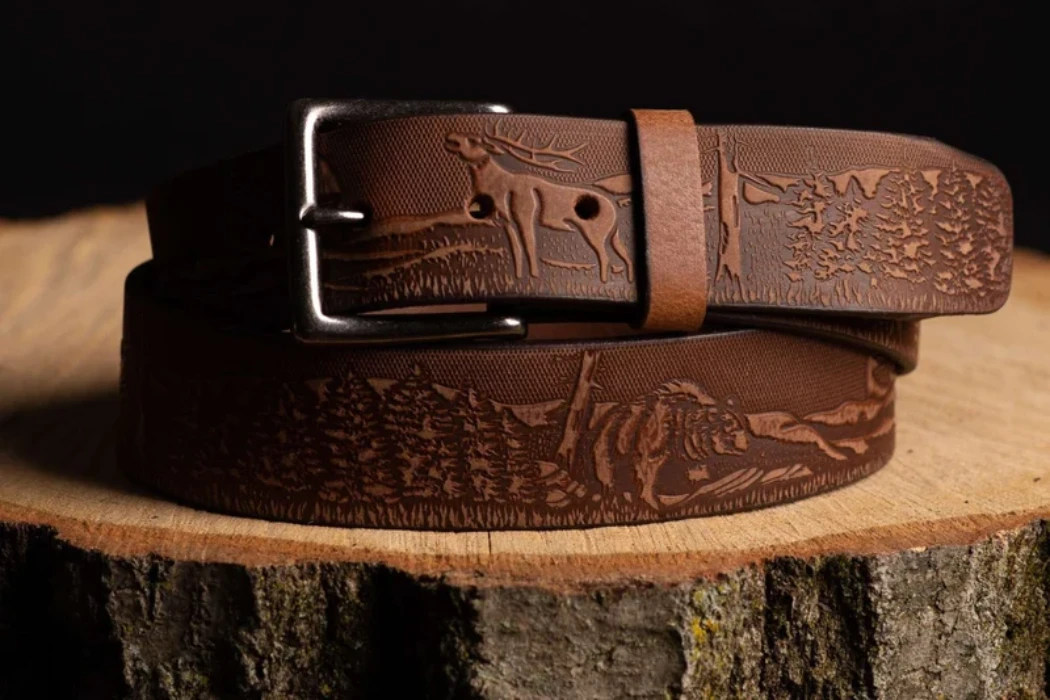
Deep embossing (often called “Blind Embossing”) is the art of reshaping the leather fiber itself. Unlike stamping which adds material to the surface, embossing uses extreme pressure—often combined with moisture and moderate heat—to compress the fibers permanently. The result is a subtle, sophisticated 3D effect that relies on light and shadow rather than color for visibility.
The Tooling Requirement
To achieve a crisp definition that doesn’t “bounce back” over time, the quality of the mold is non-negotiable.
- Brass Dies: The standard for most fashion brands. They conduct heat well and offer sharp detail for runs up to 10,000 units.
- Steel Dies: Required for high-volume production or heavy veg-tanned leathers. While 30-50% more expensive than brass, they can withstand the tons of pressure needed for deep impressions without deforming.
Cheap zinc or magnesium dies often fail to produce the “cliff-edge” sharpness that luxury buyers expect.
Debossing vs. Embossing: The Industry Confusion
Technically, these are opposite processes, though the terms are often swapped in casual conversation.
- Debossing (The Standard): The die presses down into the leather, creating a recessed logo. This is the most common method for belts because it protects the brand mark from surface abrasion.
- Embossing (The Raised Look): The logo stands up from the surface. This requires a complex “male and female” die set (one top, one bottom) to sandwich the leather. It is rarer in belts because it exposes the logo to scratches.
Material Thickness Matters
You cannot carve a valley without a mountain. For a logo to have distinct depth, the leather needs sufficient gauge.
- Minimum Spec: We recommend a minimum strap thickness of 3.0mm to 3.5mm.
- The Risk: If you attempt deep embossing on thin leather (under 2.5mm), the die may cut through the grain or create a visible “bruise” on the backside of the belt.
Comparison: Hot Stamping vs. Deep Embossing
| Feature | Hot Stamping (Foil) | Deep Embossing (Blind) |
|---|---|---|
| Visual Effect | High Contrast, Metallic, Reflective | Subtle, Tactile, Shadow-based |
| Durability | Moderate (Vulnerable to surface abrasion) | Permanent (Fiber structure is altered) |
| Ideal Material | Smooth Top Grain, Corrected Grain | Thick Full Grain, Veg-Tan (>3.0mm) |
| Main Limitation | Cannot handle heavy grain texture | Requires thick leather to avoid cut-through |
Why Choose Laser Engraving for Intricate Designs?
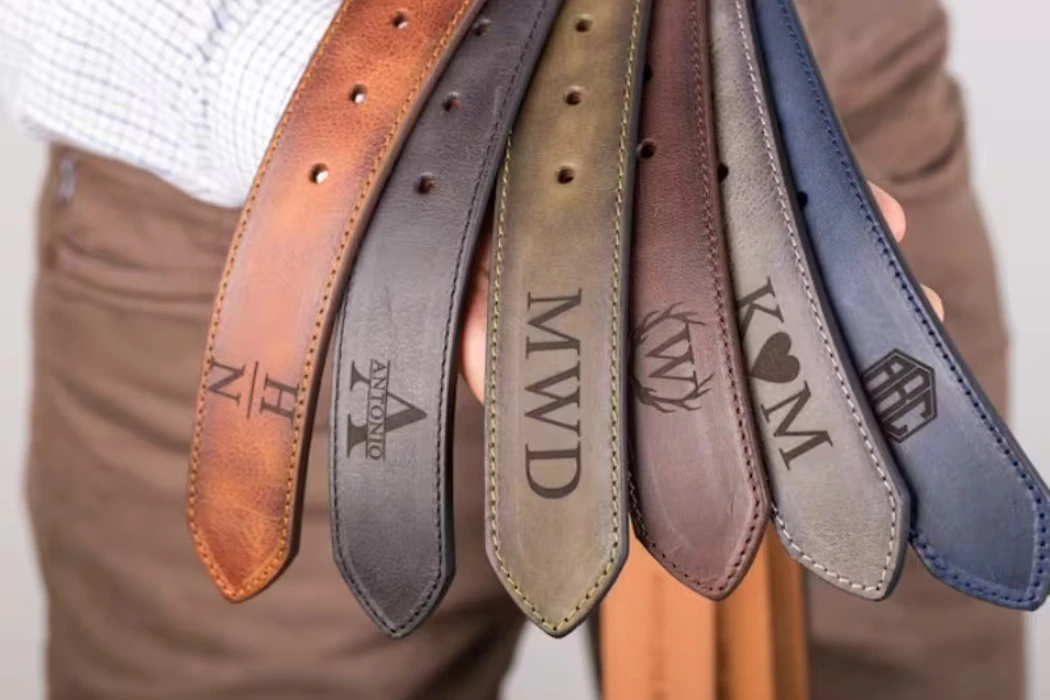
Laser engraving is a digital subtractive process. It uses a high-powered CO2 laser beam to vaporize the top layer of the leather. Unlike stamping or embossing which physically deform the leather, laser removes material to create the image. This “digital-to-physical” workflow changes the rules for what is possible in logo design.
Precision & Resolution
Physical molds have limitations. You simply cannot mill a piece of brass with lines thinner than a hair without the metal breaking under pressure. Laser beams, however, are microscopic.
- Complex Art: Lasers can render QR codes, intricate family crests, or fine script text that would be illegible if stamped.
- No “Bleed”: Because there is no pressure applied, there is no risk of the leather “mushing” around the edges of the logo. The lines remain razor-sharp.
The “Burn” Aesthetic
There is no ink involved in laser engraving. The contrast comes entirely from the carbonization of the leather itself.
- Veg-Tan Leather: The laser burns the surface to a rich, dark brown, creating a beautiful natural contrast against the tan background.
- Chrome-Tan/Black Leather: The laser removes the top finish, creating a matte, textured depression. It creates a subtle “black-on-black” look that is very popular for minimalist streetwear brands.
No-Tooling Advantage
Laser is the “Zero-Setup” method. It bypasses the traditional mold-making phase entirely.
- Speed: We can take a vector file (AI or PDF) and engrave a sample belt in minutes. Stamping would require 3-5 days to CNC machine a metal mold.
- Flexibility: Want to change the logo year from “2024” to “2025”? With laser, you just update the file. With embossing, you must pay for an entirely new mold. This makes laser ideal for prototyping and small-batch orders.
Which Technique Offers the Best Cost Efficiency?
In B2B manufacturing, the cheapest unit cost isn’t always the best choice if the setup fees kill your margin on a small order. To find the true cost, we must analyze the balance between One-Time Tooling Costs and Recurring Unit Costs.
Mold Fees: The Startup Hurdle
Both Hot Stamping and Deep Embossing require a physical metal die. This is a sunk cost you pay before producing a single belt.
- The Cost: A high-quality brass die typically costs between $50 and $150, depending on size and complexity. Steel dies can run $200+.
- The Lead Time: It takes 3-5 days to machine and test a new mold. If you find a mistake in the logo after the mold is cut, you must pay for a new one.
Production Speed: Laser vs. The Press
This is where the math flips. While Laser has zero setup cost, it is slow in production.
- The Press (Stamping/Embossing): Once the machine is set, an operator can stamp a logo in 1-2 seconds. It is incredibly efficient for orders of 1,000+ units.
- The Laser: The beam must physically trace every line of the artwork. A complex logo might take 30-60 seconds per belt. On a large order, this time adds up to significant labor costs.
MOQ Impact: When to Switch
For small batches (under 100 units) or samples, Laser is the clear winner because you avoid the $100 mold fee. However, once your order exceeds 300-500 units, the efficiency of the stamping press makes it the cheaper option, even with the mold cost included. The “break-even” point is usually around 300 units.
Table 2: Cost & Production Efficiency Matrix
| Factor | Laser Engraving | Hot Stamping / Embossing |
|---|---|---|
| Startup Cost (Mold) | $0 (Zero) | High ($50 – $200+) |
| Unit Speed | Slow (30-60 sec/unit) | Fast (< 2 sec/unit) |
| Setup Time | Instant (Digital File) | Slow (3-5 days for mold) |
| Ideal Volume | Samples & Small Batches (< 300) | Bulk Production (> 500) |
Can You Combine Methods for Custom Hybrid Effects?
In the luxury market, “Standard” is rarely enough. To create a logo that feels truly proprietary—and is difficult for counterfeiters to replicate—top-tier brands often layer these technologies. This hybrid approach turns a simple logo into a complex design element.
Foil + Emboss: The “Gold Standard”
This is the most prestigious combination in leather goods. It involves a two-step (or dual-die) process.
- The Concept: First, we create a deep blind emboss to form a “valley.” Then, we hot stamp the metallic foil precisely inside that recessed area.
- The Benefit: It solves the durability issue of foil. Because the metallic layer sits below the surface of the leather belt, it is protected from rubbing against belt loops. It offers the shine of foil with the permanence of embossing.
- The Challenge: It requires “Perfect Registration.” The foil die must align exactly with the embossed depression. Any misalignment looks messy. This increases the reject rate and requires highly skilled operators.
Placement Strategy: Where Does the Logo Go?
The location of the logo should dictate the method you choose. A belt is a functional item that moves and bends.
- The Tip (End of Belt): High friction area. We recommend Deep Embossing or Laser here. Foil at the tip often wears off within months due to constant handling.
- The Keeper (Loop): Very small surface area. Laser Engraving is ideal here because it can render tiny text sharp enough to read on a 15mm loop.
- The Buckle End (Near Hardware): Low friction area. This is the safest place for Hot Stamping or delicate hybrid effects, as it rarely rubs against pant loops.
- The Lining (Backside): For size information and “Genuine Leather” stamps, Silver Foil or Laser is standard. Laser is preferred for inventory flexibility (changing sizes on the fly).
Frequently Asked Questions
Does hot stamping fade on leather belts?
Technically, foil does not “fade” like ink, but it can abrasion off. Because belts constantly rub against denim loops, a surface-level foil stamp can start to chip or flake within 6-12 months of daily use. To prevent this, we recommend “foil embossing,” which recesses the foil below the surface of the leather to protect it from direct friction.
What is the difference between embossing and debossing?
In the leather industry, Debossing pushes the image down into the leather (creating a valley). This is the standard for belts because it is durable. Embossing pushes the image up (creating a hill). While “embossing” is the popular term used by most buyers, 90% of the time they actually want a debossed logo.
Can you laser engrave vegan/PU leather?
Yes, but it requires caution. Laser engraving involves burning. On high-quality PU, it creates a clean, dark depression. However, cheap PVC-based synthetics release toxic chlorine gas when burned and should never be lasered. Always ask your manufacturer to test a sample first to ensure the edges don’t melt into a sticky residue.
Is deep embossing permanent?
Yes, if done correctly. A permanent emboss requires a combination of high pressure, heat, and sometimes moisture (casing). This compresses the collagen fibers of the leather into a new shape. If the leather is too dry or the pressure too low, the leather will eventually “bounce back” and the logo will fade. This is why using a professional hydraulic press is superior to hand-stamping.
How deep should a leather logo be?
The ideal depth is typically between 0.5mm and 1.0mm. This provides enough depth to catch the light and create a shadow, but not so deep that it cuts through the grain layer (top grain) and weakens the structural integrity of the belt strap.
Which logo method is most eco-friendly?
Deep Embossing is the most eco-friendly method as it uses no consumables—only pressure and heat. Laser Engraving is a close second, using only energy. Hot Stamping creates waste in the form of used polyester carrier film (the strip that holds the foil), which is non-recyclable.
Conclusion
There is no single “best” method for branding a belt—only the right method for your specific design goal. Hot Stamping delivers immediate luxury appeal but demands protection from abrasion. Deep Embossing offers a timeless, rugged permanence ideal for heritage goods. Laser Engraving provides unmatched precision and speed for complex art and rapid prototyping.
At Hoplok Leather, we don’t just manufacture belts; we engineer brand identities. Whether you need a rapid laser-engraved sample collection in 3 days or a 50,000-unit production run featuring custom-molded brass dies, our dual-factory infrastructure in China and Cambodia is built to execute. We help global brands choose the right technique to ensure their logo looks as good after a year of wear as it did on the shelf.