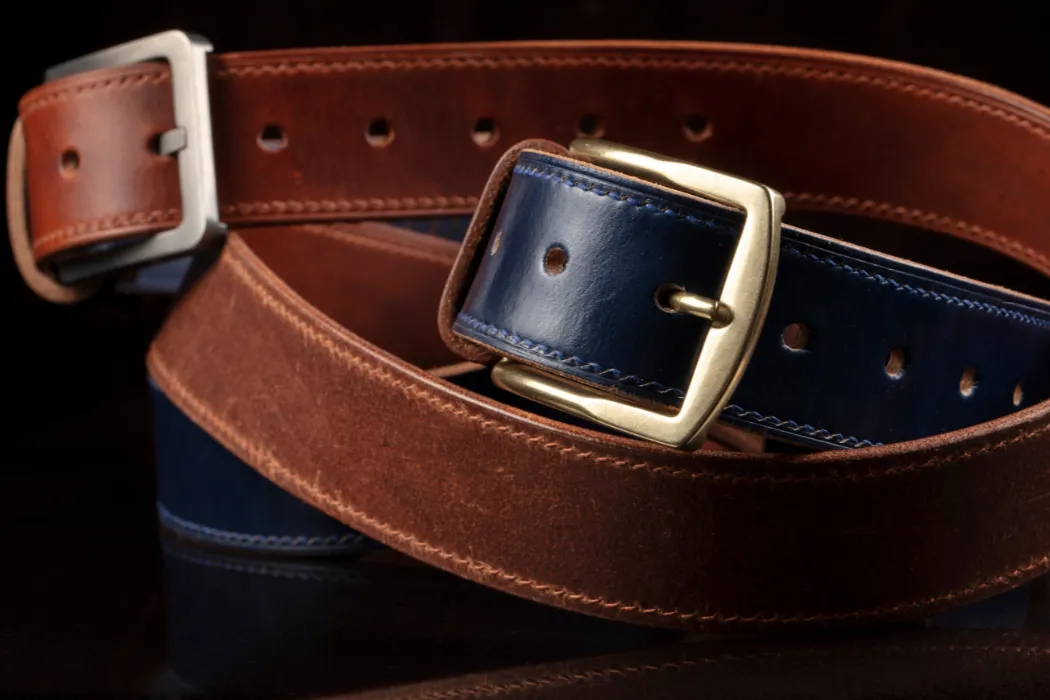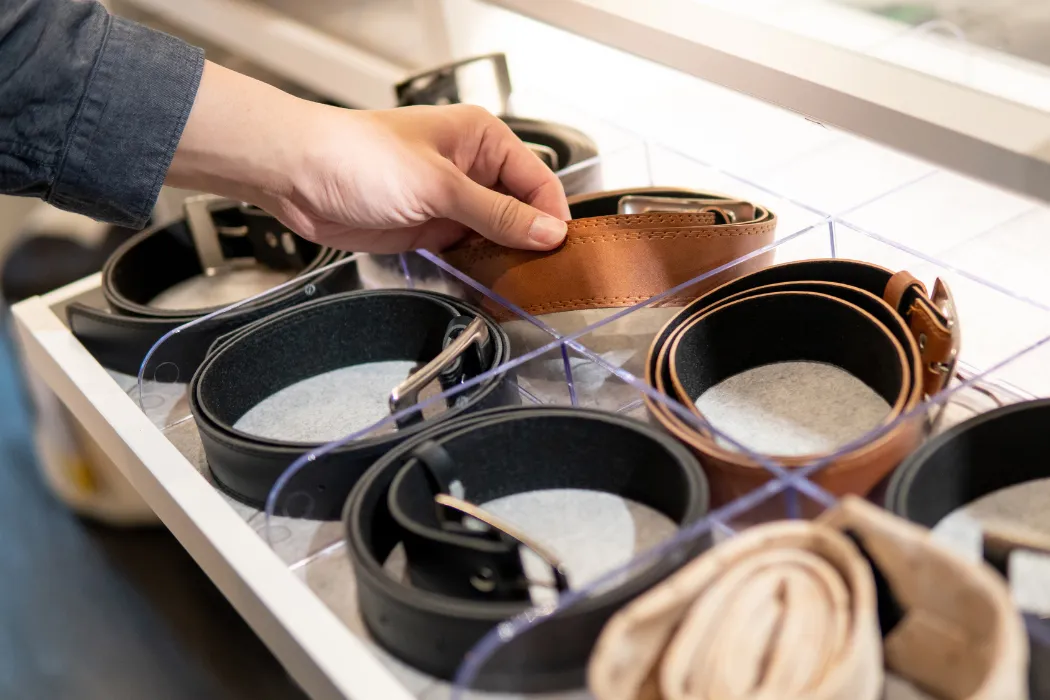
For engineering-driven manufacturers and sourcing specialists, not all leathers behave the same under tension and time. When a belt fails at the buckle or stretches prematurely, the underlying reason often traces back to material choice—whether it’s the intact collagen matrix of full-grain or the weaker split layers behind a “genuine leather” label. Even small differences—such as a 0.9–1.5 mm split tolerance or fiber compaction in the butt and shoulder regions—can determine whether a belt lasts decades or deforms within months.
This article clarifies those structural and performance variables from an engineer’s perspective. You’ll learn how full-grain leather belts achieve roughly twice the tensile strength of top-grain materials (per ISO 3376 / 3377), why fiber density in the corium layer defines durability, and how grade classifications from A/#1 to D/#4 influence cost, yield, and long-term performance. By the end, you’ll be able to specify the optimal leather grade, tanning process, and thickness range for premium belt production or procurement decisions.
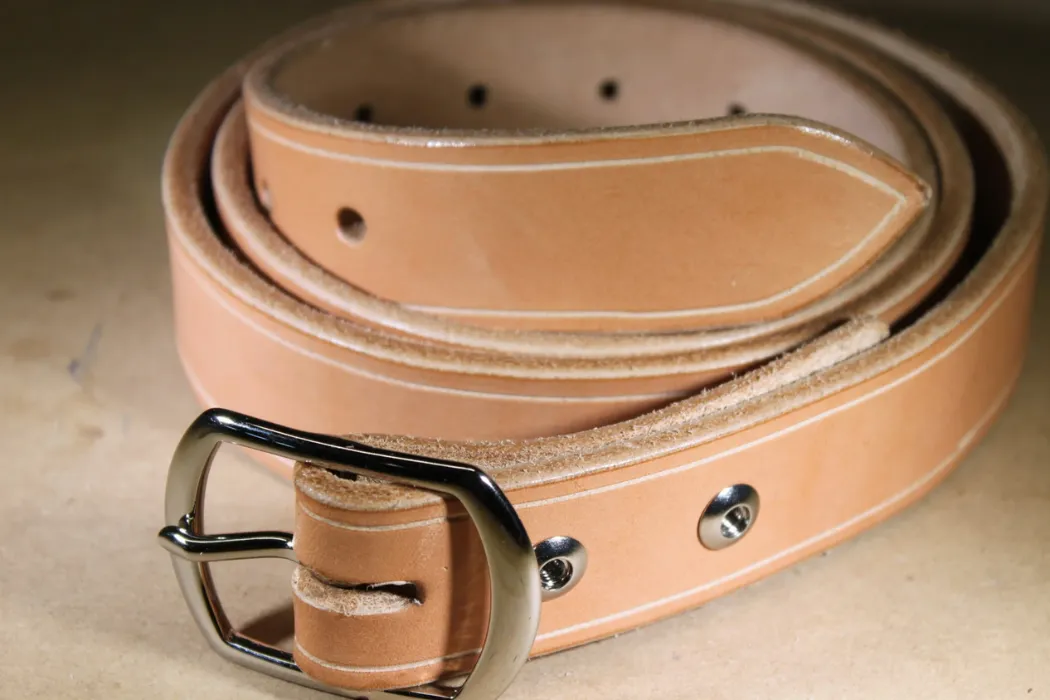
What is the Anatomy of a High-Quality Hide?
A high-quality hide derives its strength and durability from the dermis layer’s dense collagen fiber network, especially in the butt and shoulder regions, ensuring tensile integrity, flexibility, and consistent grain texture after processing.
Core Structure and Composition of a Premium Hide
The hide primarily consists of the epidermis, dermis, and hypodermis; only the dermis is retained for leather use. The dermis is the principal structural layer, providing mechanical performance through its collagen fiber organization.
Within the dermis, the papillary layer’s fine collagen fibers deliver flexibility and stretch recovery, while the reticular or corium layer’s dense, intertwined fiber bundles supply tensile strength and tear resistance. This dual-layer organization underpins the mechanical balance necessary for durable belt leather.
Epidermis and hypodermis are removed during processing as they contribute little to durability or structural integrity. The epidermis serves as the protective outer surface removed with hair and weak interfaces, and the hypodermis contains fatty tissue that undermines bonding and uniformity if retained.
Fiber Density, Regional Variations, and Quality Implications
The butt and shoulder areas contain tightly packed collagen fibers ideal for belts and other high-stress applications, while belly regions exhibit loose, elongated fibers that stretch under load, leading to poor dimensional stability and lower structural strength.
A whole cowhide averages around 55 square feet of usable surface. During finishing, uniform thickness is achieved through splitting and shaving operations to about 0.9–1.5 millimeters for top-grain leather. These precise thickness parameters help optimize flex performance and minimize stress-point failure.
Corium density and fiber hierarchy are the decisive quality indicators, as they govern both elasticity and shear resistance. Even without formalized ASTM or ISO standards for belts, manufacturers assess microscopic fiber compaction and reticular alignment as measurable proxies for superior resilience.
Research Summary and Data Context
Industry research emphasizes the dermis’s collagen network as the fundamental source of leather strength. Collagen fibrils form crisscross fiber bundles in the papillary and corium sublayers, with the finest fibrils ensuring flexibility near the grain surface and the densest bundles preserving structural load capacity deeper within the hide thickness.
The butt and shoulder regions offer maximal collagen compaction, producing hides that withstand repetitive flexing and buckle pressure when used in belt manufacturing. To remove variability, hides are split to attain a uniform layer, generally focusing on the upper grain section of about one millimeter, which maintains the natural grain pattern and mechanical balance.
Cowhide remains dominant due to its favorable combination of yield and mechanical performance. Processing precision—particularly in shaving and splitting—ensures thickness uniformity and reduces weak points caused by local fiber irregularities. These controlled steps preserve tensile integrity while achieving clean edges and consistent texture across premium cuts.
What Are the 4 Main Grades of Belt Leather?
Belt leathers are graded into four main categories—A/#1 through D/#4—based on visual defects and usable surface area. Higher grades like A/#1 have minimal blemishes and yield more usable belts, while lower grades like D/#4 show heavy damage and are suited to embossed or decorative uses.
Understanding Leather Grades A/#1 to D/#4
Leather grades for belts are identified using a tannery-specific ranking system, typically most familiar in systems like Hermann Oak’s A/#1 to D/#4 classification. Each step down the scale corresponds to greater surface defects and lower usable surface yield from each hide. These grades are visually determined, not mechanically tested, making them critical for yield estimation in belt manufacturing.
Grade A/#1 represents the highest quality leather, possessing very few blemishes or holes outside the prime cutting area and capable of yielding up to 20 belt blanks per side. This grade maintains excellent grain integrity and is used predominantly in premium full-grain or unembossed belts.
Grade B/#2 contains minor cosmetic imperfections yet still offers a high yield. Hides in this category generally remain free from branding marks, providing efficient cutting and consistent coloring for mid-range belt lines.
Grade C/#3 includes more defects such as scars or small grain disruptions. It is unsuitable for plain belts but works well for textured or embossed styles that conceal surface flaws while maintaining structural reliability.
Grade D/#4 is the lowest classification, marked by heavy branding, scars, holes, or extensive damage. Yields typically drop to around 15 belt blanks per side, with high waste percentages. These hides are most often used for belts where embossing, tooling, or dye treatments can obscure visible imperfections.
Technical Standards and Application Insights
Belt leathers commonly range from 8–9 oz (2.39–2.78 mm) in thickness for standard use belts and up to 11–14 oz (4.37–5.57 mm) for heavy-duty and gun belt applications. These thickness values directly influence the stiffness and tensile durability of the finished product, with heavier hides supporting more load-bearing uses.
Unlike standardized testing systems such as ASTM or ISO, leather grading for belts has no universal metric. Tannery-specific systems like the A/#1–D/#4 scale are typically used, meaning “Grade A” at one tannery may not exactly match another’s rating. This makes sourcing consistency a key factor for manufacturers seeking predictable yield and performance in their belt production lines.
High-grade hides allow full-grain retention, which preserves natural fiber density and results in better durability, polish, and cost-efficiency per usable square foot. These hides are ideal for high-end or custom-crafted belts requiring superior performance and finish.
Conversely, lower-grade leathers exhibit reduced yield and greater material waste. As a result, they are more economical for decorative belts where physical stress tolerance is secondary to visual appeal. The cost per usable square foot increases as yield declines, explaining substantial price variation across different belt lines and manufacturers.
Full Grain vs. Top Grain: Which is Better?
Full grain leather retains the entire natural grain layer, making it stronger, denser, and longer-lasting, while top grain is partially sanded or buffed for visual uniformity but with reduced strength. For premium belts, full grain often outperforms top grain in durability and patina.
| Property | Full Grain Leather | Top Grain Leather |
|---|---|---|
| Surface Treatment | Unaltered natural grain, no sanding or buffing | Lightly sanded or buffed to remove imperfections, then coated |
| Mechanical Strength | Approximately twice the tear/tensile strength per ISO 3376 / 3377 | Reduced strength due to partial removal of fiber-dense grain layer |
| Density / Weight | ~10% heavier at equal thickness because of intact grain fibers | Slightly lighter; grain layer partially removed |
| Durability & Patina | Develops patina, highly durable and resistant to stretch, tear, and cracking | Stable but less durable under long-term load; minimal patina |
| Typical Use | Premium, work-grade, heirloom belts from LWG-certified tanneries | Fashion belts emphasizing smooth finish and uniform appearance |
Understanding Full Grain and Top Grain Leather
Full grain leather preserves the complete natural grain surface with the dense collagen fiber matrix intact for maximum strength and breathability. This fiber density, located in the outermost hide layer, provides the material’s exceptional toughness and resistance to moisture and wear.
Top grain leather, by contrast, is derived by lightly sanding or buffing the surface to remove imperfections such as scars or insect bites. This process yields a smoother appearance but reduces structural integrity because the most densely interwoven grain fibers are partially removed.
Full grain’s natural markings are left visible, enabling it to develop a rich patina over years of use. Top grain offers a cleaner visual uniformity from the outset but lacks the same evolution in character and microstructural strength retention.
In trade or production terminology, “top grain” can refer broadly to the upper hide split, encompassing both untouched full grain and corrected grain leathers. Clarifying the finishing steps is therefore essential when evaluating leather for premium belt manufacture.
Mechanical Performance and Finish Data Comparison
Quantitative test standards such as ISO 3376 (tensile) and ISO 3377 (tear) indicate that full grain leather maintains roughly twice the strength of equal-thickness top grain because its original surface fibers remain intact. This strength differential directly influences belt longevity, resistance to hole tear‑out, and minimal permanent stretch.
The dense full-grain structure results in approximately 10% higher mass per unit thickness compared to top grain, contributing to its rigidity and enduring shape retention. This density advantage becomes particularly relevant under high tension points near buckle holes.
Top grain’s sanding and coating stages are evaluated through finish adhesion tests, such as ISO 11640. These additional finishing layers improve uniformity but create potential delamination or wear points under long-term flexing as observed by ISO 5402 methodologies.
Both full grain and top grain materials may originate from Leather Working Group (LWG)‑certified tanneries. LWG certification ensures traceability and environmentally compliant tanning processes but does not differentiate based on mechanical grade. Therefore, the most robust belt combines a full grain construction with sourcing from an LWG‑audited, high‑rating facility.
In conclusion, full grain leather is the superior selection for structural integrity and long‑term performance. Top grain offers visual refinement and cost efficiency; however, the sanding process inherently compromises its strength relative to full grain. For belt applications prioritizing longevity, load resistance, and character development, selecting full grain from an LWG‑certified source yields the optimal engineering and ethical balance.
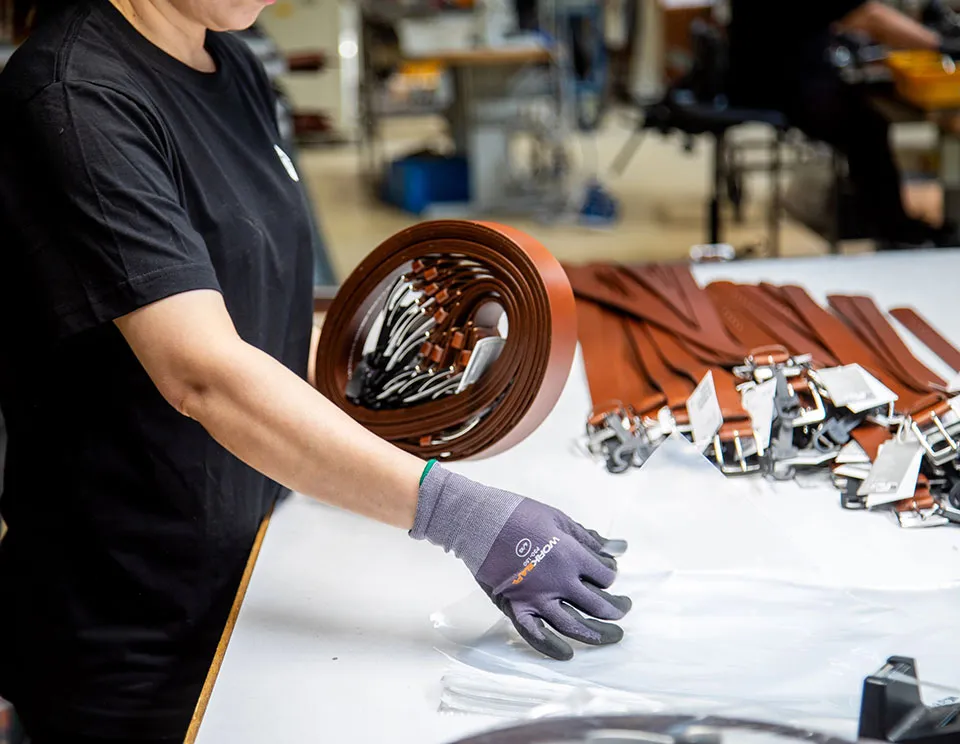
Custom Leather Belts Crafted for Global Brands
Why Avoid “Genuine Leather” Labeling?
‘Genuine leather’ often refers to leather made from lower hide layers or reconstituted scraps, producing a weak, low-value material that lacks the strength, breathability, and patina of full-grain leather. It deteriorates quickly and is unfit for premium goods.
| Leather Type | Composition & Processing | Durability & Performance |
|---|---|---|
| Genuine Leather | Derived from lower hide layers after top split or from reconstituted scraps bonded with adhesive; heavily coated to mimic grain. | Low structural integrity, poor breathability, no patina development, short lifespan. |
| Full-Grain Leather | Entire outermost grain layer preserved; minimal processing; dense natural fibers intact. | Excellent durability, breathability, develops patina, resistant to wear and tear, lasts decades. |
| Top-Grain Leather | Grain surface sanded/buffed for uniform finish; moderate fiber density. | Less durable than full-grain, flexible and smooth, moderately long lifespan. |
| Bonded Leather | Composed of leftover leather dust/scraps mixed with polyurethane or adhesive binders. | Poor durability; synthetic feel; lowest performance tier. |
What ‘Genuine Leather’ Actually Means
The term “genuine leather” is technically accurate but misleading for consumers. It typically applies to leather derived from the lower hide layers left after the top-grain removal or constructed from bonded scraps. Manufacturers apply thick surface coatings and plastic embossing to imitate the texture of natural grain. While this process enhances uniformity, it obscures the fact that the underlying structure has compromised fiber density and strength.
Such material lacks the intrinsic integrity of the hide’s grain layer, producing minimal breathability and no capacity to develop a natural patina. The heavily treated surface also limits elasticity and moisture exchange, making the leather less adaptive and more prone to delamination over time.
Why It Fails in Durability and Value
From a technical perspective, genuine leather underperforms in applications that stress tensile strength, such as belts or load-bearing accessories. Its layered or bonded construction introduces weak inter-fiber adhesion, leading to tears and cracking with repeated flexion. These defects develop faster at seams where tension concentrates, sometimes visible within months of use.
No formal test data such as ASTM D2209 tear strength values were found, but qualitative rankings universally place genuine leather well below full-grain and top-grain in endurance and dimensional stability. While full-grain leather retains its grain network and ages into higher aesthetic value, genuine’s surface coatings deteriorate, revealing inferior backing materials underneath.
For budget items like temporary shoes or fashion belts, genuine leather may suffice, but its limited lifespan and low resistance to environmental stressors disqualify it from premium or sustainable product categories. Experienced leatherworkers, therefore, avoid the label altogether, reserving production quality and longevity for higher-grade hides.
Veg Tanned vs. Chrome Tanned?
Vegetable tanning uses natural tannins from plants, producing firm, breathable leather with rich patina potential, while chrome tanning relies on chromium salts for softness, flexibility, and water resistance—making it faster, cheaper, and dominant in modern markets.
Understanding Vegetable and Chrome Tanning
Vegetable tanning immerses hides in plant-based tannins such as oak bark or chestnut extracts, a slow process taking several weeks. This method develops a dense, firm leather structure suited to long-term durability and a distinct aging character.
Chrome tanning, in contrast, relies on chromium sulfate salts that convert raw hides into leather within roughly a day. The outcome is a “wet-blue” hide that is soft, flexible, and highly receptive to dyes, enabling greater color variety and production scalability.
Although vegetable-tanned leather is environmentally friendlier and able to form a natural patina over time, chrome-tanned leather holds roughly 90% of global market share thanks to its expedited production, cost efficiency, and versatility.
Performance, Aesthetics, and Application Contrast
Vegetable-tanned leather is typically thicker and more breathable, aging beautifully as it develops character and patina with use. However, it readily absorbs moisture, making it ideal for belts, wallets, structured handbags, and accessories rather than wet or flexible environments.
Chrome-tanned leather is soft, water-resistant, and colorfast, retaining its finish even under demanding conditions. It is a common choice for footwear, outerwear, and upholstery projects requiring persistent flexibility and weather tolerance.
In controlled wear tests, including data abstracted from NIST service studies, chrome-tanned soles have demonstrated longer wear life than vegetable-tanned equivalents. This validates the modern preference for chrome processes where endurance and pliability are required, although many artisans still value vegetable-tanned hides for their tactile solidity and natural origin.
Research Summary
Vegetable-tanned leather undergoes slow immersion in tannin baths derived from bark or plant matter, enhancing firmness, breathability, and patina formation—well-suited to belts or furniture applications. Chrome-tanned hides, produced through chromium sulfate baths, result in moisture-resistant, soft, and color-stable leathers favored for outerwear or heavy-wear goods like boots. Despite the perception of tradition favoring vegetable processes, chrome methods remain dominant due to cost, throughput, and adaptability.
The market shows roughly 90% adoption of chrome tanning, with process times as short as a single day compared to the multi-week veg-tan cycle. Although no quantitative ASTM or ISO tear-strength or Leather Working Group compliance data was identified, qualitative consensus supports chrome leather for flexibility and endurance, versus the dense, patina-prone structure of vegetable-tanned alternatives.
How to Test if a Belt is Real Leather?
Authenticity can be confirmed through visual inspection, tactile tests, and ISO-standardized laboratory methods. Real leather shows natural grain variance, absorbs water, and meets defined tensile and moisture metrics under ISO 3376 and 4684. Certified LWG traceability adds further proof of genuine origin.
Visual and Physical Verification of Real Leather
Inspect for a non-repeating grain pattern and fibrous edge cross-section rather than smooth plastic layering.
Perform a light water absorption test—real leather darkens slightly and absorbs moisture, unlike PU/PVC which repels drops.
Flex the belt: natural leather folds with soft wrinkles and no cracking, while synthetics show plastic stiffness and peeling.
Smell the material—genuine leather emits an organic scent due to collagen composition, not a chemical or plastic odor.
Laboratory and Certification-Based Leather Testing
Use ISO 2418 and ISO 2419 for leather sampling and conditioning before performance testing.
Conduct tensile and tear strength tests per ISO 3376: full grain vegetable‑tanned belt leather typically measures 40–80 N tear strength.
Apply the ISO 15115 diphenylcarbazide spot test to detect chromium presence in chrome‑tanned leathers.
Measure moisture content under ISO 4684; genuine leather stabilizes at 8–14% moisture at 50–65% RH, unlike anhydrous synthetics.
Trace material authenticity through Leather Working Group (LWG) certification linking belts to audited tanneries with verified bovine full grain hides.
Technical Background and Industry Research
From an engineering and quality‑control perspective, verifying that a belt is real leather—particularly full grain—extends beyond touch-and-smell checks into quantifiable tests. ISO 2418 and ISO 2419 govern sampling and conditioning procedures, while ISO 3376 defines mechanical strength tests that identify genuine full grain leathers by their superior tensile and tear resistance compared to bonded or coated materials. Typical tear strength for vegetable‑tanned full grain bovine leather in belts ranges from 40–80 N, outperforming PU-coated synthetics that fail at significantly lower loads.
Chemical verification per ISO 15115 uses diphenylcarbazide reagent to confirm chromium presence in chrome‑tanned hides, distinguishing true leather from synthetic substitutes. Moisture analysis following ISO 4684 reveals another authenticity metric—real leathers stabilize at 8–14% water content in normal environments, attributable to their hygroscopic collagen structure. Synthetic materials remain virtually moisture‑free and repel water during basic absorption checks.
For traceability and sustainability validation, Leather Working Group (LWG) certification serves as an explicit authenticity layer. The LWG Leather Manufacturer Audit Protocol links belts to audited tanneries, ensuring that hides are of bovine full grain origin and produced under regulated environmental and chemical controls. Combining visual inspection, quick water and flex tests, and formal ISO testing backed by LWG documentation offers a comprehensive, evidence‑based process for confirming genuine leather belts.
Which Leather Grade Fits Your Market?
Choosing the right leather grade depends on target market expectations for durability, appearance, and price. Full grain serves luxury segments, top grain suits mid-market fashion, while genuine and bonded leathers fit value-oriented and promotional lines.
Aligning Leather Grades with Market Tiers
Premium brands targeting longevity and sustainability should use full grain, vegetable-tanned cowhide in 8–14 oz thickness (3.2–5.6 mm). These hides preserve the entire grain layer, offering superior tear and tensile strength while ageing naturally. Brands in the heritage or luxury space that prioritize mechanical integrity and visible natural character derive the most value here.
Mid-market fashion labels typically rely on top grain leathers, priced around 40–79 USD per meter, for a balanced visual finish and cost efficiency. The surface may be lightly sanded and pigmented, enabling color uniformity and easier defect masking without sacrificing too much strength for products like fashion belts and bags.
Budget or promotional tiers often use genuine or bonded leathers costing 1–39 USD per meter. These grades trade off long-term tear resistance for affordability, relying on coatings and embossing for visual consistency. They suit promotional belts and accessory SKUs where short lifecycle and styling variety take precedence.
Quality Standards and Sourcing Metrics
Reference standards for finished leather include EN ISO 3377‑1 (tear strength ≥ 20 N), EN ISO 3376 (tensile strength ≥ 8 MPa and < 80 % elongation), and EN ISO 4045 (pH ≥ 3.2). These metrics define the mechanical minimums for upholstery- or garment-grade leather and enable objective QC alignment across suppliers.
Surface grading, such as SATRA A–C or tannery A/B sides, indicates a usable area of roughly 88–97 %. These upper bands are desirable for belt straps or other visible components with minimal grain defects. Grades below this—C/D or Job Lot ranges—are generally reserved for lined or embossed articles where surface correction is acceptable.
LWG-aligned sourcing ensures traceable, environmentally compliant supply chains that also map well to AHFA mechanical benchmarks. Combining EN ISO mechanical conformity with LWG-certified tanneries allows brand and OEM buyers to demonstrate both performance and sustainability due diligence.
What is the “Break-In” Period for Full Grain?
Full-grain leather requires a progressive break-in period where stiffness gradually eases with wear. For heavy boots, comfort usually appears after 80–120 hours of use, with full molding reached in about two months; belts take less time due to thinner construction.
Understanding the Break-In Behavior of Full-Grain Leather
Full-grain leather retains the entire dense grain layer, making it tougher and less pliable initially than top-grain or suede. This construction preserves both the natural texture and strength of the hide, which results in a firmer feel out of the box but superior longevity once flexed through repeated use.
Vegetable-tanned versions are slower to soften due to higher fiber density and minimal surface correction, with stiffness seen as a quality trait indicating durability. As the fibers elongate slowly with motion and moisture, the material begins to shape under pressure, offering a personalized fit over time rather than forced flexibility.
Typical Break-In Timelines and Comfort Milestones
Work-boot makers like Drew’s Boots estimate 80–120 active hours (≈2–3 weeks) for initial comfort, aligning with ASTM F2413‑18 product guidance that break-in is normal. This range assumes consistent use during daily work or walking intervals, allowing the leather to progressively relax along stress folds and joint areas.
Premium brands such as HELM Boots cite about two months for a full custom-feel fit; thinner belt leathers used by Hoplok soften sooner—often within days to weeks of regular use. The difference stems from thickness, tanning process, and structural reinforcements that slow fiber mobility in heavy-duty footwear.
Research Summary
Across work‑boot and western‑boot manufacturers and specialty retailers, full‑grain leather is consistently treated as the slowest‑breaking, highest‑durability boot leather category. Quantified guidance clusters in two tiers: (1) an operational break‑in where the boot becomes reasonably comfortable under normal active use, cited around 80–120 hours of wear (about 2–3 weeks of full‑time use) for high‑quality thick full‑grain boots, and (2) a full conforming period, where the leather has substantially molded to the wearer’s foot, cited by at least one premium brand at roughly two months. Consumer-facing break‑in timetables for full‑grain western boots suggest planning about one month of stepped‑up usage, aligning with these averages when daily sessions are considered.
Technically, these durations result from the higher fiber density and thickness of full‑grain hides, particularly when vegetable‑tanned or structured for rugged duty. Several guides note this as a factor that prolongs break‑in compared with top‑grain, corrected, or suede leathers. Although no ASTM or ISO standard defines a precise “break‑in period,” spec sheets referencing ASTM F2413‑18 for safety footwear identify break‑in as a normal behavior of full‑grain uppers. This frames moderate stiffness and early resistance as expected mechanical properties, not defects. In thinner leather goods like belts, the same logic implies proportionally shorter break‑in times, but existing data anchors measurable figures to footwear performance ranges—roughly 80–120 active hours for comfort and up to two months for complete molding.
Industry Sources
Drew’s Boots cites a 2–3 week (80–120 hour) active wear-in period for robust full‑grain work boots. HELM Boots reports high-quality hides requiring about two months for full adaptation. Country View Western outlines a roughly four‑week staged process for full‑grain western boots, and DT Footwear, referencing ASTM F2413‑18 compliance, confirms that initial stiffness is expected in safety footwear built with full‑grain uppers.
How Long Do Full Grain Belts Last?
Full-grain leather belts typically last 10–25+ years depending on usage and care. With daily wear and regular conditioning, they can easily exceed a decade of service, while occasional use and proper maintenance can extend their life to a lifetime standard.
Typical Lifespan Ranges and Usage Factors
The expected service life of full‑grain leather belts varies primarily with frequency of use, environmental conditions, and maintenance. Under minimal care, a well‑constructed full‑grain belt can last about 5–10 years in daily rotation, which already outperforms most generic leather products. When periodically cleaned and conditioned, such belts often exceed 10 years even under daily wear.
For premium full‑grain pieces crafted from thick hides and vegetable‑tanned leathers, occasional wear combined with proper conditioning supports a range of 15–25+ years. Some producers, including Manuel Dreesmann and Atelier Madre, market their belts as lifetime accessories under normal wear conditions — a claim rooted in the material’s high durability when properly maintained.
A typical usage‑based pattern cited by manufacturers shows daily wear yielding 5–10 years, while occasional use can readily surpass 15 years. This spread highlights how care routines such as consistent leather hydration and storage away from moisture extremes greatly influence longevity.
Material Strength and Construction Factors Influencing Longevity
Full‑grain leather’s natural grain layer and dense collagen fiber matrix make it the strongest leather type used in belt production. This structure resists surface cracking, stretching, and tearing far better than split, bonded, or genuine leather grades. As a result, the belt body usually outlasts its fasteners when constructed with quality stitching and hardware.
Vegetable tanning carried out for 6–8 weeks — as opposed to the 2–3 week process common for lower‑cost leathers — allows deeper fiber crosslinking and improved moisture resistance. This extended tanning time not only preserves the fibers’ tensile strength but also enhances the belt’s resistance to environmental stress, sweat, and bending fatigue over many years of use.
Optimal thickness for long‑term belt durability is between 8.5–9.5 oz (approximately 3.4–3.8 mm) when taken from a double‑butt cut of the hide. Such cuts maintain uniform strength along the belt’s length. Reinforcement through saddle stitching and the use of solid brass buckles reduces mechanical failure points such as seam separation or buckle breakage, helping the belt achieve a practical lifespan of 10–25+ years or more.
In summary, both material quality and construction precision play decisive roles in determining belt longevity. The combination of full‑grain leather’s inherent strength, slow vegetable tanning, sufficient material thickness, and robust hardware design explains why well‑maintained belts frequently exceed two decades of useful service.
Final Thoughts
From an engineering perspective, full-grain leather represents the highest structural integrity and longest lifespan among belt materials. Its unaltered surface grain retains the densest collagen fibers responsible for tear resistance, dimensional stability, and natural breathability. By contrast, top-grain, genuine, and bonded leathers gradually lose mechanical strength as surface correction or reconstitution removes these critical fibers. For any product exposed to continuous flex, tension, or environmental changes, full-grain leather stands out as both the performance and sustainability benchmark.
Selecting the correct leather grade ultimately depends on your market intent: full-grain for luxury and longevity, top-grain for aesthetic consistency, and lower grades for cost-driven production. When aligned with LWG-certified sourcing, proper tanning selection, and precise construction standards, a full-grain leather belt becomes a material system designed to endure decades of function and develop character over time—a rare union of mechanical integrity, craftsmanship, and sustainable value.
Frequently Asked Questions
What distinguishes full-grain leather from genuine leather?
Full-grain leather is made from the hide’s outermost layer with the natural grain intact, offering the strongest fibers, breathability, and durability. Genuine leather, however, is formed from lower split layers that are often sanded or coated, resulting in weaker fibers and shorter lifespan.
How does hide thickness (oz) correlate to belt longevity?
Thicker hides (8–10 oz or 3.2–4.0 mm) directly improve belt longevity since they resist stretching, deformation, and daily stress. Industry standards recommend this range for premium belts designed to endure years of wear without failure.
Why do some full-grain belts peel or crack?
Peeling or cracking generally occurs when moisture balance is lost through poor conditioning or harsh cleaning products. Authentic full-grain belts rarely peel because their intact fibers stay strong; cheaper coated leathers peel at the coating‑split layer within a few years.
Is Top‑Grain or Full‑Grain better for dress belts?
Full‑grain is typically superior, retaining the full natural grain and strength for long‑term wear. Top‑grain leathers are sanded for smoothness but lose surface strength; they deliver a sleeker aesthetic but slightly less durability than full‑grain.
How can you identify a fake leather belt?
Real leather shows irregular natural grain, fibrous edges, a suede‑like underside, and absorbs water slightly, leaving a darkened spot. Fake leather looks too uniform, feels plasticky, dries water on the surface, and usually emits a chemical smell.
What is the difference between ‘Butt’ and ‘Belly’ cuts?
Butt cuts, taken from the hide’s hindquarters, are thick, firm, and ideal for belts because of consistent fiber density. Belly cuts are thinner and elastic, often stretching and deforming easily, making them more suitable for soft goods rather than structured belts.